On this page
How to identify it
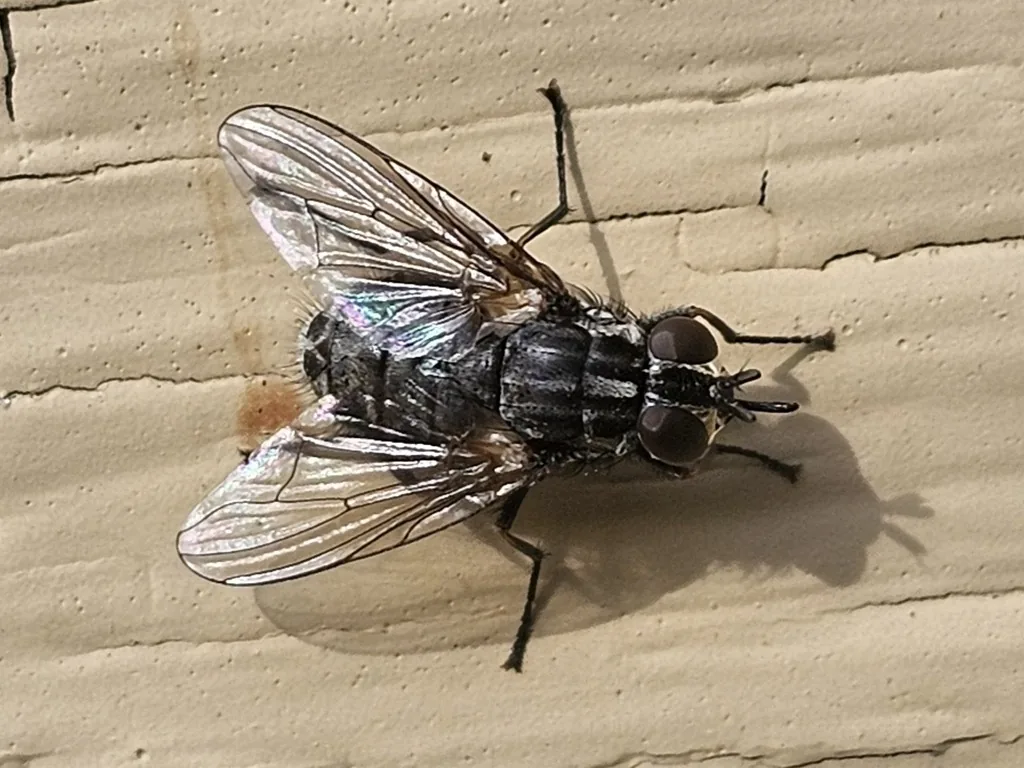
- About the size of a house fly, roughly 1/4 inch long; UC Riverside gives 1/4 to 3/8 inch. UF/IFAS gives a typical adult length of 5 to 7 mm.[2][5][3][6]
- The giveaway is a stiff, bayonet-like beak (proboscis) that sticks straight out in front of the head. House flies have soft sponging mouthparts that point down and can't break the skin.[1][2][3][5]
- The abdomen has dark spots or blotches in a checkerboard pattern. UF/IFAS describes seven round spots in that checkerboard; a house fly's abdomen has no such pattern.[2][3][4][6]
- At rest a stable fly holds its body at an angle, head higher than tail, while a house fly rests flat against the surface.[5]
- Larvae are typical maggots. UF/IFAS says they grow from translucent first instars about 1.25 mm long to pale yellow or creamy white third instars of 11 to 12 mm, then form a reddish-brown, capsule-like puparium 4.5 to 6.0 mm long. Eggs are about 1 mm long, white and sausage-shaped.[6]
Look-alikes
| Look-alike | How to tell them apart |
|---|---|
| House fly | A house fly has sponging, downward-pointing mouthparts and can't bite, lacks the checkerboard abdomen, and rests flat against surfaces instead of head-up.[1][5][2] |
| False stable fly | Despite the name, it doesn't bite: it has sponging mouthparts, is about 3/8 inch long and has a dull reddish mark on the back.[2] |
Where it lives
Found worldwide and mainly a pest of livestock. Weather fronts can carry flies from inland farms as far as 225 km to beaches where they can't establish, and they bite people there; research describes this on the northwestern Florida Gulf Coast and the Lake Superior shore, and Georgia Extension notes flies feeding on beachgoers' ankles along the coast. UF/IFAS says it is the only one of the 18 Stomoxys species found worldwide, and that the U.S. places where it regularly attacks people are coastal New Jersey, the Lake Superior and Lake Michigan shorelines, Tennessee Valley Authority lakes, and the Florida panhandle coast west to Louisiana. Within Florida, west Florida has the worst problems, though stable flies are numerous statewide.[7][4][8][3][6]
Biology and life cycle
Larvae develop in moist, fermenting plant matter rather than fresh manure: hay waste at feeding sites, silage, straw or old manure bedding wetted with urine, spilled feed, grass clippings and compost piles. UF/IFAS calls hay-ring feeding sites, where leftover hay builds up in pastures, the preferred breeding habitat, and Florida's Biting Flies guide adds compost piles and even seaweed deposits on beaches.[1][3][9][5][4][6][10]
Females lay their eggs in several batches in that material, and development from egg to adult takes about two to three weeks in summer.[9][3][4]
Both males and females feed on blood, often about once a day. A fly stays on the animal only a few minutes, then rests on a wall, fence or vegetation to digest. UF/IFAS says they bite in the early morning and late afternoon in warm weather and in the middle of the day when it is cooler, and can fully engorge in five minutes if left alone. Because they are easily interrupted while feeding, they often bite more than one host.[1][9][3][5][4][6][10]
Stable flies survive poorly above 86°F, so in hot places numbers peak in mid to late spring and early summer and fall off in midsummer. Georgia says that in the South they may breed all year but are mainly pests in spring and fall.[5][1][3]
Wet years bring more flies: in California, March rainfall predicted how many were biting in late spring and early summer.[5]
In marking studies, half of stable flies moved more than 1.6 km from the farms where they developed, but only 5% went beyond 5.1 km. On northerly winds, though, marked flies have reached northwestern Florida beaches up to 225 km from inland sites within 24 hours, and genetic work points to inland areas northwest of the beaches as the main source. UF/IFAS says they can fly 5 mph in still air, and Florida's Biting Flies guide says the source of an infestation may be well over one hundred miles away.[4][8][6][10]
In UF/IFAS figures, eggs hatch in 12 to 24 hours and larvae mature through three instars in 12 to 13 days at the optimum breeding-site temperature of 27°C. Adults can fly within an hour of emerging and mate three to five days later, and females start laying five to eight days after emerging. Each clutch of 60 to 130 eggs needs a separate blood meal, and a female may lay up to 800 eggs in her life.[6]
Besides cattle and horses, UF/IFAS lists goats, sheep, swine, donkeys, cats, dogs and people as hosts. On cattle and horses the flies gather on the legs, spreading to the belly and lower sides when there are more than 25 per leg. In a Florida study of flies caught on horse farms, only 24.3% had fed on horses; 64.6% had fed on cattle, 9.5% on people and 1.6% on dogs.[6]
Rain matters in Florida too: UF/IFAS says abundance is closely linked to rainfall in the preceding weeks. Florida peaks vary from year to year, while farther north there is typically a single peak in late summer.[6]
Damage and signs
- On people, the flies go for the legs and especially the ankles, and they can bite through clothing. UF/IFAS lists the legs, the backs of the knees and the elbows as the usual bite sites on people.[2][3][1][6]
- On dogs they feed around the edges of the ears, leaving the margins scabbed and bleeding; dogs kept in outdoor kennels can be bitten severely on the legs and ear tips. UF/IFAS says the same happens to big cats in zoos: relentless feeding on confined animals' ears leaves bloody open sores that heal slowly and can leave disfiguring scars.[3][1][2][6]
- Cattle under attack stamp, switch their tails, bunch together or stand in water, and heavy attacks cut weight gain and milk production. Horses kick and stamp, which can make shoeing hazardous. UF/IFAS adds that animals in badly affected areas have stood in water with only their heads and necks exposed, and that swine gain less weight too. Florida's panhandle beach tourism also suffers when northerly winds carry the flies to the coast.[3][5][7][9][6][10]
Health risk
The bite is painful. Stable flies can carry pathogens on their mouthparts from the blood and skin of one host to the next: a 2013 review lists equine infectious anemia, African swine fever, West Nile and Rift Valley fever viruses as known to be transmitted this way, along with Anaplasma among other bacteria and parasites, and says the hosts involved are mainly livestock and only occasionally people. For ordinary bites, MedlinePlus advises washing the site with soap and water, using ice wrapped in a cloth, and an antihistamine or anti-itch cream if needed; get emergency help for trouble breathing or swelling of the face or mouth.[7][11]
Control
Prevention
For dogs and horses, repellents containing permethrin or pyrethrins help but need reapplying every other day. UF/IFAS says citronella repellents are often used on horses. For people, it advises long sleeves and long pants, and notes most repellents work less well on biting flies than on mosquitoes and need reapplying more often.[1][6][10]
To decide whether a cattle herd needs action, UF/IFAS counts flies on both front legs of at least 15 animals. More than 10 flies per animal means economically damaging losses are likely and points to a productive breeding site nearby. Counts on horses are less reliable, so sticky traps are used to monitor on horse farms.[6]
Biting flies are most active in still air, so Florida's Biting Flies guide suggests increasing air movement on porches, patios and picnic areas, and pruning shrubs and mowing weedy areas nearby. That helps but may not give complete protection.[10]
Sanitation
Removing breeding sites is the most effective and economical control: clean up wet hay waste, spilled feed and soiled bedding, and spread manure and old bedding thinly so it dries. UF/IFAS also advises rotating hay-feeding areas in pastures.[1][5][9][6]
At home, don't leave piles of moist grass clippings. Add them to compost and turn the pile so it heats up and breaks down quickly; a neglected backyard compost pile can supply stable flies to a whole neighborhood.[1][3][2]
Organic bedding such as straw, hay or old manure can produce large numbers of stable flies once animals wet it; on dairies, UC Riverside advises removing it entirely every other week and replacing it.[5]
For stalled animals, UF/IFAS prefers wood shavings to straw or hay as bedding, because shavings don't decompose or pack down as quickly once soiled, and it advises removing waste daily.[6]
Traps and physical control
Traps such as Alsynite fiberglass traps can reduce flies in smaller settings such as small dairies, zoo pens or dog kennels, but probably can't control them alone on large operations. UF/IFAS also lists Knight stick traps and insecticide-treated targets.[5][6]
Biological control
Parasitic wasps that attack stable fly pupae are sold for release around livestock. Kentucky calls the approach experimental and unlikely to work where many breeding sites remain, and UC Riverside says releases on large California dairies have not substantially cut fly activity. UF/IFAS describes releases as a way to raise parasitism by supporting the parasitoids already present, and says insect-killing fungi and nematodes have shown potential; flies treated with fungi die in 5-7 days.[12][5][6]
Pesticides
Fly baits that work on house flies don't control stable flies, because stable flies feed on blood.[9]
Insecticides on resting sites or animals give only temporary relief and are no substitute for removing breeding sites. Flies can develop resistance quickly, so limit residual sprays and rotate chemical classes. UF/IFAS notes that resistance has been documented in Florida stable fly populations.[5][9][1][6]
Where sources disagree
Thorax stripes: UC IPM says stable flies lack the four dark stripes on the thorax that mark house flies, while a 2015 USDA review describes four black stripes, the outer two broken.[1][4]
Eggs: Georgia says a female lays 100 to 400 eggs in her life, Minnesota 400 or more, and the 2015 review 60 to 800; Kentucky gives batches of 40 to 80, and the review clusters of about 20 to 100.[3][2][4][9]
Development time: UC IPM says egg to adult can take as little as 12 days under the best temperatures; Georgia gives 14 to 24 days in warm weather, Kentucky 21 to 25 days in summer, and Minnesota 17 to 50 days depending on food and weather.[1][3][9][2]
Adult life and egg output: UF/IFAS's stable fly profile says females live four to six weeks in the lab but about seven to ten days in the field and lay up to 800 eggs, while its Biting Flies guide gives an adult life of 20 to 30 days and 500 to 600 eggs.[6][10]
Timing: the stable fly profile has eggs hatching in 12 to 24 hours and a field life cycle of 12 to 20 days but usually about 28; the Biting Flies guide gives 24 to 48 hours to hatch, 14 to 26 days as larvae and a 22- to 58-day cycle averaging 28 days.[6][10]
Florida season: UF/IFAS's stable fly profile says Florida populations most often peak in spring, while its Biting Flies guide says they are most abundant in late fall, peaking in early January.[6][10]
Common questions
- Why is a house fly biting my ankles?
- It is probably a stable fly. It looks like a house fly but has a piercing beak and tends to bite people on the legs and ankles, even through clothing.[2][3][1]
- Where do stable flies come from?
- They breed in wet, rotting plant matter such as old hay, grass clippings, compost and soiled bedding. Because they fly well, the source may be some distance away; on beaches, flies can arrive on the wind from farms far inland.[1][3][2][4]
- Do stable flies spread disease to people?
- They are mainly a livestock problem. A 2013 review describes them as mechanical carriers of pathogens in the blood and skin of their hosts, especially livestock and only occasionally people.[7]
- Why do stable flies bite at the beach?
- Along the Florida panhandle, UF/IFAS says northerly winds carry stable flies from farms to the coast, where they bite beachgoers; flies have been recorded moving up to 225 km from their farm sites.[6]
Sources
- University of California Statewide IPM Program, “Pest Notes: Flies (Stable Fly section).” ipm.ucanr.edu/home-and-landscape/flies/ (accessed 2026-11-11)
- University of Minnesota Extension, “Flies (reviewed 2024).” extension.umn.edu/garden-and-home/home-maintenance/household-insects/flies (accessed 2026-11-11)
- University of Georgia College of Agricultural and Environmental Sciences, “Compost pile can attract bloodsucking stable flies (N. C. Hinkle, February 16, 2006).” fieldreport.caes.uga.edu/?p=17998 (accessed 2026-11-11)
- International Journal of Insect Science, via PubMed, “Showler and Osbrink (2015), Stable fly, Stomoxys calcitrans (L.), dispersal and governing factors (USDA-ARS).” pubmed.ncbi.nlm.nih.gov/26816486/ (accessed 2026-11-11)
- University of California, Riverside, via VeterinaryEntomology.org, “Stable Fly (Stomoxys calcitrans L.) (A. Gerry, Extension Specialist, University of California, Riverside; September 17, 2012).” www.veterinaryentomology.org/stable-fly (accessed 2026-11-11)
- University of Florida IFAS Extension (EDIS), “Stable Fly, Stomoxys calcitrans (L.), EENY642/IN1114 (P. E. Kaufman, E. R. Burgess IV and E. N. I. Weeks; Featured Creatures, revised October 2022; archival copy).” journals.flvc.org/edis/article/view/132598 (accessed 2026-11-14). Archival EDIS copy on the Florida Virtual Campus journal system; the Ask IFAS page for IN1114 returns 410 (retired).
- Parasite, via PubMed, “Baldacchino et al. (2013), Transmission of pathogens by Stomoxys flies (Diptera, Muscidae): a review.” pubmed.ncbi.nlm.nih.gov/23985165/ (accessed 2026-11-11)
- Journal of Medical Entomology, via PubMed, “Jones et al. (1991), Origin of stable flies on west Florida beaches: electrophoretic analysis of dispersal (USDA-ARS).” pubmed.ncbi.nlm.nih.gov/1770514/ (accessed 2026-11-11)
- University of Kentucky Entomology, “ENTFACT-514: Fly Control Around Horse Barns and Stables.” entomology.ca.uky.edu/ef514 (accessed 2026-11-11)
- University of Florida IFAS Extension (EDIS), “Biting Flies, ENY-220/IG081 (J. B. Pitzer, P. G. Koehler and J. W. Diclaro II; excerpted from SP486 Pests in and around the Southern Home).” ask.ifas.ufl.edu/publication/IG081 (accessed 2026-11-14)
- MedlinePlus, U.S. National Library of Medicine, “Insect bites and stings (Medical Encyclopedia).” medlineplus.gov/ency/article/000033.htm (accessed 2026-11-11)
- University of Kentucky Entomology, “ENTFACT-502: Biological Control of Flies.” entomology.ca.uky.edu/ef502 (accessed 2026-11-11)
- iNaturalist, “Stomoxys calcitrans taxon page (order and family).” www.inaturalist.org/taxa/122223 (accessed 2026-10-06)