On this page
How to identify it
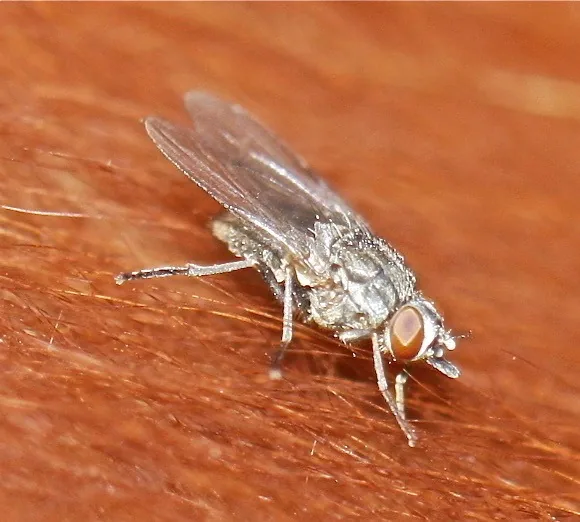
- Adults are about 3/16 inch long, roughly half the size of a house fly or stable fly, and dark gray with two dark stripes on the thorax.[1][2]
- They stay on the animal nearly all the time, resting head-down with the wings held partly open in a V; disturbed flies rise in a swarm and soon settle back.[2][1]
- In hot weather or rain they shift down to the lower sides and belly, out of direct sun.[2][1]
- UF/IFAS gives the body as 3.5 to 5 mm long, brownish gray to black and shiny, with small brownish-red antennae that point downward and two parallel stripes on top of the thorax just behind the head.[3]
- Eggs are about 1.2 mm long, tan, yellow or white when laid and reddish brown before hatching. Newly hatched maggots are white and about 1.5 mm long, grown ones 6.5 to 7.5 mm, and the pupae are 3 to 4 mm long and dark reddish brown.[3]
Look-alikes
| Look-alike | How to tell them apart |
|---|---|
| Stable fly | Stable flies and house flies are roughly twice the size of a horn fly. Horn flies are the small, dark gray flies that stay on cattle almost continuously. UF/IFAS adds that stable flies are 7 to 8 mm long with a checkerboard look on top of the abdomen, that a horn fly's palps are nearly as long as its beak while a stable fly's are much shorter, and that stable flies seldom lay eggs in fresh manure, choosing manure mixed with straw, wet feed or hay-feeding waste instead.[1][2][3] |
Where it lives
Nebraska Extension calls it the most important blood-feeding pest of pastured cattle in the U.S. Extension entomologists in Kentucky and Nebraska describe it on cattle in their states. UF/IFAS says it was brought to North America from France in 1887 and now occurs throughout the Americas, Europe, Asia and the non-tropical parts of Africa.[4][1][2][5][3]
Biology and life cycle
Both males and females feed on blood, taking 20 or more small blood meals a day through needle-like mouthparts.[2][1]
Females leave the animal only to lay eggs in fresh manure, usually within about 10 minutes of it being dropped, and each can lay up to about 500 eggs.[2][1]
Eggs hatch within a day, and the maggots feed in the manure pat for 3 to 5 days before pupating in the soil underneath. Egg to adult takes 10 to 20 days, depending on weather.[1][2]
The maggots develop only in cattle manure and do best in the dung of cattle on grass; few flies come from the droppings of cattle on concentrated feed.[2]
Horn flies spend the winter as pupae in or under manure pats, and adults emerge in spring: April or May in Nebraska, late May in Kentucky.[1][2]
In Nebraska numbers usually peak in early summer, drop when hot, dry weather dries the manure pats, and peak again in late August or early September. Newly emerged flies that find no host can travel several miles looking for one.[1]
Eggs hatch in one to two days, the maggots grow through three stages in four to eight days, and pupae take six to eight days to mature. Adults start mating three to five days after emerging, and females begin laying three to eight days after emerging.[3]
The name comes from the flies' habit of clustering around cattle's horns, but UF/IFAS says they usually settle on the back in the cooler part of the day and on the belly when it is hot.[3]
In the southeastern United States horn flies are a year-round nuisance, with fewer in winter. UF/IFAS describes numbers peaking in early summer, dropping in hot, dry weather, rising again in autumn and falling off after September or October.[3]
Damage and signs
- The constant biting costs weight: Kentucky reports that calves carrying an average of 200 or more horn flies wean about 15 pounds lighter than protected calves, and Nebraska studies found weaning weights 10 to 20 pounds higher when flies were controlled on the cows.[2][1]
- Cattle with 200 or more flies bunch together, stand in water or under trees for relief, and spend energy fighting flies instead of grazing; heavy populations also lower milk production.[1]
- Horn flies can spread summer mastitis, a disease of the udder in non-lactating cows, and have been implicated in spreading anaplasmosis. Bite wounds occasionally become infected.[2][1]
- Bulls usually carry the heaviest infestations.[2]
- UF/IFAS adds that the constant defensive behavior raises heart and breathing rates and cuts grazing time and feeding efficiency, and that heavy feeding can badly damage hides, lowering leather quality.[3]
- Horn flies spread a filarial worm, Stephanofilaria stilesi, that causes crusty skin patches on the underside of cattle, mainly in the western and southwestern United States and Canada; it can affect 80 to 90% of a herd, though no production losses have been reported. They can also carry Staphylococcus bacteria that cause mastitis in dairy cows.[3]
Health risk
Horn flies feed mainly on cattle. Kentucky notes they occasionally feed on horses, and UF/IFAS says they have been known to feed on horses, dogs, swine and sometimes people, though they stay on or near cattle through their whole life cycle. The pathogens these sources link to horn flies are cattle diseases.[2][3]
Control
Prevention
UF/IFAS gives different thresholds by animal: 50 or more flies on a lactating dairy cow is considered economically important, beef cows can tolerate upward of 200, and bulls tolerate the most. Calves and dairy cattle can't carry high numbers without measurable harm.[3]
Traps and physical control
A walk-through fly trap has also been shown to reduce horn fly numbers; Kentucky's ENTFACT-508 describes one. UF/IFAS says the trap works on the flies' reluctance to enter a darkened building, and that modern designs are reported to cut fly numbers by up to 85%.[2][3]
Biological control
Predatory beetles in manure pats can cut horn fly production by more than 90 percent, and dung beetles and quick-drying manure add more natural control. The parasitic wasps sold for fly control around stables and feedlots are not practical against a pasture fly like this one.[2]
UF/IFAS lists dung beetles and predatory rove and hister beetles in the manure as important natural enemies. Fire ants also kill developing flies in dung pats but can kill other predators and sting calves. Released parasitic wasps such as Spalangia and Muscidifurax have not controlled horn flies on their own because dung pats are so scattered, but producers are urged to protect the natural enemies already present.[3]
Pesticides
Count before treating. Kentucky and Nebraska use about 200 flies per animal as the treatment threshold, a level that may not arrive until early to mid-June; tagging too early can leave cattle poorly protected in late summer, when flies are most abundant.[5][1][2]
Insecticide ear tags, dust bags, back rubbers (oilers), pour-ons, sprays and feed-through larvicides mixed into mineral all control horn flies. Ear tags and forced-use dust bags, hung where cattle must pass to reach water or mineral, have given the most consistent results; Nebraska reports 80 to 90 percent fewer flies with well-kept forced-use bags.[2][1]
Horn flies became resistant to ear tags within several years of their introduction in the early 1980s, and Nebraska Extension says resistance to pyrethroids (IRAC Group 3A) and organophosphates (Group 1B) has been documented in many regions. Rotate the insecticide class each year (Nebraska's plan runs pyrethroid, organophosphate, macrocyclic lactone, then a pyrethroid and organophosphate mix), change application methods, and remove tags in the fall once fly numbers drop.[1][4][5][2]
Feed-through larvicides work only when every animal eats the label amount every day, and they do not kill adult flies. Flies moving in from untreated herds nearby can keep numbers high anyway.[1][4]
UF/IFAS notes that endectocides, injected or poured on, pass unchanged into the manure and can cut the number of developing flies for up to two months, and slow-release boluses work the same way. Like feed-throughs, they kill only the immature stages, not the flies on the animal.[3]
Where the sources disagree
Blood meals: Kentucky says 20 or more a day, Nebraska's 2026 article 20 to 30 and often more, Texas A&M 30 to 40, and UF/IFAS 24 to 38.[2][4][6][3]
When to tag: Kentucky and Nebraska wait for about 200 flies per animal, while Texas A&M's ear tag sheet says to tag after 100.[5][1][6]
Life cycle: Kentucky says 10 to 14 days; Nebraska and UF/IFAS say 10 to 20 days, depending on weather or temperature.[2][1][3]
Spring emergence: Nebraska's guide gives April or May, Kentucky late May.[1][2]
Seasonal peak: Nebraska's 2015 guide describes an early-summer peak and a second one in late August or early September, while its 2026 article says numbers peak during July and August.[1][4]
Weight loss: Kentucky reports calves about 15 pounds lighter at weaning, Nebraska studies 10 to 20 pounds, and Nebraska's 2026 article a 4 to 15 percent reduction in weaning weights.[2][1][4]
Eggs per female: Kentucky says up to 500 and Nebraska as many as 400 to 500 over a lifetime, while UF/IFAS gives an average of 78 over an adult life of about six to seven days, and up to 100 to 200.[2][1][3]
Common questions
- How many horn flies on a cow is too many?
- About 200 per animal is the point where Kentucky and Nebraska recommend treating. Treating earlier, especially with ear tags, can leave cattle poorly protected in late summer when flies are most numerous.[5][1]
- Do horn flies bite horses or people?
- They feed mainly on cattle and occasionally on horses; Nebraska adds that newly emerged flies searching for blood may use feedlot or dairy cattle. No cited source describes any risk to people or pets. UF/IFAS says they have also been known to feed on dogs, swine and sometimes people, but they stay on or near cattle almost all their lives.[2][1][3]
- Why aren't my fly tags working as well as they used to?
- Horn flies become resistant to insecticides used the same way year after year, especially in ear tags. Rotating to a different insecticide class each year, changing application methods and pulling tags in the fall all slow resistance.[5][1]
Sources
- University of Nebraska-Lincoln Extension, “The Horn Fly, NebGuide G1180 (D. J. Boxler, February 2015).” extensionpubs.unl.edu/publication/g1180/2015/pdf/view/g1180-2015.pdf (accessed 2026-11-14)
- University of Kentucky Entomology, “Horn Flies and Cattle, ENTFACT-509 (L. Townsend).” entomology.ca.uky.edu/ef509 (accessed 2026-11-14)
- University of Florida IFAS Extension (EDIS), “Horn Fly, Haematobia irritans irritans (Linnaeus), EENY490/IN885 (D. Fitzpatrick and P. E. Kaufman, April 2011; Featured Creatures; archival copy).” journals.flvc.org/edis/article/view/119291 (accessed 2026-11-14). Archival EDIS copy on the Florida Virtual Campus journal system; the Ask IFAS page for IN885 returns 410 (retired).
- Nebraska Extension (University of Nebraska-Lincoln), “Horn Flies on Pastured Cattle: Biology, Economic Impact, and Management (BeefWatch, May 1, 2026).” beef.unl.edu/horn-flies-pastured-cattle-biology-economic-impact-and-management/ (accessed 2026-11-13)
- University of Kentucky Entomology, “Managing Pyrethroid-Resistant Horn Flies, ENTFACT-501 (L. Townsend and J. Webb).” entomology.ca.uky.edu/ef501 (accessed 2026-11-13)
- Global Biodiversity Information Facility (GBIF), “Haematobia irritans (Linnaeus, 1758) (GBIF Backbone Taxonomy).” api.gbif.org/v1/species/1531912 (accessed 2026-11-13)