The short answer
- Cover up with long sleeves, long pants and a hat. Kentucky Extension says DEET repellents can give several hours of protection (follow the label); Wisconsin Extension calls standard repellents only marginally effective against deer and horse flies.[1][2]
- Deer flies and horse flies rest in tall grass, on shrubbery or on leaves while they wait for a host.[2][5]
- Horse flies and deer flies bite only in daylight, and only the females bite. They like sunny areas and usually won't enter barns or deep shade.[1][2][3]
Biting fly profiles
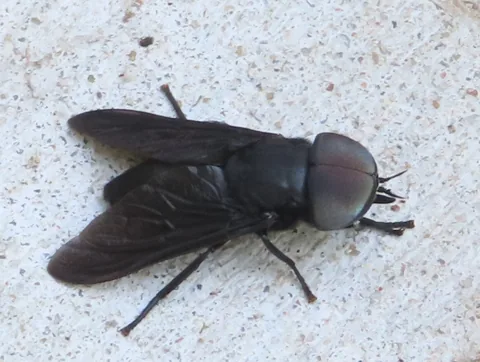 Horse Flies
Tabanus spp. (shown: black horse fly, Tabanus atratus)
Horse flies (Tabanus and related genera) are large, stout biting flies in the same family as deer flies. Only the females bite, during the day, slicing the skin and lapping up the blood.
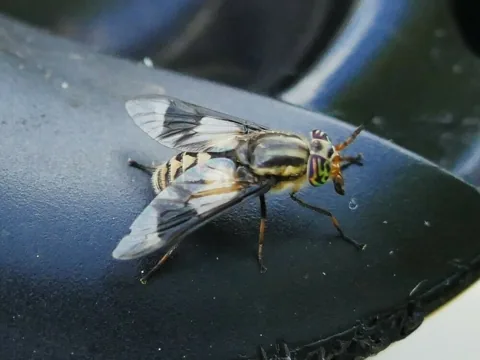 Deer Fly
Chrysops spp. (shown: Chrysops callidus)
Deer flies (genus Chrysops) are biting flies in the horse fly family. Only females bite, slicing the skin and lapping up the blood, mostly on warm days near the swamps, streams and woodland edges where their larvae develop.
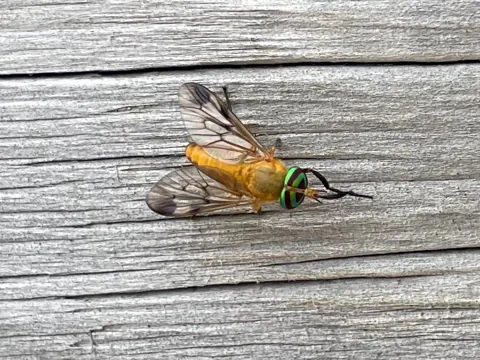 Yellow Fly
Diachlorus ferrugatus
The yellow fly, Diachlorus ferrugatus, is a biting fly in the same family as deer flies and horse flies and is common in the southeastern United States. Only the females bite, and their bites are painful and can swell fast. UF/IFAS calls the female one of the most serious biting fly pests wherever it occurs.
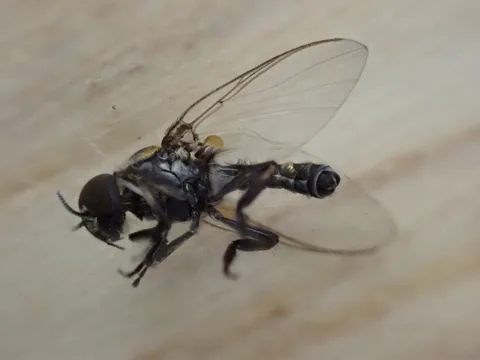 Black Flies
Simulium and related genera (family Simuliidae)
Black flies are tiny, stout, humpbacked biting flies, often called gnats or buffalo gnats. Their larvae live only in running water, and the females swarm around people and animals for blood, mostly in spring and early summer.
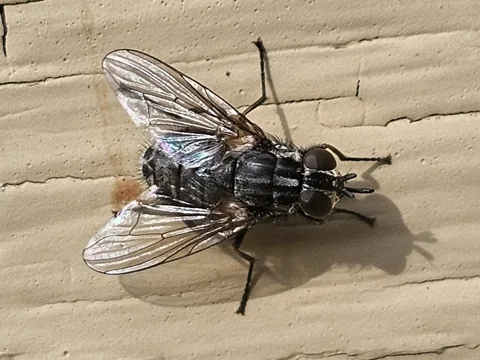 Stable Fly
Stomoxys calcitrans
The stable fly, also called the biting house fly or dog fly, looks much like a house fly but feeds on blood. Cattle are its main hosts, but it also bites horses, dogs and people, especially in neighborhoods near livestock.
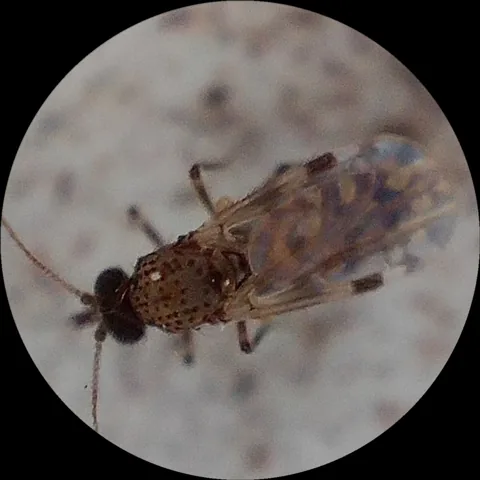 Biting Midges
Culicoides spp.
No-see-ums, also called biting midges, punkies, sand gnats or sand flies, are tiny flies, mostly in the genus Culicoides, whose bites itch intensely; most people feel them without ever seeing them.
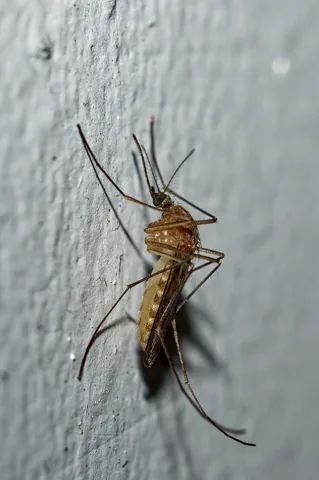 Mosquito
Culicidae (shown: Culex pipiens complex)
Mosquitoes are small, delicate flies whose females feed on blood and can pass on viruses such as West Nile; the control that works best goes after the larvae in standing water.
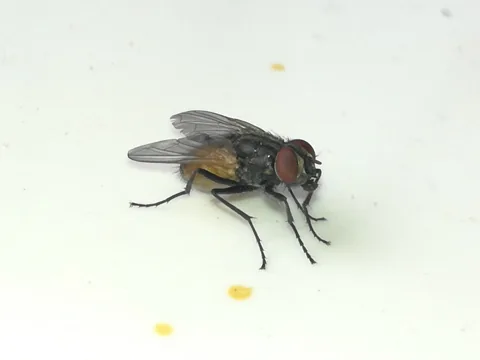 House Fly
Musca domestica
The house fly is a worldwide companion of people and domestic animals; it breeds in garbage, manure and other moist organic matter and is most numerous in hot summer months.
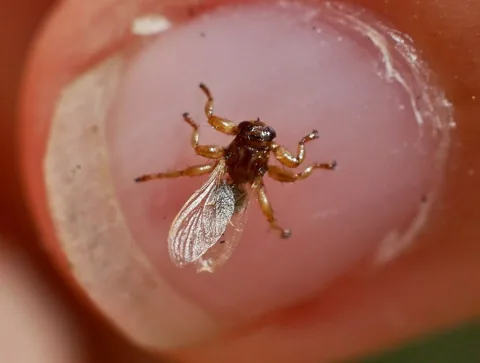 European Deer Ked
Lipoptena cervi (European deer ked); also L. mazamae, L. depressa and Neolipoptena ferrisi
Deer keds are flat, brown flies that feed on the blood of deer; once they land on a host they shed their wings and look like odd ticks, and they often land on and bite hunters, deer processors and hikers in fall.
Telling them apart
- Horse flies and deer flies: strong daytime fliers; only females bite, cutting the skin with blade-like mouthparts and feeding on the blood, and scratched bites can become infected. Their larvae develop in mud along ponds and streams, in wetlands and seepage areas, and a few in fairly dry soil.[1][2]
- Black flies: small (about 1/16 inch), gnat-like, humpbacked flies that bite only during the day. Their larvae develop in flowing creeks, streams and rivers, and adults can travel several miles.[3][5]
- Stable flies: look like house flies but have piercing mouthparts and feed on blood. They breed in moist, decaying organic matter such as lawn clippings, compost, animal bedding, manure and waste hay, and adults fly several miles to feed.[5][6]
- Yellow fly (Diachlorus ferrugatus): a common flying insect in the southeastern United States. Reports of allergic reactions to its bite are limited; a 2025 dermatology case report describes a 48-year-old man with a rapidly progressive allergic skin reaction after a bite, treated with oral prednisone.[7]
Which guide you need
- Around the yard, trails or campground: treating the wetlands where the larvae live is impractical, and residual sprays don't work because adults don't rest on any surface for long. The guide to getting rid of horse flies and deer flies covers the traps that can thin them out in a small area and the methods that fail.[2]
- At the pool: Kentucky entomologists say these flies can be serious nuisances around swimming pools, possibly drawn by the shiny water or by swimmers moving, and that there are no effective recommendations for the problem. The bugs in the pool guide covers them alongside the water bugs people find in pools.[1]
- Horses and livestock: animals that can get into a barn or deep shade during the day can escape the constant attack, and they can graze at night. Minnesota Extension says commercial repellents aren't effective against black flies, horse flies or deer flies. Stable flies breed in manure, bedding, waste hay and similar material, which the barn and livestock fly guide deals with.[1][3][5][6]
- Choosing a repellent: Wisconsin Extension calls standard insect repellents only marginally effective on these flies, though products with high levels of DEET give some protection. The guide to choosing an insect repellent covers EPA-registered ingredients and safe use.[2]
- After a bite: some people develop fevers, severe sores and allergic responses to the saliva, and CDC says deer flies have been shown to transmit tularemia in the western United States. Bite care and when to get help are in the horse fly and deer fly guide and the bug bite identification guide.[2][4]
What helps around the house
- Stable flies breed in lawn clippings, compost and other moist, decaying organic matter; Colorado State says the many breeding sites and long flights make them difficult to manage.[5]
- Horse flies, deer flies and black flies bite during the day; biting midges (no-see-ums) bite mostly at dusk, with a second peak at dawn.[1][3][5]
Photo credits
- Horse Flies: (c) Ken Clark, some rights reserved (CC BY) — via iNaturalist, CC BY 4.0
- Deer Fly: (c) John A. Gerwin, some rights reserved (CC BY) — via iNaturalist, CC BY 4.0
- Yellow Fly: (c) Philip Curley, some rights reserved (CC BY) — via iNaturalist, CC BY 4.0
- Black Flies: Stephen James McWilliam, public domain (CC0), via iNaturalist
- Stable Fly: (c) Phoenix M.S, some rights reserved (CC BY) — via iNaturalist, CC BY 4.0
- Biting Midges: Sinaloa Silvestre, public domain (CC0), via iNaturalist
- Mosquito: (c) Donald Davesne, some rights reserved (CC BY) — via iNaturalist, CC BY 4.0
- House Fly: ivan_humljani, public domain (CC0), via iNaturalist
- European Deer Ked: (c) Roman, some rights reserved (CC BY) — via iNaturalist, CC BY 4.0
Sources
- University of Kentucky Entomology, “Horse Flies and Deer Flies, ENTFACT-511 (L. Townsend).” entomology.ca.uky.edu/ef511 (accessed 2026-11-10)
- University of Wisconsin-Madison Extension, Wisconsin Horticulture, “Deer Flies and Horse Flies.” hort.extension.wisc.edu/articles/deer-flies-and-horse-flies/ (accessed 2026-11-10)
- University of Minnesota Extension, “Fly control around horses.” extension.umn.edu/horse-care-and-management/fly-control-around-horses (accessed 2026-11-10)
- Centers for Disease Control and Prevention, “How Tularemia Spreads.” www.cdc.gov/tularemia/causes/index.html (accessed 2026-11-10)
- Colorado State University Extension, “Biting Flies, Fact Sheet.” extension.colostate.edu/resource/biting-flies/ (accessed 2026-11-10)
- Penn State Extension, “Filth Fly Control on Horse Farms.” extension.psu.edu/filth-fly-control-on-horse-farms (accessed 2026-11-10)
- Cutis, abstract via PubMed, “Sequeira MJ, Ballestas NP, Sequeira EM. 2025. Managing Cutaneous Reactions to Yellow Fly (Diachlorus ferrugatus) Bites.” pubmed.ncbi.nlm.nih.gov/40392816/ (accessed 2026-11-10)
Updated 2026-11-12. Built from sourced records. Spot an error? Tell us.