On this page
How to identify it
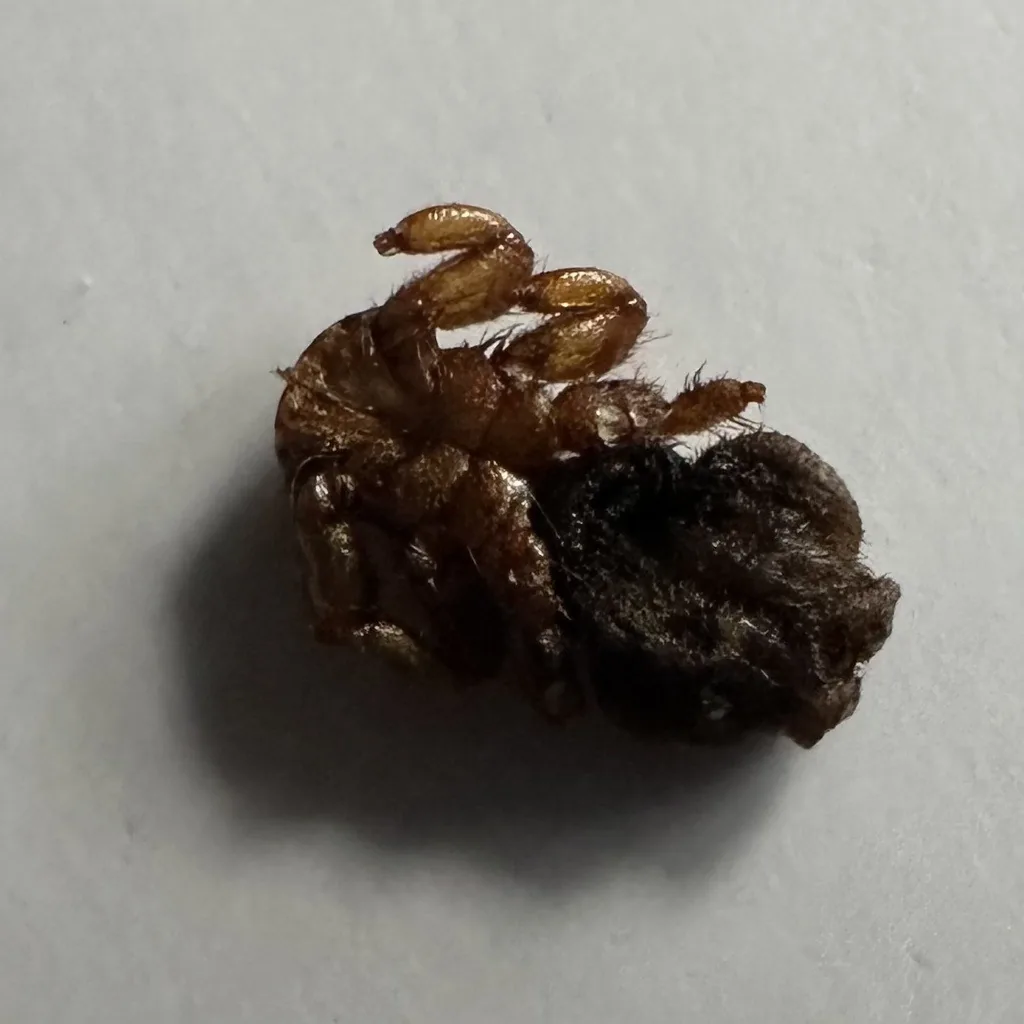
- Adults are about 1/4 inch long, reddish brown to grayish brown and bristly, with six legs, no wings, stout claws, and a pear-shaped abdomen wider than the head and thorax.[2][3][1]
- Part the wool on the neck, breast, shoulders, belly and thighs to find them.[3]
- The pupae are a giveaway: chestnut to dark reddish brown, bean- or barrel-shaped cases about 1/8 inch long, glued to the wool, usually on the belly, shoulders, thighs and lower neck.[1][3][2]
Look-alikes
| Look-alike | How to tell them apart |
|---|---|
| Ticks | Keds look enough like ticks to be called sheep ticks, but they are true insects with six legs, part of a family of flies that parasitize mammals.[1][2][3] |
| Deer keds | The sheep ked's family of parasitic flies includes species that live on deer, but the sheep ked itself is a pest only of domestic or mountain sheep and goats.[3] |
Where it lives
Native to Europe, Asia and North Africa, the sheep ked has spread with sheep to most sheep-raising areas of the world. Washington State Extension says it is most abundant in the western United States, South Dakota State reports it established in South Dakota, and Kentucky extension also covers it.[2][3][1]
Biology and life cycle
Both males and females feed on blood through piercing-sucking mouthparts.[2][1]
Females do not lay eggs. A single egg hatches inside the female, and the larva grows there for 7 to 12 days on a milk-like secretion before she glues it to the wool, where it becomes a pupa within hours.[2][1][3]
A female produces a new larva about once a week over an adult life of several months.[1][2][3]
Adults emerge from the pupa after about 3 weeks in warm months and up to about 6 weeks in cold weather.[3][1][2]
The whole life cycle is spent on the sheep. Keds pass from sheep to sheep mainly by direct contact, and shearers can carry them too; a ked knocked off its host survives only about 4 days to a week.[3][1]
Numbers are lowest in summer, build through fall and early winter, and peak around the first of the year.[1][3]
A female produces approximately one larva a week for up to fifteen weeks, and the life cycle can be completed in four to five weeks; Purdue puts a ked's life at 6-8 months, with about 15 young per female.[5][6]
Numbers are highest on lambs and lowest on adult sheep, and in general lambs carry young keds while adult sheep carry older ones.[5]
Damage and signs
- Ked bites itch, and sheep bite, rub and scratch at them, damaging and pulling out wool and leaving tags on fences; Washington State notes fleece yield losses of up to 25 percent in some areas.[1][2][3]
- Heavy infestations cause anemia and weight loss and leave sheep more open to disease. Lambs suffer most, since keds move to them after the ewes are sheared, and severe infestations raise lamb deaths.[2][3][1]
- Bites leave hard nodules in the skin called cockles, which lower the value of the hide.[1][2][3]
- South Dakota State notes that keds can mechanically spread the agent of bluetongue disease.[2]
- Ked blood-feeding measurably thins the blood: in an Ethiopian study of 414 sheep, packed cell volume averaged 26.5% in infested sheep against 35.1% in uninfested sheep, and infestation was more common in sheep in poor body condition and in the wet season.[7]
Health risk
The sheep ked lives on sheep and goats, and the WCVM says it is not known to be zoonotic; Kentucky, South Dakota State and Washington State describe no risk to people. Keds do carry bacteria: every ked pool tested in a Central European study held Bartonella melophagi, a species previously isolated from a sheep ked and from human blood in the USA.[5][1][2][3][8]
Control
Keep them out
Keep a clean flock clean by isolating newly purchased sheep and treating them before they join it.[1]
Traps and physical control
Shearing removes a large share of the keds. Kentucky says about half the adults and most of the young go with the fleece, and South Dakota State cites studies in which shearing removed 70 to 94 percent of the pupae and 75 to 91 percent of the adults.[1][2]
Pesticides
Treat right after shearing, when many keds have left with the fleece and an insecticide reaches the rest more easily. Dusts, sprays and pour-ons labeled for keds on sheep all work, though South Dakota State notes one study found fall pour-ons less effective than dusting.[1][2]
Insecticides kill adult keds but have little or no effect on the pupae glued in the wool.[2]
In Canada, the WCVM lists the permethrin-based products ECTIBAN 25 FLY-KILLER and DOKTOR DOOM RESIDUAL SURFACE INSECTICIDE SPRAY as approved for keds on sheep, and stresses that all in-contact sheep must be treated.[5]
If sheep are heavily infested in fall or winter, Purdue advises treating then instead of waiting: pick a warm, sunny day, treat in the morning and keep the sheep outside until dry. Dipping gives excellent control where facilities exist.[6]
Where sources disagree
Pupal period: Washington State gives about 3 weeks in warm months and about 6 weeks in cold months, the WCVM three to four weeks, and Purdue 2-5 weeks.[3][5][6]
Adult size: Washington State and Purdue give about 1/4 inch; the WCVM gives up to approximately 5 mm.[3][6][5]
Common questions
- Is the sheep tick a real tick?
- No. The so-called sheep tick is the sheep ked, a wingless, six-legged fly that lives its whole life in the fleece.[2][3]
- When is the best time to treat sheep for keds?
- Right after shearing. Shearing removes many keds and pupae, and the ones left are easier to reach with an insecticide on a shorn sheep.[1][2]
- Can keds survive in the barn or pasture?
- Not for long. A ked knocked off a sheep lives only about 4 days to a week, so nearly all spread is from sheep to sheep.[3][1]
- Can sheep keds make people sick?
- The WCVM says the sheep ked is not known to be zoonotic, and the extension sources describe no risk to people. Researchers have found Bartonella melophagi in keds, a bacterium also once isolated from human blood in the USA.[5][8]
Sources
- University of Kentucky Entomology, “Sheep Pests, ENTFACT-503 (L. Townsend).” entomology.ca.uky.edu/ef503 (accessed 2026-11-12)
- South Dakota State University Extension, “Sheep Keds in South Dakota, P-00393 (A. J. Varenhorst and others, April 2026).” extension.sdstate.edu/sites/default/files/2026-04/P-00393.pdf (accessed 2026-11-12)
- Washington State University Extension, “Insect Answers: Control of Sheep Keds, FS019E (A. L. Antonelli and L. Sandoval).” wpcdn.web.wsu.edu/wp-ecommerce/uploads/sites/2/product-3466-sku-FS019E.pdf (accessed 2026-11-12)
- iNaturalist, “Melophagus ovinus taxon page (order and family).” www.inaturalist.org/taxa/410002 (accessed 2026-11-12)
- Western College of Veterinary Medicine, University of Saskatchewan, “Melophagus ovinus (Learn About Parasites).” wcvm.usask.ca/learnaboutparasites/parasites/melophagus-ovinus.php (accessed 2026-11-12)
- Ohio State University Small Ruminant Team, “Control of Sheep Pests (R. E. Williams, Purdue Extension).” u.osu.edu/sheep/?p=3740 (accessed 2026-11-12)
- Veterinary Medicine and Science, via PubMed, “Epidemiology and haematological alterations of sheep ked (Melophagus ovinus) infestation and farmers' knowledge in South Gondar, Ethiopia (2026).” pubmed.ncbi.nlm.nih.gov/42927624/ (accessed 2026-11-12). Cited from the PubMed abstract.
- Parasitology Research, via PubMed, “Molecular survey of arthropod-borne pathogens in sheep keds (Melophagus ovinus), Central Europe (Rudolf et al. 2016).” pubmed.ncbi.nlm.nih.gov/27325400/ (accessed 2026-11-12). Cited from the PubMed abstract.