The short answer
- White dot: an adult female lone star tick has a single white spot in the middle of her back. A blacklegged female instead has a black shield over the front of a reddish-orange body, and black legs.[8][5][3][1]
- Shape: every life stage of the lone star tick is rounder; blacklegged ticks look more oblong, like a sesame seed.[4]
- Behavior: lone star ticks are aggressive biters that can chase a host by following carbon dioxide. Blacklegged ticks mostly wait on low plants for something to brush past.[4][1][9][3]
- Disease: blacklegged ticks spread Lyme disease, anaplasmosis, babesiosis and Powassan virus. Lone star ticks don't spread Lyme disease; they are tied to ehrlichiosis, Heartland and Bourbon viruses, STARI and alpha-gal syndrome (red meat allergy).[11][9][1][21][12]
Profiles on this site
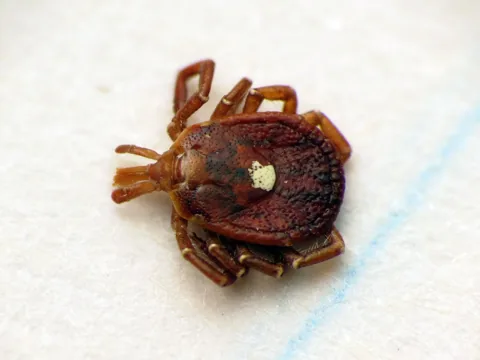 Lone Star Tick
Amblyomma americanum
The lone star tick is a very aggressive tick that readily bites people and pets across the Northeast, South and Midwest; its bite is linked to alpha-gal syndrome, a red meat allergy.
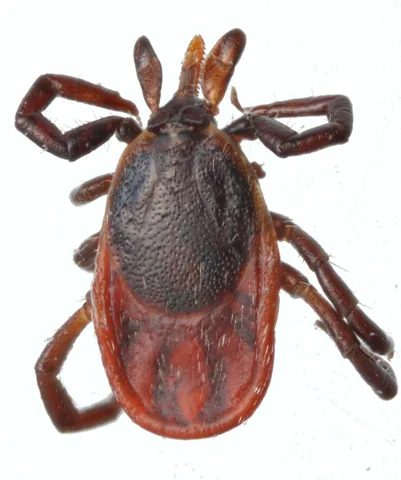 Blacklegged Tick
Ixodes scapularis
The blacklegged tick, often called the deer tick, is widely distributed across the eastern United States and spreads the bacteria that cause Lyme disease along with several other infections.
Side by side
Both are hard ticks with four life stages (egg, larva, nymph, adult), and each active stage feeds only once. Larvae, the so-called seed ticks, have six legs and are about the size of a poppy seed; nymphs and adults have eight.[4][8][6]
Adult females are the easiest stage to tell apart. Males and the tiny nymphs and larvae take a closer look, and a hand lens helps.[8][6][1]
- Adult female: lone star is reddish brown with a triangular shield bearing one white dot. Blacklegged is two-toned, a dark to black shield over the front third of the body and an orange-brown to reddish-orange rear, with black legs.[1][5][6][3]
- Adult male: a lone star male has no central dot; Kansas State describes a few short white to yellow lines on the edge of the shield, and Missouri Extension calls them inverted horseshoe markings at the rear edge. A blacklegged male is dark brown, almost black, because the shield covers his whole back.[6][7][8]
- Size: Missouri Extension gives lone star adults about 4 mm long and blacklegged adult females 3 to 4 mm (males 2 to 3 mm); Kansas State gives unfed blacklegged adults 2 to 3 mm. CDC compares a blacklegged adult to a sesame seed and a nymph to a poppy seed.[7][6][11]
- Nymphs and larvae: blacklegged nymphs are 1 to 2 mm, and larvae are the size of a poppy seed, nearly translucent and hard to see; Kentucky describes both with a translucent body and black shield and legs. Lone star nymphs and larvae are reddish brown with a circular body, and Rutgers notes young ticks can be poppy-seed size or smaller.[6][1][4]
- Mouthparts: both species have long mouthparts. Rutgers says the lone star tick's are significantly longer than an American dog tick's, so its bites are deep, and Missouri Extension says the large mouthparts can cause intense local irritation.[1][7][4]
- Where found: CDC lists the lone star tick across the Northeast, South and Midwest, and Penn State gives its range as Texas north to Missouri and east to the Atlantic. The blacklegged tick is widely distributed across the eastern U.S. and parts of the northern Midwest, and Kansas State gives it from Florida into central Texas and from Maine to Minnesota.[9][5][6]
- Habitat: lone star ticks live mostly in woodlands with dense undergrowth and around places animals rest. Blacklegged ticks favor deciduous forest with leaf litter and the tall grass and shrubs along forest edges.[2][6][3][1]
- Season: Kentucky gives lone star adults and nymphs March through September, with larvae in late summer and fall; Rhode Island gives adults April to late August. Blacklegged adults are out in fall, winter and early spring (October to May or June), any day the temperature is above freezing, and nymphs in late spring and summer.[1][2][5][3][9]
- Hunting style: lone star ticks quest on grass and low branches but also actively pursue hosts along carbon dioxide trails; Kentucky calls them active questers that chase their host. Blacklegged adults wait about knee-high on the tips of low shrubs.[2][4][1][3]
- Larvae: lone star larvae often turn up in large numbers and latch on by the hundreds. Rhode Island says they don't carry disease but their saliva can still cause an allergic reaction.[5][2]
- Main hosts: white-tailed deer feed all lone star stages, and wild turkeys are a major host for the young. Blacklegged larvae feed mostly on mice and chipmunks, while adults prefer deer; any stage of either tick will bite people and pets.[6][5]
Which diseases each one carries
Blacklegged tick: CDC lists Lyme disease (Borrelia burgdorferi and B. mayonii), anaplasmosis, babesiosis, hard tick relapsing fever (B. miyamotoi), ehrlichiosis caused by Ehrlichia muris eauclairensis, and Powassan virus. Nymphs and adult females are the stages most likely to bite people.[9][17][18][19]
Lone star tick: CDC lists ehrlichiosis (Ehrlichia chaffeensis and E. ewingii), Heartland virus, Bourbon virus and tularemia. CDC says the nymphs and adult females most often bite people and spread disease, and that the tick's saliva can make a bite red and sore without meaning an infection.[9][14][16]
STARI: some people get a red, expanding rash after a lone star tick bite, sometimes with fatigue, fever, headache and muscle and joint pain. CDC says its cause is unknown and that studies show the Lyme disease bacteria don't cause it; Kansas State links it to Borrelia lonestari, which a 2018 review calls a bacterium of uncertain clinical significance.[15][6][21]
Alpha-gal syndrome (AGS): an allergy to alpha-gal, a molecule in most mammals but not in people, that can follow a tick bite. In the U.S. it is mostly tied to lone star tick bites and less often to blacklegged or western blacklegged ticks. CDC says reactions usually start 2 to 6 hours after eating red meat or dairy, can range from hives and stomach pain to anaphylaxis, and that it can take weeks to months after a bite for symptoms to appear.[12][13]
CDC says to seek emergency care for a severe reaction; its list of AGS symptoms includes trouble breathing, swelling of the lips, throat or tongue, a drop in blood pressure and dizziness or faintness.[13]
- Lyme disease: CDC says the blacklegged tick transmits it in the Northeast, mid-Atlantic and north-central states, and that infected ticks generally must be attached more than 24 hours. A 2018 review of more than 52,000 lone star ticks from 54 surveys found B. burgdorferi scarce and at least nine transmission experiments that failed, concluding that lone star ticks are not vectors; Kentucky agrees.[11][21][1]
How to confirm which tick you have
Put the tick in a sealed container or wrap it in tape so it can't crawl off, then look at its back in good light. A white dot points to a female lone star tick; a black shield over an orange-red body with black legs points to a blacklegged female.[10][8][1][3]
For males, nymphs and larvae, check the outline: lone star ticks are rounder in every stage, while blacklegged ticks are longer and narrower. Extension offices identify ticks; Penn State says blacklegged and American dog ticks make up more than 90 percent of the requests it gets.[4][5]
CDC does not recommend commercial tick testing for deciding treatment: a positive result doesn't necessarily mean you were infected, and a negative one can give false assurance, since a different tick may have bitten you.[10]
Why the difference matters
Knowing the species tells you which illnesses to watch for. A blacklegged tick bite raises the question of Lyme disease, anaplasmosis or babesiosis; a lone star bite does not carry Lyme risk but can lead to ehrlichiosis, STARI or alpha-gal syndrome.[1][9][11][12]
Where you live matters too. CDC says blacklegged ticks in most of the Southeast are almost never infected with Lyme bacteria, and that STARI turns up mostly in the southern U.S., where Lyme disease is rare.[11][15]
What to do for each
Remove any attached tick as soon as you can; CDC says don't wait to see a provider. Grasp it close to the skin with clean fine-tipped tweezers and pull up with steady, even pressure, without twisting or jerking.[10][20]
If the mouthparts break off, remove them with tweezers if you can, or leave them and let the skin push them out. Don't use petroleum jelly, heat or nail polish to make the tick let go. Clean the bite and your hands with soap and water, rubbing alcohol or hand sanitizer, and check for more ticks.[10][20]
Lone star larvae: Rhode Island suggests sticky duct tape to lift crawling seed ticks off skin or clothes before they attach.[2]
If you get a rash or fever within several days to weeks after a bite, see your doctor and mention the tick. CDC notes alpha-gal symptoms can take weeks to months to appear, so mention an old tick bite if you react to red meat or dairy.[10][13]
- Pets: the Merck Veterinary Manual says ticks on dogs can spread ehrlichiosis and Lyme disease among others. Remove them with tweezers close to the skin, never with bare hands, and don't use hot matches.[22]
Common questions
- Can a lone star tick give you Lyme disease?
- No. A 2018 review of decades of testing concluded lone star ticks are not vectors of the Lyme bacteria, and Kentucky says they can't carry or transmit it. Lyme disease comes from blacklegged ticks.[21][1][11]
- Is a deer tick the same as a blacklegged tick?
- Yes. Ixodes scapularis is called both; Penn State prefers 'blacklegged tick' because deer are the main host only for adults.[5][11]
- Which tick causes the red meat allergy?
- In the U.S., alpha-gal syndrome is mostly linked to lone star tick bites; CDC says a few cases have followed blacklegged or western blacklegged tick bites.[12][8]
- Do male lone star ticks have the white dot?
- No. Only adult females have the single white dot; males have small white streaks or spots along the rear or outer edge.[8][6][1]
Photo credits
- Lone Star Tick: (c) Katja Schulz, some rights reserved (CC BY) — via iNaturalist, CC BY 4.0
- Blacklegged Tick: (c) Christian Back, some rights reserved (CC BY) — via iNaturalist, CC BY 4.0
Sources
- University of Kentucky Entomology, “Ticks and Disease in Kentucky (ENTFACT-618).” entomology.mgcafe.uky.edu/ef618 (accessed 2026-11-14)
- TickEncounter Resource Center, University of Rhode Island, “Lone Star Tick.” web.uri.edu/tickencounter/species/lone-star-tick/ (accessed 2026-11-14)
- TickEncounter Resource Center, University of Rhode Island, “Blacklegged (Deer) Tick.” web.uri.edu/tickencounter/species/blacklegged-tick/ (accessed 2026-11-14)
- Rutgers Cooperative Extension, “Lone Star Ticks in New Jersey: Risk, Ecology, and Prevention (FS1281).” extension.rutgers.edu/fs1281 (accessed 2026-11-14)
- Penn State Extension, “Common Ticks and Tick-borne Diseases in Pennsylvania.” extension.psu.edu/common-ticks-and-tick-borne-diseases-in-pennsylvania (accessed 2026-11-14)
- K-State Research and Extension, “Ticks in Kansas (MF2653).” bookstore.ksre.ksu.edu/pubs/ticks-in-kansas_MF2653.pdf (accessed 2026-11-14)
- University of Missouri Extension, “Ticks and Tick-borne Diseases (IPM1032).” extension.missouri.edu/publications/ipm1032 (accessed 2026-11-14)
- Missouri Department of Conservation, “Ticks (Field Guide).” mdc.mo.gov/discover-nature/field-guide/ticks (accessed 2026-11-14)
- Centers for Disease Control and Prevention, “Where Ticks Live.” www.cdc.gov/ticks/about/where-ticks-live.html (accessed 2026-11-14)
- Centers for Disease Control and Prevention, “What to Do After a Tick Bite.” www.cdc.gov/ticks/after-a-tick-bite/index.html (accessed 2026-11-14)
- Centers for Disease Control and Prevention, “How Lyme Disease Spreads.” www.cdc.gov/lyme/causes/index.html (accessed 2026-11-14)
- Centers for Disease Control and Prevention, “About Alpha-gal Syndrome.” www.cdc.gov/alpha-gal-syndrome/about/index.html (accessed 2026-11-14)
- Centers for Disease Control and Prevention, “Symptoms of Alpha-gal Syndrome.” www.cdc.gov/alpha-gal-syndrome/signs-symptoms/index.html (accessed 2026-11-14)
- Centers for Disease Control and Prevention, “About Ehrlichiosis.” www.cdc.gov/ehrlichiosis/about/index.html (accessed 2026-11-14)
- Centers for Disease Control and Prevention, “About Southern Tick-Associated Rash Illness.” www.cdc.gov/stari/about/index.html (accessed 2026-11-14)
- Centers for Disease Control and Prevention, “About Heartland Virus.” www.cdc.gov/heartland-virus/about/index.html (accessed 2026-11-14)
- Centers for Disease Control and Prevention, “About Anaplasmosis.” www.cdc.gov/anaplasmosis/about/index.html (accessed 2026-11-14)
- Centers for Disease Control and Prevention, “About Babesiosis.” www.cdc.gov/babesiosis/about/index.html (accessed 2026-11-14)
- Centers for Disease Control and Prevention, “About Powassan Virus.” www.cdc.gov/powassan/about/index.html (accessed 2026-11-14)
- MedlinePlus, U.S. National Library of Medicine, “Tick Bites (Health Topic).” medlineplus.gov/tickbites.html (accessed 2026-11-14)
- PubMed (peer-reviewed), “Stromdahl EY et al. Amblyomma americanum (Acari: Ixodidae) Ticks Are Not Vectors of the Lyme Disease Agent, Borrelia burgdorferi: A Review of the Evidence. J Med Entomol 2018;55(3):501-514.” pubmed.ncbi.nlm.nih.gov/29394366/ (accessed 2026-11-14)
- Merck Veterinary Manual, “Ticks of Dogs (Dog Owners).” www.merckvetmanual.com/dog-owners/skin-disorders-of-dogs/ticks-of-dogs (accessed 2026-11-14)