The short answer
- Count the legs. Adult and nymph ticks have eight legs; only tiny tick larvae have six. Bed bugs are insects, with six legs as nymphs and adults.[8][14][11][4][2][1]
- Look for a head and antennae. A bed bug has a distinct head with antennae and small eyes. A tick has two body regions and no antennae; the part that looks like a head is its mouthparts.[2][11][9][10]
- Notice where it was. A tick you find is usually stuck in the skin, because it stays attached for days. A bed bug feeds for about 3 to 10 minutes and then crawls back to hide in mattress seams and furniture cracks.[14][9][1][6]
- Ticks can spread disease-causing germs. The CDC says bed bugs are not known to spread diseases to people, though their bites itch and cost sleep.[12][4][2]
Profiles on this site
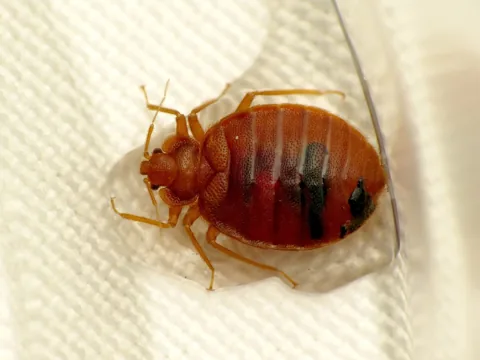 Bed Bug
Cimex lectularius
Bed bugs are wingless, blood-feeding insects that feed on sleeping or resting people, mostly at night; they have resurged worldwide and now turn up even in the finest hotels. CDC says they turn up in five-star hotels and resorts, and how clean a place is does not determine whether bed bugs are present.
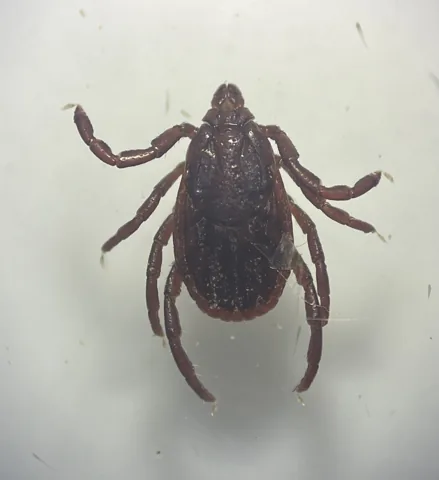 Brown Dog Tick
Rhipicephalus sanguineus
The brown dog tick is unusual: unlike most ticks, it can complete its entire life cycle indoors. It occurs across the United States, is met more often in the southern states, and can build up to high numbers on dogs and in homes and kennels. UF/IFAS Featured Creatures adds that this lets it set up populations even in colder climates.
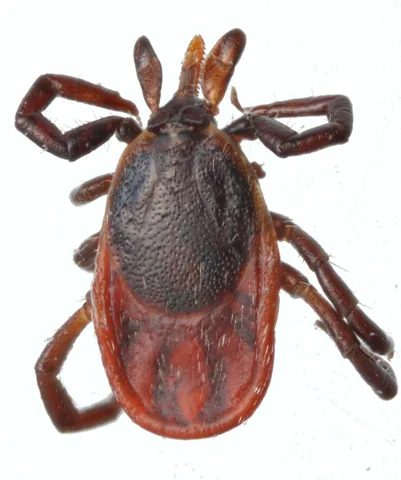 Blacklegged Tick
Ixodes scapularis
The blacklegged tick, often called the deer tick, is widely distributed across the eastern United States and spreads the bacteria that cause Lyme disease along with several other infections.
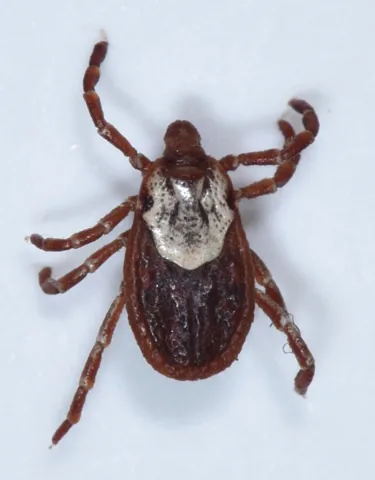 American Dog Tick
Dermacentor variabilis
The American dog tick, also called the wood tick, is widely distributed east of the Rocky Mountains. Adult females are the stage most likely to bite people, especially in spring and summer, and adults commonly climb to the crown of the head.
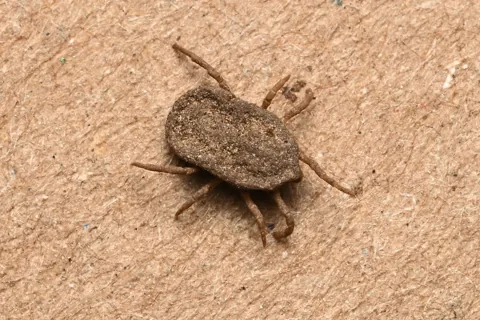 Soft Ticks (relapsing fever ticks)
Ornithodoros species (mainly O. hermsi and O. turicata in the U.S.)
Soft ticks live in rodent nests, often inside the walls and floors of rustic cabins, and come out at night to feed briefly on sleeping people. In the U.S., infected Ornithodoros soft ticks spread soft tick relapsing fever.
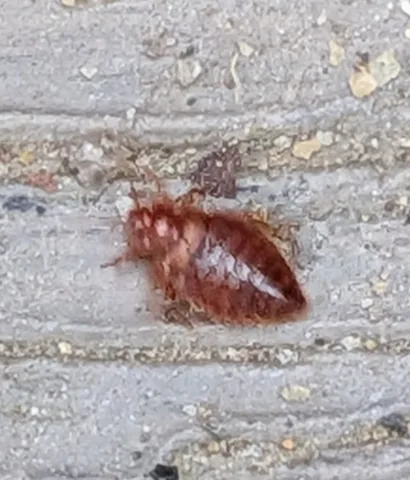 Bat Bugs
Cimex adjunctus (eastern bat bug) and Cimex pilosellus (western bat bug)
Bat bugs are close relatives of bed bugs that feed on the blood of roosting bats. They turn up in homes that have bats in the attic or walls, and they may bite people when the bats leave or are shut out.
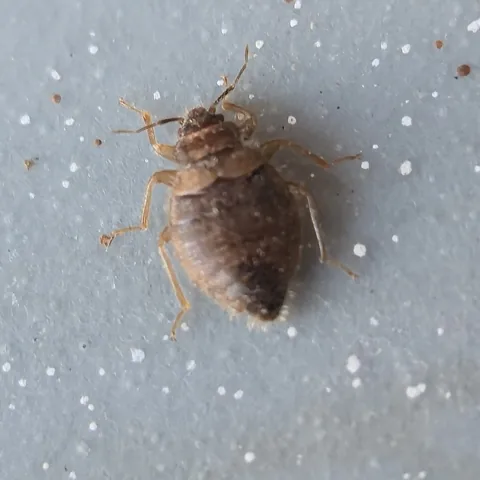 Swallow Bug
Oeciacus vicarius
Swallow bugs are close relatives of bed bugs that feed on the blood of swallows, mainly cliff swallows and sometimes barn swallows. They live in and around mud nests on buildings and bite people mainly when their birds are away.
Side by side
Extension and health agency pages agree on the main marks. Where they give different sizes, each is listed with its source.[2][11]
- What it is: bed bugs are wingless insects in the family Cimicidae. Ticks are arachnids, related to spiders and mites.[2][4][15][14]
- Legs: bed bugs six. Ticks eight as nymphs and adults, six as larvae. Tick larvae are smaller than 2mm, Kentucky says.[2][11][8][9]
- Body: a bed bug has three body regions, a head with well-developed antennae and small eyes, and an area behind the head that wraps forward on either side of it. A tick has two body regions, no antennae, and no segmented abdomen; the front part is the capitulum, which makes up the mouthparts.[2][11][9]
- Size, unfed: adult bed bugs about 3/16 inch (Kentucky), about 1/5 inch (UC IPM), about 1/4 inch (Washington DOH) or 1/4 to 3/8 inch (MedlinePlus); the CDC gives 1mm to 7mm across all stages. An unfed adult American dog tick is about 3/16 of an inch, Ohio State says, so size alone will not separate them.[1][2][6][5][4][10]
- Color and shape: bed bugs are reddish-brown, flat and oval, colored like an apple seed. Ticks come in different colors and sizes; hard ticks carry a hard plate, the scutum, just behind the mouthparts.[1][6][14][10]
- After feeding: a bed bug swells and turns bright red. A female tick grows a great deal; an engorged American dog tick female reaches about 5/8 of an inch and is mostly gray. Minnesota notes that engorged ticks are hard to identify because their size and color change so much.[6][10][8]
- Feeding time: bed bugs feed for about 3 to 10 minutes (Kentucky, Washington DOH) or 3 to 12 minutes (EPA). Hard ticks stay attached for days: Kentucky gives about 2 to 3 days for larvae, 4 to 7 for nymphs and 7 to 10 for adult females.[1][6][3][9][14]
- Where found: bed bugs hide in seams of mattresses, box springs, bed frames, headboards, couches and curtains. Ticks wait on the tips of grasses and shrubs and climb on when a host brushes past; you pick them up in grassy, brushy or wooded areas.[3][1][5][12][14]
- On the body: bed bugs normally do not stay on people; they feed on skin exposed during sleep, such as the face, neck, arms and legs. Ticks may wander to thin-skinned spots such as the ear before attaching, and the tick is often still there when you find it.[1][6][12][14]
- Disease: ticks can spread bacteria, viruses and parasites that cause human diseases through feeding. Bed bugs are not known to spread diseases to people, according to the CDC, UC IPM and MedlinePlus.[12][9][4][2][5]
When a tick turns up indoors
Most ticks are caught outdoors and carried in on people or pets. One exception matters here: Ohio State says the brown dog tick is the only tick that can become established indoors, in homes with dogs and kennels.[10][12]
- Soft ticks are another. Minnesota Extension says they live around animal burrows, bat caves and homes, especially attics where bats roost, and unlike hard ticks they do not attach firmly and feed more often for much shorter periods. That pattern can look like bed bug bites, so count the legs on anything you catch.[8][11]
Bat bugs and swallow bugs
Bat bugs and swallow bugs are close relatives of bed bugs, similar in size and color, and they turn up in homes with bat roosts or swallow nests. When the animals leave, the bugs can bite people, but they cannot reproduce on human blood.[7][2]
Telling them from bed bugs takes magnification: in bat bugs the fringe hairs just behind the head are longer than the width of the eye, and in bed bugs they are shorter. Like bed bugs they have six legs, which separates them from ticks.[7][2][11]
- Excluding the bats or birds is what ends these infestations, Colorado State says.[7]
How to confirm which one you have
Catch the bug if you can. Press it onto clear tape or seal it in a container; the CDC lists sealing a tick in a container or wrapping it tightly in tape as ways to dispose of one, and both keep it intact for a closer look.[13]
Use a hand lens. Count legs and look for antennae: six legs and antennae mean an insect, eight legs, two body regions and no antennae mean a tick.[11][2]
- Signs of bed bugs: rusty or reddish stains on sheets or mattresses from crushed bugs, dark spots of excrement that bleed into fabric like a marker, pale yellow eggs and eggshells about 1mm long, shed skins, and live bugs.[3]
- Where to check for bed bugs: mattress piping, seams and tags, cracks in the bed frame and headboard, chair and couch seams, between cushions and in curtain folds.[3][5]
- Signs of ticks: a bug attached at the skin, often in a sheltered spot such as the ear. Its saliva has anesthetic properties, so you may not feel it.[12][14]
- For bites in a room under an attic where bats roost, or near swallow nests, think about bats or birds and the bugs and soft ticks that live with them.[7][8]
Why the difference matters
A tick bite is a reason to remove the tick quickly and watch for illness; the CDC says delaying removal could increase the risk of a tickborne disease. Bed bug bites usually do not need medical treatment, but finding a bed bug means checking beds and furniture for other signs.[13][4][3]
What to do for each
Here are the first steps for each one. The linked guides go into more detail.[13][4]
- Tick on the skin: grasp it as close to the skin as possible with fine-tipped tweezers, pull it out, then clean the bite and your hands with soap and water, rubbing alcohol or hand sanitizer. If the mouthparts break off and you cannot remove them easily, leave them; the skin pushes them out as it heals.[13]
- After a tick bite: if you develop a rash or fever within several days to weeks of removing a tick, see your doctor. Check for other ticks, since there may be more on your body.[13][14]
- Ticks on a dog: Merck says ticks that have been on an animal for days look rounded from the blood they have taken in. Do not remove a tick with bare hands, and Merck says infested dogs should also be treated with anti-tick products that kill attached ticks; ask your veterinarian which one.[15]
- Bed bugs: the CDC recommends contacting a professional pest control company experienced with bed bugs. Kentucky warns against bleach, alcohol, lighters and bug bombs.[4][1]
- Bed bug bites: they usually do not need medical treatment; for itchy reactions an antihistamine may help, the CDC says, and Washington DOH notes that over-the-counter anti-itch cream can relieve itching.[4][6]
Common questions
- Can a tick live in your bed?
- Not usually. Ticks are picked up outdoors and feed for days while attached. The brown dog tick is the one tick that can become established indoors, in homes with dogs.[12][9][10]
- Do bed bugs have eight legs?
- No. Bed bugs are insects with six legs. Eight legs on an adult means a tick (or a mite or spider).[2][11][14]
- Do bed bugs bury their heads in skin like ticks?
- No. A bed bug pierces the skin with a slender beak, feeds for a few minutes and leaves. A tick stays attached and keeps feeding for days.[1][9]
- Do bed bugs spread Lyme disease?
- No. The CDC says bed bugs are not known to spread diseases to people. Lyme disease comes from ticks; the blacklegged tick carries it.[4][8]
Photo credits
- Bed Bug: (c) Katja Schulz, some rights reserved (CC BY) — via iNaturalist, CC BY 4.0
- Brown Dog Tick: (c) NoahM, some rights reserved (CC BY) — via iNaturalist, CC BY 4.0
- Blacklegged Tick: (c) Christian Back, some rights reserved (CC BY) — via iNaturalist, CC BY 4.0
- American Dog Tick: (c) Don Loarie, some rights reserved (CC BY) — via iNaturalist, CC BY 4.0
- Soft Ticks (relapsing fever ticks): (c) Trevor Van Loon, some rights reserved (CC BY) — via iNaturalist, CC BY 4.0
- Bat Bugs: (c) Jason Hill, some rights reserved (CC BY) — via iNaturalist, CC BY 4.0
- Swallow Bug: (c) John Clonce, some rights reserved (CC BY) — via iNaturalist, CC BY 4.0
Sources
- University of Kentucky Entomology, “ENTFACT-636: Bed Bugs.” entomology.mgcafe.uky.edu/ef636 (accessed 2026-11-14)
- University of California Statewide IPM Program, “Bed Bugs (Home and Landscape).” ipm.ucanr.edu/home-and-landscape/bed-bugs/ (accessed 2026-11-14)
- U.S. Environmental Protection Agency, “How to Find Bed Bugs.” www.epa.gov/bedbugs/how-find-bed-bugs (accessed 2026-11-14)
- Centers for Disease Control and Prevention, “About Bed Bugs.” www.cdc.gov/bed-bugs/about/index.html (accessed 2026-11-14)
- MedlinePlus (U.S. National Library of Medicine), “Bed Bugs.” medlineplus.gov/bedbugs.html (accessed 2026-11-14)
- Washington State Department of Health, “Bed Bugs.” doh.wa.gov/community-and-environment/pests/bed-bugs (accessed 2026-11-14)
- Colorado State University Agricultural Biology, “Bed bug look-alikes.” agsci.colostate.edu/agbio/ipm-pests/bed-bug-look-alikes/ (accessed 2026-11-14)
- University of Minnesota Extension, “Ticks.” extension.umn.edu/garden-and-home/yard-and-garden/yard-and-garden-insects/ticks (accessed 2026-11-14)
- University of Kentucky Entomology, “ENTFACT-618: Ticks and Disease in Kentucky.” entomology.mgcafe.uky.edu/ef618 (accessed 2026-11-14)
- Ohio State University Extension (Ohioline), “Ticks and Tick-Borne Diseases (HYG-2073).” ohioline.osu.edu/factsheet/hyg-2073 (accessed 2026-11-14)
- University of Rhode Island TickEncounter Resource Center, “Bugs that look like ticks.” web.uri.edu/tickencounter/is-it-a-tick/ (accessed 2026-11-14)
- Centers for Disease Control and Prevention, “About Ticks and Tickborne Disease.” www.cdc.gov/ticks/about/index.html (accessed 2026-11-14)
- Centers for Disease Control and Prevention, “What to Do After a Tick Bite.” www.cdc.gov/ticks/after-a-tick-bite/index.html (accessed 2026-11-14)
- MedlinePlus (U.S. National Library of Medicine), “Tick Bites.” medlineplus.gov/tickbites.html (accessed 2026-11-14)
- Merck Veterinary Manual, “Ticks of Dogs (Dog Owners).” www.merckvetmanual.com/dog-owners/skin-disorders-of-dogs/ticks-of-dogs (accessed 2026-11-14)