On this page
How to identify it
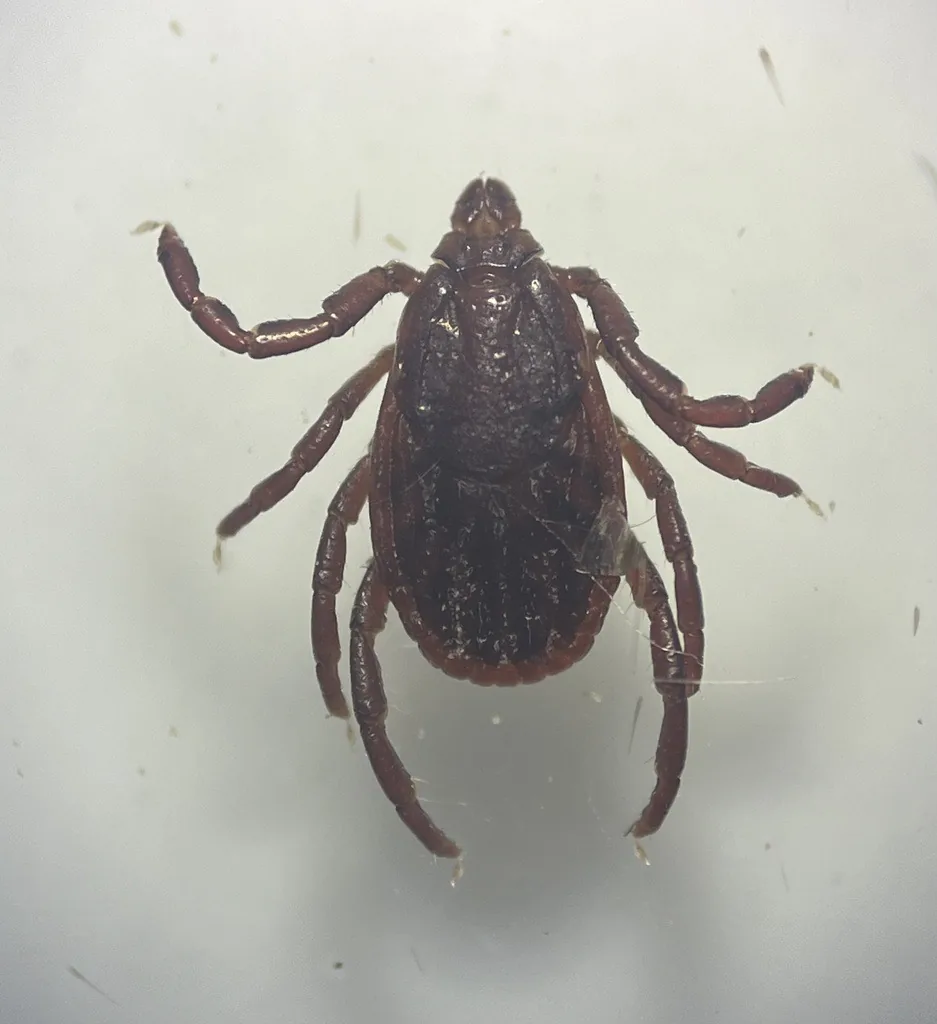
- Adults are yellowish-brown to reddish-brown with a plain, dark brown shield (scutum) and no ornamentation. The University of Saskatchewan gives unfed adult females as 4 to 5 mm long, and Kentucky describes a brown, teardrop-shaped body with short mouthparts.[4][5]
- Larvae have six legs; nymphs and adults have eight. All three stages can be on the same dog at once, so ticks of very different sizes on one dog can be the same species. UF/IFAS notes that people who think they have several kinds of ticks are often seeing different life stages, such as large adults and small seed ticks.[4][15]
- A female feeds for about a week before she is fully engorged, then drops off to lay eggs.[3][4]
- UF/IFAS Featured Creatures gives adults as 2.28 to 3.18 mm long and nymphs as 1.14 to 1.30 mm; six-legged larvae are about 0.54 mm. A female swells about a hundredfold as she feeds, to roughly the size of a raisin.[15]
- Among Florida ticks it is recognized by its color, body shape and six-sided (hexagonal) base of the mouthparts. Any tick with white coloring on its back is not a brown dog tick.[15]
Look-alikes
| Look-alike | How to tell them apart |
|---|---|
| American dog tick | The brown dog tick has a plain brown shield with no ornamentation. CDC lists the brown dog tick as the one that can infest indoor spaces like homes and kennels. UF/IFAS adds that any tick with white coloring on its back is not a brown dog tick.[4][6][15] |
Where it lives
Found worldwide, according to CDC, and described in research as a cosmopolitan parasite of dogs. URI's TickEncounter says it can be found throughout the United States but is met more often in the southern tier of states, and CDC notes it occurs in Hawaii. In Canada it is not established outdoors, but it turns up on dogs that have traveled to warmer areas and can keep going indoors in infested kennels and homes. UF/IFAS calls it the most widespread tick species in the world, more common in warmer climates.[2][11][3][4][15]
Biology and life cycle
Dogs are the main host at every life stage in the U.S., but the tick may also bite people and other mammals.[2][4]
It is a three-host tick: each stage feeds, drops off to molt and then finds another host. Saskatchewan gives feeding times of about 4 days for larvae and nymphs and about 8 days or longer for adults.[4]
Fed females lay eggs in cracks and crevices, on ledges and on top of kennels, in areas infested dogs use. Rhode Island's TickEncounter says a female can lay up to 4,000 eggs, and larvae hatch in 2 to 5 weeks.[3][4]
Owners often first notice an infestation when ticks are seen crawling up walls.[4]
Sources disagree on timing. TickEncounter says the life cycle can take as few as three months and that adults can survive 18 months without feeding; Saskatchewan says the cycle can be as short as 2 months but normally takes 4 to 5 months. Kentucky says it seems to be active year-round in other states.[3][4][5]
Dogs usually pick up ticks in an infested home, kennel or veterinary clinic rather than from direct contact with other dogs. In a 2002 Israeli study, single females fed and laid eggs inside apartments where dogs were kept indoors.[4][13]
UF/IFAS says a fully fed female can lay over 7,000 eggs, 4,000 on average, and dies when she has finished. She may start as soon as four days after dropping off and keep laying for 15 to 18 days, and the larvae hatch 6 to 23 days later.[15]
Larvae feed for 5 to 15 days and take about one to two weeks to become nymphs; nymphs feed for 3 to 13 days and take about two weeks to become adults. Males feed only for short periods.[15]
Ticks can survive three to five months in each stage without feeding. UF/IFAS says two generations a year is average, with up to four recorded in tropical countries such as Brazil, and in Florida the cycle runs year-round inside homes and in outdoor kennels and dog runs.[15]
Because the ticks hide while digesting, molting or laying eggs, an infestation can seem to disappear and then come back. Hungry ticks moving toward a dog are often seen on furniture, baseboards, carpeting and dog bedding.[15]
Damage and signs
- Small numbers usually cause no signs, but heavy infestations can cause skin irritation and hair loss in dogs. The tick carries the bacterium that causes canine ehrlichiosis and the parasite Babesia canis.[4][7][12]
- Adults are most often found around a dog's head and ears, while larvae and nymphs prefer the legs, chest and belly. UF/IFAS lists the preferred attachment sites as the head, ears, back, between the toes and the armpits.[4][15]
Health risk
CDC lists the brown dog tick as a carrier of Rocky Mountain spotted fever in the southwestern U.S. and along the U.S.-Mexico border; the disease can be deadly if not treated early with doxycycline, and its most common symptoms are fever, headache and rash. A 2005 report in the New England Journal of Medicine tied the tick to a cluster of 16 cases in eastern Arizona, most of them children 12 or younger; every confirmed patient had contact with tick-infested dogs. A 2025 study counted nearly 500 cases and 28 deaths in Arizona tribal communities since 2003.[2][1][8][10]
Control
Prevention
Check dogs daily, especially after time in kennels or veterinary clinics, and remove any attached tick right away.[6][4]
Ask your veterinarian which tick preventive suits your dog. Some brown dog tick populations carry a gene change that makes them less sensitive to permethrin and related pyrethroids. UF/IFAS reports high permethrin resistance in US brown dog ticks, notably in Florida and Texas, and says rotating products may slow resistance. It also warns that cats and certain dog breeds are considerably more sensitive to certain pesticides.[6][11][15]
Check dogs when they come home from kennels, groomers, dog parks and similar places. UF/IFAS says to remove attached ticks with tweezers or a tick-removal tool, especially adult females, and dispose of them carefully, for example by freezing them for 24 hours.[15]
Keep them out
In an eastern Arizona study, fencing at a home site appeared protective, while the number of nearby structures was the strongest risk factor for more ticks, which the authors tie to free-roaming dogs.[10]
Sanitation
Seal cracks and crevices in homes and kennels, keep grass and weeds short, wash and dry dog beds and blankets with hot water and high dryer heat, and use steam on items such as furniture that can't be washed.[15]
When to call a professional
Once ticks are in the house, treat all dogs in contact with the infested area and focus on the indoor environment. In an Arizona community with high Rocky Mountain spotted fever rates, long-acting tick collars on every dog plus monthly yard treatments cut visible infestations to under 1% of dogs within five months, compared with 64% in nearby communities.[4][9]
Once an infestation has started, UF/IFAS calls thorough treatment of the infested areas by professional pest control operators critical and says repeat treatments may be needed. It suggests contacting your local Extension office if an infestation is not resolved after a few months.[15]
Where the sources disagree
Adult size: UF/IFAS gives adults as 2.28 to 3.18 mm long; the University of Saskatchewan gives unfed adult females as 4 to 5 mm.[15][4]
Eggs: UF/IFAS says a female can lay over 7,000, 4,000 on average; Rhode Island's TickEncounter says up to 4,000. UF/IFAS gives hatching after 6 to 23 days, TickEncounter 2 to 5 weeks.[15][3]
Survival without a meal: UF/IFAS says three to five months in each stage; TickEncounter says adults can survive 18 months.[15][3]
Feeding times: Saskatchewan gives about 4 days for larvae and nymphs and about 8 days or longer for adults; UF/IFAS gives 5 to 15 days for larvae and 3 to 13 for nymphs.[4][15]
Where on the dog: Saskatchewan says adults are mostly around the head and ears and larvae and nymphs on the legs, chest and belly; UF/IFAS lists the head, ears, back, between the toes and the armpits without splitting by stage.[4][15]
Common questions
- Can ticks really live inside my house?
- Most ticks can't, but the brown dog tick can complete its whole life cycle indoors, so infestations can develop in homes and kennels.[3][4][6]
- Does the brown dog tick spread Lyme disease?
- CDC does not list it as a Lyme disease carrier. In the U.S., CDC names Rocky Mountain spotted fever as the human disease it transmits; Lyme disease is spread by blacklegged ticks.[2]
- If I take my dog away, will the ticks die off?
- Not quickly. TickEncounter says adults can survive 18 months without feeding, and Saskatchewan says people may be bitten when there are no dogs around. UF/IFAS says each stage can survive three to five months without feeding, and that without a dog nearby the tick is likely to feed on other mammals, including people.[3][4][15]
- Do brown dog ticks bite people?
- Sometimes. CDC says dogs are the main host at every stage but the tick may bite people or other mammals, and a review notes that human bites may be more common than is recognized.[2][12]
Sources
- U.S. Centers for Disease Control and Prevention, “About Rocky Mountain Spotted Fever (reviewed May 15, 2024).” www.cdc.gov/rocky-mountain-spotted-fever/about/index.html (accessed 2026-11-11)
- Centers for Disease Control and Prevention, “Where Ticks Live.” www.cdc.gov/ticks/about/where-ticks-live.html (accessed 2026-11-11)
- University of Rhode Island TickEncounter Resource Center, “Brown Dog Tick (TickEncounter).” web.uri.edu/tickencounter/species/brown-dog-tick/ (accessed 2026-11-14)
- Western College of Veterinary Medicine, University of Saskatchewan, “Rhipicephalus sanguineus: brown dog tick (Learn About Parasites).” wcvm.usask.ca/learnaboutparasites/parasites/rhipicephalus-sanguineus-brown-dog-tick.php (accessed 2026-11-14)
- University of Kentucky Entomology, “ENTFACT-618: Ticks and Disease in Kentucky.” entomology.mgcafe.uky.edu/ef618 (accessed 2026-11-11)
- Centers for Disease Control and Prevention, “Preventing Ticks on Pets.” www.cdc.gov/ticks/prevention/preventing-ticks-on-pets.html (accessed 2026-11-11)
- Centers for Disease Control and Prevention, “Ehrlichiosis: fact sheet for veterinarians.” www.cdc.gov/ehrlichiosis/pdfs/fs-ehrlichiosisvet-508.pdf (accessed 2026-11-11)
- New England Journal of Medicine, via PubMed, “Demma et al. (2005), Rocky Mountain spotted fever from an unexpected tick vector in Arizona, N Engl J Med 353(6):587-594.” pubmed.ncbi.nlm.nih.gov/16093467/ (accessed 2026-11-11)
- PLoS One, via PubMed, “Drexler et al. (2014), Community-based control of the brown dog tick in a region with high rates of Rocky Mountain spotted fever, 2012-2013, PLoS One 9(12):e112368.” pubmed.ncbi.nlm.nih.gov/25479289/ (accessed 2026-11-11)
- American Journal of Tropical Medicine and Hygiene, via PubMed, “Brophy et al. (2025), Ecologic risk factors for infestation of Rhipicephalus sanguineus s.l. in a Rocky Mountain spotted fever-endemic area of eastern Arizona, Am J Trop Med Hyg 113(1):156-162.” pubmed.ncbi.nlm.nih.gov/40328244/ (accessed 2026-11-11)
- Medical and Veterinary Entomology, via PubMed, “Tucker et al. (2021), Prevalence and distribution of pathogen infection and permethrin resistance in tropical and temperate populations of Rhipicephalus sanguineus s.l. collected worldwide, Med Vet Entomol 35(2):147-157.” pubmed.ncbi.nlm.nih.gov/32918501/ (accessed 2026-11-11)
- Veterinary Parasitology, via PubMed, “Dantas-Torres (2008), The brown dog tick, Rhipicephalus sanguineus: from taxonomy to control, Vet Parasitol 152(3-4):173-185.” pubmed.ncbi.nlm.nih.gov/18280045/ (accessed 2026-11-11)
- International Journal of Medical Microbiology, via PubMed, “Uspensky and Ioffe-Uspensky (2002), The dog factor in brown dog tick Rhipicephalus sanguineus infestations in and near human dwellings, Int J Med Microbiol 291 Suppl 33:156-163.” pubmed.ncbi.nlm.nih.gov/12141741/ (accessed 2026-11-11)
- iNaturalist, “Rhipicephalus sanguineus taxon page (order and family).” www.inaturalist.org/taxa/229905 (accessed 2026-11-11)
- University of Florida IFAS Extension, Featured Creatures, “Brown Dog Tick, Rhipicephalus sanguineus Latreille (EENY-221/IN378; Y. Tian, C. Lord and P. Kaufman).” ask.ifas.ufl.edu/publication/IN378 (accessed 2026-11-14)