On this page
How to identify it
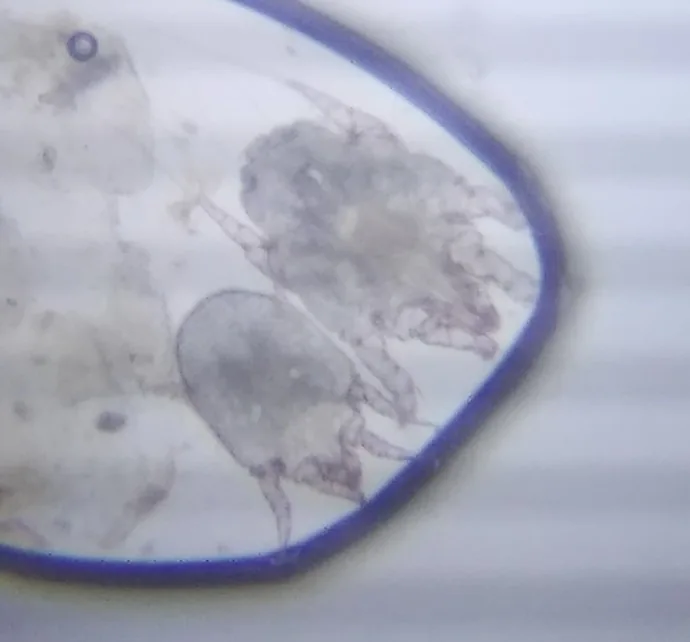
- Adults are barely visible to the naked eye: females are about 500 by 300 micrometers and males about 395 by 295. Under magnification the adults show four pairs of long legs.[1]
- The ear canal fills with waxy or crusty debris, usually dark brown and often likened to coffee grounds, sometimes with blood.[1][2]
- Infested pets scratch and rub at their ears and shake their heads. Signs vary a lot: some cats with heavy discharge hardly itch, some dogs with little visible change itch intensely, and some animals show few or no signs at all.[1][2]
- They are confirmed by spotting mites in the ear canal with an otoscope or by finding mites in ear swabs or debris examined under a microscope.[1]
- Fun fact: vets sometimes find ear mites in a cat's stool sample, because heavily infested cats swallow them while grooming.[1]
Look-alikes
| Look-alike | How to tell them apart |
|---|---|
| Flea bite allergy | Ear mites that leave the ears for the neck, rump and tail can cause skin lesions similar to flea bite allergic dermatitis. Finding the mites, in the ear canal or in ear swabs under a microscope, points to ear mites.[1] |
Where it lives
Ear mites infest dogs and cats worldwide and are commonly diagnosed during routine veterinary exams. They also live on a variety of wild carnivores, and ferrets and foxes are among their other hosts.[1][2]
Biology and life cycle
The whole life cycle takes place on the host, mainly on the skin surface of the outer ear canal. Females cement their eggs to hairs or skin, a six-legged larva hatches, and it molts through two eight-legged nymph stages to the adult in about three weeks. Adults are thought to live up to about eight weeks.[1][2]
They do not burrow. They feed on shed skin cells, ear secretions and tissue fluid, and the animal's immune reaction to the mites can make the irritation worse.[1][2]
Most often they pass from an infested mother to her puppies or kittens. They also spread by direct contact and on shared bedding, combs, brushes and other grooming gear. Off the host most mites last only a few days, but they can survive for months in cool, damp conditions.[1][2]
Young animals are affected more often than older ones, especially kittens 3 to 6 months old, possibly because older animals build up immunity. The Canadian Veterinary Journal calls the infestation highly contagious, a particular problem in catteries.[2][1][4]
Damage and signs
- The itch can be intense. Scratching, rubbing and head shaking can injure the ear flap and the lining of the ear canal and can lead to bleeding and aural hematomas.[1][2]
- Secondary bacterial infection can follow, sometimes producing a pus-filled ear infection.[1][2]
- Mites that wander out of the ears can cause crusty, bumpy skin lesions on the head, neck, feet, rump and tip of the tail. Signs sometimes include severe behavior changes and seizures.[1][2]
- Ear mites are estimated to cause up to 85 percent of outer ear inflammation (otitis externa) cases in cats and up to 50 percent in dogs.[2]
Health risk
People are rarely affected. Parasites & Vectors notes that humans are occasionally infested, and a 1977 report in Laryngoscope described outer-ear inflammation (otitis externa) in a person caused by this mite.[2][7]
Control
Sanitation
Treat every dog and cat in contact with the infested pet, since mites spread quickly and some carriers show few or no signs. Clean thoroughly or throw out bedding, and clean combs, brushes and other grooming tools that can carry mites.[1][2]
When to call a professional
Labeled products in Canada include milbemycin (MILBEMITE), moxidectin with imidacloprid (ADVANTAGE MULTI) and selamectin (REVOLUTION); ivermectin, milbemycin (MILBEMAX) and the newer isoxazolines are also used extralabel. Whole-body treatments are preferred over ear-only ones, because mites can live elsewhere on the body.[1]
Not all products kill the eggs, so products with lasting activity are preferred; otherwise a second treatment after three weeks may be needed to catch mites that hatch in the meantime.[1]
In controlled studies, a single dose of fluralaner (Bravecto) cut mite counts by 100 percent in cats and 99.8 percent in dogs after 28 days, and a single oral dose of lotilaner (Credelio) cut counts by 99.6% in cats.[2][5]
A review of the selamectin plus sarolaner spot-on for cats (Revolution Plus, sold as Stronghold Plus in the EU) reports high single-dose efficacy against ear mites; the review was written mainly by the maker's staff.[6]
Gentle but thorough ear cleaning, medication to ease the itch, and antibiotics for any secondary bacterial infection also help.[1]
Common questions
- What does ear mite debris look like?
- It is waxy or crusty material in the ear canal, usually dark brown and often compared to coffee grounds, sometimes mixed with blood.[1][2]
- Can people get ear mites from pets?
- Rarely. Humans are occasionally infested, and at least one published report describes ear-canal inflammation in a person caused by the cat and dog ear mite.[2][7]
- Why does every pet in the house need treatment for ear mites?
- Ear mites spread quickly through direct contact and shared bedding or grooming tools, and some infested dogs and cats show few or no signs, which is why all in-contact dogs and cats should be treated.[1][2]
- What gets rid of ear mites in cats?
- A review of studies found that isoxazolines (sarolaner, fluralaner, esafoxolaner), tigolaner and macrocyclic lactones (selamectin, eprinomectin, moxidectin) can all cure the infestation, with rare and mostly mild skin side effects. Ask your vet which product suits your pet.[4]
Sources
- University of Saskatchewan, Western College of Veterinary Medicine, “Otodectes cynotis (Learn About Parasites).” wcvm.usask.ca/learnaboutparasites/parasites/otodectes-cynotis.php (accessed 2026-11-12)
- Parasites & Vectors (BioMed Central), “Efficacy of fluralaner against Otodectes cynotis infestations in dogs and cats (J. Taenzler and colleagues, published 16 January 2017).” parasitesandvectors.biomedcentral.com/articles/10.1186/s13071-016-1954-y (accessed 2026-11-12)
- iNaturalist, “Otodectes cynotis taxon page (order and family).” www.inaturalist.org/taxa/262955 (accessed 2026-11-12)
- Canadian Veterinary Journal (2025), via PubMed, “The most effective systemic treatment in cats with otodectic mange: A critically appraised topic.” pubmed.ncbi.nlm.nih.gov/40510273/ (accessed 2026-11-12). Cited from the PubMed abstract.
- Parasites & Vectors (2025), via PubMed, “Efficacy evaluation of lotilaner (Credelio) in experimentally induced Otodectes cynotis infestations in cats.” pubmed.ncbi.nlm.nih.gov/41163194/ (accessed 2026-11-12). Cited from the PubMed abstract.
- Veterinary Parasitology: Regional Studies and Reports (2026), via PubMed, “A review of the parasiticidal efficacy of a selamectin plus sarolaner combination for use on cats.” pubmed.ncbi.nlm.nih.gov/42736011/ (accessed 2026-11-12). Cited from the PubMed abstract; authors include Zoetis employees.
- Laryngoscope (1977), via PubMed, “Otitis externa in man caused by the mite Otodectes cynotis.” pubmed.ncbi.nlm.nih.gov/916787/ (accessed 2026-11-12). Cited for its title; PubMed lists no abstract.