On this page
How to identify it
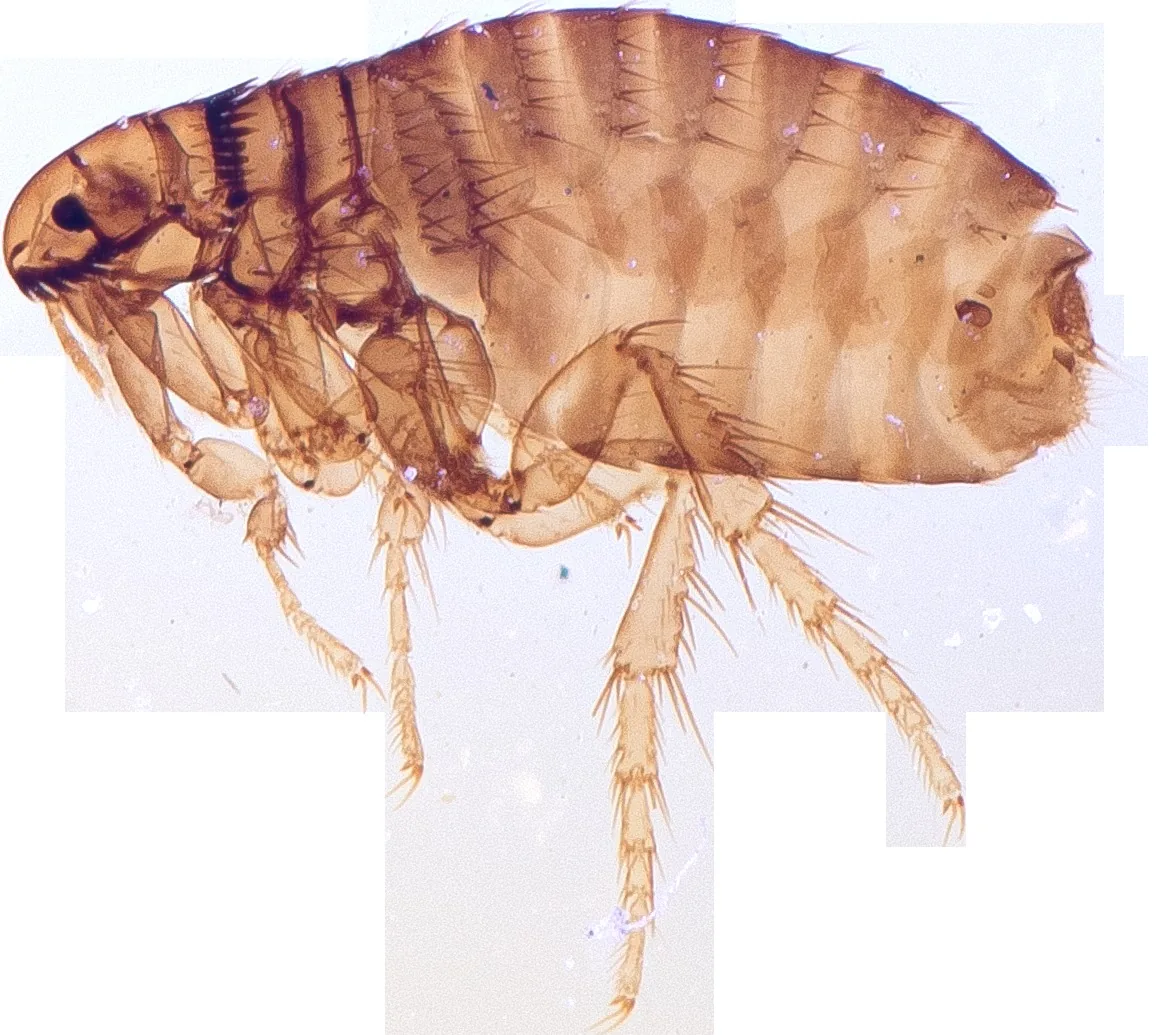
- Like the cat flea, it is a small, wingless, reddish-brown flea, flattened from side to side and no more than about 1/8 inch long.[1][2]
- Telling the two apart takes magnification. Researchers note that variation in their features makes correct identification difficult without molecular tests, and studies have used head shape and other measurements to separate them.[6][7]
- UF/IFAS gives adult dog fleas as 2.0 to 3.25 mm long, wingless and flattened from side to side, with large black eyes, a comb of spines along the lower edge of the head and another behind it.[9]
- The best field mark is in the lower head comb: in the dog flea the first spine is much shorter than the second, while in the cat flea it is as long as or barely shorter than the second. UF/IFAS adds that the dog flea's head is rounder, about one and a half times as long as wide (the cat flea's is about twice as long as wide), and that it has seven to eight teeth on the tibia of each leg, against four to five in the cat flea.[9]
Look-alikes
| Look-alike | How to tell them apart |
|---|---|
| Cat flea | Nearly identical. In California, UC says the cat flea is the usual flea on dogs; telling the two apart needs magnification and, because their features vary, sometimes a molecular test. UF/IFAS says the first spine of the lower head comb is much shorter than the second in the dog flea but about as long as the second in the cat flea.[1][6][9] |
Where it lives
It occurs worldwide: a 2022 study calls the dog flea and the cat flea two cosmopolitan species, among the most prevalent fleas throughout the world. UC IPM says the cat flea is the most common external parasite on domestic cats and dogs and calls the dog flea rare in California. UF/IFAS says it had been reported from 31 states and the District of Columbia, though no comprehensive U.S. survey has been done in over half a century; in one Georgia study over 21% of fleas recovered from dogs were dog fleas, and it is found relatively often on wolves, foxes and coyotes, especially in the north.[6][1][9]
Biology and life cycle
Adult fleas live and feed on the animal, and only adults bite. NPIC says a female flea can lay 30 to 50 eggs a day on the host, many of which fall into carpet, furniture and pet bedding and hatch in about a week.[2]
In other parts of the world it is the main flea on dogs. In a 2018 survey of 116 outdoor dogs in rural South Korea, 28.4% had fleas, and every flea-infested dog carried dog fleas. In Uzbekistan, 58% of fleas collected from 77 dogs were dog fleas and none were cat fleas. UF/IFAS lists it as the predominant flea on dogs in Ireland, Greece, Albania, Hungary, Korea, Argentina and rural Chile, and the Korean study notes that the cat flea is the dominant flea on dogs in the USA, Mexico and western Europe.[5][7][9]
UF/IFAS says the life cycle can be completed in two to four weeks, so there can be several generations a year. Adults are on their hosts all year, with numbers peaking in late summer or early autumn.[9]
Eggs are pearl-white, 0.1 to 0.5 mm long and not sticky, so they fall into the host's sleeping or resting area; at 25°C and 75% relative humidity they hatched in three to four days. The larvae are white, legless and eyeless and feed on flea dirt, the blood-rich droppings of the adults, usually for two to three weeks.[9]
The last larval stage spins a sticky silk cocoon that picks up debris. Adults can stay inactive inside the cocoon for long periods when no host is around, and once a flea finds a host it usually stays on that animal for the rest of its life.[9]
Reported hosts include dogs, coyotes, wolves, cats, rabbits, rats, gray and red foxes, woodchucks and people. UF/IFAS says it is more likely to infest dogs that live outdoors, in kennels or in rural areas than indoor or urban dogs.[9]
Health risk
Fleas can carry the dog and cat tapeworm, Dipylidium caninum. CDC says pets and people get it by swallowing an infected flea, that most reported human cases are in children, and that most infected people have no symptoms; the rice-grain-sized tapeworm segments may be seen in stool. CDC lists the dog flea among the few flea species that affect people's health.[4][3]
Control
Prevention
Confirm fleas first. Comb your pet with a flea comb, look for flea dirt (dried blood and feces) where pets rest, or walk around pet resting areas in white socks pulled up to the knee, where fleas will jump on and show up. UF/IFAS adds that fleas on pets and bites around your ankles are the hallmark signs, and that dogs itch for many reasons besides fleas.[1][9]
Treat pets for tapeworms when your veterinarian finds them, and have children wash their hands after playing with pets; CDC says flea control is the most effective way to prevent tapeworm infection.[4]
Before taking a dog to another home, a veterinary clinic, a kennel or another place many dogs visit, UF/IFAS suggests planning flea protection with your veterinarian, such as treating the dog beforehand or after pickup but before it comes home.[9]
Sanitation
Vacuum floors, rugs, furniture and baseboard cracks daily or every other day, and launder pet bedding in hot, soapy water at least once a week. Keep vacuuming for 10 days to 2 weeks after treatment as new adults emerge. Outdoors, UF/IFAS says to wash dog houses, bedding and other materials and set them in the sun.[1][2][9]
Traps and physical control
Comb pets regularly with a metal flea comb to remove adults and to see whether other treatment is needed; NPIC suggests dropping combed fleas into soapy water.[1][2]
Pesticides
Ask your veterinarian to choose an on-animal product (spot-on or oral). UC says these work better than sprays or dusts, and NPIC warns that many dog products cannot be used on cats. UF/IFAS says to check with your veterinarian about your dog's health and breed sensitivities before using any insecticide on a pet, because cats and many dog breeds are sensitive to some of the chemicals.[1][2][9]
Where the dog flea dominates
Surveys of dogs abroad show the dog flea is common outside the U.S. South Korean researchers found it on every flea-infested outdoor dog they checked and suggested that local climate may hold back other flea species outdoors. A 2022 study from Uzbekistan found dog fleas, Oriental cat fleas and human fleas on dogs, but no cat fleas.[5][7]
Fleas and pet health
The Merck Veterinary Manual says the cat flea is by far the most prevalent flea on North American dogs and cats, and lists the dog flea among the few other species that commonly infest them.[10]
Merck says the dog tapeworm develops in both cat and dog fleas, and dogs and cats become infected by swallowing fleas while grooming. UF/IFAS adds that the dog flea is a principal host of the nematode Acanthocheilonema reconditum, which causes a relatively benign filarial infection in dogs.[10][9]
Some pets are allergic to flea saliva. In this flea allergy dermatitis, Merck says dogs mainly show itching and crusted bumps on the lower back, tailhead and rear and inner thighs. Heavy flea burdens can also cause iron-deficiency anemia, particularly in young animals. See your veterinarian if your pet shows these signs.[11][10]
Where the sources disagree
How common in the U.S.: UC IPM calls the dog flea rare in California; UF/IFAS cites a Georgia study in which over 21% of fleas recovered from dogs were dog fleas.[1][9]
Egg hatch: NPIC says flea eggs hatch in about a week; UF/IFAS says dog flea eggs hatched in three to four days at 25°C and 75% relative humidity but can take up to a week.[2][9]
Common questions
- Is my dog's flea a dog flea or a cat flea?
- Probably a cat flea. UC IPM says the cat flea is the most common flea on domestic cats and dogs and that dog fleas are rare in California, and the two look so much alike that confirming one takes magnification or a lab test.[1][6]
- Can dog fleas give people tapeworms?
- Yes, if a person swallows an infected flea. CDC says most reported cases are in children, most people have no symptoms, and treatment is simple and very effective.[4]
- Do I need to treat my yard for dog fleas?
- Usually not. UC says outdoor sprays aren't necessary unless you find significant numbers of adult fleas, and NPIC says to treat outdoors only in heavily infested areas, such as shaded spots where pets lie.[1][2]
- How can I tell a dog flea from a cat flea?
- Only under magnification. Look at the comb of spines on the lower edge of the head: UF/IFAS says the dog flea's first spine is much shorter than the second, while the cat flea's two are nearly equal, and the dog flea's head is rounder.[9]
Sources
- University of California Statewide IPM Program, “Pest Notes: Fleas, Publication 7419.” ipm.ucanr.edu/legacy_assets/PDF/PESTNOTES/pnfleas.pdf (accessed 2026-11-14)
- National Pesticide Information Center, “Fleas.” npic.orst.edu/pest/flea.html (accessed 2026-11-14)
- Centers for Disease Control and Prevention, “About Fleas.” www.cdc.gov/fleas/about/index.html (accessed 2026-11-11)
- Centers for Disease Control and Prevention, “About Dog or Cat Tapeworm Infection.” www.cdc.gov/dipylidium/about/index.html (accessed 2026-11-11)
- Parasites & Vectors, via PubMed Central, “Ahn et al. (2018), Ctenocephalides canis is the dominant flea species of dogs in the Republic of Korea, Parasites & Vectors 11:196.” pmc.ncbi.nlm.nih.gov/articles/PMC5859511/ (accessed 2026-11-14)
- Insects, via PubMed, “Garcia-Sanchez et al. (2022), Morphometrics as a complementary tool in the differentiation of two cosmopolitan flea species: Ctenocephalides felis and Ctenocephalides canis, Insects 13(8):707.” pubmed.ncbi.nlm.nih.gov/36005332/ (accessed 2026-11-11)
- Parasites & Vectors, via PubMed, “Deak et al. (2022), Fleas from the Silk Road in Central Asia: identification of Ctenocephalides canis and Ctenocephalides orientis on owned dogs in Uzbekistan, Parasites & Vectors 15:345.” pubmed.ncbi.nlm.nih.gov/36175928/ (accessed 2026-11-11)
- iNaturalist, “Ctenocephalides canis taxon page (order and family).” www.inaturalist.org/taxa/307364 (accessed 2026-11-11)
- University of Florida IFAS Extension, Featured Creatures, “Dog Flea, Ctenocephalides canis (Curtis) (EENY589/IN1033; K. Seraydar and P. Kaufman).” ask.ifas.ufl.edu/publication/IN1033 (accessed 2026-11-14)
- Merck Veterinary Manual, “Fleas in Dogs and Cats (C. Gentry).” www.merckvetmanual.com/integumentary-system/fleas-and-flea-allergy-dermatitis/fleas-in-dogs-and-cats (accessed 2026-11-14)
- Merck Veterinary Manual, “Flea Allergy Dermatitis in Dogs and Cats (C. Gentry).” www.merckvetmanual.com/integumentary-system/fleas-and-flea-allergy-dermatitis/flea-allergy-dermatitis-in-dogs-and-cats (accessed 2026-11-14)