On this page
How to identify it
- Adults are dark brown, flattened side to side and about half the size of a cat flea, roughly 2 mm long, with an angular head.[1][2]
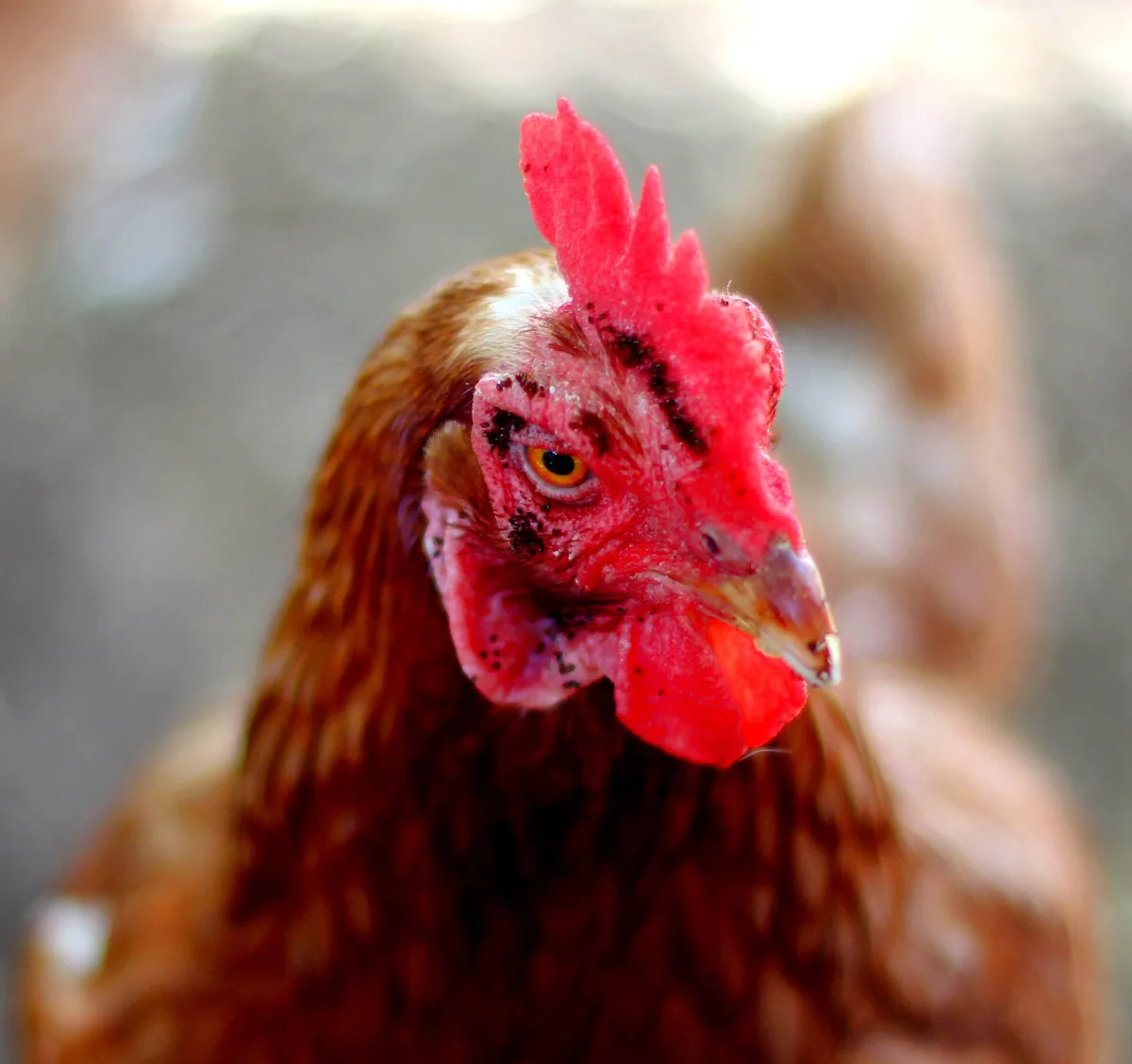
- On chickens, females attach in clusters of dozens or hundreds on featherless skin of the head, such as the comb, wattles and face, where they look like dark specks embedded in the skin.[1][2]
- Only the females stay fixed in place; males stay mobile on the host and may mate with many females.[2]
- Dogs, cats and other mammals that have contact with infested backyard flocks occasionally pick them up.[2]
- UF/IFAS says the fleas have their heads embedded in the host's flesh and cannot be brushed off. On dogs and cats they are usually found around the margin of the outer ear or occasionally between the toe pads, and they have also been reported from horses, pigs and humans.[4]
- Under magnification, UF/IFAS notes, the sticktight flea lacks both the genal and pronotal combs (rows of bristles below the eye and behind the head) that the cat flea has.[4]
Look-alikes
| Look-alike | How to tell them apart |
|---|---|
| Cat flea and other fleas | Other fleas of birds and mammals feed off and on and move around, while sticktight females embed and stay in one spot; the sticktight flea is also about half the size of a cat flea. UF/IFAS calls it one of the smallest fleas on domestic animals and adds that it has neither of the cat flea's two bristle combs.[2][1][4] |
| Chicken body louse | Body lice are straw-colored and run across the skin when the feathers are parted, often around the vent, instead of sitting embedded on the comb and face.[2] |
Where it lives
Merck calls it an occasional poultry pest in temperate areas and a major one in the subtropical and tropical Americas, common in backyard flocks and wherever birds spend a lot of time outdoors or mix with wildlife. It was the only flea found in a survey of backyard chickens in southern California and has been recorded on wild Florida scrub-jays; a dermatology review says it is found in warm climates. UF/IFAS says it can be a severe poultry pest in Florida, where the fleas are usually more prevalent in the cooler months of the year.[1][5][6][3][7]
Biology and life cycle
Females lay eggs without detaching; the eggs fall into the litter or soil. Larvae feed on organic debris and on host blood passed by the adults, develop best in sandy, well-drained soil, and pupate there. The whole cycle takes about 1 to 2 months.[1][2]
New adults may come out within a week, or wait in the cocoon for weeks or months if no host is around, which is why old bedding can restart an infestation.[2]
It infests many kinds of birds, including wild ones. In south-central Florida it was found on 12 of 81 threatened Florida scrub-jays sampled, with up to 57 fleas on one bird, and the researchers concluded it caused the death of several jays.[2][6]
UF/IFAS says both sexes hop around freely before mating; once fertilized, the female attaches by her mouthparts and spends the rest of her life in that position. Adults are usually found on the heads of fowl, and females remain attached for 2 to 3 weeks.[4][7]
Larvae feed on organic debris, including adult flea feces. UF/IFAS gives 2 to 4 weeks before they pupate, in a silken cocoon covered with dust and dirt; the adult may emerge within days or, under adverse conditions, stay quiescent in the cocoon for several weeks or months.[4][7]
Damage and signs
- The fleas cause irritation, restlessness and blood loss leading to anemia and death, especially in young birds. Many fleas around the eyes can cause swelling that interferes with vision. UF/IFAS adds that irritation from feeding, secondary infection and sheer numbers can make the eyes swell shut so the host starves, that young animals succumb to anemia, and that young fowl can be killed while other fowl lay fewer eggs.[1][2][4][7]
- In a Texas case, a laying flock housed on a dirt floor with an outside run dropped sharply in production about four weeks after housing, and about 500 of 1,000 birds were left; the birds examined were anemic, with large numbers of sticktight fleas on the comb, wattles and face plus body lice.[2]
- A survey of 20 backyard flocks in southern California found the sticktight flea, the only flea species present, on 20 percent of properties, with dozens to hundreds on some birds.[5]
- Hosts include chickens, turkeys, pigeons, pheasants, quail, people and many other mammals.[1]
Health risk
In people, most infestations occur in those who handle infested animals, and the embedded flea can cause delayed redness around its head; a dermatology review lists oral or topical antihistamines or a topical corticosteroid as common treatments. The same review calls the sticktight flea a carrier of plague, rickettsial infections and other diseases. Field surveys differ: a 2025 study in Uganda reported Rickettsia in sticktight fleas for the first time, while a survey around El Paso and nearby Texas, New Mexico and Ciudad Juarez found Rickettsia in only one pool of cat fleas, not in the sticktight fleas collected.[3][8][9]
Control
Prevention
Watch the birds after treatment to catch a new infestation early, and limit contact with wild birds and wildlife: Merck says these fleas are common where poultry spend time outdoors or mix with wildlife, and the California survey authors call for better biosecurity in backyard flocks.[2][1][5]
Keep them out
UF/IFAS says wire cages at least 3 ft above the ground should be used to minimize the chance of sticktight flea infestation.[4]
Sanitation
Clean out the coop: remove and replace contaminated shavings, litter and straw, where the larvae develop, to break the life cycle.[2][1]
To avoid reinfestation, UF/IFAS says to treat the premises to stop flea larvae developing there; several insecticides are registered for treating outdoor areas for fleas.[4]
Traps and physical control
A few fleas can be removed by grasping each one with tweezers and pulling it off. UF/IFAS says to grasp each flea with tweezers and pull firmly.[2][4]
Pesticides
Merck lists dusting the litter surface with permethrin or another pyrethroid to kill immature fleas, and says insect growth regulators such as methoprene are also effective; Texas A&M suggests spraying the fresh shavings with an insect growth regulator.[1][2]
Treat the birds with an insecticide approved for on-bird use, typically permethrin, and follow the label.[1][2]
If there are too many fleas to remove one by one, UF/IFAS says to apply a flea product registered for on-animal use according to its label and to keep it out of the animal's eyes. Dead fleas may stay attached after treatment.[4]
Common questions
- What are the dark specks stuck to my chicken's comb and wattles?
- Clusters of dark specks embedded in the comb, wattles or face that don't brush off are likely sticktight fleas.[1][2]
- Can my dog get sticktight fleas from my chickens?
- Yes. Dogs, cats and other mammals that have contact with infested backyard flocks occasionally pick them up.[2]
- Can sticktight fleas spread disease to people?
- A dermatology review calls them carriers of plague and rickettsial infections, and Rickettsia has been found in sticktight fleas in Uganda; a Texas and New Mexico survey found none in the sticktight fleas it tested.[3][8][9]
- Why do sticktight fleas keep coming back?
- Eggs drop into the litter and larvae develop there, and new adults can wait in their cocoons for weeks or months, so the bedding has to be removed and replaced.[2][1]
- Can I just brush sticktight fleas off?
- No. UF/IFAS says their heads are embedded in the host's flesh and they cannot be brushed off; pull them off with tweezers, or use a flea product registered for on-animal use if there are too many.[4]
Sources
- Merck Veterinary Manual, “Fleas of Poultry.” www.merckvetmanual.com/poultry/ectoparasites/fleas-of-poultry (accessed 2026-11-11)
- Texas A&M Veterinary Medical Diagnostic Laboratory, “Sticktight fleas, body lice discovered in 30-week-old laying chickens (case study, M. Ficken, August 9, 2024).” tvmdl.tamu.edu/case-studies/sticktight-fleas-body-lice-discovered-in-30-week-old-laying-chickens/ (accessed 2026-11-11)
- Cutis, via PubMed, “What's Eating You? Update on the Sticktight Flea (Huebsch and Elston 2023).” pubmed.ncbi.nlm.nih.gov/38290077/ (accessed 2026-11-11)
- University of Florida IFAS Extension (EDIS), “Sticktight Flea, Echidnophaga gallinacea, ENY-244/MG236 (P. G. Koehler, R. M. Pereira and P. E. Kaufman; revised May 2009; EDIS archival copy).” journals.flvc.org/edis/article/download/139425/144483 (accessed 2026-11-14). Original EDIS page https://ask.ifas.ufl.edu/publication/MG236 returns 410 Gone; this is the EDIS archival PDF on journals.flvc.org.
- Journal of Medical Entomology, via PubMed, “Diversity and Prevalence of Ectoparasites on Backyard Chicken Flocks in California (Murillo and Mullens 2016).” pubmed.ncbi.nlm.nih.gov/26753948/ (accessed 2026-11-11)
- Journal of Parasitology, via PubMed, “An introduced generalist parasite, the sticktight flea, and its pathology in the threatened Florida scrub-jay (Boughton et al. 2006).” pubmed.ncbi.nlm.nih.gov/17152932/ (accessed 2026-11-11)
- University of Florida IFAS Extension (EDIS), “External Parasites of Poultry, ENY-290/IG140 (P. E. Kaufman, P. G. Koehler and J. F. Butler; revised November 2007; EDIS archival copy).” journals.flvc.org/edis/article/download/117126/115259 (accessed 2026-11-14). Original EDIS page https://ask.ifas.ufl.edu/publication/IG140 returns 410 Gone; this is the EDIS archival PDF on journals.flvc.org.
- Infection Ecology and Epidemiology, via PubMed, “Molecular detection of Rickettsia felis, R. asembonensis and Yersinia pestis from peri-domestic fleas in Uganda (Eneku et al. 2025).” pubmed.ncbi.nlm.nih.gov/40041476/ (accessed 2026-11-11)
- American Journal of Tropical Medicine and Hygiene, via PubMed, “Survey of fleas and ticks for Rickettsia rickettsii and Rickettsia typhi in El Paso and other areas (Valdez et al. 2025).” pubmed.ncbi.nlm.nih.gov/40527312/ (accessed 2026-11-11)
- iNaturalist, “Echidnophaga gallinacea taxon page (order and family).” www.inaturalist.org/taxa/270667 (accessed 2026-11-11)