On this page
How to identify it
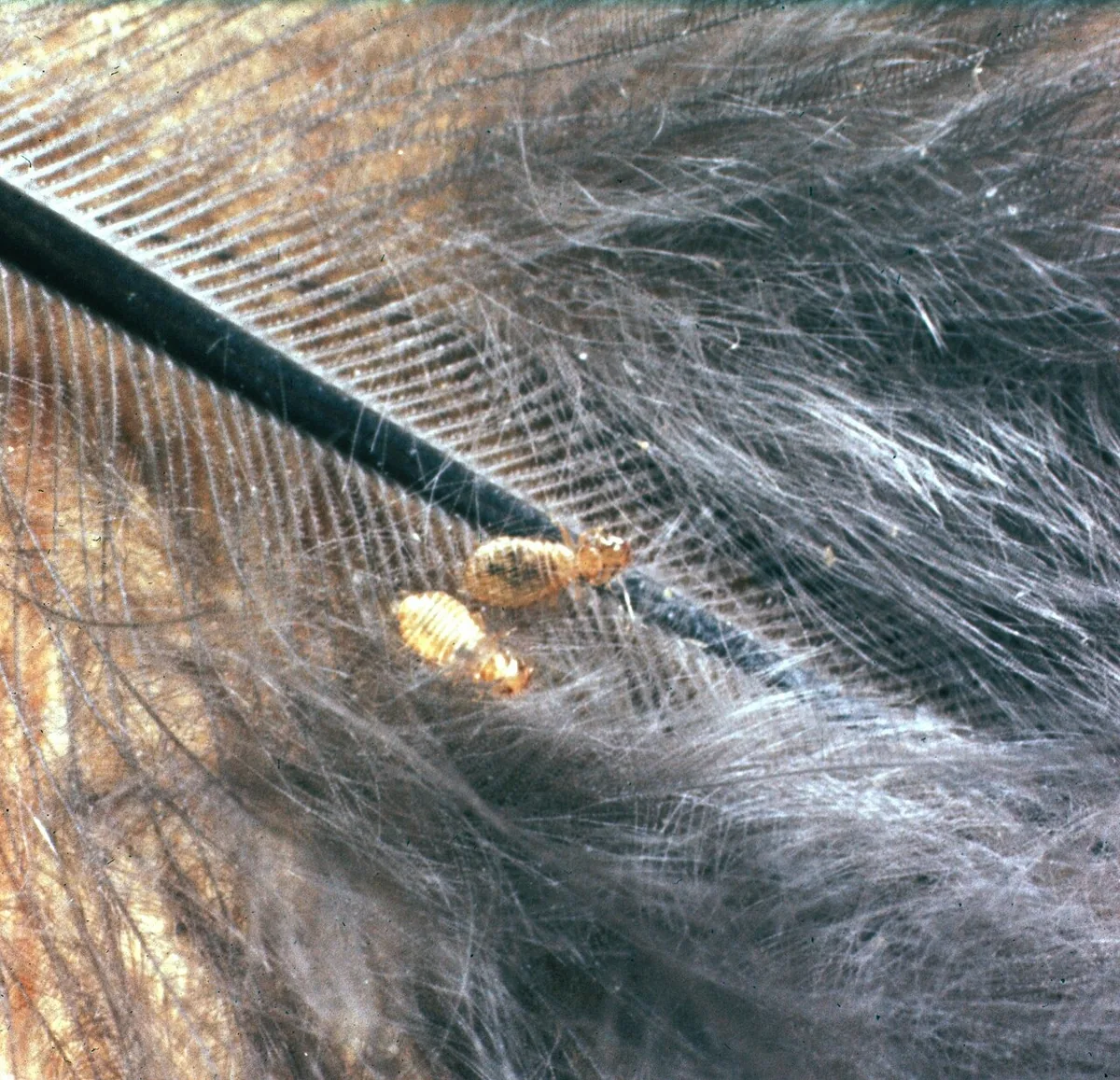
- Lice are mostly 1 to 6 mm (0.04 to 0.24 inch) long, wingless, flattened and straw-colored to yellowish or brown, with six legs; mites are smaller, rounder and have eight legs.[2][3]
- The chicken body louse is about 3 to 3.5 mm (1/8 inch) long and the shaft louse about 2 mm; the body louse is most common around the sparsely feathered vent, breast and thigh.[2]
- Look for eggs (nits): body louse eggs are glued in white clusters at the base of feathers, especially around the vent, while shaft louse eggs are laid singly at the base of the feather shaft.[2][3][4]
- Different lice favor different spots: the chicken head louse on the crown of the head, the wing louse between the barbs of the large wing feathers, and the body, fluff and shaft lice on the back, breast and vent area.[3]
Look-alikes
| Look-alike | How to tell them apart |
|---|---|
| Northern fowl mite | Northern fowl mites are tiny, rounded, eight-legged blood feeders that turn red to black and blacken the feathers around the vent with dried blood and droppings; lice are larger, flat, six-legged insects that chew on feathers and skin.[2][4] |
Where it lives
Poultry lice go wherever chickens are kept. The chicken body louse and the shaft louse are the species most often found on poultry. A survey of 20 backyard flocks in southern California found six louse species, with the chicken body louse on half the properties and the fluff louse on about a third, a wider mix of parasites than commercial flocks usually carry.[2][4][5][3]
Biology and life cycle
Lice are permanent parasites: a louse generally completes its whole life cycle, egg to adult, on one bird and dies within a few days to a week if it falls off. They pass from bird to bird when birds are kept in close contact.[2][3][4]
Chicken body louse eggs hatch in about 4 to 7 days, and the young reach adulthood in another 10 to 15 days; UC Riverside gives 4 to 5 days to hatch and three nymph stages of 3 to 4 days each.[2][3]
Counts of eggs per female differ by source: UC ANR says an adult can lay 50 to 300 eggs in its roughly 3-week life, Texas A&M says as many as 60 eggs, and UC Riverside says up to 4 eggs a day for an adult life of about 12 days. Texas A&M puts the full egg-to-adult cycle at about 30 days.[2][4][3]
Louse numbers tend to peak in autumn and winter. Birds keep lice down by grooming, so birds with trimmed or injured beaks carry many more lice, sometimes hundreds instead of fewer than 50.[2][3]
In a study of hens given a box of sand mixed with diatomaceous earth, kaolin clay or sulfur, hens that dust-bathed in it had 80 to 100 percent fewer lice and mites after a week, but the parasites came back once the box was removed; leftover sulfur kept controlling mites, with a weaker lasting effect on lice.[6]
Damage and signs
- Infested birds look agitated, with damaged feathers and poor condition; signs can include lower feed intake, slower growth and fewer eggs. Young birds suffer most.[4][2][3]
- A 2024 study found that even low numbers of chicken body lice made hens preen much more, and moderately infested hens had skin lesions that uninfested hens never showed.[7]
- Sources differ on blood feeding: Texas A&M says these lice chew the skin but do not suck blood as mites do, while UC ANR and UC Riverside say the body louse and shaft louse also take blood when they puncture the skin or pinfeathers. UC Riverside adds that louse damage is generally much less severe than that of blood-feeding mites.[4][2][3]
Health risk
Poultry lice cannot survive on people or on non-bird pets. When a flock is heavily infested, lice may crawl onto the hands of people handling the birds, but they cannot feed and soon die off the host.[2][3]
Control
Prevention
Check new birds and equipment before they join the flock. Inspect birds at least twice a month by parting feathers at the vent, breast, thigh, under the wings and on the head; hold wings up to the light to spot wing lice, and focus on young, old, sick or beak-trimmed birds.[3][2]
Sanitation
Treat the whole flock at the same time. Unlike chicken mites, which hide in the coop by day and require treating the building, lice stay on the birds, so treatment goes on the birds themselves.[2][3]
Traps and physical control
Give birds a dust bath of sand mixed with food-grade diatomaceous earth. UC Riverside suggests about 6 cups to roughly 25 pounds of washed play sand in a tub, and wearing a dust mask when handling the powder.[3][6]
Pesticides
Treat with sprays or dusts labeled for poultry, parting the feathers so the product reaches the skin, and follow label withdrawal periods for eggs and meat. Louse eggs resist insecticides and hatch after the product wears off, so plan repeat treatments; UC ANR gives both 7-to-10-day and 10-to-14-day intervals, continuing until lice and nits drop below the level that called for treatment.[2][3]
Common questions
- What are the tiny bugs crawling at the base of my chicken's feathers?
- Small, flat, straw-colored insects that run through the feathers, with white egg clusters glued to the feather bases, are chewing lice, most often the chicken body louse.[2][3][4]
- Can chicken lice live on people?
- No. Poultry lice may crawl onto your hands from a heavily infested bird, but they can't feed on people or non-bird pets and die within days off a bird.[2][3]
- Do I need to spray the coop for lice?
- Not the way you would for chicken mites. Lice live their whole lives on the birds, so treat every bird in the flock with a product labeled for poultry and repeat to catch lice that hatch from eggs.[2][3]
Sources
- iNaturalist, “Menacanthus stramineus taxon page (order and family).” www.inaturalist.org/taxa/236895 (accessed 2026-11-11)
- University of California Division of Agriculture and Natural Resources (UC ANR), “Common Lice and Mites of Poultry: Identification and Treatment (ANR Publication 8162; McCrea, Jeffrey, Ernst and Gerry).” ucanr.edu/sites/aves/files/335922.pdf (accessed 2026-11-11)
- University of California, Riverside, Department of Entomology (VeterinaryEntomology.org), “Chicken Lice (A. Murillo and A. Gerry, September 2016).” www.veterinaryentomology.org/chicken-lice (accessed 2026-11-11)
- Texas A&M AgriLife Extension Service, “Common External Parasites in Backyard Poultry.” texaslocalproduce.tamu.edu/files/2019/05/Common-External-Parasites-in-Backyard-Poultry.pdf (accessed 2026-11-11)
- Journal of Medical Entomology, via PubMed, “Murillo AC, Mullens BA (2016), Diversity and prevalence of ectoparasites on backyard chicken flocks in California, Journal of Medical Entomology 53(3):707-711.” pubmed.ncbi.nlm.nih.gov/26753948/ (accessed 2026-11-11). Cited from the PubMed abstract.
- Medical and Veterinary Entomology, via PubMed, “Martin CD, Mullens BA (2012), Housing and dustbathing effects on northern fowl mites (Ornithonyssus sylviarum) and chicken body lice (Menacanthus stramineus) on hens, Medical and Veterinary Entomology 26(3):323-333.” pubmed.ncbi.nlm.nih.gov/22458590/ (accessed 2026-11-11). Cited from the PubMed abstract.
- Parasites & Vectors, via PubMed, “Murillo AC, Abdoli A, Blatchford RA, Keogh EJ, Gerry AC (2024), Low levels of chicken body louse (Menacanthus stramineus) infestations affect chicken welfare in a cage-free housing system, Parasites & Vectors 17:221.” pubmed.ncbi.nlm.nih.gov/38745229/ (accessed 2026-11-11). Cited from the PubMed abstract.