On this page
How to identify it
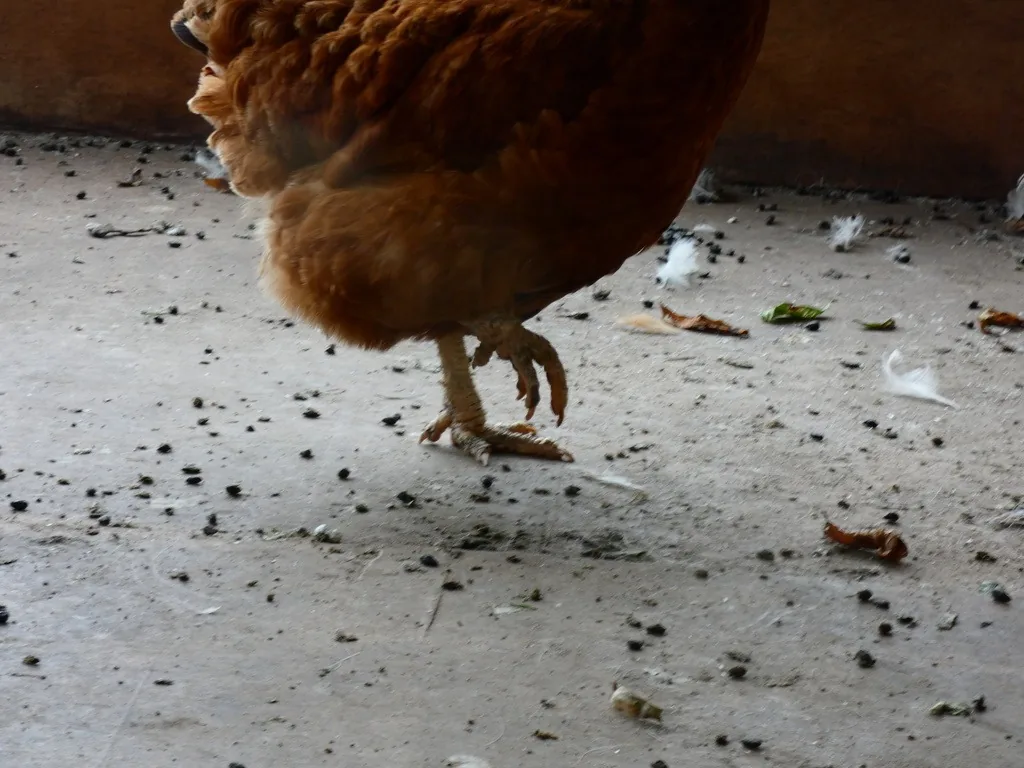
- Look at the legs and feet: they first look brittle, flaky or powdery, then the scales lift and the legs become thick, crusty and lumpy.[2][1][3]
- The mite spends its whole life cycle burrowing in the skin under the scales of the feet and shanks, occasionally around the beak, though Arizona Extension notes it can survive off the bird for several days.[2][3][1]
Where it lives
A parasite of backyard flocks: rare in modern commercial poultry, which are generally young birds with little contact with older infested birds, but not uncommon in backyard flocks.[3][2]
Biology and life cycle
It spreads by close contact with infested birds and their surroundings; older birds are the most commonly affected and most often the source.[2][1][3]
Damage and signs
Health risk
It lives in the skin of birds; none of the cited sources reports it infesting people.[1][2][3]
Control
Prevention
Quarantine new birds before adding them to the flock, and isolate infested birds: close contact is needed for the mite to spread.[1][2]
Traps and physical control
Non-insecticidal treatments coat the legs with petroleum jelly or dip them in linseed or other oils, which suffocates the mites; UC adds that once the dead scales soften they can be gently rubbed off.[1][2]
Common questions
- Why are my chicken's leg scales sticking up?
- Raised, crusty scales and thickened legs are the classic sign of scaly leg mites burrowing under the scales; a veterinarian can confirm it from a skin scraping.[1][2][3]
- Can scaly leg mites spread to my other birds?
- Yes. They pass from bird to bird by close contact, so isolate infested birds and treat them before they rejoin the flock.[3][1][2]
Sources
- The University of Arizona Cooperative Extension, “Backyard Chickens and Ectoparasites: Introduction and Management, AZ1878 (S. Nair, D. H. Gouge, A. C. Murillo, 2021).” extension.arizona.edu/sites/extension.arizona.edu/files/pubs/az1878-2021.pdf (accessed 2026-11-12)
- University of California Agriculture and Natural Resources, “Common Lice and Mites of Poultry: Identification and Treatment (Publication 8162).” poultryhealthinspection.ucdavis.edu/sites/g/files/dgvnsk6711/files/inline-files/Lice%20&%20Mites%20of%20Poultry%20-%20McCrea%208162_0.pdf (accessed 2026-11-12)
- Merck Veterinary Manual, “Mites of Poultry (Merck Veterinary Manual).” www.merckvetmanual.com/poultry/ectoparasites/mites-of-poultry (accessed 2026-11-12)
- iNaturalist, “Knemidokoptes mutans taxon page (order and family).” www.inaturalist.org/taxa/391240 (accessed 2026-10-06)