On this page
How to identify it
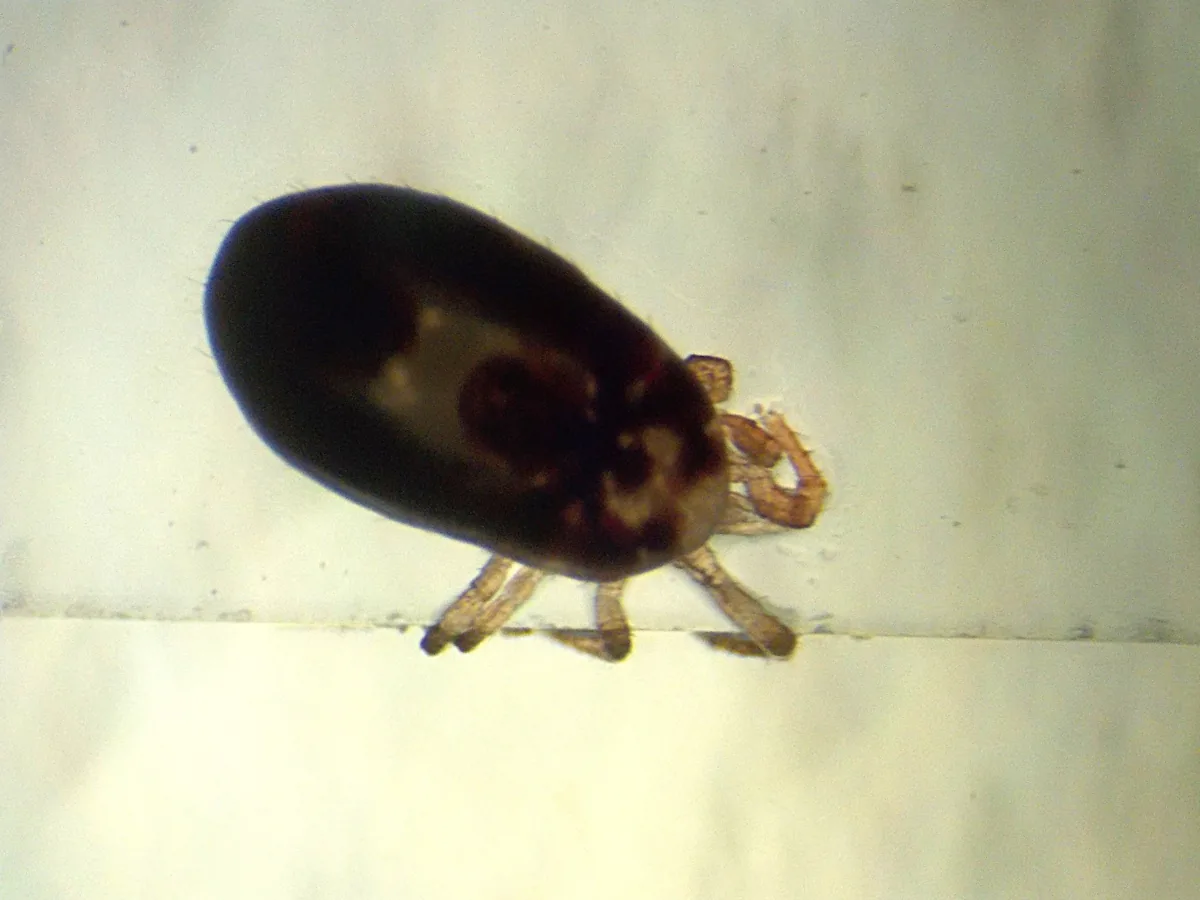
- About the size of a period on a typed page. UF/IFAS gives adults as about one millimeter long.[3][4]
- Black, yellow or white before feeding and bright red after a blood meal; mites often cluster together in hiding spots near the birds.[3][1]
- You usually have to check birds at night to find mites on them; by day they hide off the bird.[1][2]
- Larvae hatch with six legs and don't feed; the two nymph stages and the adults have eight legs. Nymphs and adult females feed on blood routinely, while males feed only now and then.[4]
Look-alikes
| Look-alike | How to tell them apart |
|---|---|
| Northern fowl mite | Also red to black, but it stays on the bird day and night, so mites seen on birds, eggs or cages in daytime point to northern fowl mite. UF/IFAS says the two are alike in size and look, but the chicken mite doesn't spend its whole life on the host.[1][3][2][4] |
| Bird and rodent mites | Other biting mites that move from nests and rodents into homes.[3] |
Where it lives
Found around the world on poultry and on wild birds such as pigeons, sparrows and starlings. In the United States, extension guides from California (UC ANR), Texas (Texas A&M AgriLife) and Utah (Utah State University) cover it. UF/IFAS names Europe, Japan, China and the United States among places it is found and says it is most prevalent in Europe; in the United States it is rarely found in caged-layer operations and more often on breeder farms. The Merck Veterinary Manual likewise calls it rare in modern caged laying operations but found in cage-free, breeder and broiler flocks.[2][5][3][1][4][6]
Biology and life cycle
It feeds mostly at night and then retreats to cracks and crevices in woodwork, under clods of dirt or manure, and into nests, where females lay small groups of eggs.[1][3][2]
Eggs hatch in about 2 days, and the larvae molt in 1 to 2 days without feeding; every other stage feeds on blood. The life cycle can take as few as 7 days.[1]
Hosts include chickens, pigeons, sparrows, doves and starlings; reviews also record feeding on cats, dogs, rodents, rabbits, horses and people. UF/IFAS says it feeds on at least 30 bird species, and the Merck Veterinary Manual adds turkeys and canaries to the list of hosts.[3][5][4][6]
Females lay eggs in clutches of four to eight where they hide, around 30 in a lifetime. Larvae molt after one day; each nymph stage feeds and then molts.[4]
Mites feed every two to four days and usually spend up to an hour on the bird.[4]
The Merck Veterinary Manual says populations build quickly in warm months and more slowly in cold weather.[6]
Damage and signs
- It harms hen health, welfare and egg production, and is suspected of spreading poultry diseases.[5][7]
- Because it needs daytime hiding places it is mainly a problem for birds on litter or with nest boxes, floor nests and breeder flocks, rather than caged layers.[1][2]
- Mites spread on people, equipment and birds from infested areas. Merck says that in the poultry industry mites usually travel between houses and farms on egg flats, crates and coops or with workers.[3][6]
- Sparagano and colleagues expect it to become more common and harder to control as egg production moves away from conventional cages.[7]
- Infested flocks can show anemia, stress, disturbed sleep and feather pecking, and feeding can leave lesions on the breast and legs (UF/IFAS). Merck adds lower egg production, lower male fertility, slower weight gain in young birds and poorer feed conversion; heavy infestations can kill birds.[4][6]
Health risk
It bites people: workers who enter an infested coop at night, and people in homes near infested bird nests, coops or rodents. Reviews describe dermatitis that ranges from mild to severe and is often misdiagnosed; over 240 urban human cases had been reported by 2022, mostly in private homes, with pigeons and other birds living on buildings as a source. Because doctors often don't recognize it, mention nearby birds, nests or poultry if you have unexplained itchy bites.[1][3][8][9]
Control
Keep them out
Remove wild bird nests from buildings by bagging them (the inverted-bag method), clean where the nest sat, seal cracks, and control rodents and wild birds.[3]
Sanitation
Treat the whole coop, not just the birds. Clean coops, roosts and nests, and expect mites to survive an empty house for months. UF/IFAS says removing the birds for a long time won't get rid of the mites, and that in Norway chicken houses are commonly heated to 45 °C (113 °F) to kill them. Merck says starting with mite-free birds and good sanitation prevents a buildup, and lists hiding places to treat: behind nest boxes, in cracks and crevices and where roost poles touch their supports.[1][2][4][6]
In infested homes, hot-wash and hot-dry bedding and clothing left on floors, and use a labeled dust such as silica aerogel in cracks and crevices.[3]
Pesticides
Use products labeled for poultry and poultry houses. Spray litter, bedding and building structures, using a liquid spray that gets into cracks and crevices, as well as treating the birds; Texas A&M advises re-treating birds and housing every 4 to 7 days because the life cycle is so short.[1][2]
Follow the label, including withdrawal times before slaughter, and check with your county agricultural commissioner or extension office for current approved products. Resistance to acaricides is widely reported, so rotate chemical classes. UF/IFAS notes that more than 35 compounds have been used against chicken mites, but many countries now restrict which may be used.[1][7][4]
Merck says inert dusts such as food-grade diatomaceous earth and pure synthetic amorphous silica can be effective; apply diatomaceous earth only in well-ventilated areas and wear a dust mask.[6]
Where sources disagree
Survival without a host: Utah State says up to a month off a host, Texas A&M up to six months for adults, and UC ANR up to 34 weeks of starvation.[3][2][1]
Life cycle: UC ANR says as few as 7 days; Texas A&M says 7 to 14 days.[1][2]
Survival without birds (more): UF/IFAS says deutonymphs and adults can live up to eight months without feeding, and Merck says a house can stay infested for up to 9 months after the birds are removed.[4][6]
Adult size: UF/IFAS gives about one millimeter; Merck gives about 1.5 mm for adult females.[4][6]
Spreading poultry diseases: UF/IFAS says the mites spread fowl pox, Newcastle disease and fowl cholera; Merck says their role as vectors in nature still needs study, though experimental transmission of fowlpox virus and several bacteria has been shown.[4][6]
Common questions
- Why do my chickens look unwell and lay fewer eggs?
- Chicken mites are one cause: they harm hen health and egg production. Check coop cracks by day and the birds at night, when the mites feed.[5][1][2]
- Can chicken mites bite people?
- Yes. They bite people who enter infested coops at night and can move into homes from bird nests; the bites cause itchy dermatitis.[1][3][8]
- When should I look for them?
- At night, when they feed; by day look in cracks, nest boxes and under roosts.[1][3][2]
- Will leaving the coop empty starve them out?
- Not quickly. Adults can survive for months without feeding, so treat the whole house before birds return. UF/IFAS says older stages can live up to eight months without feeding.[1][2][4]
- Can you see chicken mites on the birds in daytime?
- Rarely. UF/IFAS and Merck say they feed at night and leave the birds by day, so look in nest boxes, cracks and litter during the day or check the birds closely at night.[4][6]
Sources
- University of California Agriculture and Natural Resources, “Common Lice and Mites of Poultry: Identification and Treatment (Publication 8162).” poultryhealthinspection.ucdavis.edu/sites/g/files/dgvnsk6711/files/inline-files/Lice%20&%20Mites%20of%20Poultry%20-%20McCrea%208162_0.pdf (accessed 2026-11-14)
- Texas A&M AgriLife Extension, “Common External Parasites in Backyard Poultry (POSC-PU-042).” mytexas.ag.tamu.edu/publications/common-external-parasites-in-backyard-poultry/ (accessed 2026-11-14)
- Utah State University Extension (Integrated Pest Management), “Bird Mites: Dermanyssus gallinae; Ornithonyssus sylviarum (Structural and Nuisance Pests).” extension.usu.edu/planthealth/ipm/notes_nuisance/bird-mites.php (accessed 2026-11-14)
- University of Florida/IFAS Extension (Featured Creatures), “Chicken Mite (Poultry Red Mite, Roost Mite), Dermanyssus gallinae (De Geer), EENY-611/IN1070.” ask.ifas.ufl.edu/publication/IN1070 (accessed 2026-11-14). Used for identification, range, biology and poultry management; its human-feeding and St. Louis encephalitis remarks are not used (medical-source rule).
- Parasites & Vectors, via PubMed, “Should the poultry red mite Dermanyssus gallinae be of wider concern for veterinary and medical science? (George et al. 2015).” pubmed.ncbi.nlm.nih.gov/25884317/ (accessed 2026-11-14)
- Merck Veterinary Manual, “Mites of Poultry (A. C. Murillo; reviewed Jan 2026).” www.merckvetmanual.com/poultry/ectoparasites/mites-of-poultry (accessed 2026-11-14). Used for poultry lines only.
- Annual Review of Entomology, via PubMed, “Significance and control of the poultry red mite, Dermanyssus gallinae (Sparagano et al. 2014).” pubmed.ncbi.nlm.nih.gov/24397522/ (accessed 2026-11-14)
- Pathogens, via PubMed, “Dermanyssosis in the Urban Context: When the One Health Paradigm Is Put into Practice (Barlaam et al. 2022).” pubmed.ncbi.nlm.nih.gov/36558730/ (accessed 2026-11-14)
- Avian Pathology, via PubMed, “Dermanyssus gallinae attacks humans. Mind the gap! (Cafiero et al. 2019).” pubmed.ncbi.nlm.nih.gov/31264450/ (accessed 2026-11-14)
- iNaturalist, “Dermanyssus gallinae taxon page (order and family).” www.inaturalist.org/taxa/263331 (accessed 2026-11-14)