On this page
How to identify it
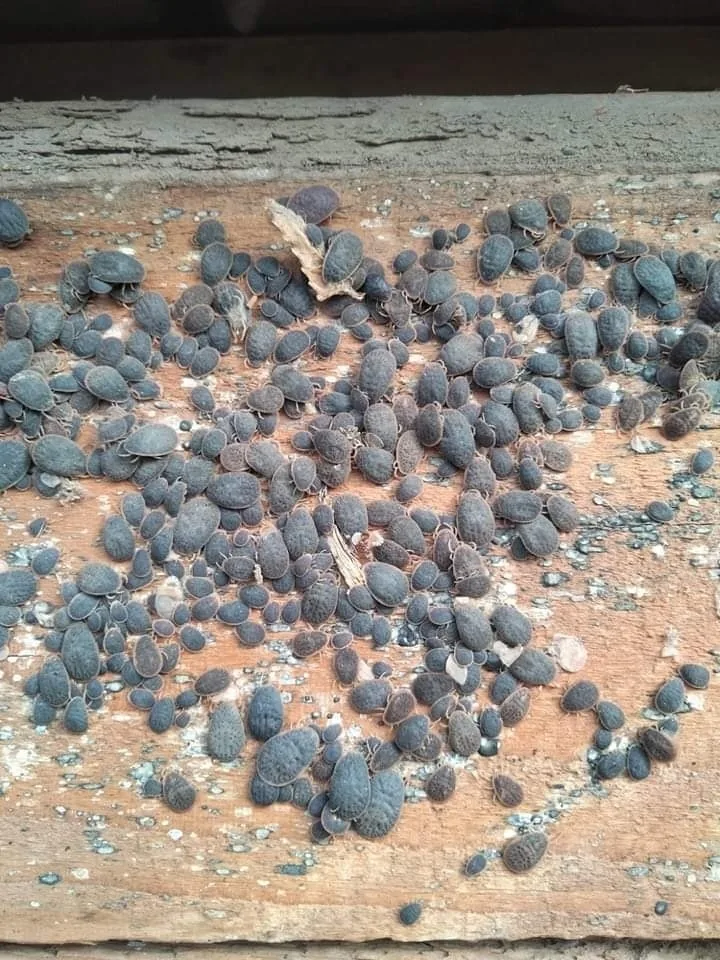
- Adults are oval and flattened, about 8 mm (0.3 inch) long, with soft, leathery, deeply folded skin. Unfed ticks are reddish brown and turn bluish gray when engorged; starving ticks may look pale yellow or yellowish brown.[1]
- Look in the coop rather than on the birds. In a year-long survey of 58 infested poultry shelters in Pakistan, 87 percent of the 7,219 soft ticks collected were in the shelters and crevices; only the larvae were found mostly on the birds.[3]
- Adults and nymphs spend little time on the birds and are easily missed in inspections: they feed at night for 15 to 30 minutes, then drop off and hide. UF/IFAS notes that it is hard to control because it hides near the roosts by day, and the Merck Veterinary Manual says all stages can be found hiding in cracks and crevices during the day.[1][2][4]
Look-alikes
| Look-alike | How to tell them apart |
|---|---|
| Chicken mite (red mite) | Also feeds at night and hides in cracks and crevices of the coop by day, but it is a mite about 1 mm (0.04 inch) long, while an adult fowl tick is about 8 mm (0.3 inch).[1] |
| Other Argas fowl ticks | Two New World relatives, Argas miniatus across the southern U.S. and Argas sanchezi in the West, also commonly infest domestic fowl. Until 1970 some authors treated them as the same species as Argas persicus, so many older 'fowl tick' records from the southern U.S. probably belong to them.[5] |
Where it lives
Argas persicus occurs around the world but has been collected only sporadically in the United States, mostly in Maryland and Pennsylvania; it was probably brought in on chickens at some point. It also occurs in Mexico. GBIF lists only a handful of U.S. records since 1990 (New Mexico and Colorado); worldwide, most records come from Mexico, China, Iraq and Pakistan. University of Arizona Extension says fowl ticks prefer warm, dry climates and are occasional pests of poultry, and that in many parts of the lower United States Argas persicus occurs alongside related species such as A. miniatus, A. sanchezi and A. radiatus. The Merck Veterinary Manual says the fowl tick is found worldwide in tropical and subtropical countries, that these ticks are particularly active in poultry houses in warm, dry weather, and that they are rarely found in commercial caged laying operations but may turn up in cage-free housing, including breeder, pasture and small-scale flocks. UF/IFAS lists the fowl tick among the parasites that can cause serious problems for poultry in Florida.[5][6][7][1][4][2]
Biology and life cycle
In a laboratory study at about 33 C and 65 percent humidity, fowl ticks fed on chickens completed their life cycle, egg to egg, in 113 to 132 days.[3]
Larvae stay attached and feed on a bird for 2 to 7 days. Nymphs and adults take short meals at night, mostly under the wings in adults, and go back to their hiding places afterward. Females lay several batches of 200 to 500 eggs in cracks and crevices of the coop or nest, feeding between batches. UF/IFAS says larvae stay on the host up to five days until fully engorged, leaving the feeding sites severely irritated, then drop off and molt about 7 days after hatching; nymphs feed and molt 3 to 4 times before becoming adults, and at night large numbers of ticks often move between their hiding places and the birds.[1][2]
University of Arizona Extension says adult females are reported to live more than four years without a blood meal, so leaving a coop empty for a long time usually won't get rid of them. The Merck Veterinary Manual gives the same figure, and UF/IFAS warns that leaving facilities vacant for a long time usually will not eliminate a population.[1][4][2]
Egg numbers differ by source: UF/IFAS says a female lays 25 to 100 eggs at a time in clumps and may produce as many as 700 in her lifetime, with eggs hatching in 1 to 4 weeks, while the Merck Veterinary Manual says females lay as many as 500 eggs after each feeding.[2][4]
Damage and signs
- The most significant effect is anemia; other signs include weight loss, depression, toxemia and paralysis, red spots on the skin where ticks fed, and uneasiness on the roost at night. Death is rare, but egg production can be severely reduced.[1]
- Fowl ticks also spread Borrelia anserina, the bacterium that causes avian spirochetosis (avian borreliosis), one of the most widespread poultry diseases in the world. It turned up in 2 of 34 fowl ticks tested from laying-hen farms in Algeria and in 4 of 18 tested from pigeon nests in Pakistan. The Merck Veterinary Manual adds that it also carries Aegyptianella pullorum, the rickettsia behind aegyptianellosis (fowl disease).[8][9][4]
Health risk
In the United States it has not been recorded biting people, but it is known to bite humans on rare occasions in other parts of the world. The bacterium found in it in the studies cited here, Borrelia anserina, causes avian borreliosis, a disease of birds.[5][8]
Control
Prevention
Keep wild birds and rodents away from the flock, coop and feed: seal gaps and entry points, store feed in secure containers and clean up spilled feed. Quarantine new birds for at least a week before adding them to the flock.[1]
Sanitation
Clean the coop regularly and keep it dry and well ventilated. Fowl ticks hide in cracks and crevices of the coop and nests, so seal gaps and target cleaning there. Small numbers on birds can be picked off by hand. UF/IFAS calls sanitation the best control of the fowl tick, and the Merck Veterinary Manual advises filling in cracks and crevices.[1][2][4]
Pesticides
Severe infestations need pesticide treatment: University of Arizona Extension advises housing treated birds separately and treating the coop with high-pressure sprays of pyrethrins, reaching all cracks and crevices thoroughly. Products registered vary by state; follow the label. UF/IFAS notes that thorough pesticide sprays help but are not completely effective, so fowl tick problems take persistence. The Merck Veterinary Manual likewise advises cleaning the house first, then treating walls, ceilings, cracks and crevices with a labeled acaricide.[1][2][4]
Where the sources disagree
Eggs per batch: University of Arizona Extension gives 200 to 500, the Merck Veterinary Manual as many as 500 after each feeding, and an older UF/IFAS publication 25 to 100 at a time.[1][4][2]
Which tick: UF/IFAS and the Merck Veterinary Manual describe the fowl tick, Argas persicus, as a poultry pest, while a 2022 review says it has been collected only sporadically in the United States and that many older southern U.S. records probably belong to A. miniatus; Merck notes the U.S. A. persicus complex now includes A. miniatus, A. sanchezi and A. radiatus.[2][4][5]
Common questions
- What are the flat, wrinkled ticks hiding in my chicken coop?
- Flat, oval, wrinkled soft ticks hiding in cracks and crevices of the coop are fowl ticks or one of their close Argas relatives.[1][5]
- Will leaving my coop empty kill fowl ticks?
- Usually not. University of Arizona Extension says adult females are reported to survive more than four years without a blood meal.[1]
- Do fowl ticks bite people?
- Not in U.S. records. Elsewhere in the world they bite people only on rare occasions.[5]
- What is a blue bug on chickens?
- It is another name for the fowl tick, according to UF/IFAS.[2]
- Are fowl ticks found in commercial flocks?
- Rarely in commercial caged laying operations, the Merck Veterinary Manual says, but they may be found in cage-free housing, including breeder, pasture and small-scale flocks.[4]
Sources
- The University of Arizona Cooperative Extension, “Backyard Chickens and Ectoparasites: Introduction and Management, AZ1878 (S. Nair, D. H. Gouge, A. C. Murillo, 2021).” extension.arizona.edu/sites/extension.arizona.edu/files/pubs/az1878-2021.pdf (accessed 2026-11-14)
- University of Florida/IFAS Extension (EDIS), “External Parasites of Poultry, ENY-290/IG140 (rev. 11/2007, archival copy).” journals.flvc.org/edis/article/download/117126/115259 (accessed 2026-11-14). Archival EDIS copy on journals.flvc.org (ask.ifas.ufl.edu/publication/IG140 returns 410). Its pesticide table is not used (no rates).
- Frontiers in Veterinary Science, via PubMed, “Life cycle and genetic identification of Argas persicus infesting domestic fowl in Khyber Pakhtunkhwa, Pakistan (Zahid et al. 2021; full text via PMC).” pubmed.ncbi.nlm.nih.gov/34095277/ (accessed 2026-11-14)
- Merck Veterinary Manual, “Fowl Ticks (Merck Veterinary Manual, poultry; reviewed Jan. 2026).” www.merckvetmanual.com/poultry/arthropods-in-poultry/fowl-ticks (accessed 2026-11-14)
- Ticks and Tick-borne Diseases, via PubMed, “Tick species infesting humans in the United States (Eisen 2022, CDC Division of Vector-Borne Diseases; full text via PMC).” pubmed.ncbi.nlm.nih.gov/35973261/ (accessed 2026-11-14)
- Global Biodiversity Information Facility (GBIF), “Argas persicus: U.S. occurrence records since 1990 by state (GBIF occurrence search).” api.gbif.org/v1/occurrence/search?taxonKey=2184918&country=US&hasGeospatialIssue=false&occurrenceStatus=PRESENT&year=1990%2C2026&facet=stateProvince&facetLimit=400&limit=0 (accessed 2026-11-14)
- Global Biodiversity Information Facility (GBIF), “Argas persicus: occurrence records since 1990 by country (GBIF occurrence search).” api.gbif.org/v1/occurrence/search?taxonKey=2184918&hasGeospatialIssue=false&occurrenceStatus=PRESENT&year=1990%2C2026&facet=country&limit=0 (accessed 2026-11-14)
- Comparative Immunology, Microbiology and Infectious Diseases, via PubMed, “Molecular detection of avian spirochete Borrelia anserina in Argas persicus ticks in Algeria (Ouchene et al. 2020).” pubmed.ncbi.nlm.nih.gov/31896047/ (accessed 2026-11-14)
- EcoHealth, via PubMed, “First molecular record of Argas hermanni and Argas sp. closely related to Argas persicus, with detection of Borrelia anserina in Argas persicus from pigeons in Pakistan (Rahman et al. 2026).” pubmed.ncbi.nlm.nih.gov/42192069/ (accessed 2026-11-14)
- iNaturalist, “Argas persicus taxon page (order and family).” www.inaturalist.org/taxa/263516 (accessed 2026-11-14)