On this page
How to identify it
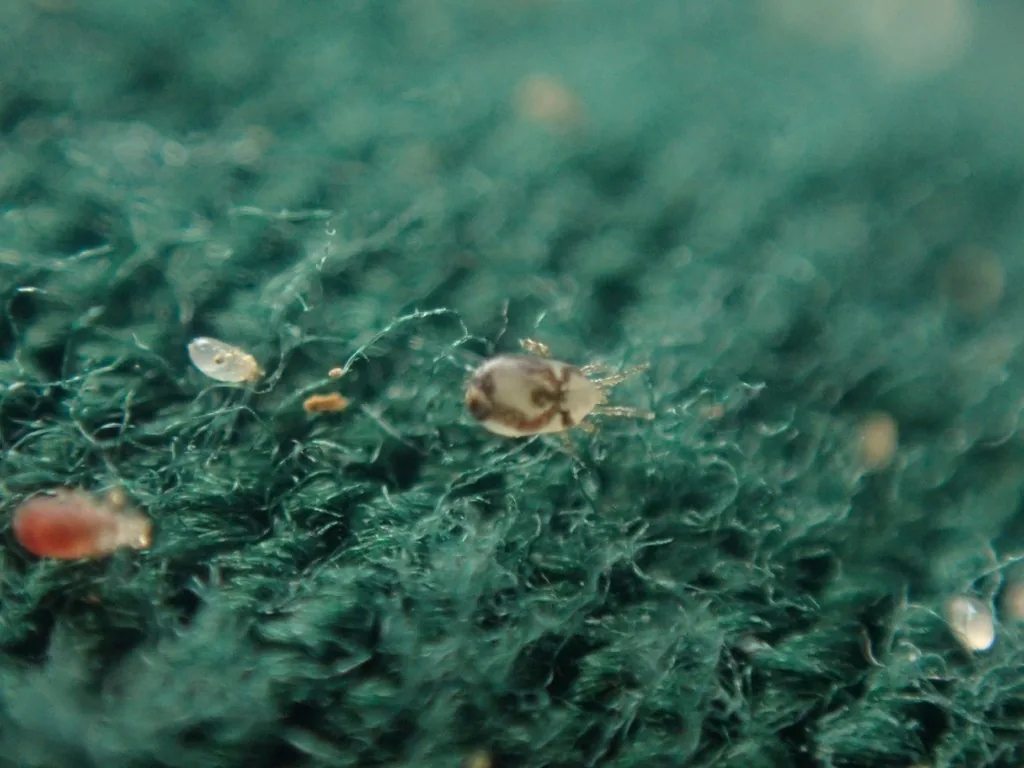
- Adults are about 1/25 inch long, eight-legged and dark red to black; they look like tiny specks moving on the skin. Virginia Cooperative Extension puts them at 0.5 to 1 millimeter (0.02 to 0.04 inch), gray to black but red after a blood meal, and says they move slowly and can't fly.[1][2][3][4]
- Check the vent area: heavily infested birds have blackened, matted feathers there, darkened by dried blood, mite droppings, eggs and shed skins, and the skin around the vent may be scabbed and cracked. Virginia Tech also lists thickened skin, agitated birds that preen often, especially on the roost, blood spots or mites on eggs, and a pale comb as signs, and notes that early infestations can be hard to spot.[2][1][5][4]
- Eggs are laid in masses at the base of the feathers, usually around the vent, and mites may show up on the eggs the hens lay and on the hands of people who collect them.[1][2][5]
- A flashlight or bright daylight makes the mites move, which makes them easier to see.[2][5]
Look-alikes
| Look-alike | How to tell them apart |
|---|---|
| Chicken mite (red mite) | The chicken mite hides in cracks in the coop by day and comes out to feed on birds at night, while the northern fowl mite stays on the bird day and night. UF/IFAS adds that its life cycle can also be completed in as little as 7 days, and that because it spends much of its life off the host, treating the premises as well as the birds helps.[1][2][5][6] |
| Tropical fowl mite (Ornithonyssus bursa) | A close relative that is often confused with the northern fowl mite and behaves much the same way, spending its whole life on the bird. UF/IFAS says it is widely distributed in South America, the Caribbean and the southern United States, feeds day or night, prefers English sparrows besides domestic fowl, and commonly moves from wild birds to poultry.[1][6] |
Where it lives
Found on poultry and on more than 70 species of North American wild birds, which with rodents spread it to flocks; UC reports it throughout California's commercial egg-laying facilities. GBIF holds only about 170 US records since 1990, from 10 states counting the District of Columbia, most from Michigan and California, far fewer than the poultry literature suggests. UF/IFAS calls it the most important external parasite of poultry in Florida and says it is found throughout many temperate regions of the world on domestic fowl and wild birds.[7][1][5][8][9][6]
Biology and life cycle
It spends its whole life on the bird, and the life cycle from egg to egg-laying adult takes about a week or less, so numbers rise quickly; a severe infestation can spread through a flock in three to six weeks.[1][5][3]
Eggs hatch in one to two days. The larvae don't feed and molt within about eight hours, and the nymphs and adults feed on blood. UF/IFAS describes four stages, egg, larva, nymph and adult, and says nymphs mature to adults in 4 to 7 days and a female finishes laying in 2 days after a blood meal, averaging 2 to 5 eggs.[1][9]
Mites gather mostly around the vent, and the back becomes another favored site as numbers grow. Eggs and mites can also be found under the wings, in the beard and crest, and on feathers high on the legs. UF/IFAS says adults also wander to the eggs and rafters, and Virginia Tech names the vent, tail and breast as the most common spots.[1][5][9][4]
It is often worse in cool weather, but it can be found on birds at any time of year; in a UC Riverside study, how far mites sat from the skin along the vent feathers tracked the temperature. In Florida, UF/IFAS says, economically important populations normally occur from December through March; the mites prefer lower temperatures (65 to 68°F ambient) and lower humidity.[1][3][7][9]
Younger birds carry more mites. Populations build fast on hens 20 to 30 weeks old, and birds older than about 40 weeks usually don't support large numbers.[1][2][5]
It has been recorded on more than 70 species of North American wild birds, which, along with rodents, carry it to flocks. UF/IFAS says young wild birds in the nest are often severely infested, and fledglings feeding around poultry farms may carry mites from house to house.[7][1][9]
Virginia Tech says a single adult female can start an infestation: she can lay unfertilized eggs that become males and then mate with her male offspring.[4]
Numbers climb even though each female lays few eggs: UF/IFAS says newly infested birds may carry more than 20,000 mites each within 9 to 10 weeks under optimal conditions, and Virginia Tech says infestations peak after 4 to 5 weeks, when a single bird may host over 100,000 mites.[9][4]
Damage and signs
Health risk
The mites can bite people who handle infested birds or eggs. Doctors have reported itchy red bumps on exposed skin from northern fowl mites, including a case traced to an abandoned bird nest in a home's roof that cleared with topical steroids, and a 1982 report linked the mite to occupational asthma in poultry workers.[11][12][13]
Control
Prevention
Prevention works best: keep wild birds and rodents away from the flock and its feed, and check new birds before adding them. Virginia Tech calls biosecurity the best way to prevent infestation and suggests designated clothing and shoes for the flock.[1][2][4]
Check part of the flock regularly, about every two weeks, by parting the vent feathers and looking for mites, eggs and dark debris.[2][1]
Kentucky advises assuming new birds are infested, treating them and keeping them apart from the flock until the treatment course is finished.[2]
Virginia Tech says to rotate approaches so the mites don't develop resistance to one treatment, and that treatments work best while numbers are low, under 50 mites per bird; UF/IFAS likewise advises alternating chemicals.[4][9]
Pesticides
Use only products labeled for application to birds, focus on the vent area so the product reaches the skin, treat all birds at the same time, and follow the label.[2][5]
Treatments don't kill the eggs, so one application is rarely enough; a follow-up is needed to catch the mites that hatch afterward. UF/IFAS says none of the recommended materials kill the eggs, and since the mite can go through a generation in 7 days, birds need re-treating in 4 to 7 days.[1][5][2][9]
When to call a professional
Ivermectin is not labeled for poultry; Mississippi State says it has worked in some breeder flocks but needs a prescription from a licensed veterinarian.[1]
Virginia Tech advises consulting a pest control specialist or veterinarian before any chemical treatment, especially off-label use, and says sprays are less effective for birds housed on the floor than in cages. It warns that dusts carry inhalation risks, sulfur can be combustible in confined spaces, and carbaryl powder should not be used on the birds or the premises.[4]
Where sources disagree
Life cycle length: Mississippi State says egg to egg-laying female can take as little as five to seven days, UC says fewer than seven, Texas A&M about one week, and Kentucky about 7 to 10 days. UF/IFAS gives 5 to 7 days or longer, depending on temperature and humidity, and Virginia Tech 5 to 12 days.[1][5][3][2][9][4]
Survival off the bird: Kentucky and UC give up to two to three weeks. Mississippi State says a well-fed mite may last two to three weeks at room temperature but that most die within three to four days without a host. UF/IFAS and Virginia Tech also give 2 to 3 weeks.[2][5][1][9][4]
Follow-up treatment: UC advises treating all birds twice, 5 to 7 days apart; Kentucky says to check again in 7 to 10 days and retreat as needed; Mississippi State warns that waiting more than about seven days lets a new generation develop and that at least three closely spaced treatments may be needed. UF/IFAS says to re-treat in 4 to 7 days.[5][2][1][9]
Dusts: Texas A&M lists food-grade diatomaceous earth in dust baths as a control option, while Mississippi State reports varying success with it and with sulfur, because dust may not reach the skin where the mites live.[3][1]
How often it bites people: Kentucky says it will bite humans that it gets on but does not infest them, while UC says it only occasionally bites people, causing a small red bump and intense itching.[2][5]
How important it is: Texas A&M calls it the most common external parasite of poultry, Mississippi State the most serious in North America, and UC arguably the most important external parasite of caged poultry in California. UF/IFAS calls it the most important external parasite of poultry in Florida.[3][1][5][9]
Eggs per female: UF/IFAS says each female lays an average of 2 to 5 eggs, while Virginia Tech says an adult female produces 1 to 3 eggs after a single feeding.[9][4]
Size: Mississippi State, Kentucky and Texas A&M material puts adults at about 1/25 inch long, while Virginia Tech gives 0.5 to 1 millimeter (0.02 to 0.04 inch).[1][2][3][4]
Common questions
- Why are my hen's vent feathers dark and dirty?
- Dark, matted feathers and scabby skin around the vent, with tiny dark moving specks, are classic signs of northern fowl mites.[2][1][5]
- How did my backyard flock get northern fowl mites?
- Wild birds and rodents carry them, and they can also arrive with new birds or on people, crates and equipment. UF/IFAS adds egg flats hauled from farm to farm, and Virginia Tech lists sparrows, starlings and pet birds.[1][2][9][4]
- Can I starve them out by moving the birds?
- UC says removing birds from an infested building for more than three weeks will control it, because adults survive starvation only two to three weeks. Mississippi State cautions that returning birds sooner than three weeks may not solve the problem. UF/IFAS warns that removing birds and replacing them 2 weeks later may not break the life cycle, because mites survive 2 to 3 weeks off the host.[5][1][9]
Sources
- Mississippi State University Extension, “Northern Fowl Mite Management.” extension.msstate.edu/publications/northern-fowl-mite-management (accessed 2026-11-11)
- University of Kentucky Cooperative Extension (Entomology), “External Mite and Insect Parasites of Backyard Chickens (ENTFACT-516, L. Townsend).” entomology.ca.uky.edu/files/ef516.pdf (accessed 2026-11-11)
- Texas A&M AgriLife Extension, “Common External Parasites in Backyard Poultry (POSC-PU-042).” mytexas.ag.tamu.edu/publications/common-external-parasites-in-backyard-poultry/ (accessed 2026-11-11)
- Virginia Cooperative Extension (Virginia Tech), “Poultry Parasites: Northern Fowl Mites, APSC-190P (L. Jacobs, 2023).” www.pubs.ext.vt.edu/content/dam/pubs_ext_vt_edu/APSC/apsc-190/APSC-190.pdf (accessed 2026-11-14)
- University of California Agriculture and Natural Resources, “Common Lice and Mites of Poultry: Identification and Treatment (Publication 8162).” poultryhealthinspection.ucdavis.edu/sites/g/files/dgvnsk6711/files/inline-files/Lice%20&%20Mites%20of%20Poultry%20-%20McCrea%208162_0.pdf (accessed 2026-11-11)
- University of Florida IFAS Extension (EDIS), “External Parasites of Poultry, ENY-290/IG140 (P. E. Kaufman, P. G. Koehler and J. F. Butler; rev. November 2007).” journals.flvc.org/edis/article/view/117126 (accessed 2026-11-14). Ask IFAS https://ask.ifas.ufl.edu/publication/IG140 returns 410 Gone (retired); this is the archived EDIS copy in the University of Florida's EDIS journal on journals.flvc.org.
- Journal of Parasitology, via PubMed, “Temperature governs on-host distribution of the northern fowl mite, Ornithonyssus sylviarum (De La Riva, Soto and Mullens 2015).” pubmed.ncbi.nlm.nih.gov/25275303/ (accessed 2026-11-11)
- Global Biodiversity Information Facility (GBIF), “Ornithonyssus sylviarum: US occurrence records since 1990 by state (GBIF occurrence search API).” api.gbif.org/v1/occurrence/search?taxonKey=4548776&country=US&hasGeospatialIssue=false&occurrenceStatus=PRESENT&year=1990%2C2026&facet=stateProvince&facetLimit=400&limit=0 (accessed 2026-11-11)
- University of Florida IFAS Extension (EDIS), “Northern Fowl Mite, ENY-286/IG141 (P. E. Kaufman, P. G. Koehler, J. F. Butler and H. L. Cromroy; rev. March 2006).” journals.flvc.org/edis/article/view/115720 (accessed 2026-11-14). Ask IFAS https://ask.ifas.ufl.edu/publication/IG141 returns 410 Gone (retired); this is the archived EDIS copy in the University of Florida's EDIS journal on journals.flvc.org.
- Scientific Reports, via PubMed, “Parasitic mites alter chicken behaviour and negatively impact animal welfare (Murillo et al. 2020).” pubmed.ncbi.nlm.nih.gov/32427882/ (accessed 2026-11-11)
- Clinical and Experimental Dermatology, via PubMed, “Avian mite dermatitis (Orton, Warren and Wilkinson 2000).” pubmed.ncbi.nlm.nih.gov/10733637/ (accessed 2026-11-11)
- Archives of Dermatology, via PubMed, “Chronic pruritus: an uncommon cause. Avian mite dermatitis caused by Ornithonyssus sylviarum (Northern fowl mite) (Gupta, Billings and Ellis 1988).” pubmed.ncbi.nlm.nih.gov/3389854/ (accessed 2026-11-11)
- The Lancet, via PubMed, “Northern fowl mite (Ornithonyssus sylviarum) in occupational asthma of poultry workers (Lutsky and Bar-Sela 1982).” pubmed.ncbi.nlm.nih.gov/6126731/ (accessed 2026-11-11)
- iNaturalist, “Ornithonyssus sylviarum taxon page (order and family).” www.inaturalist.org/taxa/263408 (accessed 2026-11-11)