The short answer
- Confirm it first. Merck says slowly parting the hair often shows fast-moving fleas or flea droppings, which are reddish black and comma- or pellet-shaped. Put a few specks on a damp paper towel: flea droppings dissolve into a reddish brown smear. A fine-toothed flea comb run over the face, neck and the area in front of the tail also pulls adult fleas out of the fur.[1][8]
- Plan on treating more than the dog. NPIC says many flea eggs fall off the pet into carpet, furniture and pet bedding, and advises focusing on both the pet and the living space. Merck says that even with a fully effective on-pet product, clearing an existing infestation typically takes 2 to 3 months because of the stages already in the home.[9][2]
- Before putting any product on the dog, read the whole label and ask your veterinarian. FDA says to match the product to your pet's species, life stage and weight, and never to use a dog product on a cat; EPA found that cats exposed to dog products were an important problem. Then vacuum and wash pet bedding.[3][4][6]
Related profiles on this site
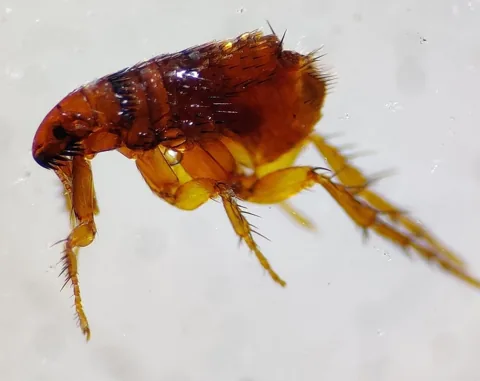 Cat Flea
Ctenocephalides felis
The cat flea is the most common external parasite of domestic cats and dogs, and the flea most often found on both. Adults spend most of their time on the pet, while eggs, larvae and pupae build up wherever the pet rests.
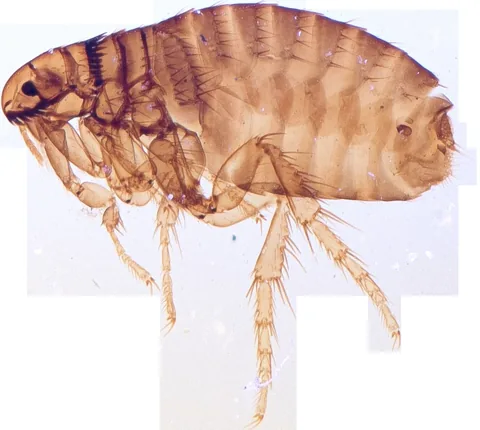 Dog Flea
Ctenocephalides canis
The dog flea looks very much like the cat flea but is the less common of the two on U.S. pets: UC IPM says the cat flea is the most common external parasite on domestic cats and dogs and calls the dog flea rare in California. In some countries, such as South Korea and Uzbekistan, surveys have found it to be the main flea on dogs.
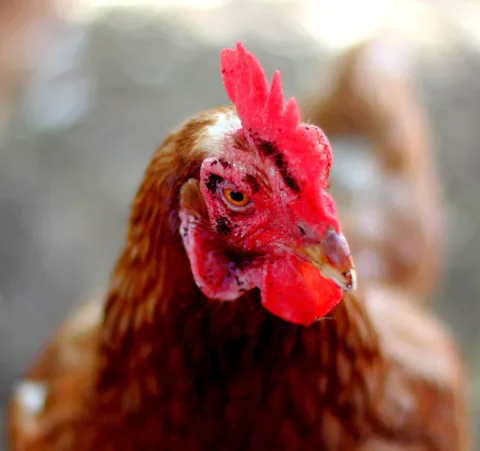 Sticktight Flea
Echidnophaga gallinacea
The sticktight flea is a small, dark flea that embeds its mouthparts in its host's skin and stays put for days or weeks. Texas A&M's veterinary diagnostic lab calls it the main flea pest of poultry, and it also attaches to dogs, cats and people.
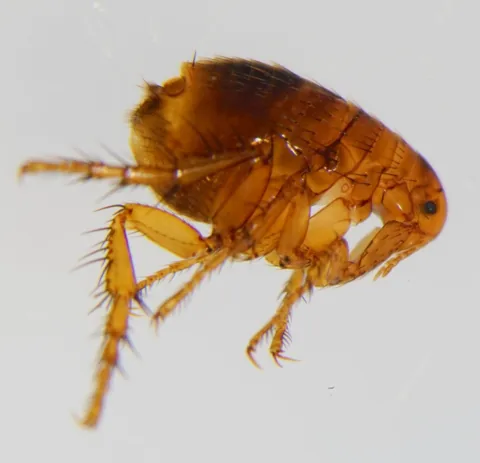 Human Flea
Pulex irritans
The human flea is a bloodsucking flea with a long association with people, one of its main hosts, though it also feeds on a wide range of wild and domestic animals. UF/IFAS notes it has even been found in archaeological sediments in Europe and Greenland.
How to confirm it's fleas
Fleas are fast, so the droppings are often easier to find than the insects. The Merck Veterinary Manual describes flea dirt as blood that passes quickly through the flea and dries within minutes into reddish-black pellets or coils, and Texas A&M AgriLife describes flea feces as a fine, reddish-black dust in pet fur and bedding.[2][8]
- Wet paper test: Merck's pet owner guide says flea excrement placed in water or on a damp paper towel dissolves and gives a reddish brown color.[1]
- Flea comb: Texas A&M AgriLife says a fine-toothed flea comb removes adult fleas from fur. Pay special attention to the face and neck and the area in front of the tail, and dip the comb often in soapy water or an alcohol solution to kill the fleas you catch.[8]
- Check the bedding: Merck says looking through the pet's bedding for flea eggs, larvae and droppings also helps confirm fleas.[1]
- Keep combing later: UC IPM recommends periodic combing with a flea comb, along with regular cleaning, to catch new infestations early.[7]
- No fleas, but a very itchy dog? Merck says dogs that are highly allergic to flea bites groom so much that they may be nearly free of fleas, which makes evidence hard to find, and that fleas don't rule out another cause of itching. That is a question for your veterinarian.[1]
Is it just a few fleas?
Probably not. Merck says a female cat flea can produce up to 50 eggs per day; NPIC gives 30 to 50 eggs a day. The eggs fall from the fur onto bedding, carpet or soil and hatch in 1 to 6 days, and the larvae move deep into carpet fibers or under debris, away from light.[1][9]
Kentucky Extension adds that the pupal cocoon is impervious to insecticides, which is one reason some fleas keep appearing even after the pet and home are treated. It advises continuing to vacuum rather than retreating right away, because vacuuming brings fleas out of their cocoons and into contact with the treatment sooner.[6]
- Where the fleas came from: Kentucky says pets pick up fleas from kennels, groomers, stray dogs and cats, or wildlife such as opossums and raccoons crossing the yard, and that fleas seldom jump directly from one pet to another.[6]
- Other pets in the house: Kentucky says that once all pets stay treated, the infestation dies out as fleas emerging in the home jump on a treated pet and are killed. Any untreated pet keeps the cycle going.[6]
What fleas can do to your dog
Most dogs just itch, but some react strongly. FDA says flea bites can cause flea allergy dermatitis, an allergic reaction to proteins in flea saliva, and that constant scratching can cause permanent hair loss or other skin problems. Texas A&M AgriLife says as few as one or two bites can cause severe itching in an allergic pet.[3][8]
- Flea allergy dermatitis: Merck says allergic dogs may scratch, lick, chew and nibble at their skin, often leading to hair loss, scabbing and secondary infections, and that animals under 1 year old don't usually have it.[1]
- Anemia: Merck says fleas can cause iron-deficiency anemia in heavily infested animals, particularly young ones, and its owner guide says anemia may develop in heavy infestations or young puppies. FDA says severe infestations can lead to anemia and, in rare cases, death.[2][1][3]
- Tapeworms: CDC says dogs and cats get the Dipylidium tapeworm by swallowing an infected flea, often while grooming. Dried segments look like grains of rice, about 2 mm, hard and yellowish, and may be stuck to the fur near the rear end. CDC says vets rely on owners to notice these segments, because routine fecal exams usually miss the eggs.[12]
Before you put anything on your dog
FDA says side effects from flea and tick products can and sometimes do occur, and strongly recommends involving your veterinarian when choosing one, especially if your pet has a health condition. Read the label, the package insert and any other literature, and save the packaging in case you need to report a problem.[3]
- Match the label to the animal: FDA says the product must match your pet's species, life stage and weight class, and a puppy must be at least the minimum weight on the label. EPA's review found small breed dogs were affected more than larger breeds by some spot-on products.[3][4]
- Never use a dog product on a cat: FDA says not to, and EPA's veterinarians found cats are more sensitive to certain pesticides in dog products. UC IPM says products containing permethrin or amitraz should never be applied to cats. The permethrin and cats page explains why.[3][4][7]
- Ask first for fragile pets: FDA says to talk to your veterinarian before using a product on weak, old, medicated, sick, pregnant or nursing pets, or on pets that reacted to flea products before, and to tell the vet about any other products you use.[3]
- After you apply it: FDA says to watch your pet closely, especially the first time, wash your hands with soap and water or wear gloves, and call your veterinarian right away if your pet has a bad reaction.[3]
- Storage: EPA says to keep pesticides in their original containers, away from pet food and water dishes and out of reach of pets and children.[5]
Will the fleas bite me?
They can. CDC says most fleas in the United States prefer animals, but people get bitten when they share space with a flea-infested animal, and bites often land on the lower legs and feet. MedlinePlus says flea bites are more likely to itch than hurt.[11][13]
- Disease: CDC says fleas can sometimes infect people or pets with germs that cause flea-borne typhus, plague or cat scratch disease.[10]
- Children: CDC says people, like pets, can get flea tapeworms by accidentally swallowing an infected flea, and small children are at higher risk because they spend more time near floors and carpets. CDC says the infection is easily treatable.[10][12]
- Best protection: CDC says the best way to prevent fleas on people is to keep pets free of fleas.[11]
What to do next: the pet, the house and the yard
Kentucky Extension says most flea problems can be eliminated by treating the pet and, if needed, the inside of the home, and that treating the yard may help if pets spend most of their time outdoors. CDC advises treating pets for fleas year-round.[6][11]
- The dog (and every other pet): work with your veterinarian on an on-pet product, as FDA recommends, and treat all the animals in the home.[3][6]
- The house: Kentucky says vacuuming removes many eggs, larvae and pupae and stirs fleas out of their cocoons sooner. Vacuum where pets rest, along room edges and under furniture, then seal the bag in a garbage bag and put it in an outdoor trash can. The fleas in the house guide covers the rest.[6]
- The yard: UC IPM says outdoor sprays aren't necessary unless you find significant numbers of fleas. Walk the pet's resting spots in white socks pulled up to the knee; fleas jump on and are easy to see. The fleas in the yard guide has the details.[7][6]
When to call the vet or a pro
Call your veterinarian if your dog scratches constantly, has hair loss or scabs, or you see rice-like segments near its rear. Kentucky says a hypersensitive animal will often require veterinary help, Merck says your vet can prescribe medicine for the skin condition, and CDC says to have your veterinarian treat pets with tapeworms.[6][1][12]
FDA says to call your veterinarian if a pet shows signs of illness after a flea product, such as wobbliness, incoordination, poor appetite, vomiting, diarrhea or heavy drooling.[3]
- Pest control: Kentucky says that if adult fleas are still seen after 4 weeks, the home or pets may need retreating, and that homeowners who don't want to treat the premises themselves can hire a professional pest control firm.[6]
- Wildlife under the house: Kentucky says a skunk or feral cat living beneath a home can be a hidden source of fleas and should be removed by a nuisance wildlife or pest control professional, and Texas A&M AgriLife says a pest control company can treat for fleas and seal openings wildlife use.[6][8]
Common questions
- What does flea dirt look like?
- Reddish-black specks, like fine dust or tiny commas, in the fur and bedding. Merck says they dissolve into a reddish brown color on a damp paper towel, and Texas A&M AgriLife describes flea feces as a fine, reddish-black dust.[1][8]
- Are the fleas on my dog dog fleas?
- Usually not. Merck says most fleas found on both dogs and cats are cat fleas, and Texas A&M AgriLife says the cat flea causes most flea problems in Texas and feeds on cats, dogs and wildlife.[1][8]
- Can I use my dog's flea treatment on my cat?
- No. FDA says not to use a dog product on a cat, and EPA says cats can be harmed by dog products because they are more sensitive to certain pesticides.[3][4]
- How long until the fleas are gone?
- Weeks to months. Merck says complete control of an existing infestation typically takes 2 to 3 months even with a fully effective on-pet product, and Kentucky says eradicating a severe infestation may take several weeks.[2][6]
Photo credits
- Cat Flea: (c) Thomas Gyselinck, some rights reserved (CC BY) — via iNaturalist, CC BY 4.0
- Dog Flea: Ctenocephalides canis by Hallvard Elven, Naturhistorisk museum, Universitetet i Oslo — via Wikimedia Commons, CC BY 3.0
- Sticktight Flea: Tradimus, public domain (CC0), via Wikimedia Commons
- Human Flea: (c) carnifex, some rights reserved (CC BY) — via iNaturalist, CC BY 4.0
Sources
- Merck Veterinary Manual, “Fleas of Dogs (Pet Owner Version).” www.merckvetmanual.com/dog-owners/skin-disorders-of-dogs/fleas-of-dogs (accessed 2026-11-14)
- Merck Veterinary Manual, “Fleas in Dogs and Cats (Professional Version).” www.merckvetmanual.com/integumentary-system/fleas-and-flea-allergy-dermatitis/fleas-in-dogs-and-cats (accessed 2026-11-14)
- U.S. Food and Drug Administration, “Safe Use of Flea and Tick Products in Pets.” www.fda.gov/consumers/consumer-updates/safe-use-flea-and-tick-products-pets (accessed 2026-11-14)
- U.S. Environmental Protection Agency, “EPA Evaluation of Pet Spot-on Products: Analysis and Plans for Reducing Harmful Effects.” www.epa.gov/pets/epa-evaluation-pet-spot-products-analysis-and-plans-reducing-harmful-effects (accessed 2026-11-14)
- U.S. Environmental Protection Agency, “Read the Label First: Protect Your Pets.” www.epa.gov/pets/read-label-first-protect-your-pets (accessed 2026-11-14)
- University of Kentucky Entomology, “ENTFACT-602: Flea Control and Prevention.” entomology.mgcafe.uky.edu/ef602 (accessed 2026-11-14)
- University of California Statewide IPM Program, “Pest Notes: Fleas.” ipm.ucanr.edu/home-and-landscape/fleas/ (accessed 2026-11-14)
- Texas A&M AgriLife Extension Service, “How to Get Rid of Fleas.” agrilifeextension.tamu.edu/library/insects/controlling-fleas/ (accessed 2026-11-14)
- National Pesticide Information Center (Oregon State University and U.S. EPA), “Fleas.” npic.orst.edu/pest/flea.html (accessed 2026-11-14)
- Centers for Disease Control and Prevention, “About Fleas.” www.cdc.gov/fleas/about/index.html (accessed 2026-11-14)
- Centers for Disease Control and Prevention, “Preventing Fleas.” www.cdc.gov/fleas/prevention/index.html (accessed 2026-11-14)
- Centers for Disease Control and Prevention, “About Dog or Cat Tapeworm Infection.” www.cdc.gov/dipylidium/about/index.html (accessed 2026-11-14)
- MedlinePlus, U.S. National Library of Medicine, “Insect bites and stings (Medical Encyclopedia).” medlineplus.gov/ency/article/000033.htm (accessed 2026-11-14)