The short answer
- Watch for scratching, licking, chewing and overgrooming, hair loss, and tiny dark specks in the fur. Merck says extremely allergic cats can groom so much that you find no fleas at all, so check for flea dirt with a flea comb and a damp paper towel.[1][3]
- Never put a dog flea product on a cat. EPA found that cats are harmed by dog products because they are more sensitive to certain pesticides, CDC says permethrin should not be used on cats, and FDA says a product for dogs should not be used on cats.[6][7][5]
- Ask your vet which cat product to use. Merck says the most effective flea products are sold by veterinarians, and FDA strongly recommends involving your vet, especially for kittens and for sick, old, pregnant or nursing cats.[1][5]
- Treat every pet in the house and the home, not just the cat you saw fleas on. Merck says eggs drop off into bedding, carpet and soil, and that you may keep seeing some fleas until the home infestation is gone.[2][1]
- Call your vet now if a kitten or small cat is covered in fleas, or seems weak, or if your cat becomes wobbly, drools, vomits or has a seizure after any flea product. Merck and FDA say heavy flea loads can cause anemia, especially in young animals, and FDA lists those signs as reactions to report to the vet.[2][5]
The fleas on your cat
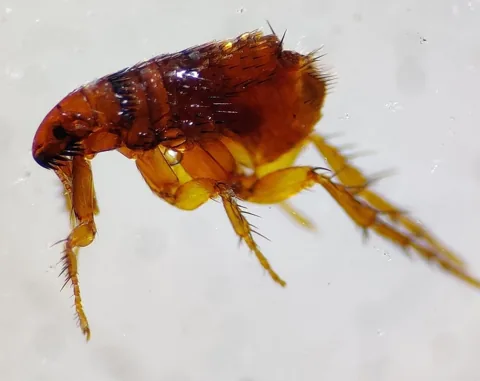 Cat Flea
Ctenocephalides felis
The cat flea is the most common external parasite of domestic cats and dogs, and the flea most often found on both. Adults spend most of their time on the pet, while eggs, larvae and pupae build up wherever the pet rests.
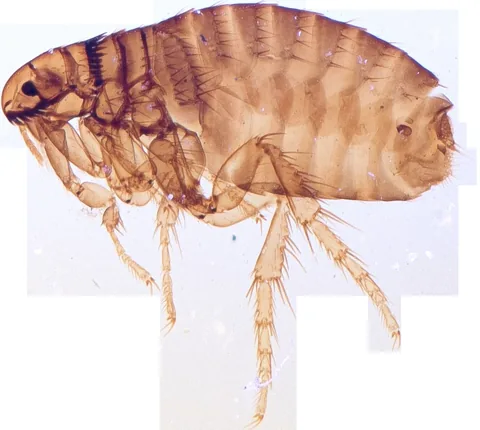 Dog Flea
Ctenocephalides canis
The dog flea looks very much like the cat flea but is the less common of the two on U.S. pets: UC IPM says the cat flea is the most common external parasite on domestic cats and dogs and calls the dog flea rare in California. In some countries, such as South Korea and Uzbekistan, surveys have found it to be the main flea on dogs.
Signs your cat has fleas
Fleas make cats itch. Merck says even non-allergic cats will scratch now and then from the bites, while a cat allergic to flea saliva may repeatedly lick, scratch and chew its skin.[1]
Overgrooming is a common cat sign. Merck says the main signs in allergic cats are itching and small bumps with scratches or overgrooming on the face, neck and back, and lists hair loss the cat causes itself among the reaction patterns.[3]
Part the fur and look at the skin. Merck says an allergic cat may have small, solid, crusted bumps over the back, neck and face, called miliary dermatitis, or a "racing stripe" of inflamed skin along the back. Our flea allergy dermatitis page covers the allergy in detail.[1][3]
Look for tapeworm segments too. CDC says dried segments look like grains of rice near the tail or on fresh stool, and Merck says cats get the common tapeworm by eating fleas.[9][4]
The flea dirt test
Slowly part the hair against the way it lies. Merck says this often shows flea droppings or fast-moving fleas; a fine-tooth flea comb and a look at the cat's bedding for eggs, larvae and droppings help when you can't see fleas.[1]
Flea dirt is flea droppings. Merck describes it as reddish black and shaped like small pellets or commas.[1][3]
Put the specks on a damp white paper towel or in water. Merck says flea droppings dissolve into a reddish-brown color.[1]
No fleas found does not mean no fleas. Merck says fleas may not be visible on extremely allergic cats because of grooming, and a flea-free look can still hide a flea allergy.[1][3]
Indoor cats get fleas too
Merck says wild animals and stray cats and dogs bring fleas into yards, that even pets that only go outside briefly can become infested, and that people can carry fleas into the house without knowing it.[1]
A flea-infested dog or cat can bring fleas into the home, where Merck says they lay eggs that develop into new fleas that infest other pets and bite people.[1]
Merck says flea allergy in cats can occur year-round with indoor pets, and that flea control is critical for preventing tapeworms even in indoor cats.[1][4]
CDC says animals that are allowed outside are more likely to bring fleas inside.[7]
Kittens, small cats and anemia
Fleas feed on blood. Merck says they can cause iron-deficiency anemia in heavily infested hosts, particularly young animals, and FDA says severe infestations can lead to anemia and, in rare cases, death.[2][5]
Don't use a flea product on a kitten unless the label specifically allows it. FDA says to make sure a product matches the pet's species, life stage and weight, and that the kitten is at least the minimum weight on the label.[5]
For kittens too young for flea products, FDA says to use a flea comb to remove fleas and flea eggs.[5]
A kitten crawling with fleas, or one that seems weak or listless, needs a vet visit rather than home treatment. Merck says anemia from fleas is a particular risk in young animals.[2]
Never use dog flea products on cats
This is the most important rule on this page. EPA's veterinarian team found that misuse or accidental exposure of cats to dog products was an important problem, that cats can be harmed by dog products because they are more sensitive to certain pesticides, and that label warnings against using dog products on cats are not working well enough.[6]
CDC's flea-borne typhus prevention advice says plainly that permethrin should not be used on cats. Our is permethrin safe for cats page explains why it is toxic to them and what poisoning looks like.[7]
Cats can also be exposed by touching or grooming a dog that was just treated. FDA says that in a home with more than one pet, apply a spray or spot-on to one pet at a time and keep the treated animal apart until it dries, especially when the product is only for dogs and you have a cat.[5][6]
Read the label every time, even on a product you have used before, because FDA says the directions or warnings may have changed. FDA also says not to put a house or yard product directly on a pet.[5]
If your cat reacts to any flea product, call your vet right away. FDA lists dizziness, wobbliness, incoordination, poor appetite, depression, vomiting, diarrhea and excessive drooling as signs, and says some animals have had seizures or died.[5]
Use a vet-recommended cat product
Merck says the most effective flea products are sold by veterinarians, and that you should discuss flea control products with your vet and pick one that works for your cat and where it lives.[1]
FDA says hundreds of products exist, from pills and chews to collars, sprays, shampoos, powders and spot-ons, some only from a vet and some over the counter, and that side effects can occur. It strongly recommends involving your vet, especially if your cat has health conditions.[5]
Talk to your vet before treating a weak, old, medicated, sick, pregnant or nursing cat, FDA says, even if the cat did fine with the same product before. This page gives no product names or doses; let your vet choose.[5]
Don't expect every flea to vanish at once. Merck says many products do not kill fleas immediately, so you may still see some fleas on your cat until the home infestation is gone.[1]
Treat the home and every pet
Most of the flea population is off the cat. Merck says cat flea eggs fall from the coat onto bedding, carpet or soil, and that indoor larvae survive deep in carpet fibers, in cracks between floorboards and on damp basement floors.[2][1]
Treat every dog and cat in the household. Merck says prevention and treatment of flea allergy require treating the affected pet, the other pets in the household and the environment.[3]
Wash pet blankets, throw rugs and carriers, and vacuum where pets sleep or rest, including sofa and chair crevices and under beds, Merck says. CDC adds to vacuum often and empty the vacuum bag outside.[1][10]
Merck says your vet can recommend a home insecticide that is safe to use around cats, aimed where eggs and larvae gather. Our how to get rid of fleas in the house page walks through the steps.[1]
Outdoors, Merck says to focus on shaded, moist spots where pets lounge, such as under porches and shrubs, and notes that spraying a sunny open lawn does little.[1]
Diseases cat fleas carry
Tapeworm. CDC says dogs and cats get the flea tapeworm by swallowing an infected flea while grooming, and that people, mostly children, get it the same way. CDC says flea control is the most effective prevention. See our tapeworms from fleas page.[9]
Cat scratch disease. CDC says Bartonella henselae causes cat scratch disease, the most common form of bartonellosis in the US, and spreads to people by the scratch of cats that have been infected by fleas. Merck says the bacteria live in fleas and that people are infected when flea droppings get into a scratch or bite wound.[8][2]
CDC lists people who interact with cats that have fleas among those at risk, and says a cat scratch can spread germs even when it only breaks the surface of the skin. Avoid rough play, trim your cat's nails and supervise children around cats, CDC says.[8][11]
Flea-borne (murine) typhus. CDC says the cat flea is one of the fleas that spread it, that fleas pick it up from infected rats, cats or opossums, and that contact with free-roaming cats is a risk factor. See our murine typhus page for symptoms and when to get care.[7]
CDC's advice for all of these is the same: keep fleas off your pets, talk to your vet about flea control products, and wash your hands after handling cats.[7][11][9]
Common questions
- Can my indoor cat get fleas?
- Yes. Merck says people and other pets can carry fleas inside, and pets that go out only briefly can pick them up.[1]
- Can I use my dog's flea treatment on my cat?
- No. EPA says cats can be harmed by dog products because they are more sensitive to certain pesticides, CDC says permethrin should not be used on cats, and FDA says a product for dogs should not be used on cats.[6][7][5]
- How do I know the black specks are flea dirt?
- Put them on a damp paper towel. Merck says flea droppings dissolve into a reddish-brown color.[1]
- Can fleas from my cat make me sick?
- They can. CDC says cat fleas can spread cat scratch disease (through cat scratches), flea-borne typhus and the flea tapeworm. Flea control on every pet is the main prevention, according to CDC.[8][7][9]
- Why do I still see fleas after treating my cat?
- Merck says many flea products do not kill fleas immediately and that new fleas keep emerging from the home until the environmental infestation is gone, so treat the home and every pet.[1]
Photo credits
- Cat Flea: (c) Thomas Gyselinck, some rights reserved (CC BY) — via iNaturalist, CC BY 4.0
- Dog Flea: Ctenocephalides canis by Hallvard Elven, Naturhistorisk museum, Universitetet i Oslo — via Wikimedia Commons, CC BY 3.0
Sources
- Merck Veterinary Manual, “Fleas of Cats (Pet Owner Version).” www.merckvetmanual.com/cat-owners/skin-disorders-of-cats/fleas-of-cats (accessed 2026-11-15)
- Merck Veterinary Manual, “Fleas in Dogs and Cats.” www.merckvetmanual.com/integumentary-system/fleas-and-flea-allergy-dermatitis/fleas-in-dogs-and-cats (accessed 2026-11-15)
- Merck Veterinary Manual, “Flea Allergy Dermatitis in Dogs and Cats.” www.merckvetmanual.com/integumentary-system/fleas-and-flea-allergy-dermatitis/flea-allergy-dermatitis-in-dogs-and-cats (accessed 2026-11-15)
- Merck Veterinary Manual, “Gastrointestinal Parasites of Cats (Pet Owner Version).” www.merckvetmanual.com/cat-owners/digestive-disorders-of-cats/gastrointestinal-parasites-of-cats (accessed 2026-11-15)
- U.S. Food and Drug Administration, “Safe Use of Flea and Tick Products in Pets.” www.fda.gov/consumers/consumer-updates/safe-use-flea-and-tick-products-pets (accessed 2026-11-15)
- U.S. Environmental Protection Agency, “EPA Evaluation of Pet Spot-on Products: Analysis and Plans for Reducing Harmful Effects.” www.epa.gov/pets/epa-evaluation-pet-spot-products-analysis-and-plans-reducing-harmful-effects (accessed 2026-11-15)
- Centers for Disease Control and Prevention, “About Flea-borne Typhus.” www.cdc.gov/typhus/about/murine.html (accessed 2026-11-15)
- Centers for Disease Control and Prevention, “About Bartonella.” www.cdc.gov/bartonella/about/index.html (accessed 2026-11-15)
- Centers for Disease Control and Prevention, “About Dipylidium Infection.” www.cdc.gov/dipylidium/about/index.html (accessed 2026-11-15)
- Centers for Disease Control and Prevention, “Preventing Fleas.” www.cdc.gov/fleas/prevention/index.html (accessed 2026-11-15)
- Centers for Disease Control and Prevention, “Cats: Healthy Pets, Healthy People.” www.cdc.gov/healthy-pets/about/cats.html (accessed 2026-11-15)