The short answer
- If you see small, rice-like segments stuck to the fur around your pet's tail or on fresh stool, call your veterinarian. Merck says diagnosis is based on finding tapeworm segments or eggs in the feces or stuck to the hair around the anus.[2][3]
- Pets get this tapeworm by swallowing an infected flea, usually while grooming. Merck calls flea control the critical preventive step, even for dogs and cats that stay indoors.[2][3]
- Most infected pets don't look sick. Merck says adult tapeworms rarely cause serious disease; when signs show up they range from a poor coat, variable appetite and mild diarrhea to, rarely, blockage of the intestine or seizures.[2][1]
- Your vet can treat it. Several drugs are approved for this tapeworm in dogs and cats, Merck says, so let your vet choose; the worm will come back if fleas are still around.[1][3]
- Children can catch it by swallowing a flea. CDC says most people with it have no symptoms, the usual clue is segments in a child's stool, and treatment is simple and very effective.[6][7]
Fleas and lice that carry the flea tapeworm
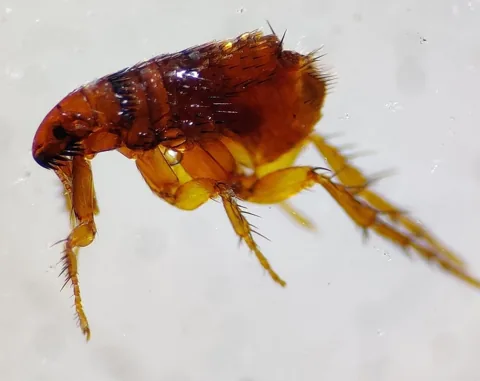 Cat Flea
Ctenocephalides felis
The cat flea is the most common external parasite of domestic cats and dogs, and the flea most often found on both. Adults spend most of their time on the pet, while eggs, larvae and pupae build up wherever the pet rests.
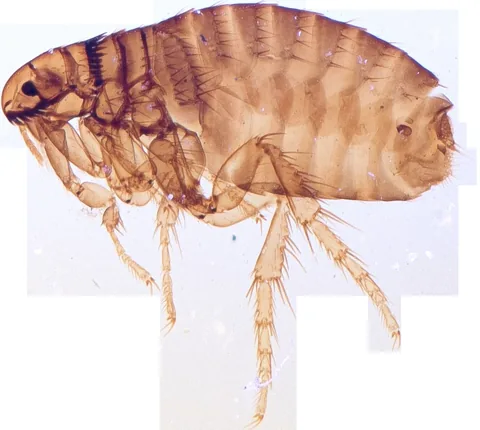 Dog Flea
Ctenocephalides canis
The dog flea looks very much like the cat flea but is the less common of the two on U.S. pets: UC IPM says the cat flea is the most common external parasite on domestic cats and dogs and calls the dog flea rare in California. In some countries, such as South Korea and Uzbekistan, surveys have found it to be the main flea on dogs.
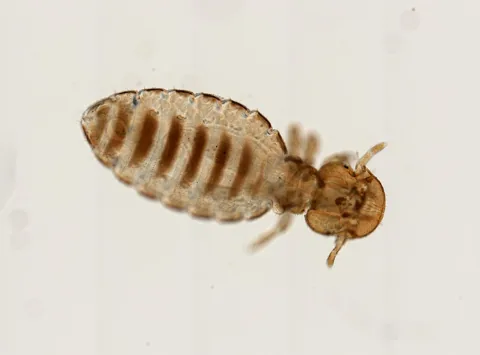 Dog and cat lice
Trichodectes canis (dog chewing louse), Linognathus setosus (dog sucking louse) and Felicola subrostratus (cat chewing louse)
Dog and cat lice are tiny, flat, wingless insects that live their whole lives in a pet's coat. Dogs carry a chewing louse, Trichodectes canis, and a sucking louse, Linognathus setosus, while cats usually carry only a chewing louse, Felicola subrostratus. They spread by contact and through bedding and grooming tools and can cause itching and hair loss. They are not a source of human lice; the CDC states that animals do not get or spread head lice. A veterinarian can confirm them, and flea-and-tick products, a repeat treatment and hot washing of bedding usually clear them.
How dogs and cats get tapeworms from fleas
The tapeworm needs a flea to finish its life cycle. CDC says segments of the adult worm break off and pass in the pet's stool; they carry the eggs, and once a segment dries out the eggs are released. Flea larvae living in bedding, carpet or the yard eat those eggs.[6][7]
The young tapeworm develops inside the flea larva and stays in the flea as it matures into an adult, CDC's parasite lab page says.[7]
Merck says a dog or cat then becomes infected by swallowing the flea, often while grooming, and that even pets on prepared food with little access to prey can get it this way.[1][2]
Fleas are the usual carrier, but Merck lists lice as a rarer one. If your vet finds lice on your pet, see our dog and cat lice page.[1]
Most of the fleas found on dogs and cats are cat fleas, Merck says, and Merck lists tapeworm infection among the diseases fleas spread.[4]
Signs in your pet: rice-like segments near the tail
Segments are often the only sign. CDC describes dried segments as small (about 2 mm), hard, yellowish and shaped like grains of rice, and says fresh ones can sometimes be seen crawling near the pet's anus or on a fresh bowel movement. Merck describes them as shaped like cucumber seeds.[6][1]
Merck says adult tapeworms in the intestine of dogs and cats rarely cause disease. Signs, when present, can include unthriftiness, malaise, irritability, a variable appetite, a shaggy coat, colic and mild diarrhea; rarely, telescoping of the intestine, emaciation or seizures.[2][1]
Call your veterinarian if you see segments, and promptly if your pet seems unwell, has diarrhea or colic, or has a seizure. Merck notes that all fecal flotation methods for tapeworm eggs have low sensitivity, so mention any segments you have seen at home.[2][1]
Vet treatment, and why the worm keeps coming back
Merck says several drugs are approved in the US to treat Dipylidium caninum in dogs and in cats. Your veterinarian picks the product and amount for your pet; this page does not give doses.[1][3]
Treatment alone is not enough. Merck says control of tapeworms requires both treatment and prevention, and that this tapeworm is different from the ones pets get from prey because it can keep cycling through fleas around a confined, infected animal.[1][2]
Merck also reports that in 2018 this tapeworm was described as resisting approved treatments in multiple US states. If segments keep showing up after treatment, go back to your vet.[1]
Flea control is part of the treatment
Merck says flea control is critical for tapeworm control, even for indoor cats, and is the critical preventive step even for indoor dogs. Our guides on getting rid of fleas in the house and in the yard cover the steps.[3][2]
Work with your veterinarian to choose a flea product, and match it to your pet's species, life stage and weight, the FDA advises. If the product is for dogs, don't use it on cats.[5]
Flea larvae eat the tapeworm eggs, CDC says, so the fleas developing in your home are where new infections start. Our page on flea growth regulators explains the products that stop flea larvae from maturing.[6]
Can people get tapeworms from fleas?
Yes. CDC says people get Dipylidium the same way dogs and cats do, by swallowing a flea infected with tapeworm larvae, and most reported cases are in children; CDC's parasite lab page suggests close contact with flea-infested pets may be why.[6][7]
Most infected people have no symptoms, CDC says. The usual clue is segments in a child's stool. CDC's lab page notes segments can also turn up around the anus, on diapers, and sometimes on floors or furniture, and that fresh ones move and can be mistaken for maggots or fly larvae.[6][7]
If you see this in your child, call your child's doctor. CDC says most infections in people are diagnosed by a healthcare provider finding segments around the anus or in the stool, sometimes with a stool exam, and that treatment is simple and very effective.[6]
- Control fleas on pets and in the home. CDC calls this the most effective way to prevent the infection in pets and people.[6]
- Have your veterinarian treat dogs and cats that have tapeworms.[6]
- Clean up after your pet, especially in playgrounds and parks, bag the poop and put it in the trash.[6]
- Don't let children play in areas soiled with pet or other animal feces.[6]
- Teach children to wash their hands after petting or playing with dogs and cats and after playing outdoors.[6]
How big does the flea tapeworm get?
Sources give different ranges. CDC's overview says adult tapeworms may measure 4–28 inches long; CDC's parasite lab page gives up to 60 cm long and 3 mm wide; and the Merck Veterinary Manual gives 15–70 cm long and up to 3 mm wide.[6][7][1]
Each segment is about the size of a grain of rice, CDC says. CDC's lab page gives mature segments an average size of 12 mm by 3 mm, while its overview puts dried segments at about 2 mm.[6][7]
Common questions
- What do tapeworm segments from fleas look like?
- Like grains of rice when dry: small, hard and yellowish, CDC says, and sometimes stuck to the fur around a pet's rear. Freshly passed segments can move and may be mistaken for maggots or fly larvae.[6][7]
- My pet stays indoors. Can it still get tapeworms?
- Yes. Merck says even confined dogs and cats can get Dipylidium because it cycles through fleas, which is why flea control matters for indoor pets.[2][3]
- Will my vet see it on a routine stool test?
- Not always. Merck says fecal flotation methods have low sensitivity for tapeworm, and CDC says vets rely on owners to notice the segments. Tell your vet what you saw.[1][6]
- Can I catch tapeworms by petting my dog?
- The risk comes from swallowing an infected flea, CDC says. Hand washing after handling pets and good flea control lower the risk.[6]
- Do fleas spread other diseases?
- Yes. Merck lists flea-borne typhus-like infections, flea allergy and anemia along with tapeworms. See our murine typhus page for the human side.[4]
Photo credits
- Cat Flea: (c) Thomas Gyselinck, some rights reserved (CC BY) — via iNaturalist, CC BY 4.0
- Dog Flea: Ctenocephalides canis by Hallvard Elven, Naturhistorisk museum, Universitetet i Oslo — via Wikimedia Commons, CC BY 3.0
- Dog and cat lice: Daniel J. Drew, Yale Peabody Museum, public domain (CC0), via Wikimedia Commons
Sources
- Merck Veterinary Manual, “Tapeworms in Dogs and Cats.” www.merckvetmanual.com/digestive-system/gastrointestinal-parasites-of-small-animals/tapeworms-in-small-animals (accessed 2026-11-15)
- Merck Veterinary Manual, “Gastrointestinal Parasites of Dogs (Pet Owner Version).” www.merckvetmanual.com/dog-owners/digestive-disorders-of-dogs/gastrointestinal-parasites-of-dogs (accessed 2026-11-15)
- Merck Veterinary Manual, “Gastrointestinal Parasites of Cats (Pet Owner Version).” www.merckvetmanual.com/cat-owners/digestive-disorders-of-cats/gastrointestinal-parasites-of-cats (accessed 2026-11-15)
- Merck Veterinary Manual, “Fleas of Dogs (Pet Owner Version).” www.merckvetmanual.com/dog-owners/skin-disorders-of-dogs/fleas-of-dogs (accessed 2026-11-15)
- U.S. Food and Drug Administration, “Safe Use of Flea and Tick Products in Pets.” www.fda.gov/consumers/consumer-updates/safe-use-flea-and-tick-products-pets (accessed 2026-11-15)
- Centers for Disease Control and Prevention, “About Dog or Cat Tapeworm Infection.” www.cdc.gov/dipylidium/about/index.html (accessed 2026-11-15)
- Centers for Disease Control and Prevention, “DPDx: Dipylidium caninum.” www.cdc.gov/dpdx/dipylidium/index.html (accessed 2026-11-15)