The short answer
- Infected fleas spread murine typhus, most often the Oriental rat flea and the cat flea. The germ is in flea droppings (flea dirt), which get rubbed into the bite or other breaks in the skin; CDC says people can also breathe in infected flea dirt, a route Texas health officials call less common than a biting flea.[4][8]
- The fleas pick it up from animals such as rats, opossums and cats. CDC says most US cases come from southern California, Hawaii and southern Texas.[4][5]
- See a doctor if fever, headache, chills, body aches or a rash follow contact with fleas, rats, opossums or stray cats, and mention that contact. Texas's health department says to see a doctor as soon as possible because waiting too long can mean a hospital stay.[4][8]
The fleas and animals behind murine typhus
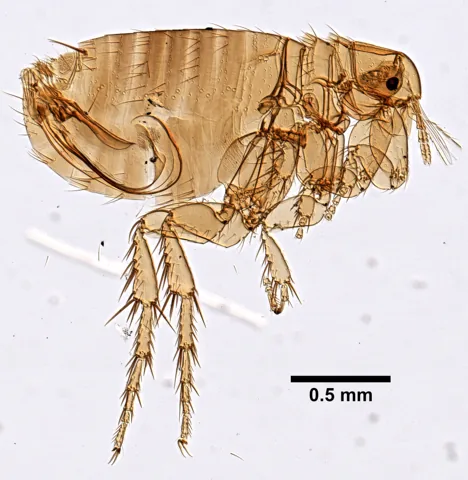 Oriental Rat Flea
Xenopsylla cheopis
The oriental rat flea is a parasite of rats and other small mammals and is best known for spreading two diseases to people: plague and flea-borne (murine) typhus. People are incidental hosts.
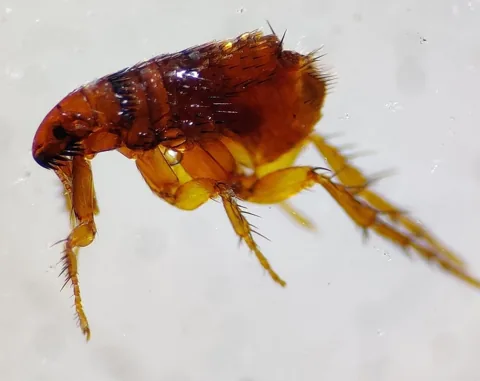 Cat Flea
Ctenocephalides felis
The cat flea is the most common external parasite of domestic cats and dogs, and the flea most often found on both. Adults spend most of their time on the pet, while eggs, larvae and pupae build up wherever the pet rests.
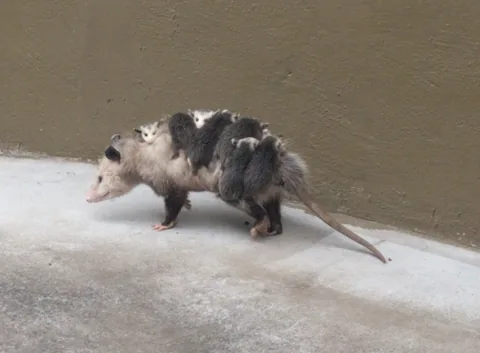 Virginia opossum
Didelphis virginiana
The Virginia opossum is North America's only marsupial, a cat-sized animal with a pointed face and a long, hairless tail. Around homes it raids pet food, garbage and fruit and dens under decks, sheds and houses.
 Norway Rat
Rattus norvegicus
The Norway rat, also called the brown or sewer rat, is a large, burrowing rat found throughout the contiguous United States wherever people live.
 Roof Rat
Rattus rattus
The roof rat, also called the black or ship rat, is a sleek, agile climber that nests above ground in trees, ivy, attics and wall voids.
How murine typhus spreads
- The germ: murine typhus is caused by the bacterium Rickettsia typhi, CDC and MedlinePlus say.[4][7]
- Flea dirt, not just the bite: fleas defecate while they feed, and the droppings carry the bacteria. They enter through the bite wound or other cuts when the skin is scratched or rubbed, according to CDC and the Texas Department of State Health Services.[4][8]
- Other routes: people can breathe in infected flea dirt or rub it into their eyes, CDC says. Hawaii's health department adds exposure of mucous membranes to infected flea feces.[4][10]
- Not from people: CDC and Los Angeles County say the bacteria do not spread from person to person, and Hawaii's health department says it does not pass from people to fleas either.[4][9][10]
- Many patients never noticed a flea: CDC says very few patients recall a flea bite or flea exposure in the one to two weeks before they fall ill, so a missing bite does not rule it out.[4]
- An infected flea stays infected for the rest of its life, according to CDC and Hawaii's health department.[4][10]
Which fleas and animals are involved
- Oriental rat flea (Xenopsylla cheopis): named by CDC and Texas DSHS as one of the two most common carriers. Texas DSHS calls rats and their fleas the natural reservoirs of the disease.[4][8]
- Cat flea (Ctenocephalides felis): the other common carrier, per CDC and Texas DSHS. The Merck Veterinary Manual says the main transmission cycle in the US involves opossums, cats and cat fleas.[4][8][1]
- Rats: CDC lists rats among the animals fleas get infected from. Hawaii's health department says the disease there is carried by rats, mice and mongoose.[4][10]
- Opossums: CDC names opossums as a source of infected fleas and a risk factor, and Los Angeles County lists rats, free-roaming cats and opossums as the main animals carrying infected fleas in that county.[4][9]
- Cats and dogs: CDC's clinician page says opossums, cats and dogs living in urban or suburban areas have been tied to fleas carrying the bacterium in recent US cases. Los Angeles County says pets allowed outside can pick up infected fleas and carry them to people.[5][9]
- Other animals: MedlinePlus says the risk is higher around rat feces or fleas and animals such as cats, possums, raccoons and skunks. The CDC clinician page also lists the mouse flea as a possible carrier.[7][5]
Where and when people catch it
- Where: CDC says southern California, Hawaii and southern Texas report most US cases, although cases likely occur in other states. MedlinePlus places it in the southern United States, including California and Texas.[4][7]
- Rising cases: CDC says reported cases have increased significantly since 2008 in the few states that report the disease, and calls it possibly re-emerging in parts of the country. Los Angeles County documented an all-time high of 220 cases in 2025, up from 187 in 2024, with clusters mainly in Central and South Los Angeles.[4][6][9]
- Hawaii: the state health department says murine typhus is reported in Hawaii every year, mostly from Maui County, with sporadic cases on the other islands, and that many cases likely go unreported.[10]
- Season: Los Angeles County says cases occur year-round but peak in late summer and fall, and MedlinePlus says it is often seen in summer and fall.[9][7]
- Why there is no national count: CDC says the disease was nationally notifiable from 1930 to 1987 and was then dropped from the list because it had become rare, and today only a few states report it.[6][4]
Symptoms
- Timing: CDC's public page says symptoms begin 3 to 14 days after contact with infected fleas or flea dirt, while CDC's clinician page and Hawaii's health department give 7 to 14 days. Texas DSHS gives an incubation period of 6 to 14 days, and Los Angeles County says within two weeks.[4][5][10][8][9]
- Common symptoms, per CDC: fever and chills, body aches and muscle pain, headache, loss of appetite, nausea, vomiting, stomach pain and cough. Texas DSHS adds weakness and says onset is often sudden.[4][8]
- The rash: CDC says about half of patients get a rash, usually starting around day 5 of illness. Texas DSHS describes it starting on the trunk and spreading to the arms and legs, and Los Angeles County and CDC's clinician page say it usually spares the palms and soles. CDC's clinician page warns the rash may be absent, so it cannot be relied on.[4][8][9][5]
- MedlinePlus adds backache and a hacking, dry cough, and notes that the fever can be very high.[7]
How serious it can get
- Most people recover, and CDC says almost all cases resolve completely with the right antibiotics. Deaths are rare, according to CDC and MedlinePlus.[4][7]
- It can still be serious. CDC says some people need hospital care if treatment is delayed, and the disease can damage organs. MedlinePlus lists kidney problems and pneumonia among the possible complications, and Los Angeles County says it can rarely cause meningitis or inflammation of the heart valves (endocarditis).[4][7][9]
- Without treatment, CDC says fever can last 2 to 3 weeks; Hawaii's health department and Texas DSHS say untreated illness may drag on for months.[4][10][8]
- Los Angeles County reported its first flea-borne typhus deaths since 1993 in 2022.[9]
When to get care
- See a doctor if you develop the symptoms above, CDC says, and mention any contact with fleas, rats or mice, stray cats or wildlife such as opossums. MedlinePlus says to contact your provider if you develop typhus symptoms because it can require emergency care.[4][7]
- Do not wait for a flea bite to show up. CDC says people often don't know they were bitten or exposed to flea dirt.[4]
- Go early. Texas DSHS says waiting too long to see a doctor may mean a hospital stay, and CDC says antibiotics work best when started soon after symptoms begin.[8][4]
- Treatment is an antibiotic your doctor prescribes. CDC names doxycycline and says it can be used in people of all ages, and that people treated early usually recover quickly. Because lab results can take weeks, CDC and Hawaii's health department say a doctor may start treatment before the results come back.[4][10]
How it is diagnosed
- In the first week, CDC says murine typhus looks like many other illnesses, so the doctor relies on your symptoms and your contact with fleas and animals. MedlinePlus says you may be asked whether you remember flea bites.[4][7]
- Blood tests look for the bacteria or for antibodies that show a recent infection, CDC says. Confirmation usually takes two blood samples weeks apart: CDC's clinician page says the second is drawn 2 to 10 weeks after the first, and Hawaii's health department says 2 to 3 weeks apart.[4][5][10]
- Antibodies often do not show up until 7 to 10 days after illness starts, according to CDC's clinician page, and Los Angeles County says a test taken in the first week can come back falsely negative. Both say treatment should not be held back while waiting for tests.[5][9]
Preventing murine typhus
- Keep fleas off your pets. CDC says pets that go outside are more likely to bring fleas inside and advises talking to your veterinarian about flea collars, oral medicines or topical products. Texas DSHS says to control fleas on pets regularly.[4][8]
- Keep rats and opossums away from the house. CDC advises storing food, including pet food, in tightly sealed containers, clearing brush, rock piles, junk and clutter, sealing holes rodents can use and keeping lids closed on trash and compost.[4]
- Don't feed the neighborhood. Texas DSHS says not to leave pet food out at night because it attracts other animals, and Hawaii's health department suggests feeding pets a single serving and not leaving food out overnight.[8][10]
- Make the yard less inviting. Texas DSHS advises removing brush and trash, keeping grass mowed and keeping firewood off the ground. Los Angeles County adds closing crawl spaces and attics and trimming vegetation around buildings so animals cannot nest there.[8][9]
- Treat for fleas before you kill rodents. Texas DSHS says to treat for fleas first, because fleas leave dead rodents and look for new hosts, possibly you and your family. Hawaii's health department says trapping rodents alive is preferable to poison for the same reason, and to double-bag dead rodents before putting them in the trash.[8][10]
- Leave stray and wild animals alone. CDC and Los Angeles County say not to feed or pet stray or free-roaming animals, and CDC says to wear gloves when handling sick or dead animals.[4][9]
- Use repellent outdoors. CDC and Los Angeles County recommend EPA-registered insect repellents; CDC says to follow the label, since some products are for skin and others for clothing only. There is no vaccine, according to CDC and Los Angeles County.[4][9]
Pets and murine typhus
- The Merck Veterinary Manual says cat fleas carry the typhus-like rickettsiae and that murine typhus occurs in people and many small mammals along the southeastern, southwestern and Gulf coasts of the US, with opossums, cats and cat fleas at the center of the main US cycle.[1]
- Los Angeles County says infected animals are not known to get sick from flea-borne typhus; the concern is that outdoor pets can carry infected fleas home to people.[9]
- Choose flea products with your veterinarian. FDA says to match the product to your pet's species, life stage and weight, never to use a dog product on a cat, and to read the label every time. CDC's typhus page also warns that permethrin should not be used on cats.[2][4]
- CDC's flea guidance says the best way to keep fleas off people is to keep pets free of fleas, including limiting time outdoors and contact with wild and stray animals and treating pets year-round.[3]
Common questions
- Can I get murine typhus from my cat or dog?
- Not from the pet itself, but from its fleas. Los Angeles County says outdoor pets can carry infected fleas to people, and CDC advises keeping fleas off pets as a main prevention step.[9][4]
- Is murine typhus contagious between people?
- No. CDC, Los Angeles County and Hawaii's health department all say it does not spread from person to person.[4][9][10]
- I never saw a flea bite. Could it still be typhus?
- Yes. CDC says very few patients remember a flea bite or flea exposure, and the germ can enter through scratches or be breathed in with dried flea dirt. Tell your doctor about any contact with rats, opossums or stray cats.[4][8]
- Is murine typhus the same as epidemic typhus?
- No. Texas DSHS says flea-borne typhus is like louse-borne typhus but generally milder and is caused by a different bacterium, Rickettsia typhi, and MedlinePlus says the murine form is rarely deadly.[8][7]
- Can you get murine typhus twice?
- Texas DSHS says that once you recover you will not get it again.[8]
- Should I put out rat poison if I have rats and fleas?
- Deal with the fleas first. Texas DSHS says to treat for fleas before rodent control because fleas leave dead rodents for new hosts, and Hawaii's health department prefers live trapping to poison for that reason.[8][10]
Photo credits
- Oriental Rat Flea: Daniel J. Drew, public domain (CC0), via Wikimedia Commons
- Cat Flea: (c) Thomas Gyselinck, some rights reserved (CC BY) — via iNaturalist, CC BY 4.0
- Virginia opossum: (c) Millie Basden, some rights reserved (CC BY) — via iNaturalist, CC BY 4.0
- Norway Rat: petehawkins, public domain (CC0), via iNaturalist
- Roof Rat: (c) Laura Mae, some rights reserved (CC BY) — via iNaturalist, CC BY 4.0
Sources
- Merck Veterinary Manual, “Fleas in Dogs and Cats (Professional Version).” www.merckvetmanual.com/integumentary-system/fleas-and-flea-allergy-dermatitis/fleas-in-dogs-and-cats (accessed 2026-11-14)
- U.S. Food and Drug Administration, “Safe Use of Flea and Tick Products in Pets.” www.fda.gov/consumers/consumer-updates/safe-use-flea-and-tick-products-pets (accessed 2026-11-14)
- Centers for Disease Control and Prevention, “Preventing Fleas.” www.cdc.gov/fleas/prevention/index.html (accessed 2026-11-14)
- Centers for Disease Control and Prevention, “About Flea-borne Typhus.” www.cdc.gov/typhus/about/murine.html (accessed 2026-11-14)
- Centers for Disease Control and Prevention, “Clinical Overview of Flea-borne Typhus.” www.cdc.gov/typhus/hcp/clinical-overview/clinical-overview-of-murine-typhus.html (accessed 2026-11-14)
- Centers for Disease Control and Prevention, “Flea-borne Typhus Historical Trends.” www.cdc.gov/typhus/data-research/facts-stats/index.html (accessed 2026-11-14)
- MedlinePlus, U.S. National Library of Medicine, “Typhus (Medical Encyclopedia).” medlineplus.gov/ency/article/001363.htm (accessed 2026-11-14)
- Texas Department of State Health Services, “Flea-borne Typhus.” www.dshs.texas.gov/notifiable-conditions/zoonosis-control/zoonosis-control-diseases-and-conditions/flea-borne-typhus (accessed 2026-11-14)
- Los Angeles County Department of Public Health, “Flea-borne Typhus.” publichealth.lacounty.gov/acd/diseases/Typhus/Index.htm (accessed 2026-11-14)
- Hawaii State Department of Health, “Murine Typhus.” health.hawaii.gov/docd/disease_listing/murine-typhus/ (accessed 2026-11-14)
Updated 2026-11-14. Built from sourced records. Spot an error? Tell us.