The short answer
- What spreads it: in the US, mainly the American dog tick, the Rocky Mountain wood tick and the brown dog tick (CDC). The Merck Veterinary Manual names the same three ticks.[1][2][11]
- Where: despite the name, cases are reported in every one of the lower 48 states, and most come from the Southeast and south-central US, led by North Carolina, Oklahoma, Arkansas, Tennessee and Missouri (CDC). MedlinePlus also says most recent cases are in the eastern US. In parts of Arizona the brown dog tick spreads it around homes year-round.[2][9]
- See a doctor now if you get a fever, headache, rash, nausea or vomiting, stomach pain or muscle pain after a tick bite or time in tick habitat. CDC says early symptoms are not specific but the disease can rapidly progress to a serious, life-threatening illness, and MedlinePlus says to contact your provider if symptoms follow tick exposure.[1][9]
- Don't wait for the rash or a lab result. CDC says the rash often appears late, blood tests can take weeks, and a provider who suspects RMSF should start antibiotic treatment before results come back. There is no vaccine (CDC).[1][3]
Ticks that spread it
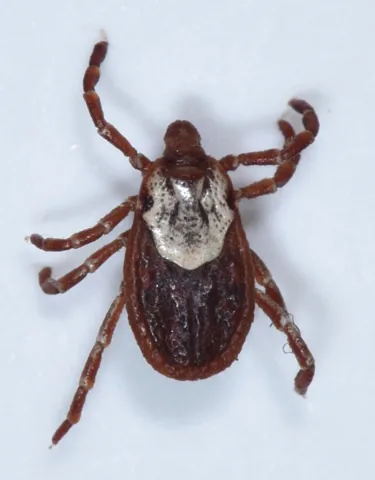 American Dog Tick
Dermacentor variabilis
The American dog tick, also called the wood tick, is widely distributed east of the Rocky Mountains. Adult females are the stage most likely to bite people, especially in spring and summer, and adults commonly climb to the crown of the head.
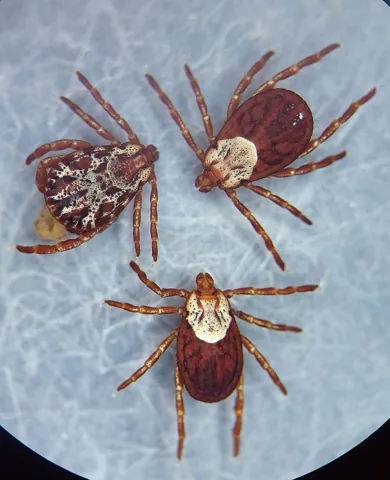 Rocky Mountain Wood Tick
Dermacentor andersoni
The Rocky Mountain wood tick is the tick most often found on people and pets in Colorado and Utah. It is most active in spring, then goes dormant as the weather turns hot and dry, and it is the vector of Colorado tick fever.
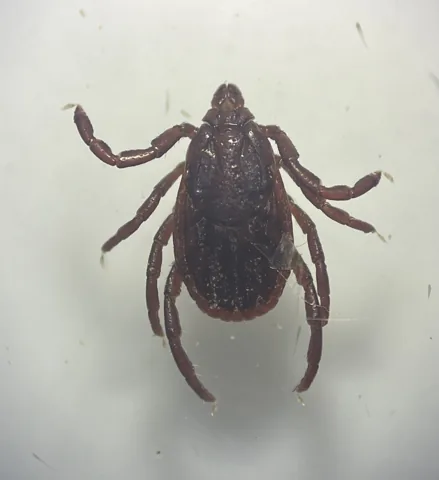 Brown Dog Tick
Rhipicephalus sanguineus
The brown dog tick is unusual: unlike most ticks, it can complete its entire life cycle indoors. It occurs across the United States, is met more often in the southern states, and can build up to high numbers on dogs and in homes and kennels. UF/IFAS Featured Creatures adds that this lets it set up populations even in colder climates.
Which ticks spread Rocky Mountain spotted fever
RMSF is caused by the bacterium Rickettsia rickettsii, and CDC says it is transmitted mostly by three ticks. MedlinePlus puts it more simply: the wood tick carries it in the western US and the dog tick in the eastern US.[2][9]
- American dog tick (Dermacentor variabilis): found widely east of the Rocky Mountains and in limited areas west of them. CDC says the highest risk of being bitten is in spring and summer and adult females are most likely to bite people.[5][2]
- Rocky Mountain wood tick (Dermacentor andersoni): Rocky Mountain states and southwestern Canada from elevations of 4,000 to 10,500 feet. CDC says adult ticks are mainly the ones that pass diseases to people; this tick also spreads Colorado tick fever and tularemia.[5][2]
- Brown dog tick (Rhipicephalus sanguineus): found worldwide, and CDC says it is the main RMSF vector in parts of the southwestern US and Mexico. Dogs are its main host at every life stage, but it may bite people too (CDC). The Merck Veterinary Manual says it is the primary vector in focal areas of Arizona, particularly on Native American tribal lands.[5][2][11]
- Not sure which tick you have? The tick profiles and the types of ticks guide below show how to tell them apart; CDC's maps show where each species lives, but it notes that a tick being present in an area doesn't mean it is spreading a given disease there.[5]
Where and when people get it
CDC reports RMSF under the category spotted fever rickettsiosis, which is reported in each of the lower 48 states, with most cases from North Carolina, Oklahoma, Arkansas, Tennessee and Missouri. MedlinePlus lists North and South Carolina, Virginia, Georgia, Tennessee and Oklahoma among the eastern states with most recent cases.[2][9]
Season: CDC says cases are reported in every month, but most occur from May to August, and ticks are most active in the warmer months of April to September. MedlinePlus says most cases occur in spring and summer.[2][1][9]
Not everyone remembers a tick bite, MedlinePlus notes, so time spent in woods or high brush where ticks live counts as exposure too; CDC's advice to see a provider covers both a known bite and time in those areas.[9][1]
Arizona and the brown dog tick
Arizona is different. CDC says brown dog tick transmission in Arizona and northern Mexico means cases happen year-round, tick exposure happens in and around the home, including yards, kennels and inside houses, and cases there have unusually high incidence and fatality, particularly among children.[2]
The Arizona Department of Health Services says it first noticed rising RMSF cases in 2002, when a study found the brown dog tick carrying the germ in Arizona, and that mild winters and the tick's preference for dogs let the disease spread year-round. In November 2011 it reported 38 Arizona cases so far that year, compared with 17 in all of 2010, mostly in the eastern part of the state.[10]
CDC reported more than 300 cases and 20 deaths on Arizona Indian reservations between 2002 and 2014.[8]
Arizona's advice: dogs in rural and eastern Arizona should always wear a fresh tick collar, pets and people should be checked for ticks after time in rural or wild areas, and weeds, grass and debris around homes should be cleared to remove tick habitat (AZ DHS). For brown dog ticks already living indoors, see how to get rid of brown dog ticks in the house.[10]
Symptoms and when to get care
CDC lists fever, headache, rash, nausea or vomiting, stomach pain, muscle pain and lack of appetite. MedlinePlus adds chills, confusion, light sensitivity and diarrhea, and says symptoms usually develop about 2 to 14 days after the tick bite.[1][9]
The rash: CDC says it usually develops 2 to 4 days after the fever begins; the Arizona Department of Health Services says 2 to 5 days. It can look like red splotches or pinpoint dots and can change over the illness (CDC). MedlinePlus says it often first appears on the wrists and ankles as spots 1 to 5 mm across, then spreads, and some people never get a rash.[1][10][9]
If you become ill after a tick bite or after being in the woods or high brush, see your healthcare provider (CDC). Tell them about the bite or the outdoor exposure; CDC tells clinicians to always ask about tick bites, tick habitat and travel.[1][3]
This page can't diagnose you. For removing the tick, saving it and watching the bite, follow what to do after a tick bite; that guide also covers the other tickborne diseases with similar early symptoms.[1]
Why early care matters
CDC says RMSF can be deadly if not treated early, and that early treatment with the antibiotic doxycycline can prevent death and severe illness; it is approved for adults and children of all ages. CDC's clinician guidance says doxycycline works best at preventing severe complications if started within the first 5 days of illness.[1][4]
Waiting is what makes it dangerous. A 2015 CDC release said delaying treatment after infection begins raises the risk of hospitalization and death, and that severely ill patients may need amputation of fingers, toes or limbs and intensive care. CDC lists amputation, hearing loss and mental disability as possible permanent damage after severe RMSF; MedlinePlus lists brain damage, clotting problems, and heart, kidney and lung failure as complications of untreated infection.[8][1][9]
CDC does not recommend antibiotics after a tick bite to prevent RMSF in people without symptoms; instead, watch for symptoms and see a provider if fever, rash or other symptoms develop within two weeks. MedlinePlus also says antibiotics are not usually given after a tick bite. Any treatment decision is your doctor's.[4][9]
How it is diagnosed
Your provider may order blood tests, but CDC says results can take weeks and treatment should start before they are back if RMSF is suspected. CDC tells clinicians that antibody tests are frequently negative in the first week of illness, and never to delay treatment while waiting for results or because of an early negative result.[1][3]
MedlinePlus says tests may include antibody tests, blood counts, kidney and clotting tests, a urine test and a skin biopsy from the rash.[9]
Preventing it
With no vaccine, CDC says prevention means preventing tick bites on yourself, on your pets and in your yard. The yard part is covered in tick control in the yard.[1]
- Use an EPA-registered repellent with DEET, picaridin, IR3535, oil of lemon eucalyptus, para-menthane-diol or 2-undecanone, and follow the label; CDC says not to use OLE or PMD products on children under 3. EPA's repellent search tool lists only registered skin-applied products and lets you filter for ticks.[6][12]
- Treat boots, clothing and gear with 0.5% permethrin, or buy pretreated gear (CDC).[6]
- After being outdoors, tumble dry clothes on high heat for 10 minutes, shower soon, and do a full-body tick check, including after time in your own backyard (CDC).[6]
- Check pets daily and remove ticks you find. CDC says pets can carry ticks into the house, and the brown dog tick can infest homes and kennels.[7]
- Don't crush ticks from pets with bare fingers: MedlinePlus says that can infect people too. Remove ticks with tweezers, pulling carefully and steadily (MedlinePlus); the full method is in what to do after a tick bite.[9]
Dogs and Rocky Mountain spotted fever
Dogs get RMSF too. The Merck Veterinary Manual lists early signs including fever up to 105°F (40.5°C), small skin hemorrhages, swollen lymph nodes, joint inflammation, coughing or nosebleeds, eye problems, swelling of the face or legs and neurologic signs such as wobbliness or seizures. Call your veterinarian if your dog shows these after tick exposure; Merck says treatment should start before test confirmation because delay raises illness and death rates.[11]
A sick dog won't give you RMSF directly. Merck says dog-to-human transmission has not been documented because a tick is needed, but infected dogs are a sentinel for human risk, owners and dogs can fall ill around the same time, and where brown dog ticks spread it, more dogs means more risk for people and other dogs.[11]
For prevention, Merck says to use products proven against the brown dog tick where it is the vector, and to consider long-acting tick collars on all susceptible dogs in endemic areas. Ask your veterinarian which product fits your dog; for removing a tick from a dog, see the dog tick removal guide.[11]
Common questions
- Is Rocky Mountain spotted fever only in the Rocky Mountains?
- No. CDC says cases are reported in all lower 48 states, with most from North Carolina, Oklahoma, Arkansas, Tennessee and Missouri, and MedlinePlus says most recent cases are in the eastern US.[2][9]
- How soon after a tick bite do symptoms start?
- MedlinePlus says usually about 2 to 14 days after the bite. CDC tells people to see a provider if fever, rash or other symptoms develop within two weeks of a tick bite.[9][4]
- How long does a tick have to be attached?
- Sources differ. MedlinePlus says the bacteria are unlikely to pass from a tick attached for less than 20 hours; the Merck Veterinary Manual says transmission typically occurs within hours of attachment. Remove any tick as soon as you find it.[9][11]
- Can I wait to see if a rash appears?
- No. CDC says the rash usually appears 2 to 4 days after the fever starts and often late in the illness, and some people never get one (MedlinePlus). See a provider when symptoms start.[1][9]
- Is there a vaccine?
- No. CDC says there is no vaccine for RMSF, so prevention means avoiding tick bites; CDC's 2015 Arizona release said the same.[1][8]
Photo credits
- American Dog Tick: (c) Don Loarie, some rights reserved (CC BY) — via iNaturalist, CC BY 4.0
- Rocky Mountain Wood Tick: (c) Toby, some rights reserved (CC BY) — via iNaturalist, CC BY 4.0
- Brown Dog Tick: (c) NoahM, some rights reserved (CC BY) — via iNaturalist, CC BY 4.0
Sources
- Centers for Disease Control and Prevention, “About Rocky Mountain Spotted Fever.” www.cdc.gov/rocky-mountain-spotted-fever/about/index.html (accessed 2026-11-14)
- Centers for Disease Control and Prevention, “Clinical Overview of Transmission and Epidemiology (RMSF).” www.cdc.gov/rocky-mountain-spotted-fever/hcp/clinical-overview/index.html (accessed 2026-11-14)
- Centers for Disease Control and Prevention, “Clinical and Laboratory Diagnosis for Rocky Mountain Spotted Fever.” www.cdc.gov/rocky-mountain-spotted-fever/hcp/diagnosis-testing/index.html (accessed 2026-11-14)
- Centers for Disease Control and Prevention, “Clinical Care of Rocky Mountain Spotted Fever.” www.cdc.gov/rocky-mountain-spotted-fever/hcp/clinical-care/index.html (accessed 2026-11-14)
- Centers for Disease Control and Prevention, “Where Ticks Live.” www.cdc.gov/ticks/about/where-ticks-live.html (accessed 2026-11-14)
- Centers for Disease Control and Prevention, “Preventing Tick Bites.” www.cdc.gov/ticks/prevention/index.html (accessed 2026-11-14)
- Centers for Disease Control and Prevention, “Preventing Ticks on Pets.” www.cdc.gov/ticks/prevention/preventing-ticks-on-pets.html (accessed 2026-11-14)
- Centers for Disease Control and Prevention, “Prevention and early treatment of RMSF in Arizona (press release, June 19, 2015).” archive.cdc.gov/www_cdc_gov/media/releases/2015/p0619-RMSF.html (accessed 2026-11-14)
- MedlinePlus, National Library of Medicine, “Rocky Mountain spotted fever (Medical Encyclopedia).” medlineplus.gov/ency/article/000654.htm (accessed 2026-11-14)
- Arizona Department of Health Services, “Rocky Mountain Spotted Fever (Director's blog, November 15, 2011).” directorsblog.health.azdhs.gov/rocky-mountain-spotted-fever/ (accessed 2026-11-14)
- Merck Veterinary Manual, “Rocky Mountain Spotted Fever in Dogs.” www.merckvetmanual.com/generalized-conditions/rickettsial-diseases/rocky-mountain-spotted-fever-in-dogs (accessed 2026-11-14)
- US Environmental Protection Agency, “Find the Repellent that is Right for You.” www.epa.gov/insect-repellents/find-repellent-right-you (accessed 2026-11-14)