The short answer
- It most likely came in on a dog, a cat, your clothes or someone's gear. University of Kentucky says ticks can hitch a ride on pets and fall off in your home before they feed, and CDC says pets can carry ticks inside, where they may bite people.[7][3][1]
- Don't crush it with your fingers. CDC says to dispose of a live tick by putting it in a sealed container, wrapping it tightly in tape, putting it in alcohol or flushing it. If you may want it identified, keep it: put it in a sealed bag or container (alcohol helps preserve it) with the date and place it was found.[2][7][10]
- Check everyone, then the pets. Do a full-body tick check on yourself and your kids (CDC), check dogs and cats that go outdoors, and tumble dry clothes worn outside on high heat for 10 minutes.[1][3][4]
- One tick is rarely an infestation. The exception is the brown dog tick, which Ohio State and Kentucky say is the only tick that can live its whole life indoors. If you keep finding ticks inside, especially on or near a dog, see our brown dog tick guide.[10][7][9]
Related pest profiles
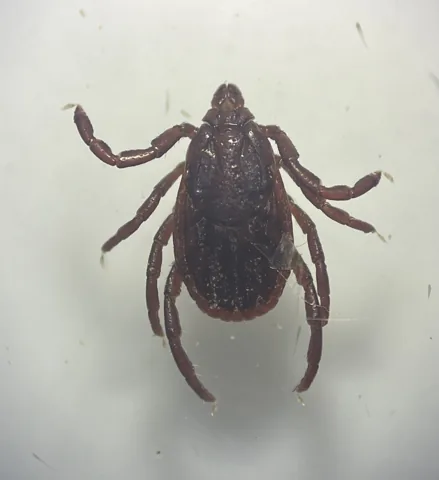 Brown Dog Tick
Rhipicephalus sanguineus
The brown dog tick is unusual: unlike most ticks, it can complete its entire life cycle indoors. It occurs across the United States, is met more often in the southern states, and can build up to high numbers on dogs and in homes and kennels. UF/IFAS Featured Creatures adds that this lets it set up populations even in colder climates.
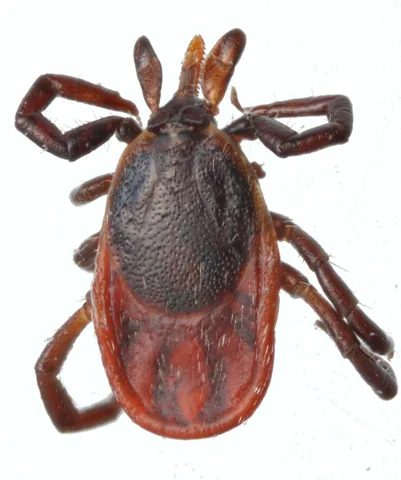 Blacklegged Tick
Ixodes scapularis
The blacklegged tick, often called the deer tick, is widely distributed across the eastern United States and spreads the bacteria that cause Lyme disease along with several other infections.
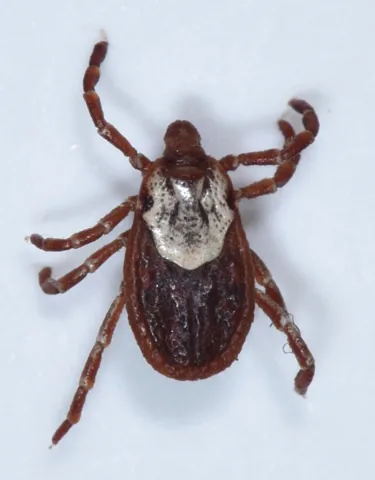 American Dog Tick
Dermacentor variabilis
The American dog tick, also called the wood tick, is widely distributed east of the Rocky Mountains. Adult females are the stage most likely to bite people, especially in spring and summer, and adults commonly climb to the crown of the head.
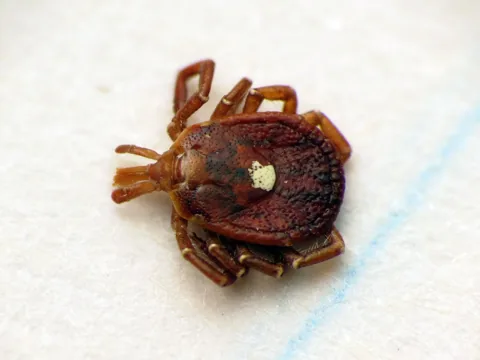 Lone Star Tick
Amblyomma americanum
The lone star tick is a very aggressive tick that readily bites people and pets across the Northeast, South and Midwest; its bite is linked to alpha-gal syndrome, a red meat allergy.
How did a tick get inside?
On people and their things. CDC says ticks may be carried into the house on clothing and can ride in on clothing and pets, then attach to a person later, which is why it says to examine pets, coats and daypacks.[1]
On pets. CDC says dogs and cats often come into contact with ticks outside and can transport them indoors, where the ticks may then bite people. University of Kentucky says ticks can fall off pets in your home before they feed.[3][7]
From a nearby field or woods. Clemson says woodland ticks (blacklegged or deer tick, lone star tick, American dog tick) crawl around for several hours before attaching, so they may be brought into a home on pets or clothing, and a home built on recent field or forest has a higher chance of ticks close by.[9]
Which tick could it be?
Four ticks are the usual suspects in U.S. homes. These field marks are a quick guide; our types of ticks page has photos and every species, and young ticks are hard to tell apart. Ohio State says larvae and nymphs are entirely tan or brown and difficult to identify to species.[10][7]
- Blacklegged (deer) tick: Kentucky describes adults as a reddish-orange body with black legs and scutum (the shield behind the head). Ohio State says adults are only slightly more than 1/16 inch (males) to about 3/32 inch (unfed females), and CDC says it is widely distributed across the eastern United States.[7][10][5]
- American dog tick: brown with a complex white pattern on the scutum and short mouthparts (Kentucky). Ohio State says it is the largest tick in Ohio, about 3/16 of an inch. CDC says it is widely distributed east of the Rocky Mountains.[7][10][5]
- Lone star tick: reddish brown, and the adult female has one white dot on her back (Kentucky). Ohio State says the unfed female is about 3/16 inch with a silvery spot. CDC says it is widely distributed in the Northeast, South and Midwest.[7][10][5]
- Brown dog tick: reddish brown with no markings, about 1/8 inch unfed (Ohio State); Kentucky describes a brown, teardrop-shaped body with short mouthparts. CDC says dogs are its main host in every life stage, but it may also bite people.[10][7][5]
What to do with the tick
Don't squash it with bare fingers. CDC says not to crush a tick with your fingers, and Merck Veterinary Manual warns never to handle ticks with bare hands because some tick-borne germs, such as the one that causes Rocky Mountain spotted fever, can enter through breaks in the skin.[2][11]
To kill it, CDC lists four options: a sealed container, wrapping it tightly in tape, flushing it down the toilet, or putting it in alcohol.[2]
To keep it for ID, skip the toilet. Kentucky says to store a tick in a sealed plastic bag with the date and location noted, and that your local Cooperative Extension office can identify it. Ohio State suggests a container with hand sanitizer or rubbing alcohol, which helps preserve it, and says to take it to your healthcare provider if you get flu-like symptoms.[7][10]
If you find a tick already attached to you or a child, remove it right away with fine-tipped tweezers and follow the steps on our what to do after a tick bite page.[2][6]
Check yourself, your kids and your pets
Do a full-body tick check. CDC says to use a hand-held or full-length mirror and to check these places on you and your children: under the arms, in and around the ears, inside the belly button, the back of the knees, in and around the hair, and around the waist. Clemson adds that young ticks are small enough to be mistaken for freckles or dirt, and that it helps to have another person check places you can't see.[1][9]
Shower. CDC says showering within two hours of coming indoors has been shown to reduce your risk of getting Lyme disease, may wash off unattached ticks and is a good chance to do a tick check.[1]
Run the clothes through the dryer. CDC says to tumble dry clothes on high heat for 10 minutes to kill ticks on dry clothing; damp clothes may need more time. If they need washing first, CDC recommends hot water and says cold and medium temperature water will not kill ticks.[1]
- Pets: CDC says to check pets that go outdoors every day. Run your fingers through the fur with gentle pressure to feel for small bumps, and look in and around the ears, around the eyelids, under the collar, under the front legs, between the back legs, between the toes and around the tail.[3][4]
- If you find a tick on your dog, see how to remove a tick from a dog. Merck Veterinary Manual says to remove it as soon as possible with tweezers grasped close to the skin.[11]
Is a loose tick dangerous?
A tick crawling on the floor hasn't bitten anyone. The risk is a tick you haven't found yet. MedlinePlus says certain ticks can pass on germs when they bite, and CDC says to see your doctor if you develop a rash or fever within several weeks of removing a tick.[6][2]
MedlinePlus lists the most common signs of tickborne disease as fever, chills, aches and pains, and rash, and says to contact your health care provider if any develop within several weeks of removing a tick. Ohio State says to tell the provider you were recently bitten by a tick and to bring the saved tick.[6][10]
Which diseases depend on the tick and where you live; our what to do after a tick bite page covers them by disease.[2][6]
Protecting your dog or cat
Merck Veterinary Manual says infested dogs should be treated with anti-tick products that kill attached larvae, nymphs and adults, that care is needed choosing the product, and to ask your veterinarian for the best one for your pet. It adds that you should tell the veterinarian about any other pets in the household.[11]
FDA strongly recommends involving your veterinarian when choosing a flea and tick product, especially if your pet has health conditions, reading the label and package insert, and saving the packaging in case a problem occurs and you need to report it.[12]
Could it be an infestation?
Usually not. Clemson says woodland ticks do not establish populations indoors, and Ohio State says the brown dog tick is the only tick that can become established indoors in homes with dogs and in kennels.[9][10]
Suspect brown dog ticks if you keep finding ticks inside, especially around where a dog sleeps. CDC says this tick can infest indoor spaces like homes and kennels. Clemson says that indoors the ticks are found in cracks, crevices, behind baseboards and other protected places close to the floor, and that a female can lay as many as 5,000 eggs, so infestations can become very large.[3][9]
Adults on the dog usually attach in the ears and between the toes, and larvae and nymphs on the back (Ohio State, Clemson). The University of Rhode Island says brown dog ticks can complete their life cycle in as few as three months and adults can survive for 18 months without feeding; Ohio State gives about 60 days per generation under ideal conditions.[10][9][8]
Ohio State says brown dog ticks rarely feed on people, and CDC says the tick may also bite humans. Our brown dog tick guide covers treating the dog, vacuuming and crack-and-crevice treatment step by step.[10][5]
When to call a doctor, vet or pro
Doctor: if you or a child gets fever, chills, aches or a rash within several weeks of a tick bite (MedlinePlus, CDC). Ohio State says to contact your healthcare professional right away and mention the tick bite.[6][2][10]
Veterinarian: to choose a tick product for your pet, or if you find ticks on your dog. Merck and FDA both say to involve your veterinarian.[11][12]
Pest control pro: if ticks keep turning up indoors. The University of Rhode Island says brown dog tick infestations can be difficult to control, usually need a four-step process (pets, house, yard and vacuuming) and may take several months to eradicate.[8][10]
Common questions
- Does one tick in the house mean there are more?
- Usually not. Most ticks ride in on pets or clothing and don't establish indoors (Clemson). The brown dog tick is the exception (Ohio State, CDC).[9][10][3]
- How do I kill a tick I found?
- CDC says put it in a sealed container, wrap it tightly in tape, flush it or put it in alcohol, and don't crush it with your fingers. Keep it in a sealed bag or alcohol if you want it identified.[2][10]
- Will the dryer kill ticks on clothes?
- Yes. CDC says high heat for 10 minutes kills ticks on dry clothing; damp clothes need longer, and washing should be in hot water.[1]
- Should I shower after finding a tick?
- If you've been outdoors, yes. CDC says showering within two hours of coming indoors has been shown to reduce Lyme disease risk and is a good time for a tick check.[1]
- Can a tick live in my house?
- Most can't establish indoors. Kentucky and Ohio State say the brown dog tick can complete its whole life cycle inside.[7][10]
- Who can identify the tick?
- Kentucky says your local Cooperative Extension office can identify it; store it in a sealed bag with the date and place found.[7]
Photo credits
- Brown Dog Tick: (c) NoahM, some rights reserved (CC BY) — via iNaturalist, CC BY 4.0
- Blacklegged Tick: (c) Christian Back, some rights reserved (CC BY) — via iNaturalist, CC BY 4.0
- American Dog Tick: (c) Don Loarie, some rights reserved (CC BY) — via iNaturalist, CC BY 4.0
- Lone Star Tick: (c) Katja Schulz, some rights reserved (CC BY) — via iNaturalist, CC BY 4.0
Sources
- Centers for Disease Control and Prevention, “Preventing Tick Bites.” www.cdc.gov/ticks/prevention/index.html (accessed 2026-11-14)
- Centers for Disease Control and Prevention, “What to Do After a Tick Bite.” www.cdc.gov/ticks/after-a-tick-bite/index.html (accessed 2026-11-14)
- Centers for Disease Control and Prevention, “Preventing Ticks on Pets.” www.cdc.gov/ticks/prevention/preventing-ticks-on-pets.html (accessed 2026-11-14)
- Centers for Disease Control and Prevention, “How to Check Your Pet for Ticks (fact sheet).” www.cdc.gov/healthy-pets/media/pdfs/publications/check-pets-for-ticks-508.pdf (accessed 2026-11-14)
- Centers for Disease Control and Prevention, “Where Ticks Live.” www.cdc.gov/ticks/about/where-ticks-live.html (accessed 2026-11-14)
- MedlinePlus, U.S. National Library of Medicine (NIH), “Tick Bites (MedlinePlus health topic).” medlineplus.gov/tickbites.html (accessed 2026-11-14)
- University of Kentucky Entomology, “ENTFACT-618: Ticks and Disease in Kentucky.” entomology.mgcafe.uky.edu/ef618 (accessed 2026-11-14)
- University of Rhode Island TickEncounter Resource Center, “Brown Dog Tick.” web.uri.edu/tickencounter/species/brown-dog-tick/ (accessed 2026-11-14)
- Clemson Cooperative Extension Home & Garden Information Center, “Ticks Around Your Home, HGIC 2484 (J. M. Sargent, P. A. Zungoli, E. P. Benson).” hgic.clemson.edu/factsheet/ticks/ (accessed 2026-11-14)
- Ohio State University Extension (Ohioline), “Ticks and Tick-Borne Diseases (HYG-2073).” ohioline.osu.edu/factsheet/HYG-2073 (accessed 2026-11-14)
- Merck Veterinary Manual, “Ticks of Dogs (Dog Owners).” www.merckvetmanual.com/dog-owners/skin-disorders-of-dogs/ticks-of-dogs (accessed 2026-11-14)
- U.S. Food and Drug Administration, “Safe Use of Flea and Tick Products in Pets.” www.fda.gov/consumers/consumer-updates/safe-use-flea-and-tick-products-pets (accessed 2026-11-14)