The short answer
- Try not to crush it, and don't throw it away. Catch it on clear tape stuck to white paper, or put it in a pill bottle or zipper bag with a teaspoon of rubbing alcohol, so it can be identified.[3]
- Get the ID confirmed before you treat anything. Bat bugs, carpet beetles and fleas are often mistaken for bed bugs, and your county extension office or a pest professional can identify it.[1][7][8]
- One bug may or may not mean an infestation. NPIC says an immature or male bed bug brought into a home won't start one, but one pregnant female can; Mississippi State Extension also says a single mated female is enough. Inspect the bed and nearby furniture next.[1][2]
- Keep sleeping in your own bed, and skip the bug bomb. NPIC warns that moving to another room lets the bugs follow you and spread, and foggers don't reach bed bugs hiding in cracks.[1][10]
Related profiles on this site
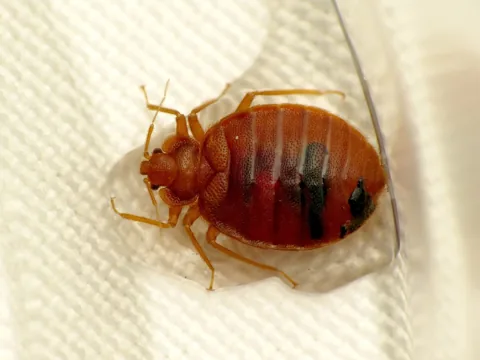 Bed Bug
Cimex lectularius
Bed bugs are wingless, blood-feeding insects that feed on sleeping or resting people, mostly at night; they have resurged worldwide and now turn up even in the finest hotels. CDC says they turn up in five-star hotels and resorts, and how clean a place is does not determine whether bed bugs are present.
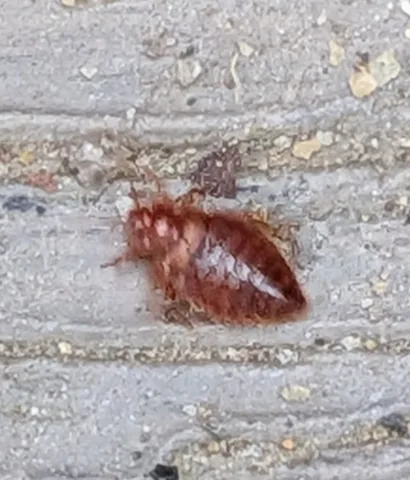 Bat Bugs
Cimex adjunctus (eastern bat bug) and Cimex pilosellus (western bat bug)
Bat bugs are close relatives of bed bugs that feed on the blood of roosting bats. They turn up in homes that have bats in the attic or walls, and they may bite people when the bats leave or are shut out.
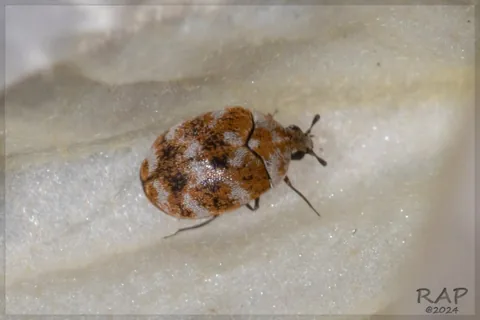 Varied Carpet Beetle
Anthrenus verbasci
Carpet beetles are small beetles whose larvae damage wool, silk, fur, feathers, leather and other animal products; the adults feed on pollen outdoors and often fly in through windows.
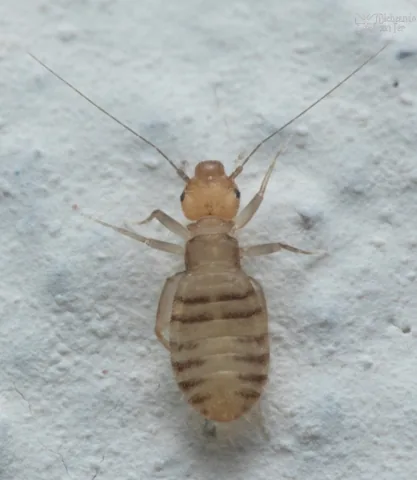 Booklice
Liposcelis species and other psocids (family Liposcelididae)
Booklice, also called psocids, are tiny insects that feed on mold and fungi. Finding them indoors usually means high humidity or a moisture problem, and drying things out is the most effective control.
Is it really a bed bug?
Check what you caught against this description first. Several insects get mistaken for bed bugs, and EPA warns that misidentifying them gives a real infestation more time to spread.[7][1]
- Bed bug: an adult is about the size of an apple seed (5-7 mm, 3/16 - 1/4 inch long), long and brown with a flat, oval body when unfed, and reddish-brown and swollen after a meal. Young bed bugs are smaller and lighter in color.[6][14]
- Bat bugs and swallow bugs: close relatives that look almost the same, red- or gray-brown and wingless. Telling them apart takes a hand lens or microscope: on bat bugs the fringe hairs just behind the head are longer than the width of the eyes, on bed bugs they are shorter. Bat bugs turn up near roosting bats, in attics and upper floors, and cannot reproduce on human blood.[15][5]
- Carpet beetles: adults are small (1/16 to 1/8-inch) oval beetles, often speckled or mottled; the larvae are tan to brownish and densely covered with hairs or bristles. EPA names carpet beetles as an insect easily mistaken for bed bugs.[18][7]
- Booklice (psocids): small, soft-bodied, wingless insects, 1-2 mm long. Penn State says their flat shape gets them confused with bed bugs, but a newly hatched bed bug is about the size of an adult booklouse, and bed bugs are rounder with a head narrower than the body.[16][17]
Does one bed bug mean an infestation?
Not always. People pick up bed bugs on luggage, clothes, bedding, furniture and other belongings, and bring them home after overnight stays. NPIC says an immature bed bug or a male introduced into a home will not start an infestation, but one pregnant female can quickly reproduce. Mississippi State Extension puts it the same way: a single mated female is enough to start one.[5][1][2]
Where you found it is a clue. Bed bugs tend to gather, but Kentucky's entomologists note you can also find a single bug here and there. Early in an infestation they stay mostly in beds and places people rest; as numbers grow they move beyond the bed.[4]
- A bite alone doesn't settle it either way. CDC says bite marks may take as long as 14 days to show up in some people, and UC IPM says bites should never be used for diagnosis because other household pests bite and reactions vary between people. You confirm bed bugs by finding the bugs or their signs.[13][5]
How to catch and save it for ID
Cornell's IPM program suggests a small, break-resistant container such as a plastic pill bottle or a zipper-lock bag with 1 tsp of rubbing alcohol in it, or taping the bug to a sheet of white paper with clear tape. Freezing it also works. Either way, package it carefully so it isn't damaged on the way to an expert.[3]
- Take it to an expert. NPIC points to your local Cooperative Extension office or a pest management professional, EPA says extension agents can identify the pest at no cost to you, and Mississippi State Extension accepts suspected bed bugs for identification through its county offices. Cornell suggests sending several adults if you can catch them.[1][8][2][3]
Where to look for more
Start at the bed. EPA says bed bugs hide near the piping, seams and tags of the mattress and box spring and in cracks of the bed frame and headboard. CDC says they tend to live within 8 feet of where people sleep. Then check couches and recliners, which NPIC lists as common hiding places; Cornell says to check the couch after the bedroom if anyone naps there.[7][13][1][3]
Signs to look for besides live bugs: rusty or reddish stains on sheets or mattresses from crushed bugs, dark spots of excrement that bleed into fabric like a marker, tiny pale eggs and eggshells, and shed skins.[7]
- Cornell adds a word of caution: once you find a bug, save it, stop searching and call a professional, since you don't want to disturb the bugs. Our signs of bed bugs guide walks through a full inspection if you want to look further yourself.[3]
What not to do
Don't move to the couch or a spare room. NPIC says that if you find bed bugs near your bed, sleeping in another part of the house lets them follow you, spreading the infestation and making it harder to treat. Cornell also advises against sleeping away from home while you deal with them.[1][3]
- Don't carry bedding or clutter into clean rooms. EPA says not to move items from an infested area to a non-infested area, and to use sealed plastic bags for anything you take to the dryer.[9]
- Don't set off a bug bomb. EPA says foggers should not be the only control, since the spray has to touch the bugs and won't reach them in cracks and crevices. Kentucky's entomologists say bleach, alcohol, lighters and bug bombs should not be used against bed bugs, and NPIC says pesticide applications and other disturbances can push bed bugs into other rooms or the apartment next door.[10][4][1]
- Don't throw furniture out in a hurry. NPIC says discarding it right away can spread bed bugs through the house, and other people may take home what you throw out and start new infestations.[1]
If you've been bitten
Bed bugs are not known to spread diseases to people. Bites can cause itching and loss of sleep, and intense scratching can lead to a skin infection. Some people have no reaction at all, and severe allergic reactions are rare.[13][14]
- CDC says bites usually don't need medical treatment: antiseptic creams or lotions help with itching, an antihistamine may help with itchy inflammatory reactions, and you should avoid scratching. If you think you're having an allergic reaction, such as enlarged bite marks or painful swelling, talk with your healthcare provider.[13]
What to do next
Once the bug is confirmed as a bed bug, make a plan rather than reaching for a spray can. EPA's top tips include not panicking and thinking through your treatment options before grabbing a spray can, and Kentucky's entomologists say dish-shaped interceptor traps under bed and sofa legs help reveal bed bugs in the early stages of an infestation.[11][4]
When to call a pro
Sooner rather than later. UC IPM says confirmed bed bug infestations should be managed by trained professionals, and NPIC says a professional is often needed. Bed bugs are hard to control even for professionals, and many are resistant to common pesticides.[5][1]
- If you live in an apartment or other shared building: Kentucky says unnoticed infestations in multi-unit housing are more likely to spread to other units, and NPIC recommends a coordinated effort with neighbors and the landlord.[4][1]
- When you hire: EPA advises choosing a company experienced with bed bugs, checking its credentials, and expecting it to inspect, take apart furniture if needed, and use vacuums, heat and pesticides along with follow-up monitoring.[12]
Common questions
- Can one bed bug lay eggs?
- Only a female that has mated. NPIC says a male or an immature bed bug brought into a home won't start an infestation, but one pregnant female can quickly reproduce.[1][2]
- Should I kill it?
- Save it instead. Cornell says to freeze it or seal it in a jar with a teaspoon of rubbing alcohol or hand sanitizer so it can be identified.[3]
- Did it come in on me?
- Probably not on the clothes you were wearing. Cornell says people move too much to make a good hiding place; bed bugs are more likely to travel in luggage, backpacks, mattresses and used furniture.[3]
- Is a bat bug any better?
- It changes the fix. Bat bugs can bite people but can't reproduce on human blood, and UC IPM says managing them means dealing with the bat roost or bird nest, so the ID matters.[15][5]
Photo credits
- Bed Bug: (c) Katja Schulz, some rights reserved (CC BY) — via iNaturalist, CC BY 4.0
- Bat Bugs: (c) Jason Hill, some rights reserved (CC BY) — via iNaturalist, CC BY 4.0
- Varied Carpet Beetle: (c) RAP, some rights reserved (CC BY) — via iNaturalist, CC BY 4.0
- Booklice: (c) Luis Fernando Valdez Ojeda, some rights reserved (CC BY) — via iNaturalist, CC BY 4.0
Sources
- National Pesticide Information Center, “Bed Bugs (last updated April 15, 2026).” npic.orst.edu/pest/bedbug/index.html (accessed 2026-11-14)
- Mississippi State University Extension Service, “Bed Bugs and What to Do About Them (Publication 2546).” extension.msstate.edu/publications/bed-bugs-and-what-do-about-them (accessed 2026-11-14)
- New York State Integrated Pest Management Program, Cornell University, “Bed Bug FAQs.” cals.cornell.edu/new-york-state-integrated-pest-management/outreach-education/whats-bugging-you/bed-bugs/bed-bug-faqs (accessed 2026-11-14)
- University of Kentucky Entomology, “ENTFACT-636: Bed Bugs.” entomology.mgcafe.uky.edu/ef636 (accessed 2026-11-14)
- University of California Statewide IPM Program, “Pest Notes: Bed Bugs, Publication 7454.” ipm.ucanr.edu/legacy_assets/PDF/PESTNOTES/pnbedbugs.pdf (accessed 2026-11-14)
- U.S. Environmental Protection Agency, “Bed Bugs Appearance and Life Cycle.” www.epa.gov/bedbugs/bed-bugs-appearance-and-life-cycle (accessed 2026-11-14)
- U.S. Environmental Protection Agency, “How to Find Bed Bugs.” www.epa.gov/bedbugs/how-find-bed-bugs (accessed 2026-11-14)
- U.S. Environmental Protection Agency, “Do-it-yourself Bed Bug Control.” www.epa.gov/bedbugs/do-it-yourself-bed-bug-control (accessed 2026-11-14)
- U.S. Environmental Protection Agency, “Preparing for Treatment Against Bed Bugs.” www.epa.gov/bedbugs/preparing-treatment-against-bed-bugs (accessed 2026-11-14)
- U.S. Environmental Protection Agency, “Should I Use a Fogger?.” www.epa.gov/bedbugs/should-i-use-fogger (accessed 2026-11-14)
- U.S. Environmental Protection Agency, “Top 10 Tips to Prevent or Control Bed Bugs.” www.epa.gov/bedbugs/top-ten-tips-prevent-or-control-bed-bugs (accessed 2026-11-14)
- U.S. Environmental Protection Agency, “Hiring a Pest Management Professional for Bed Bugs.” www.epa.gov/bedbugs/hiring-pest-management-professional-bed-bugs (accessed 2026-11-14)
- Centers for Disease Control and Prevention, “About Bed Bugs.” www.cdc.gov/bed-bugs/about/index.html (accessed 2026-11-14)
- MedlinePlus, U.S. National Library of Medicine, “Bed Bugs.” medlineplus.gov/bedbugs.html (accessed 2026-11-14)
- Colorado State University, Agricultural Biology, “Bed Bug Look-Alikes.” agsci.colostate.edu/agbio/ipm-pests/bed-bug-look-alikes/ (accessed 2026-11-14)
- Penn State Extension, “Booklice.” extension.psu.edu/booklice (accessed 2026-11-14)
- Washington State University Pestsense, “Psocids (booklice or barklice).” pestsense.cahnrs.wsu.edu/fact-sheet/psocids-booklice-or-barklice/ (accessed 2026-11-14)
- University of Kentucky Entomology, “ENTFACT-601: Carpet Beetles.” entomology.mgcafe.uky.edu/ef601 (accessed 2026-11-14)