The short answer
- Where the bumps are: bed bugs bite any skin left exposed while you sleep, such as the face, neck, arms, hands and legs. Scabies favors the webs and sides of the fingers, the wrists, elbows, armpits, waist and buttocks.[9][7][6][1]
- What else you see: scabies can leave tiny burrows, thin lines that MedlinePlus says look like a pencil mark. Bed bugs leave evidence in the bed instead: the bugs, their shed skins and dark fecal spots along mattress seams.[1][5][11][9]
- Who else itches: scabies spreads by direct, prolonged skin-to-skin contact, and itching that is intense and worse at night in more than one person in the house points to it. Bed bug reactions vary from person to person, and some people sleeping in the same bed may show no marks at all.[1][5][9][8]
- Who confirms it: a clinician diagnoses scabies, usually by finding the mite, its eggs or its feces in a skin sample. Bed bugs are confirmed by finding the bugs or their signs where you sleep, not from the bites.[1][6][12][11]
Profiles on this site
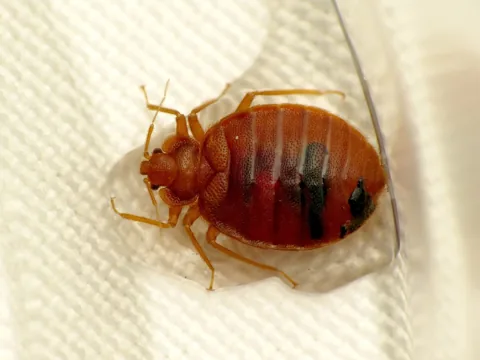 Bed Bug
Cimex lectularius
Bed bugs are wingless, blood-feeding insects that feed on sleeping or resting people, mostly at night; they have resurged worldwide and now turn up even in the finest hotels. CDC says they turn up in five-star hotels and resorts, and how clean a place is does not determine whether bed bugs are present.
 Scabies mite
Sarcoptes scabiei
Scabies is a skin infestation caused by a microscopic mite, Sarcoptes scabiei, that burrows into the upper layer of the skin of people and many other mammals. Its hallmark is intense itching, especially at night, and it spreads mainly through direct, prolonged skin-to-skin contact.
Side by side: bed bug bites and scabies
Each line gives bed bugs first, then scabies.[7][1]
- What causes it: bed bugs are wingless, reddish-brown insects 1 to 7 mm long, about the color of an apple seed; MedlinePlus puts adults at 1/4 to 3/8 inch. Scabies is caused by the human itch mite, Sarcoptes scabiei var. hominis; adult females are 0.30 to 0.45 mm long, too small to see well.[7][8][11][1][4]
- Where it lives: bed bugs don't stay on people the way lice or ticks do; after feeding they crawl back to hiding places close to the bed, such as mattresses, box springs, bed frames and headboards. The scabies mite lives in the skin and lays its eggs there.[11][1][5]
- How you get it: bed bugs hitch rides on second-hand items, delivered furniture and bedding, and on people's belongings. Scabies spreads mostly through direct, prolonged skin-to-skin contact with an infested person, and less commonly through shared clothing, towels or bedding.[9][11][1][5]
- Where the marks show: bed bugs bite exposed skin while you sleep, such as the face, neck, arms, hands or legs. Scabies shows up between the fingers, on the wrists, elbows and armpits, and on the waist, thighs, genitals and lower buttocks; in infants and young children the rash often appears on the head, face, neck, palms and soles.[9][7][6][1][5]
- What the marks look like: CDC says bed bug bites look like mosquito or flea bites, a slightly swollen red area, and may be random or in a straight line. Washington's health department says they are often clustered or in a line along the edge of clothing or where the sheets were pulled up. Scabies causes a pimple-like rash, sometimes with tiny burrows on the skin.[7][9][1][5]
- When the marks appear: bed bug bite marks usually show up from one to several days after the bite, and can take as long as 14 days in some people. A first scabies infestation takes 4 to 8 weeks to cause symptoms according to CDC, or 2 to 6 weeks according to the Wisconsin Department of Health Services; someone who has had scabies before may react within 1 to 4 days.[7][9][1][6]
- The itch: some people have no reaction at all to bed bug bites, while sensitive people can develop itchy red welts. Scabies itching is intense and worst at night.[8][9][1][5][6]
- Others in the home: because bed bug reactions vary, bites may go unnoticed or be mistaken for flea or mosquito bites, so one person with no marks doesn't clear the bed. Scabies is easily spread among people in close contact, and whole households are treated at the same time.[9][5][1]
- Disease: bed bugs are not known to spread disease to people, and a JAMA review found little evidence that they carry communicable disease. With either one, heavy scratching can lead to a skin infection.[7][8][10][6]
- How it's confirmed: for bed bugs, the only way to really confirm them as the cause is to find the bugs or their signs in the bed or bedroom. For scabies, a health care provider looks for the mite, its eggs or its feces, often by scraping the skin or lifting a mite from the end of a burrow.[12][11][1][5][6]
How to check the bed for bed bugs
Bites alone can't settle it, so look for the insect. Kentucky Extension says bed bugs gather in habitual hiding places like mattresses, box springs, bed frames and headboards, and they become more likely if you have traveled or brought home used beds or furniture before the bites began.[11][12]
- Strip the bed and check the seams, folds and edges of the mattress and box spring, then the bed frame and headboard. A thorough check means taking the bed apart and standing pieces on edge.[11]
- Look for the bugs themselves, the shed skins of young bugs, and blackish fecal spots, sometimes with reddish smears or rusty bloodstains on sheets and the mattress.[11][9]
- Bed bugs fit into crevices no wider than a toothpick, so check screw holes and the underside of the box spring where it rests on the frame.[11]
- Pitfall-style traps placed under the bed legs catch wandering bed bugs that crawl in and can't climb out, which helps confirm bugs that a visual search missed.[11]
- If you find a bug, keep it. UC IPM notes that people who can't produce a specimen are harder to diagnose, and Kentucky says confirming bed bugs often takes a professional.[12][11]
- If the bed is clean and the itch keeps spreading through the household or is worst at night, stop searching for bugs and see a health care provider about scabies.[1][2][12]
Why it matters: the fixes don't overlap
Treating the house won't cure scabies, and a prescription won't clear bed bugs from a mattress. CDC says not to use insecticide sprays or fumigants for scabies, and Wisconsin's health department says environmental pesticides should be avoided.[2][6]
Bed bugs, on the other hand, are a pest-control job: UC IPM says confirmed infestations are best handled by trained professionals, and getting rid of them may mean treating or removing infested material and monitoring until the bugs are gone.[12][11]
What to do for each
Scabies is a medical problem for a health care provider; bed bugs are a pest problem for the home.[2][12]
- Suspected scabies: see a health care provider. CDC says over-the-counter medicine does not treat scabies; a provider diagnoses it and can prescribe a treatment that kills the mites.[2][1][5]
- Scabies in the household: treat all household members and close contacts at the same time, even without symptoms, and tell people you had skin-to-skin contact with in the previous two months to seek care.[1][2][6]
- Scabies laundry: wash clothing, towels and bedding used next to the skin in the three days before treatment in hot water and dry on the hot cycle; CDC says 122°F for 10 minutes kills mites and eggs, and MedlinePlus advises drying at 140°F or higher. Seal what you can't wash in a plastic bag for several days to a week, since the mites generally don't survive more than two to three days away from skin.[1][3][5]
- Itch after scabies treatment: itching can last weeks after the mites are dead, because it is an allergic reaction to the mites. CDC says to go back to the provider if itching is still there two to four weeks after treatment or new burrows or rash appear.[1][5][6]
- Bed bug bites: most go away by themselves without treatment. Avoid scratching to prevent infection, and speak with a health care provider if bites are very itchy or you think you're having an allergic reaction.[9][7][8]
- Bed bugs in the home: vacuum seams and crevices of the mattress, bed frame and nearby furniture, bag and discard the vacuum contents outdoors, wash linens in hot water and dry them hot for at least 20 minutes, and cover the mattress, box spring and pillows with bed bug encasements; then follow a full control plan.[9][11]
What about the dog?
Dogs get their own variety of the scabies mite, Sarcoptes scabiei var. canis, which causes sarcoptic mange. The Merck Veterinary Manual calls it highly contagious among dogs; skin signs usually start on the belly, chest, ears, elbows and hocks and spread if untreated. Merck adds that people who handle infested dogs may be affected.[13]
CDC says animals don't spread human scabies, and the mites that infest animals can't survive or reproduce on people, so an itchy pet points to a vet visit for the pet, not human scabies treatment for the family.[3][13]
Bed bugs bite animals as well as people while they sleep.[7]
Common questions
- Can bed bugs give you scabies?
- No. They are different animals: bed bugs are blood-feeding insects that hide near the bed, while scabies is caused by a mite that lives in human skin and spreads mostly by skin-to-skin contact.[7][1][5]
- Can I catch scabies from a hotel bed or used mattress?
- It's unusual. CDC says scabies spreads mostly by prolonged skin-to-skin contact and less commonly through shared bedding, clothing or towels; Wisconsin DHS says that, except in severe cases, clothing, bedding and furniture don't spread it. Bed bugs, on the other hand, do travel in used beds and furniture.[1][6][9][11]
- Do bed bug bites always come in a line?
- No. CDC says the marks may be random or in a straight line, and Washington's health department says they are often clustered or in a line; some people show no marks at all.[7][9][8]
- Do I need to spray the house for scabies?
- No. CDC says not to use insecticide sprays or fumigants for scabies, and Wisconsin DHS says environmental pesticides should be avoided. Washing bedding and clothing and bagging what you can't wash is enough.[2][6][1]
- Can a pest control company tell me whether it's scabies?
- No. A pest professional can confirm bed bugs by finding them or their signs, but scabies is diagnosed by a health care provider from a skin exam and, usually, a skin sample.[12][11][1][6]
Photo credits
- Bed Bug: (c) Katja Schulz, some rights reserved (CC BY) — via iNaturalist, CC BY 4.0
- Scabies mite: Tero Linjama, public domain (CC0), via iNaturalist
Sources
- Centers for Disease Control and Prevention, “About Scabies.” www.cdc.gov/scabies/about/index.html (accessed 2026-11-14)
- Centers for Disease Control and Prevention, “Treatment of Scabies.” www.cdc.gov/scabies/treatment/index.html (accessed 2026-11-14)
- Centers for Disease Control and Prevention, “Preventing Scabies.” www.cdc.gov/scabies/prevention/index.html (accessed 2026-11-14)
- Centers for Disease Control and Prevention, “DPDx: Scabies.” www.cdc.gov/dpdx/scabies/index.html (accessed 2026-11-14)
- MedlinePlus, U.S. National Library of Medicine, “Scabies (Medical Encyclopedia).” medlineplus.gov/ency/article/000830.htm (accessed 2026-11-14)
- Wisconsin Department of Health Services, Division of Public Health, “Scabies, Disease Fact Sheet Series (P-42089).” www.dhs.wisconsin.gov/publications/p4/p42089.pdf (accessed 2026-11-14)
- Centers for Disease Control and Prevention, “About Bed Bugs.” www.cdc.gov/bed-bugs/about/index.html (accessed 2026-11-14)
- MedlinePlus, U.S. National Library of Medicine, “Bed Bugs (health topic).” medlineplus.gov/bedbugs.html (accessed 2026-11-14)
- Washington State Department of Health, “Bed Bugs.” doh.wa.gov/community-and-environment/pests/bed-bugs (accessed 2026-11-14)
- JAMA (PubMed abstract), “Goddard J, deShazo R. Bed bugs (Cimex lectularius) and clinical consequences of their bites. JAMA 2009;301(13):1358-66 (PMID 19336711).” pubmed.ncbi.nlm.nih.gov/19336711/ (accessed 2026-11-14)
- University of Kentucky Entomology, “ENTFACT-636: Bed Bugs.” entomology.ca.uky.edu/ef636 (accessed 2026-11-14)
- UC Statewide IPM Program, “Pest Notes: Bed Bugs.” ipm.ucanr.edu/home-and-landscape/bed-bugs/ (accessed 2026-11-14)
- Merck Veterinary Manual, “Mange in Dogs and Cats.” www.merckvetmanual.com/integumentary-system/mange/mange-in-dogs-and-cats (accessed 2026-11-14)