The short answer
- Think back a day or two. Chigger bites follow time outdoors in tall grass, weeds, berry patches or woodland edges, and they show up mostly in summer and fall. Scabies has nothing to do with the outdoors; it spreads by direct, prolonged skin-to-skin contact with someone who has it.[8][1][7]
- Look at where the bumps are. Chigger bites bunch up where clothing fits tight: sock lines, the waistband, warm skin folds, and the rash may stop where underwear meets the legs. Scabies favors the webs between the fingers, the wrists, elbows, armpits, waist, buttocks and genitals.[8][12][1][9]
- Notice the timing of the itch. Chigger itching starts within hours of the bite and fades on its own. Scabies itching is worst at night, and in a first infestation it can take weeks to start.[8][10][1][9]
- Ask who else is itching. Scabies often runs through a whole family or a care facility, and it needs a prescription; no over-the-counter product is approved to treat it. Chigger bites don't call for prescription mite-killing medicine; care is aimed at the itch.[7][1][2][8]
Profiles on this site
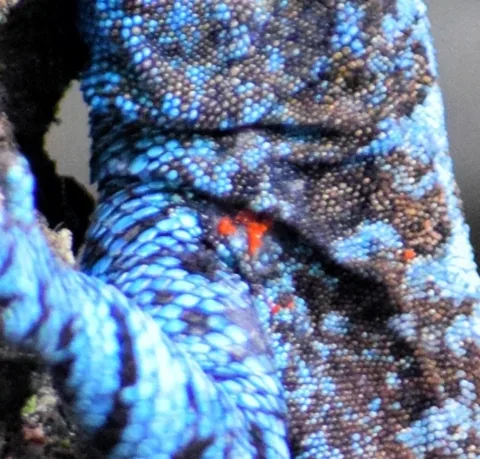 Chiggers
Trombiculidae (e.g., Trombicula / Eutrombicula alfreddugesi)
Chiggers are the tiny larvae of mites; only the larva bites, and its feeding causes intense itching and small red welts. Contrary to popular belief, chiggers don't burrow into the skin or suck blood.
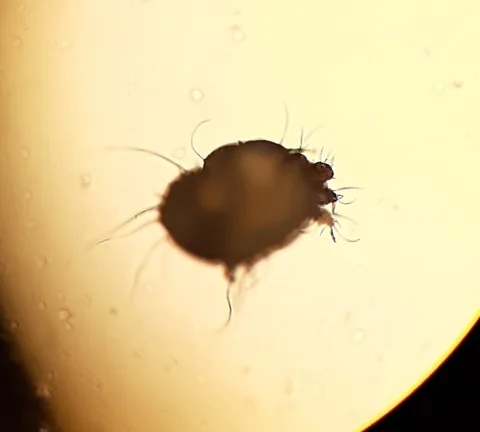 Scabies mite
Sarcoptes scabiei
Scabies is a skin infestation caused by a microscopic mite, Sarcoptes scabiei, that burrows into the upper layer of the skin of people and many other mammals. Its hallmark is intense itching, especially at night, and it spreads mainly through direct, prolonged skin-to-skin contact.
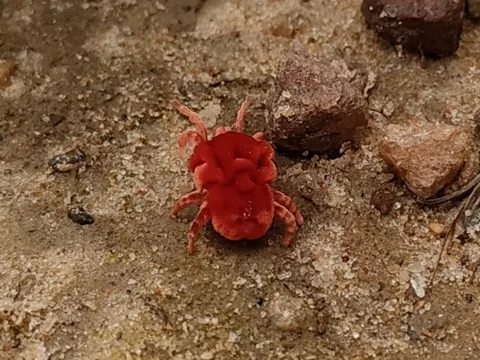 Velvet Mites
Trombidiidae (velvet mites)
Velvet mites are tiny, bright red, velvety mites seen scurrying over patios, brick walls and soil in spring. The adults prey on small insects and insect eggs, and they are harmless to people.
Side by side
"Chigger" is the name for the larval stage of trombiculid mites; in the U.S. the one most people meet is Trombicula (Eutrombicula) alfreddugesi. Scabies is caused by the human itch mite, Sarcoptes scabiei var. hominis.[15][10][17][1]
- The mite: a chigger is a six-legged larva, red or yellowish-red, less than 1/150 inch across by the Missouri Department of Conservation's measure and 0.15 to 0.3 mm long in a StatPearls review. An adult female scabies mite is a round, sac-like mite 0.30 to 0.45 mm long; its larvae have six legs and its nymphs eight.[17][15][10][5]
- Where it comes from: chigger larvae wait on the edges of leaves and grass for a passing host. Humans are accidental hosts; their natural hosts include rodents, birds, snakes and toads. Scabies mites live on people and spread mainly by skin-to-skin contact, less often through shared clothing, towels or bedding.[10][15][1]
- Does it burrow: no for chiggers. They pierce the skin, inject digestive enzymes and feed on dissolved skin cells through a hardened feeding tube called a stylostome. Yes for scabies. The female mite tunnels just under the skin surface, lives there and lays her eggs in the burrow.[15][16][10][1][5]
- How long it stays: chigger larvae are easily scratched off and rarely stay attached to a person for more than 48 hours. A person with scabies can spread it until the mites and eggs are destroyed, usually by treatment.[10][9]
- Where the bumps are: chiggers bite around the waist, the ankles and warm skin folds, along the sock and belt lines. Scabies shows between the fingers, in the folds of the wrist, elbow, knee and armpit, and on the penis, nipples, waist, buttocks and shoulder blades. Infants and young children with scabies often get a rash on the head, face, neck, palms and soles.[8][12][1]
- What it looks like: chigger bites are red, pimple-like bumps or hives. Scabies causes a pimple-like rash, and you may see tiny burrows, thin raised wavy lines that are grayish or skin-colored and look like pencil marks.[8][1][5][7]
- When the itch starts: chigger itching begins several hours after the larvae attach, and the bite itself is painless. With a first scabies infestation, symptoms take 4 to 8 weeks to appear according to CDC, or 2 to 6 weeks according to the Wisconsin Department of Health Services; after an earlier infestation they can show within 1 to 4 days.[8][1][9]
- When it itches most: scabies itching is intense and worst at night, per CDC, MedlinePlus and Wisconsin DHS. MedlinePlus describes chigger itching as severe but doesn't tie it to night.[1][7][9][8]
- Season: MedlinePlus says chigger bites mostly happen in summer and fall. Scabies is found worldwide and anyone can get it.[8][1]
- Spread to others: scabies is easily spread among people in close contact, and whole families are often affected. Chigger larvae climb onto people from grass and leaves.[7][10]
- How it ends: chigger bite reactions are usually mild and self-limited, healing within a couple of weeks, though the itch can last for weeks. Scabies needs prescription treatment, and household members and close contacts are treated at the same time.[10][11][2][1]
Why chigger bites end up at the sock line and waistband
After a chigger gets onto a person, it crawls upward under or through clothing until it reaches a spot where the clothing presses tight against the skin, then settles there to feed. That's why the bites collect at the tops of socks and shoes, under waistbands and bra bands, behind the knees, in the crotch and in the armpits. Ohio State notes that bites on open, uncovered skin are more likely from mosquitoes or biting flies.[15][16]
Only the larva bites. Nymphs and adults are free-living predators of insect eggs and small arthropods, and the adults are the bright red mites people sometimes call red bugs. Ohio State adds that the larger red mites seen on patios and lawn furniture are not chiggers and don't bite people.[13][15][16]
The itch comes from the body's reaction to the chigger's saliva and digestive enzymes, which causes redness, swelling and itching. The larva itself is seldom found on the skin; diagnosis usually rests on recent time in chigger habitat and the look and placement of the bumps.[10][16][8]
How scabies behaves differently
A scabies mite spends its life in the skin. The female lays 2 to 3 eggs a day as she burrows, the burrows stay in the top layer of skin and can reach a centimeter or more in length, and the mites leave fecal pellets behind them as they go.[5][14]
People can spread scabies before they have any symptoms. An otherwise healthy person may carry fewer than 10 to 15 mites, which is why a scraping can come back negative even when scabies is present.[1]
Scabies outbreaks are more common in nursing homes, extended care facilities, child care centers, college dorms, jails and prisons, and homeless shelters. Crusted (Norwegian) scabies is a severe, very contagious form with very large numbers of mites, mostly in people with weakened immune systems.[1][7]
Pets and other animals don't spread human scabies. Animals get a different scabies mite that causes mange; it can't survive or reproduce on people but can cause temporary itching if it gets on your skin.[4][7]
How to confirm which one it is
Chigger bites are usually diagnosed by looking at the rash and asking about recent outdoor activity; a provider may use a magnifier to find chiggers on the skin. Scabies is confirmed by finding the mite, its eggs or its feces, usually by scraping the skin or lifting the mite from the end of a burrow with a needle tip and looking at the sample under a microscope.[8][10][1][7][9]
- Write down where you were in the days before the itching began: time in tall grass, weeds, berry patches or woodland edges points toward chiggers.[8][10]
- Map the bumps. A band at the sock line or waistband fits chiggers; bumps between the fingers and on the wrists fit scabies.[12][8][1][9]
- Note whether the itch is worse at night and whether family members or close contacts have it too. Both are classic scabies clues.[1][7][9]
- If you suspect scabies, see a health care provider. CDC and MedlinePlus both say to seek care for possible scabies or after close contact with someone diagnosed with it.[3][7]
- For chigger bites, MedlinePlus says to contact a provider if the rash itches very badly or symptoms get worse or don't improve with treatment.[8]
Why getting it right matters
The fixes don't overlap. Scabies needs a prescription cream, lotion or pill that kills the mites, and CDC says no over-the-counter product has been tested and approved for human scabies. Treating only the person with the rash invites reinfestation, so CDC says to treat all household members and close contacts at the same time.[2][3][1]
Chigger bites need no mite-killing treatment at all. The chiggers are usually gone within a day or two, and care aims at the itch. MedlinePlus says antibiotics aren't needed unless the skin becomes infected.[10][8]
Indoor insecticide sprays aren't the answer for either one. Wisconsin's health department says environmental pesticides should be avoided for scabies, and chiggers live outdoors in vegetation, not indoors.[9][15]
Scratching either rash can lead to a skin infection, such as impetigo with scabies.[7][8][9]
What to do for each
For chiggers: MedlinePlus says antihistamines and corticosteroid creams or lotions may help the itch, and a dermatology review lists anti-itch products, oral antihistamines and topical corticosteroids for symptom relief.[8][11]
For scabies: see a provider for a prescription and follow its instructions. Treat everyone in the household and close contacts at the same time, even those without symptoms, and tell people you've had direct skin contact with in the previous two months to seek care.[1][7][3]
Wash clothing, towels and bedding used next to the skin in the three days before treatment starts, in hot water, and dry them on the hot cycle; CDC says temperatures above 122°F for 10 minutes kill mites and eggs. Seal what can't be washed or dry-cleaned in a plastic bag for several days to a week. CDC says scabies mites generally don't survive more than 2 to 3 days off human skin.[1][4][3]
Itching can last two weeks or more after successful scabies treatment. That alone isn't a sign treatment failed. Children and adults can usually return to child care, school or work the day after treatment.[7][9][1]
Preventing chigger bites and chiggers in the yard
On the body: MedlinePlus says to avoid areas known to have chiggers and to use bug spray with DEET on skin and clothing. A medical review recommends repellents with DEET or picaridin, and CDC notes that permethrin-treated clothing repels and kills chiggers. Covering the skin also helps.[8][12][6][11]
Chiggers favor damp areas with low shrubs, tall grass and weeds, and they are patchy: one spot can be heavily infested while another a few yards away has none. Missouri says chiggers avoid direct sunlight and normally won't infest areas that are mowed or otherwise kept up.[15][17]
In the yard, Ohio State suggests brush control, regular mowing and opening up the landscape to more sun and air flow. To check a spot, lay a square of black paper or cardboard in the grass for about 10 minutes and look for tiny yellowish-red mites crawling onto it.[16]
Spraying is of limited use. Missouri says it gives temporary control of only days or weeks, and Ohio State doesn't generally recommend insecticide because of rebound populations and harm to beneficial insects. If you treat, both point to the unkempt edges and hot spots rather than the whole lawn, following the label.[15][16]
Common questions
- Do chiggers burrow under your skin?
- No. Ohio State Extension calls that a myth, and Missouri Extension says chiggers do not burrow into the skin. Chigger larvae attach at the skin surface, feed through a tube formed from hardened skin tissue, and are easily scratched off. The scabies mite is the one that burrows.[15][16][10][1]
- Can chiggers live in my bed or house?
- Chiggers live outdoors in vegetation. Missouri Extension says they die quickly once dislodged from a host, and suggests laundering clothes worn in chigger habitat before wearing them again.[15][10]
- Could my dog or cat have given me scabies?
- Not human scabies. CDC says animals don't spread human scabies. Pets get a different mite that causes mange, which can cause temporary itching on people but can't survive or reproduce on human skin.[4][7]
- Do I need to spray or fumigate the house for scabies?
- No. Wisconsin's health department says environmental pesticides should be avoided. Washing or bagging recently used clothing, towels and bedding and vacuuming carpets and upholstered furniture is what CDC and MedlinePlus advise.[9][1][7]
- I was treated for scabies and still itch. Did it fail?
- Not necessarily. MedlinePlus says itching may continue for 2 weeks or more after treatment, and Wisconsin DHS says itching that lasts one to two weeks shouldn't be taken as treatment failure or reinfestation. Check back with your provider if it goes on longer or new burrows appear.[7][9]
Photo credits
- Chiggers: (c) Alberto Alcalá, some rights reserved (CC BY) — via iNaturalist, CC BY 4.0
- Scabies mite: Tero Linjama, public domain (CC0), via iNaturalist
- Velvet Mites: (c) Firos AK, some rights reserved (CC BY) — via iNaturalist, CC BY 4.0
Sources
- Centers for Disease Control and Prevention, “About Scabies.” www.cdc.gov/scabies/about/index.html (accessed 2026-11-14)
- Centers for Disease Control and Prevention, “Clinical Care of Scabies.” www.cdc.gov/scabies/hcp/clinical-care/index.html (accessed 2026-11-14)
- Centers for Disease Control and Prevention, “Treatment of Scabies.” www.cdc.gov/scabies/treatment/index.html (accessed 2026-11-14)
- Centers for Disease Control and Prevention, “Preventing Scabies.” www.cdc.gov/scabies/prevention/index.html (accessed 2026-11-14)
- Centers for Disease Control and Prevention, “DPDx: Scabies.” www.cdc.gov/dpdx/scabies/index.html (accessed 2026-11-14)
- Centers for Disease Control and Prevention, “Mosquitoes, Ticks, and Other Arthropods (CDC Yellow Book).” www.cdc.gov/yellow-book/hcp/environmental-hazards-risks/mosquitoes-ticks-and-other-arthropods.html (accessed 2026-11-14)
- MedlinePlus Medical Encyclopedia (U.S. National Library of Medicine), “Scabies.” medlineplus.gov/ency/article/000830.htm (accessed 2026-11-14)
- MedlinePlus Medical Encyclopedia (U.S. National Library of Medicine), “Chiggers.” medlineplus.gov/ency/article/001333.htm (accessed 2026-11-14)
- Wisconsin Department of Health Services, Division of Public Health, “Scabies, Disease Fact Sheet Series (P-42089).” www.dhs.wisconsin.gov/publications/p4/p42089.pdf (accessed 2026-11-14)
- StatPearls Publishing (NCBI Bookshelf), PubMed 30860763, “Chigger Bites and Trombiculiasis (Alexander, Chen, Buckley; StatPearls, 2024).” pubmed.ncbi.nlm.nih.gov/30860763/ (accessed 2026-11-14)
- Cutis, PubMed 28686755, “What's eating you? Chiggers (Hohenberger, Elston; Cutis 2017).” pubmed.ncbi.nlm.nih.gov/28686755/ (accessed 2026-11-14)
- American Family Physician, PubMed 24364549, “Arthropod bites (Juckett; Am Fam Physician 2013).” pubmed.ncbi.nlm.nih.gov/24364549/ (accessed 2026-11-14)
- Acta Tropica, PubMed 39366499, “A review on trombiculiasis (Acta Tropica 2024).” pubmed.ncbi.nlm.nih.gov/39366499/ (accessed 2026-11-14)
- Parasites & Vectors (PMC5477759), “A review of Sarcoptes scabiei: past, present and future (Arlian, Morgan; Parasites & Vectors 2017).” pmc.ncbi.nlm.nih.gov/articles/PMC5477759/ (accessed 2026-11-14)
- University of Missouri Extension, “Chiggers, G7398 (rev. R. M. Houseman).” extension.missouri.edu/publications/g7398 (accessed 2026-11-14)
- Ohio State University Extension, “Chiggers, ANR-0182.” ohioline.osu.edu/factsheet/anr-0182-0 (accessed 2026-11-14)
- Missouri Department of Conservation, “Chiggers (Field Guide).” mdc.mo.gov/discover-nature/field-guide/chiggers (accessed 2026-11-14)