The short answer
- Size: a no-see-um is usually 1 to 2 mm long, about 1/16 inch, small enough that most people never see it feed. A mosquito is about 1/4 to 1/2 inch, not counting legs and beak.[1][3][10]
- Wings: many biting midges have wings patterned with dark and pale spots. Mosquito wings have a fringe of hairs and scales along the edges and veins.[1][4][10][11]
- Beak: a mosquito has a long proboscis it uses like a straw. A biting midge's mouthparts are short and carry blade-like mandibles that cut the skin.[10][6][1]
- Breeding: mosquito larvae live in standing or quiet water. No-see-um larvae live in wet mud and moist soil and can't survive in water more than 2 inches deep.[10][11][2][4]
Profiles on this site
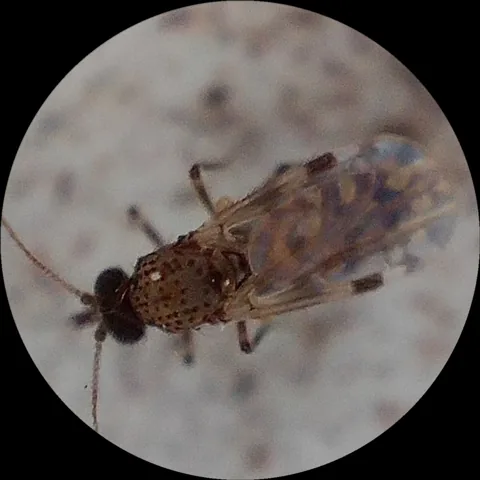 Biting Midges
Culicoides spp.
No-see-ums, also called biting midges, punkies, sand gnats or sand flies, are tiny flies, mostly in the genus Culicoides, whose bites itch intensely; most people feel them without ever seeing them.
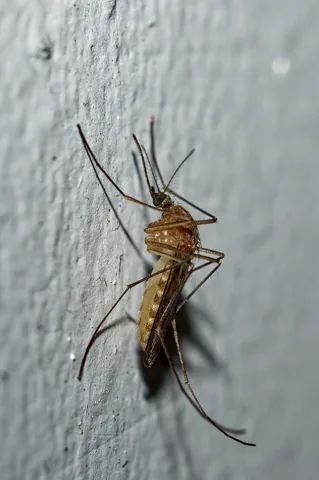 Mosquito
Culicidae (shown: Culex pipiens complex)
Mosquitoes are small, delicate flies whose females feed on blood and can pass on viruses such as West Nile; the control that works best goes after the larvae in standing water.
Side by side
Each line below sets biting midges (no-see-ums, punkies, sand gnats) against mosquitoes. Both are two-winged flies, and in both only the females drink blood; male biting midges have mouthparts that can't pierce skin, and male mosquitoes feed on nectar.[1][3][6][10]
- Size: biting midges are usually 1.0 to 2.0 mm (0.04 to 0.08 inch) long, per UF/IFAS; the Merck Veterinary Manual gives 1 to 3 mm and Clemson about 1/16 inch. Mosquitoes are about 1/4 to 1/2 inch long without their legs and beak.[1][4][3][10]
- Body: no-see-ums are small, dark flies with short, stocky bodies and a shiny thorax. Mosquitoes are small, delicate flies with long legs.[2][11][10]
- Wings: the wings of most biting midge species carry a pattern of dark and pale spots, and Merck describes them as patterned or densely mottled. Mosquito wings are long and slender, with small scales along the edges and veins that show under a magnifying glass.[1][4][11][10]
- Mouthparts: a female biting midge has a short proboscis with mandibles for cutting flesh. A mosquito has a long proboscis; in females it pierces skin and draws blood.[1][6][10]
- Antennae: biting midges have 15-segmented antennae, the last five segments much longer than the rest. Male mosquitoes have featherlike antennae.[1][10]
- Larvae: biting midge larvae are tiny, slender and wormlike, 2 to 5 mm long when grown, and are not fully aquatic. Mosquito larvae, called wrigglers, hang just under the water surface and breathe through tubes at the tail end.[1][2][10][11]
- Breeding sites: biting midges use mud or moist soil around streams, ponds and marshes, wet tree holes, and in towns over-irrigated mulch or sod, construction sites and indoor plant pots. Mosquitoes need standing or quiet water: ponds, bird baths, clogged gutters, old tires, flowerpots, and for some Aedes species something as small as a water-filled bottle cap.[4][3][2][1][10][11]
- Biting hours: no-see-ums are usually active at dawn and dusk, and Merck says most active before and during dusk; UF/IFAS adds that many species bite in broad daylight in cold weather and on the coast. CDC says mosquitoes can bite day and night, and UC IPM says some species are active at dawn and dusk and others throughout the day.[2][4][3][1][6][11]
- Season: no-see-ums are most numerous in summer and can occur year-round where winters are warm. Merck says biting midges fly only in the warm months.[2][4]
- Getting indoors: no-see-ums pass through ordinary door and window screens. Screens in good repair keep mosquitoes out, and UC IPM tells homeowners to fix any holes.[2][1][11]
- Noticing the bite: you can usually see a mosquito, while most people never see the midge as it feeds, which is where the name no-see-um comes from.[3][2]
The bites
CDC says the common reactions to a mosquito bite are itching and swelling. MedlinePlus says mosquito bites are more likely to itch than hurt.[6][8]
For bites from either, MedlinePlus advises washing the spot with soap and water, using an antihistamine or anti-itch cream if needed, and watching for signs of infection such as increasing redness, swelling or pain over the next several days. It says to call 911 for trouble breathing or swelling anywhere on the face or in the mouth.[8]
Photos of no-see-um welts and blisters, and how they compare with black fly and eye gnat bites, are in the no-see-um guide linked below.[2][3]
How to confirm which one you have
Catch one if you can: on a mosquito, look for the long beak and the scales along the wing edges and veins, which a magnifying glass shows. On a speck-sized fly, look for spotted wings; UF/IFAS says those wing patterns are what entomologists use to tell biting midge species apart.[10][11][1]
If you only find bites, think about where you were. Bites at dawn or dusk near marshes, ponds, beaches, over-watered turf or wet mulch point to no-see-ums, since Arizona Extension says bites are heaviest near where the midges emerge. Mosquito larvae are visible: wrigglers hang just under the surface of standing water and dive when disturbed.[2][4][10]
Merck says identifying biting midge species is complex and best left to an entomologist, and suggests contacting extension entomology staff to find local breeding grounds.[4]
Why the ID changes the plan
Screens: UC IPM says screens in good repair help keep mosquitoes out, but Arizona Extension says no-see-ums pass through standard 16 x 16 or 18 x 16 mesh. Arizona Extension recommends 30 x 30 mesh where possible; Clemson says 20 x 20 mesh or smaller excludes biting midges on porches. UF/IFAS notes that no-see-um screen is small enough to exclude them but isn't usually used on windows and doors.[2][3][1][11]
Breeding sites: dumping containers and draining standing water is the main mosquito fix. It does little for no-see-ums, whose larvae live in damp mud; for them Arizona Extension says to hold off irrigation and let wet spots drain and dry, and UF/IFAS says the larvae and pupae cannot survive drying out.[11][10][2][1]
Spraying: UC IPM says outdoor insecticide sprays and repellent devices give mosquitoes only a temporary knockdown with no lasting effect. Clemson calls area-wide control of biting midges nearly impossible because populations refill quickly from breeding sites.[11][3]
Fans: biting midges are poor fliers. Merck says an electric fan cuts their host-seeking and feeding, and Clemson suggests a ceiling or box fan on a covered porch.[4][3]
Repellents for each
CDC recommends EPA-registered repellents with DEET, picaridin, IR3535, oil of lemon eucalyptus (OLE), para-menthane-diol (PMD) or 2-undecanone against mosquitoes, and says not to use OLE or PMD products on children under 3.[7]
Arizona Extension says repellents that work against mosquitoes also work against biting midges, and UF/IFAS says DEET is the main repellent used against them. In one Spanish lab test that UF/IFAS cites, lemon eucalyptus oil repelled Culicoides obsoletus better than DEET.[2][1]
EPA's repellent search tool and the protection times it lists cover mosquitoes and ticks, so a label's hours are not a promise against no-see-ums. CDC also recommends long sleeves, long pants and permethrin-treated clothing for mosquitoes; for no-see-ums Arizona Extension adds hats with fine mesh netting.[9][7][2]
Disease: what each can spread
Mosquitoes: CDC says mosquito bites can spread germs that cause illnesses such as West Nile virus, dengue and malaria, while nuisance mosquitoes bite but don't spread germs. UC IPM lists St. Louis encephalitis, Western equine encephalomyelitis and Zika among the viruses mosquitoes carry in California.[6][11]
Biting midges and people: CDC says Oropouche virus spreads to people mainly through bites of the biting midge Culicoides paraensis, that these midges are present in multiple U.S. states, and that travelers to the Caribbean and South and Central America are at higher risk. Some mosquitoes, including Culex quinquefasciatus, can also carry it.[5]
Biting midges and animals: Merck says Culicoides are the main carriers of bluetongue virus in cattle, sheep, goats and wild ruminants, and that horses are particularly prone to insect-bite hypersensitivity (sweet itch) to midge bites, with intense itching on the mane, tail and belly. Similar reactions have been reported in cattle, sheep and dogs, though less documented than in horses.[4]
For horses and other stock, Merck suggests limiting exposure at dusk and dawn, fans in stables and kennels, and insecticides and repellents; UF/IFAS notes that keeping animals indoors from dusk to dawn may help.[4][1]
What to do for each
Mosquitoes: empty and turn over containers, avoid overwatering, keep screens repaired, and treat water you can't drain with a Bti product. The mosquito breeding and yard guides below go through it step by step.[11][10]
No-see-ums: fix soggy turf and leaky irrigation near where bites happen, upgrade porch screening to fine mesh, run a fan, and use a repellent at dawn and dusk. The no-see-um guide below covers each step and its limits.[2][3][4]
Common questions
- Are no-see-ums baby mosquitoes?
- No. They are adult biting midges, a different family of flies (Ceratopogonidae). Young mosquitoes are wrigglers that live in standing water.[1][10]
- Can no-see-ums get through window screens?
- Yes. They pass through standard 16 x 16 and 18 x 16 mesh. Arizona Extension recommends 30 x 30 mesh, and Clemson says 20 x 20 or smaller.[2][3]
- Does mosquito repellent work on no-see-ums?
- Arizona Extension says repellents effective against mosquitoes are effective against biting midges, and UF/IFAS says DEET is the main one used. EPA's listed protection times are for mosquitoes and ticks.[2][1][9]
- Do no-see-ums carry disease in the U.S.?
- CDC says the midge that spreads Oropouche virus is present in multiple U.S. states, though travelers to the Caribbean and South and Central America face the higher risk. In livestock, Merck says Culicoides are the main carriers of bluetongue virus.[5][4]
Photo credits
- Biting Midges: Sinaloa Silvestre, public domain (CC0), via iNaturalist
- Mosquito: (c) Donald Davesne, some rights reserved (CC BY) — via iNaturalist, CC BY 4.0
Sources
- University of Florida IFAS Extension, Featured Creatures, “Biting Midges, No-See-Ums Culicoides spp. (EENY-349/IN626).” ask.ifas.ufl.edu/publication/IN626 (accessed 2026-11-14)
- University of Arizona Cooperative Extension, “No-See-Ums.” cales.arizona.edu/apmc/docs/No-See-Ums-IPMShort.pdf (accessed 2026-11-14)
- Clemson Cooperative Extension, Home & Garden Information Center, “Gnats.” hgic.clemson.edu/factsheet/gnats/ (accessed 2026-11-14)
- Merck Veterinary Manual, “Biting Midges of Animals.” www.merckvetmanual.com/integumentary-system/flies/biting-midges-of-animals (accessed 2026-11-14)
- Centers for Disease Control and Prevention, “Oropouche: Causes and How It Spreads.” www.cdc.gov/oropouche/causes/index.html (accessed 2026-11-14)
- Centers for Disease Control and Prevention, “About Mosquitoes.” www.cdc.gov/mosquitoes/about/index.html (accessed 2026-11-14)
- Centers for Disease Control and Prevention, “Preventing Mosquito Bites.” www.cdc.gov/mosquitoes/prevention/index.html (accessed 2026-11-14)
- MedlinePlus Medical Encyclopedia (U.S. National Library of Medicine), “Insect bites and stings.” medlineplus.gov/ency/article/000033.htm (accessed 2026-11-14)
- U.S. Environmental Protection Agency, “Find the Repellent that is Right for You.” www.epa.gov/insect-repellents/find-repellent-right-you (accessed 2026-11-14)
- Missouri Department of Conservation, “Mosquitoes.” mdc.mo.gov/discover-nature/field-guide/mosquitoes (accessed 2026-11-14)
- UC Statewide IPM Program, “Mosquitoes (Pest Notes).” ipm.ucanr.edu/home-and-landscape/mosquitoes/ (accessed 2026-11-14)