The short answer
- Color: the Asian tiger mosquito is black with sharp white markings, including white bands on the legs. House mosquitoes are dull golden-brown with all-dark legs and no leg bands.[12][1][14]
- The back: an Asian tiger mosquito has a single silvery-white stripe running down the middle of its head and thorax. A house mosquito has no such stripe.[1][13]
- Time of day: Asian tiger mosquitoes bite mainly in daylight, often in shade. House mosquitoes are most active from dusk to dawn and often come indoors to bite sleeping people.[11][12][3][14]
- Water: Asian tiger mosquitoes breed in small containers, needing only about 1/4 inch of water. House mosquitoes lay floating egg rafts on stagnant, often polluted water such as storm drains, catch basins and septic seepage.[9][2][3][10]
Profiles on this site
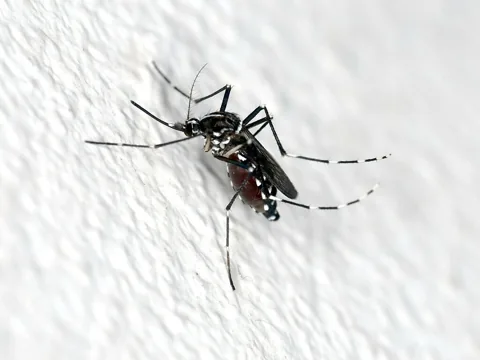 Asian Tiger Mosquito
Aedes albopictus
The Asian tiger mosquito is an invasive, aggressive mosquito that bites during the day and breeds in small water-holding containers around homes. First found at a tire dump near Houston in 1985, it spread rapidly through the southern United States and up the East Coast.
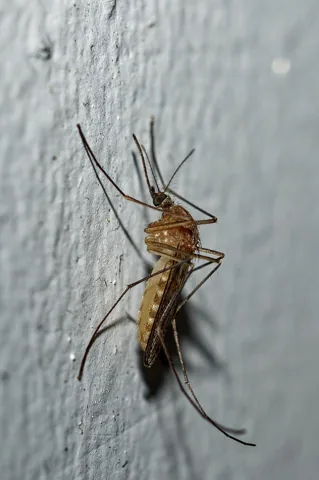 Northern House Mosquito
Culex pipiens
The northern house mosquito, Culex pipiens, is often the most common pest mosquito in cities and suburbs. It bites from dusk to dawn, breeds in stagnant and polluted water, and is a major carrier of West Nile virus in North America.
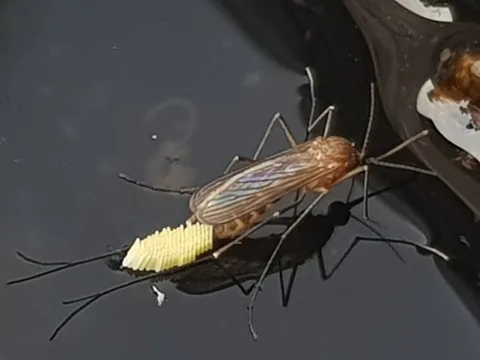 Southern House Mosquito
Culex quinquefasciatus
The southern house mosquito bites in the evening, at night and in the early morning, and Texas A&M calls it the most important carrier of West Nile virus and St. Louis encephalitis, especially in the eastern U.S. It prefers birds but will come through unscreened windows and open doors to bite sleeping people.
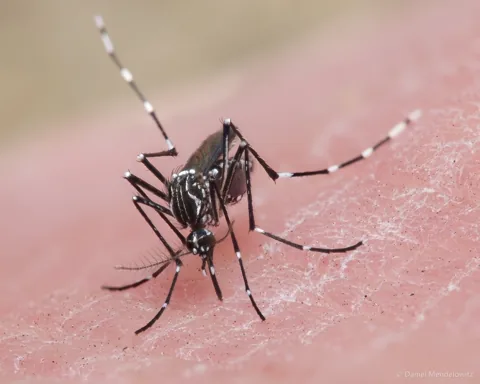 Yellow Fever Mosquito
Aedes aegypti
The yellow fever mosquito, Aedes aegypti, is a container-breeding mosquito that lives close to people and prefers to bite them. It lives indoors and outdoors, and the CDC calls it the main type of mosquito that spreads Zika, dengue and chikungunya viruses.
Side by side: Asian tiger mosquito and house mosquitoes
Each line gives the Asian tiger mosquito (Aedes albopictus) first, then the house mosquitoes (the northern house mosquito, Culex pipiens, and the southern house mosquito, Culex quinquefasciatus).[3][12][14]
- Overall look: a small, strikingly marked black-and-white mosquito. House mosquitoes are delicate and dull brown, without obvious markings.[12][14]
- Back of the thorax: dark scales with a conspicuous silvery-white stripe down the middle that narrows toward the rear, continuing onto the top of the head. The northern house mosquito's thorax is covered in golden-brown scales.[1]
- Legs: broad white bands at the base of the hind leg segments, more than a third of each segment long, and the last segment usually all white. House mosquito legs are entirely dark, with no bands on the legs or the beak.[1][12][14]
- Beak (proboscis): unbanded in the Asian tiger mosquito; unbanded and covered with short golden-brown scales in the northern house mosquito.[1][14]
- Abdomen: dark with white patches on the sides and narrow white bands. In house mosquitoes the abdomen has dingy-white or light bands at the base of each segment, which Texas A&M describes as M-shaped in the southern house mosquito.[1][12][14]
- Biting time: an aggressive day biter, especially in shady areas. House mosquitoes are most active from dusk to dawn and bite in the evening, at night and in the early morning.[1][12][11][3][14]
- Favorite hosts: feeds readily on people and other mammals, and lives in or near homes or in nearby woods. House mosquitoes are mainly bird feeders but bite people, and some urban strains feed readily on humans.[1][2][10][3]
- Indoors or out: the Asian tiger mosquito lives outdoors. House mosquitoes readily enter houses, often through unscreened windows or open doors, and bite people while they sleep.[2][1][14]
- Eggs: laid one at a time on the inner walls of containers just above the waterline, where they stick like glue and can survive drying out for up to 8 months. A house mosquito lays its eggs on the water surface in a floating raft of 100 to 300 eggs.[2][3]
- Breeding water: small artificial or natural containers, from tires and buckets to a plastic drink cup; it does not breed in swamps. House mosquitoes prefer stagnant water with a lot of organic matter, are highly tolerant of polluted water, and also use containers.[9][11][1][10][14]
- Winter: the Asian tiger mosquito overwinters as eggs. Mated house mosquito females spend the winter as adults in culverts, basements and other protected places that stay above freezing, then bite in spring.[1][10]
- Flight range: Asian tiger and yellow fever mosquitoes fly only a few blocks in their lifetime; Texas A&M says the tiger usually stays within a block or two of where it bred. Clemson's fact sheet disagrees, saying tiger mosquitoes can fly several miles from breeding sites. House mosquitoes don't fly long distances either but have been known to fly up to 2 miles, and Texas A&M says the southern house mosquito rarely flies more than a mile.[2][12][11][3][14]
- Diseases: Aedes mosquitoes (the Asian tiger and yellow fever mosquitoes) can spread dengue, Zika and chikungunya viruses. Culex mosquitoes can spread West Nile, St. Louis encephalitis and eastern equine encephalitis viruses.[4][5][3]
A note on the yellow fever mosquito
The yellow fever mosquito (Aedes aegypti) is a close relative of the Asian tiger mosquito and is easy to confuse with it. It is small, brown or black, with white bands on the legs and abdomen.[13][2]
Texas A&M tells them apart by the back: instead of the tiger's single center stripe, the yellow fever mosquito has two thin white stripes down the middle of the thorax and y-shaped markings, plus white scales on the clypeus, the front of the face.[13][1]
It is mainly a mosquito of the warm southern states, though Texas A&M says it can be active as far north as New York City. CDC says it prefers to live near and bite people and, unlike the Asian tiger mosquito, lives indoors as well as outdoors. It breeds in the same kinds of containers and spreads the same viruses.[13][2][4][5]
Where each one breeds around a home
Asian tiger mosquito: rain gutters, birdbaths, flowerpots and saucers, tires, barrels, boats, tarps, cans and garden pools, plus tree holes. Rutgers notes it can complete its life cycle in water only 1/4 inch deep, and UC IPM says even a bottle cap of water can support Aedes larvae.[11][9][15]
Its eggs are the hard part. They stick to container walls above the waterline and survive drying out for months, so a container that is emptied but not scrubbed can produce mosquitoes again after the next rain or sprinkler run. CDC says an egg takes 7 to 10 days to develop into an adult.[2][15]
House mosquitoes: tin cans, buckets, tires and other containers holding stagnant water; untended birdbaths, clogged gutters and plastic wading pools; storm drains and catch basins; and septic seepage and other foul water. Rutgers calls the northern house mosquito an indicator of polluted water close by.[10][1]
CDC adds larger water: ponds, lake edges, swamps, unmaintained swimming pools, ditches and low pastures. Adults rest by day in grass, shrubs and other thick vegetation where it is cool, dark and humid.[3]
Diseases each can carry
Asian tiger and yellow fever mosquitoes: CDC says dengue viruses are spread to people through the bites of infected Aedes aegypti or Aedes albopictus, the same mosquitoes that spread Zika and chikungunya. CDC also notes that Aedes mosquitoes can bite at night as well as in the day.[4][5]
House mosquitoes: CDC says West Nile virus cycles in nature between birds and mosquitoes, especially Culex, and Culex mosquitoes in US states can also spread St. Louis encephalitis and eastern equine encephalitis viruses.[6][3]
Rutgers explains why the bird habit matters: house mosquitoes pick up St. Louis encephalitis virus from infected birds, including house sparrows, and can then pass it to people.[10]
MedlinePlus says there are no vaccines or medicines to prevent West Nile virus, and the best protection is preventing mosquito bites.[8]
Pets: FDA says heartworm disease in dogs, cats and ferrets is spread only through the bite of a mosquito. FDA-approved preventives need a veterinarian's prescription, and FDA advises year-round prevention.[16]
How to confirm which one you have
Note when you get bitten. Bites in the shade during the day point to the Asian tiger mosquito; bites after dark, or in bed, point to house mosquitoes.[11][12][14][3]
Look at a mosquito that lands on you, or photograph one you swat on a light surface. Black with white leg bands and a white center stripe is an Asian tiger mosquito. Plain brown with dark legs is a house mosquito.[1][12][14]
Look in standing water. Egg rafts floating on stagnant water are Culex. Larvae (wigglers) in a flowerpot saucer, bucket or tire are more likely container Aedes, though house mosquitoes use containers too.[3][2][10]
Local mosquito control programs track Culex numbers and test them for viruses, so they are a good place to report a heavy problem or a breeding site you cannot reach, such as a storm drain.[3]
Yard steps for each
For both: once a week, empty and scrub, turn over, cover or throw out anything that holds water, such as tires, buckets, planters, toys, pools, birdbaths and flowerpot saucers. Tightly cover rain barrels and other water storage, and keep window and door screens in good repair.[7]
- Asian tiger mosquito: hunt down small containers; Clemson says one abandoned house or trash-filled yard can infest a whole neighborhood. Drill drainage holes in stored containers or turn them over, and clear blocked gutters. Clemson notes that night fogging by mosquito control agencies often misses this species because it is active by day.[11][9][15]
- House mosquitoes: go after foul and permanent water. Use mosquito dunks or other larvicides in ponds or unmaintained pools that cannot be drained, repair cracks in a septic tank, and cover open vent or plumbing pipes with wire mesh whose holes are smaller than a mosquito.[3][7]
- Protect yourself on their schedule: daytime yard work in shade calls for repellent against tiger mosquitoes, while MedlinePlus advises staying indoors between dusk and dawn, when house mosquitoes are most active. UC IPM lists DEET, picaridin and oil of lemon eucalyptus as effective repellents; follow the label.[11][8][15]
- Spraying adults is a weak fix for either. UC IPM says outdoor sprays and repellent devices can reduce adults only briefly and have no lasting effect, so management should focus on standing water and larvae.[15]
Common questions
- Is the black-and-white striped mosquito an Asian tiger mosquito?
- Usually. A small black mosquito with white leg bands and one white stripe down the middle of its back is the Asian tiger mosquito. Two thin center stripes with y-shaped markings point to the yellow fever mosquito instead.[1][12][13]
- Why do I get bitten during the day?
- Daytime biting in shady spots is typical of the Asian tiger mosquito. House mosquitoes are most active from dusk to dawn.[11][12][3]
- Which one carries West Nile virus?
- CDC says West Nile virus cycles between birds and mosquitoes, especially Culex, the group that includes the house mosquitoes.[6][3]
- Can a house mosquito breed in a bucket?
- Yes. House mosquitoes also use buckets, tires, clogged gutters and birdbaths holding stagnant water, though they are best known for storm drains, catch basins and other foul water.[10][3][1]
- Why does dumping water not stop tiger mosquitoes?
- Their eggs stick to the container wall above the waterline and survive drying for up to 8 months. Scrub the container when you empty it, or turn it over so it cannot refill.[2][7][11]
Photo credits
- Asian Tiger Mosquito: (c) Rafael Carbonell Font, some rights reserved (CC BY) — via iNaturalist, CC BY 4.0
- Northern House Mosquito: (c) Donald Davesne, some rights reserved (CC BY) — via iNaturalist, CC BY 4.0
- Southern House Mosquito: (c) Lek Khauv, some rights reserved (CC BY) — via iNaturalist, CC BY 4.0
- Yellow Fever Mosquito: (c) Dan Mendelowitz, some rights reserved (CC BY) — via iNaturalist, CC BY 4.0
Sources
- Connecticut Agricultural Experiment Station, “Identification Guide to the Mosquitoes of Connecticut, Bulletin No. 966 (Andreadis, Thomas and Shepard, 2005).” portal.ct.gov/-/media/caes/documents/publications/bulletins/b966b996pdf.pdf (accessed 2026-11-14)
- Centers for Disease Control and Prevention, “Life Cycle of Aedes Mosquitoes.” www.cdc.gov/mosquitoes/about/life-cycle-of-aedes-mosquitoes.html (accessed 2026-11-14)
- Centers for Disease Control and Prevention, “About Culex Mosquitoes.” www.cdc.gov/mosquitoes/about/life-cycle-of-culex-mosquitoes.html (accessed 2026-11-14)
- Centers for Disease Control and Prevention, “How Dengue Spreads.” www.cdc.gov/dengue/transmission/index.html (accessed 2026-11-14)
- Centers for Disease Control and Prevention, “How Zika Spreads.” www.cdc.gov/zika/causes/index.html (accessed 2026-11-14)
- Centers for Disease Control and Prevention, “West Nile: Causes and How It Spreads.” www.cdc.gov/west-nile-virus/causes/index.html (accessed 2026-11-14)
- Centers for Disease Control and Prevention, “Mosquito Control at Home.” www.cdc.gov/mosquitoes/mosquito-control/mosquito-control-at-home.html (accessed 2026-11-14)
- MedlinePlus, National Library of Medicine, “West Nile Virus.” medlineplus.gov/westnilevirus.html (accessed 2026-11-14)
- Rutgers University Center for Vector Biology, “Aedes albopictus (Skuse).” vectorbio.rutgers.edu/outreach/species/albo.htm (accessed 2026-11-14)
- Rutgers University Center for Vector Biology, “Culex pipiens: The Northern House Mosquito.” vectorbio.rutgers.edu/outreach/species/cxpip.htm (accessed 2026-11-14)
- Clemson Cooperative Extension Home & Garden Information Center, “Asian Tiger Mosquito (HGIC 2471).” hgic.clemson.edu/factsheet/asian-tiger-mosquito/ (accessed 2026-11-14)
- Texas A&M AgriLife (Mosquito Safari), “Aedes albopictus.” mosquitosafari.tamu.edu/types/aedes-albopictus/ (accessed 2026-11-14)
- Texas A&M AgriLife (Mosquito Safari), “Aedes aegypti.” mosquitosafari.tamu.edu/types/aedes-aegypti/ (accessed 2026-11-14)
- Texas A&M AgriLife (Mosquito Safari), “Culex quinquefasciatus.” mosquitosafari.tamu.edu/types/culex-quinquefasciatus/ (accessed 2026-11-14)
- University of California Statewide IPM Program, “Pest Notes: Mosquitoes.” ipm.ucanr.edu/home-and-landscape/mosquitoes/ (accessed 2026-11-14)
- U.S. Food and Drug Administration, “Keep the Worms Out of Your Pet's Heart! The Facts about Heartworm Disease.” www.fda.gov/animal-veterinary/animal-health-literacy/keep-worms-out-your-pets-heart-facts-about-heartworm-disease (accessed 2026-11-14)