The short answer
- Try to move it. A nit is cemented to a single hair and stays put. Dandruff, hair spray and gel residue flick off easily.[6][1][3]
- Check where it sits. Live nits are attached within 1/4 inch of the base of the hair. Dandruff is scale from the scalp skin itself, not a speck fixed to one hair.[1][5]
- Watch for a slider. A white tube that slides up and down the hair is a hair cast (a pseudonit), not an egg.[11][12]
- Look for something alive. CDC says finding a live nymph or adult louse is the best way to diagnose head lice; dandruff never crawls.[1][4]
Profiles on this site
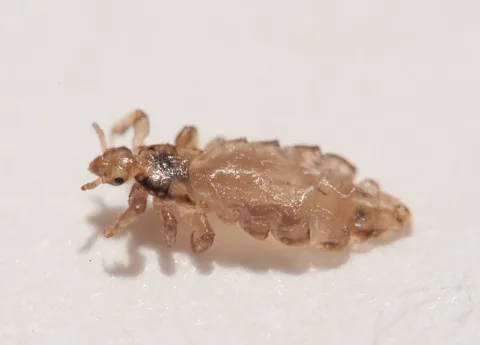 Head Louse
Pediculus humanus capitis
Head lice are tiny wingless insects that live their whole lives on the human head and feed on small amounts of blood from the scalp. They make the scalp itch but don't spread disease and aren't a sign of being dirty. Getting rid of them means treating the person with a lice medicine and combing out lice and nits, not treating the house.
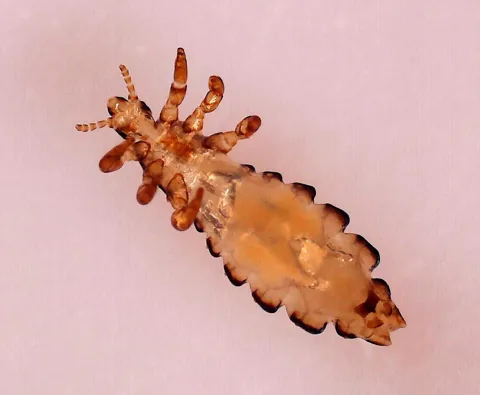 Body lice
Pediculus humanus humanus
Body lice are tiny insects that feed on human blood but live and lay their eggs in clothing and bedding. Unlike head lice, they can spread disease. They mostly affect people who can't bathe or change clothes regularly, and an infestation is usually cleared with regular bathing, clean clothes and hot-water laundering of clothes and bedding.
Side by side
Each line compares nits (head louse eggs) with dandruff, the flaky scaling that MedlinePlus groups under seborrheic dermatitis.[5][1]
- What it is: a nit is an egg laid by a female head louse at the base of the hair. Dandruff is scaling of the scalp skin; a dermatology review describes it as mild scaling and itching with no visible inflammation.[6][7][13]
- Attachment: the egg is coated with a glue-like substance that cements it to the hair shaft, and MedlinePlus calls nits tiny white specks that are hard to get off. Minnesota health officials say flakes of dandruff, hair spray or gel can be easily flicked off.[7][3][6]
- Position: nits are laid close to the scalp, and CDC says nits found more than 1/4 inch from the base of the hair are almost always hatched or dead. Dandruff and seborrheic dermatitis scale sits on the skin, and MedlinePlus lists the scalp, eyebrows, eyelids, nose creases and behind the ears among its usual sites.[1][6][5]
- Shape and size: nits are oval, about 1/32 inch (0.8 mm) long; MedlinePlus compares one to a dandruff flake for size, which is one reason the two get mixed up.[7][4][5]
- Color: Minnesota describes nits as small and grayish; UC IPM says to look for tiny yellow-white nits. A dermatology case report notes that a viable nit looks brown and oval with a curved end and an empty one translucent. MedlinePlus says seborrheic dermatitis scales are white and flaking, or yellowish, oily and sticky.[6][7][12][5]
- Where on the head: CDC and MedlinePlus say nits turn up most often behind the ears and near the back of the neck. Seborrheic dermatitis scale comes from the scalp skin itself and often forms where the skin is oily.[1][3][5]
- Itching: head lice cause itching, a tickling feeling and sometimes sores, but CDC notes people may have no symptoms, especially with a first or light infestation. Dandruff and seborrheic dermatitis itch too, so itching alone doesn't tell them apart.[1][5][13]
- Other skin signs: MedlinePlus lists small red bumps on the scalp, neck and shoulders, which may crust and ooze, with head lice. With seborrheic dermatitis it lists greasy areas of skin, scaly plaques and mild redness.[3][5]
- Course: CDC says successful treatment kills crawling lice, though nits may stay in the hair. MedlinePlus calls seborrheic dermatitis a long-term condition that comes and goes but can be controlled with treatment.[1][5]
- Cause: CDC says the most common way to get head lice is head-to-head contact with someone who has them, and Minnesota adds shared combs, brushes, hats and towels. MedlinePlus links seborrheic dermatitis to oil gland activity, Malassezia yeasts that live on the skin, skin barrier changes and genes.[1][6][5]
Hair casts and other white specks
Hair casts, also called pseudonits, are slender, shiny white to yellow tubes about 2 to 8 mm long that wrap around the hair shaft. A dermatology report says their most useful feature is that they slide easily along the hair. A nit is firmly attached to one hair and can't be flicked off.[11][12][6]
A Barcelona case report describes white specks on a woman's dreadlock with no lice or nits anywhere else on the scalp. Magnified, they were white, tube-shaped and not stuck to the hair: hair casts. Its teaching point: pseudonits are white objects that easily move along the hair and are often misdiagnosed as lice.[12]
In an Italian clinic series of 42 people sent in for suspected head or pubic lice, magnification confirmed lice in 30. The other 12 had seborrheic dermatitis (5), hair casts (3), trichobacteriosis (2), white piedra (1) and trichorrhexis nodosa (1).[10]
Hair spray droplets, gel flakes and dirt are the other usual mix-ups CDC names. Like dandruff, they come off with a flick or a wash.[1][6]
What live lice look like
Adult head lice are about 2 to 3 mm long, about the size of a sesame seed, per CDC and MedlinePlus. UC IPM gives 1/12 to 1/8 inch and says they range from beige to gray.[1][4][7]
They are wingless, with six legs that each end in a claw for gripping the hair. They crawl and cannot hop or fly.[7][1][6]
Nymphs, the young lice, look like small adults about the size of a pinhead. CDC says nits take about a week to hatch and nymphs about seven days to become adults.[1]
Lice are small, move fast and avoid light, so they are easy to miss. That is why a comb finds them better than eyes alone.[1][4]
How to check
Use bright light. MedlinePlus suggests full sun or the brightest lights in your home in daytime, with disposable gloves, and parting the hair down to the scalp in very small sections. A magnifying lens helps.[3][1][4]
Start at the back hairline and behind the ears, where Minnesota and CDC say nits are most often found.[6][1]
Comb, don't just look. In a blinded German school study, wet combing hair moistened with conditioner was far better at finding active infestations than looking, and simple inspection underestimated active infestation by a factor of 3.5. Looking did better at spotting old nits, which don't mean lice are present now.[9]
Test each white speck: try to slide it off with your fingers. If it moves freely or flicks away, it isn't a nit. If it's stuck on one hair close to the scalp, look at it under magnification.[6][11][1]
Read what you find: live lice mean an active infestation. If you find no live lice and the only nits are more than 1/4 inch from the scalp, CDC says the infestation is probably old and does not need treatment.[1][9]
Why getting it right matters
A Harvard study of specimens sent in by health care workers and others found that head lice were frequently overdiagnosed, active and old infestations were rarely told apart, and lice treatments were applied more often to children without lice than to children with them. Its authors advise treating only after live lice or eggs that look viable are seen.[8]
Minnesota health officials say treating people without lice or nits is not recommended, and the Italian clinic authors say telling pseudonits from nits prevents unnecessary treatment, anxiety and embarrassment.[6][10]
CDC says head lice don't spread disease and are not considered a health hazard, and MedlinePlus says head lice never carry or spread diseases, so there is time to check carefully before treating.[1][3]
What to do for each
Head lice: Minnesota health officials recommend an over-the-counter or prescription lice-killing product, and say a second treatment 7 to 10 days later is often needed. MedlinePlus says to ask a provider or pharmacist if you aren't sure which product to use, and to check with a provider first if you are pregnant or nursing or want to treat a young child. CDC's clinical guidance compares the products. The head lice guide below goes through each option and nit combing.[6][4][2]
Dandruff and seborrheic dermatitis: MedlinePlus says flaking can be treated with over-the-counter dandruff or medicated shampoos labeled for seborrheic dermatitis or dandruff, used according to label directions. It lists salicylic acid, coal tar, zinc, resorcinol, ketoconazole and selenium sulfide as common ingredients.[5]
If it was neither: hair casts can be removed with a comb, per a dermatology report, and a provider can sort out the rarer causes of pseudonits under magnification.[11][10]
When to see a health care provider
You aren't sure what you're seeing. CDC says to see a provider if you're not sure a person has head lice, and Minnesota says to call your doctor with questions about the diagnosis.[1][6]
Lice keep coming back or symptoms continue after home treatment. MedlinePlus also says to contact your provider for red, tender skin that could signal infection, and to talk to one before treating again if active lice remain.[3][2]
Scalp flaking doesn't respond to self-care or over-the-counter shampoos, or patches drain fluid or pus, crust, or become very red or painful (MedlinePlus).[5]
A baby has scaly patches on the scalp. MedlinePlus says cradle cap is the term for seborrheic dermatitis on an infant's scalp, and says to check with a provider before using a lice treatment on a young child.[5][4]
Common questions
- How can I tell nits from dandruff fast?
- Pinch the speck and slide it along the hair. A nit is glued to one hair near the scalp and doesn't budge. Dandruff and hair product flakes brush or flick off.[6][3][1]
- What are white things that slide up and down the hair?
- Likely hair casts, also called pseudonits: slender white tubes around the hair shaft that slide easily along it. Nits are cemented in place.[11][12]
- Are head lice dangerous?
- CDC says head lice don't spread disease and aren't considered a health hazard. MedlinePlus says scratching can lead to a skin infection, so watch for red, tender skin.[1][3]
- I only found nits. Does my child have lice?
- Not necessarily. CDC says nits only more than 1/4 inch from the scalp, with no live lice, point to an old infestation that doesn't need treatment. A study found wet combing finds active lice much better than looking.[1][9]
Photo credits
- Head Louse: (c) Rolf Lawrenz, some rights reserved (CC BY) — via iNaturalist, CC BY 4.0
- Body lice: (c) Christine Young, some rights reserved (CC BY) — via iNaturalist, CC BY 4.0
Sources
- Centers for Disease Control and Prevention, “Head Lice: About.” www.cdc.gov/lice/about/head-lice.html (accessed 2026-11-14)
- Centers for Disease Control and Prevention, “Clinical Care of Head Lice.” www.cdc.gov/lice/hcp/clinical-care/index.html (accessed 2026-11-14)
- MedlinePlus Medical Encyclopedia (U.S. National Library of Medicine), “Head lice.” medlineplus.gov/ency/article/000840.htm (accessed 2026-11-14)
- MedlinePlus (U.S. National Library of Medicine), “Head Lice (health topic).” medlineplus.gov/headlice.html (accessed 2026-11-14)
- MedlinePlus Medical Encyclopedia (U.S. National Library of Medicine), “Seborrheic dermatitis.” medlineplus.gov/ency/article/000963.htm (accessed 2026-11-14)
- Minnesota Department of Health, “Head Lice fact sheet.” www.health.state.mn.us/diseases/headlice/headlice.html (accessed 2026-11-14)
- UC Statewide IPM Program, “Head Lice (Pest Notes).” ipm.ucanr.edu/home-and-landscape/head-lice/ (accessed 2026-11-14)
- Pediatric Infectious Disease Journal, abstract via PubMed, “Overdiagnosis and consequent mismanagement of head louse infestations in North America (Pollack, Kiszewski, Spielman 2000).” pubmed.ncbi.nlm.nih.gov/10959734/ (accessed 2026-11-14)
- Archives of Dermatology, abstract via PubMed, “Accuracy of diagnosis of pediculosis capitis: visual inspection vs wet combing (Jahnke et al. 2009).” pubmed.ncbi.nlm.nih.gov/19289764/ (accessed 2026-11-14)
- Skin Appendage Disorders, via PubMed Central, “Trichoscopy in the Differential Diagnosis of Pseudonits (Lacarrubba, Verzi, Micali 2019).” pmc.ncbi.nlm.nih.gov/articles/PMC6489062/ (accessed 2026-11-14)
- International Journal of Trichology, via PubMed Central, “Adult Onset Hair Casts: Nits Which Do Not Itch! (Lokhande, Sutaria 2017).” pmc.ncbi.nlm.nih.gov/articles/PMC5551310/ (accessed 2026-11-14)
- Dermatology Practical & Conceptual, via PubMed Central, “Pseudonits or Hair Casts (Lukoviek et al. 2020).” pmc.ncbi.nlm.nih.gov/articles/PMC7588169/ (accessed 2026-11-14)
- Journal of Cutaneous Medicine and Surgery, abstract via PubMed, “Understanding the Scalp: Dandruff and Seborrheic Dermatitis (Gupta et al. 2025).” pubmed.ncbi.nlm.nih.gov/41133934/ (accessed 2026-11-14)