The short answer
- Where it lives: head lice stay in the hair on the head, sometimes the eyebrows and eyelashes. Body lice live and lay eggs in clothing and bedding, mainly in the seams, and move to the skin only to feed. Crab lice cling to pubic hair and other coarse body hair.[1][5][7][2][3][10]
- Shape: crab lice are short and broad, with big pincer-like middle and back legs, so they look like tiny crabs. CDC says pubic lice are broader and flatter than other lice. Head and body lice lack that crab shape and look so much alike that Clemson calls them very similar in appearance; they differ in where they live and how they behave.[3][10][6]
- Size: head and body lice adults are about the size of a sesame seed (CDC gives 2 to 3 mm for head lice and 2.3 to 3.6 mm for body lice). Adult crab lice are smaller, 1.1 to 1.8 mm by CDC's measure, or about 1/16 inch per Clemson.[1][2][3][10][9]
- Health risk: only body lice spread disease. CDC and MedlinePlus list epidemic typhus, trench fever (Bartonella quintana infection) and epidemic relapsing fever; CDC says head lice and pubic lice do not transmit disease.[2][7][1][3][5]
Profiles on this site
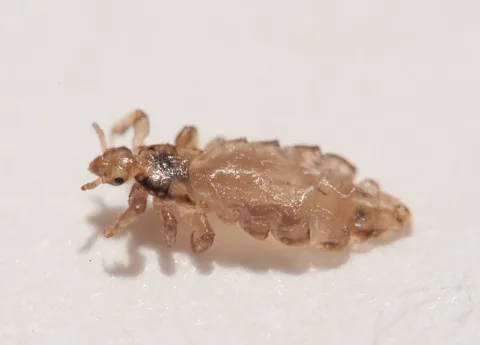 Head Louse
Pediculus humanus capitis
Head lice are tiny wingless insects that live their whole lives on the human head and feed on small amounts of blood from the scalp. They make the scalp itch but don't spread disease and aren't a sign of being dirty. Getting rid of them means treating the person with a lice medicine and combing out lice and nits, not treating the house.
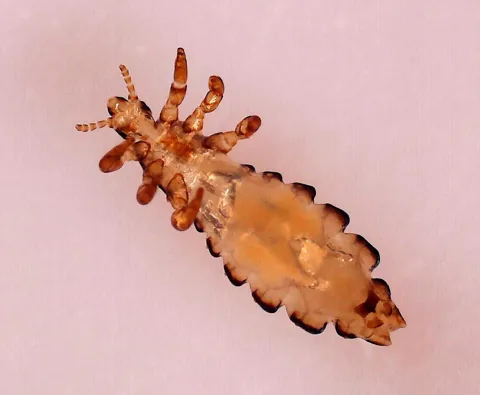 Body lice
Pediculus humanus humanus
Body lice are tiny insects that feed on human blood but live and lay their eggs in clothing and bedding. Unlike head lice, they can spread disease. They mostly affect people who can't bathe or change clothes regularly, and an infestation is usually cleared with regular bathing, clean clothes and hot-water laundering of clothes and bedding.
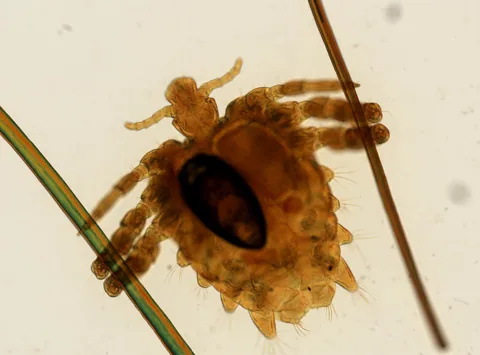 Crab Lice (Pubic Lice)
Pthirus pubis
Crab lice, or pubic lice (Pthirus pubis), are blood-feeding insects found only on people, usually in pubic hair, and they spread mostly through sexual contact.
Side by side: head, body and crab lice
Names: the head louse is Pediculus humanus capitis and the body louse is Pediculus humanus, also called the clothes louse. The crab louse, or pubic louse, is Pthirus pubis.[1][9][7][10][13]
Size: head lice 2 to 3 mm (CDC), 1/12 to 1/8 inch (UC IPM) or about 1/8 inch (Minnesota); body lice 2.3 to 3.6 mm (CDC); crab lice 1.1 to 1.8 mm (CDC) or about 1/16 inch (Clemson). CDC compares head and body lice to a sesame seed and crab lice to the tip of a pencil.[1][11][8][2][3][10]
Shape and legs: head and body lice have six legs (UC IPM, CDC), and UC IPM says each head louse leg ends in a claw for grabbing a hair. CDC describes pubic lice as short, crab-like, broader and flatter than head and body lice, and Clemson says the enlarged, pincer-like second and third pairs of legs are what give them the crab look.[11][2][3][10]
Color: head lice range from beige to gray (UC IPM). Body lice are tan to grayish white (CDC, Texas DSHS). Clemson describes crab lice as grayish.[11][2][9][10]
Where the adults are: head lice live on the scalp and spend their whole lives on the hairy part of the head, and CDC and MedlinePlus say they can also be on the eyebrows and eyelashes. Body lice live on clothing and bedding and only move to the skin to feed. Crab lice attach to pubic hair and can also turn up in armpit hair, chest and back hair, the beard and mustache, eyebrows and eyelashes.[1][5][11][7][2][9][3][6][10]
Where the eggs (nits) are: head lice glue their eggs to hairs close to the scalp; Minnesota says to look along the hairline at the back of the head and neck and behind the ears. Body lice lay eggs on or near clothing seams, especially around the waistline and under the arms, and sometimes on body hair (Texas DSHS). Crab lice cement their eggs to the base of coarse hairs in the pubic area (Clemson; MedlinePlus describes them as small gray-white oval eggs).[11][8][5][9][2][10][6]
How they spread: head lice spread mainly by head-to-head contact, and less often by shared hats, combs, brushes, towels or bedding. Body lice spread by direct contact and through clothing, beds and linens. Crab lice usually spread through sexual contact; CDC says spread by clothing or bedding happens only occasionally, and by a toilet seat very rarely.[1][11][8][2][7][3][6][10]
Who gets them: in the United States head lice are most common in preschool and elementary school children and the people they live with, and having them has nothing to do with cleanliness. Body lice affect people who can't bathe or change into clean clothes regularly, most often people experiencing homelessness in the U.S. Pubic lice are most common in adults.[1][5][8][2][7][3]
Itching and skin signs: itching is the most common symptom of lice, per CDC and the American Family Physician review. CDC says itching may not start until four to six weeks after a first head lice infestation, and MedlinePlus says pubic lice itching can start soon after contact or take up to 2 to 4 weeks. Long-term body lice leave heavily bitten skin thickened and darkened around the waist, groin and upper thighs. Clemson says crab lice bites sometimes leave small blue dots with tenderness and swelling.[1][12][6][2][7][9][10]
Survival off a person: CDC says head lice die within two days off the head (UC IPM says 1 to 2 days) and body lice within 1 to 2 days without a blood meal. For crab lice CDC gives 24 to 48 hours, while Clemson says they do not live more than 24 hours away from the warmth and humidity of human skin.[1][11][2][9][3][10]
- Disease: body lice can spread epidemic typhus, trench fever and relapsing fever (CDC, MedlinePlus). CDC says head lice do not transmit disease, Minnesota says they are not known to, and MedlinePlus says that unlike body lice, head lice never carry diseases. CDC says pubic lice do not transmit disease; a 2021 clinical review notes reports that raise the possibility of crab lice carrying Bartonella and Acinetobacter bacteria but says this needs more study.[2][7][1][8][5][3][13]
Head louse or body louse? Check where you found it
Clemson says head lice and body lice look very similar but behave differently: head lice stay on the head for their whole lives, while body lice come onto a person only to feed and hide in clothing seams the rest of the time. Both are about the size of a sesame seed and tan or gray (CDC, UC IPM), so you can't sort one from the other by looks alone.[10][1][2][11]
A louse found crawling in the hair on the head is a head louse; CDC says lice found on the head are generally head lice, not pubic lice. Lice and eggs in the seams of clothing point to body lice, which is how CDC and MedlinePlus say body lice are usually diagnosed.[3][2][7]
Crab lice: what sets them apart
Look at the shape. CDC says pubic lice look very different from head and body lice, and MedlinePlus says they're called crabs because of their appearance. Clemson says young crab lice that have begun feeding usually stay in one place, gripping a hair shaft with their crab-like legs.[3][6][10]
Look at the hair type. Crab lice live on coarse hair. Besides the pubic area, CDC lists the eyebrows, eyelashes, beard, mustache, armpit, groin, torso, scalp and anus as places they can be found, and the 2021 review says they may infest scalp and body hair. Brown or rust-colored specks from feeding or droppings can also be a sign, according to the review.[10][3][13]
In adults, finding pubic lice is a reason to get checked for other sexually transmitted infections; the CDC treatment guidelines, MedlinePlus and the American Family Physician review all say so.[4][6][12]
How to confirm which louse you have
For head lice, part the hair down to the scalp in small sections under bright light and look for moving lice and for eggs near the scalp, especially at the nape of the neck and behind the ears. A magnifying glass helps.[5][8][11]
Nits glued to the hair are not the same as flakes. Minnesota says hair spray, gel or dandruff can be flicked off, while nits are firmly attached. UC IPM says nits more than 1/4 inch from the scalp are probably dead or already hatched, and the American Family Physician review says nits alone are not enough to diagnose a current infestation; you need to see a live louse.[8][5][11][12]
For body lice, check the seams of clothing, particularly around the waistline and under the arms, for crawling lice and eggs. A magnifying lens helps.[2][7][9]
For crab lice, look closely at pubic hair, and in a child at the eyelashes, for lice gripping the hair and for eggs at the base of the hairs. Providers can identify them with a magnifier called a dermatoscope (MedlinePlus).[3][6][10]
Why getting it right matters
The fix is different for each. Head lice and pubic lice are treated with over-the-counter or prescription lice medicines (CDC). For body lice, CDC says bathing and regular changes into clean, machine-washed clothes are the only treatment usually needed, though a lice medicine is recommended in some cases.[1][3][2]
The people who need to know are different too. For head lice, MedlinePlus says children and adults should be treated right away if any lice or eggs are found. With pubic lice, CDC says sex partners from the previous month should be treated, and sexual contact avoided until everyone has been treated and rechecked.[5][4][3]
What to do for each
Head lice: see the treatment and nit-removal steps on our head lice guide, and call a health care provider if you have questions about the diagnosis (Minnesota). CDC says to machine wash clothing, towels and bedding the person used in the two days before treatment in hot water (130°F) and dry them on high heat, or seal unwashable items in a plastic bag for two weeks, and to vacuum floors and furniture where the person sat or lay. CDC says spending a lot of time on house cleaning is not needed.[1][8]
Body lice: bathe and change into clean clothes at least once a week, and wash clothing, bedding and towels in hot water (at least 130°F) and dry them on the hot cycle. CDC and Texas DSHS say items that can't be washed can be dry cleaned or sealed in a plastic bag for two weeks. Don't share clothing, beds, bedding or towels.[2][9]
Crab lice: see a health care provider, who can recommend a treatment and check for other sexually transmitted infections. CDC's treatment guidelines say the usual lice treatments should not be applied to the eyes and that eyelash infestations are treated differently, so let a provider handle those. Machine wash and dry bedding and clothing on hot, dry clean them, or keep them out of use (CDC's treatment guidelines say for at least 72 hours; CDC's consumer page says seal them for two weeks).[3][4][6]
Skip the bug bombs. CDC says fumigant sprays and fogs are not needed to control pubic lice and can be toxic if inhaled or absorbed through the skin, and CDC's treatment guidelines say fumigating living areas is unnecessary. The American Family Physician review says extensive environmental cleanup is not needed after lice are found.[3][4][12]
Common questions
- Can head lice turn into body lice?
- No. MedlinePlus says each of the three types is different and getting one does not mean you will get another. Head lice stay in the hair on the head; body lice live in clothing.[7][10][1]
- Can crab lice live on your head?
- Sometimes. CDC lists the scalp among the less common places pubic lice are found, and the 2021 review says they may infest scalp hair. But CDC says lice found on the head are generally head lice, not pubic lice.[3][13]
- Can you get crab lice from a toilet seat?
- Very rarely. CDC says pubic lice usually spread through sexual contact, occasionally through clothing or bedding, and only very rarely from a toilet seat just used by an infested person.[3][6]
- Which kind of lice can spread disease?
- Only body lice. CDC and MedlinePlus say they can spread typhus, trench fever and relapsing fever. CDC says head lice and pubic lice do not transmit disease.[2][7][1][3]
- Can I get lice from my dog or cat?
- People rarely get lice from pets. The Merck Veterinary Manual says pet lice are not normally attracted to humans and that lice usually stay on one host species.[14][15]
Photo credits
- Head Louse: (c) Rolf Lawrenz, some rights reserved (CC BY) — via iNaturalist, CC BY 4.0
- Body lice: (c) Christine Young, some rights reserved (CC BY) — via iNaturalist, CC BY 4.0
- Crab Lice (Pubic Lice): Daniel J. Drew, public domain (CC0), via Wikimedia Commons
Sources
- U.S. Centers for Disease Control and Prevention, “About Head Lice.” www.cdc.gov/lice/about/head-lice.html (accessed 2026-11-14)
- U.S. Centers for Disease Control and Prevention, “About Body Lice.” www.cdc.gov/lice/about/body-lice.html (accessed 2026-11-14)
- U.S. Centers for Disease Control and Prevention, “About Pubic "Crab" Lice.” www.cdc.gov/lice/about/pubic-lice.html (accessed 2026-11-14)
- U.S. Centers for Disease Control and Prevention, “Ectoparasitic Infections, Sexually Transmitted Infections Treatment Guidelines, 2021.” www.cdc.gov/std/treatment-guidelines/ectoparasitic.htm (accessed 2026-11-14)
- MedlinePlus, U.S. National Library of Medicine, “Head lice (Medical Encyclopedia).” medlineplus.gov/ency/article/000840.htm (accessed 2026-11-14)
- MedlinePlus, U.S. National Library of Medicine, “Pubic lice (Medical Encyclopedia).” medlineplus.gov/ency/article/000841.htm (accessed 2026-11-14)
- MedlinePlus, U.S. National Library of Medicine, “Body Lice.” medlineplus.gov/bodylice.html (accessed 2026-11-14)
- Minnesota Department of Health, “Head Lice Fact Sheet.” www.health.state.mn.us/diseases/headlice/headlice.html (accessed 2026-11-14)
- Texas Department of State Health Services, Public Health Region 1, “Body Lice Fact Sheet.” www.dshs.texas.gov/sites/default/files/region1/documents/Epi/Body-Lice-Fact-Sheet.pdf (accessed 2026-11-14)
- Clemson Cooperative Extension, Home & Garden Information Center, “Crab Lice (HGIC).” hgic.clemson.edu/factsheet/crab-lice/ (accessed 2026-11-14)
- University of California Statewide IPM Program, “Head Lice (Pest Notes, Home and Landscape).” ipm.ucanr.edu/home-and-landscape/head-lice/ (accessed 2026-11-14)
- American Family Physician, via PubMed, “Lice and Scabies: Treatment Update (Gunning, Kiraly and Pippitt, American Family Physician, 2019), abstract.” pubmed.ncbi.nlm.nih.gov/31083883/ (accessed 2026-11-14)
- Clinical and Experimental Dermatology, via PubMed, “A clinical review and history of pubic lice (Patel, Tan and Levell, Clinical and Experimental Dermatology, 2021), abstract.” pubmed.ncbi.nlm.nih.gov/33811771/ (accessed 2026-11-14)
- Merck Veterinary Manual, “Overview of Lice in Animals.” www.merckvetmanual.com/integumentary-system/lice/overview-of-lice (accessed 2026-11-14)
- Merck Veterinary Manual, “Lice of Dogs (Pet Owner Version).” www.merckvetmanual.com/dog-owners/skin-disorders-of-dogs/lice-of-dogs (accessed 2026-11-14)