On this page
How to identify it
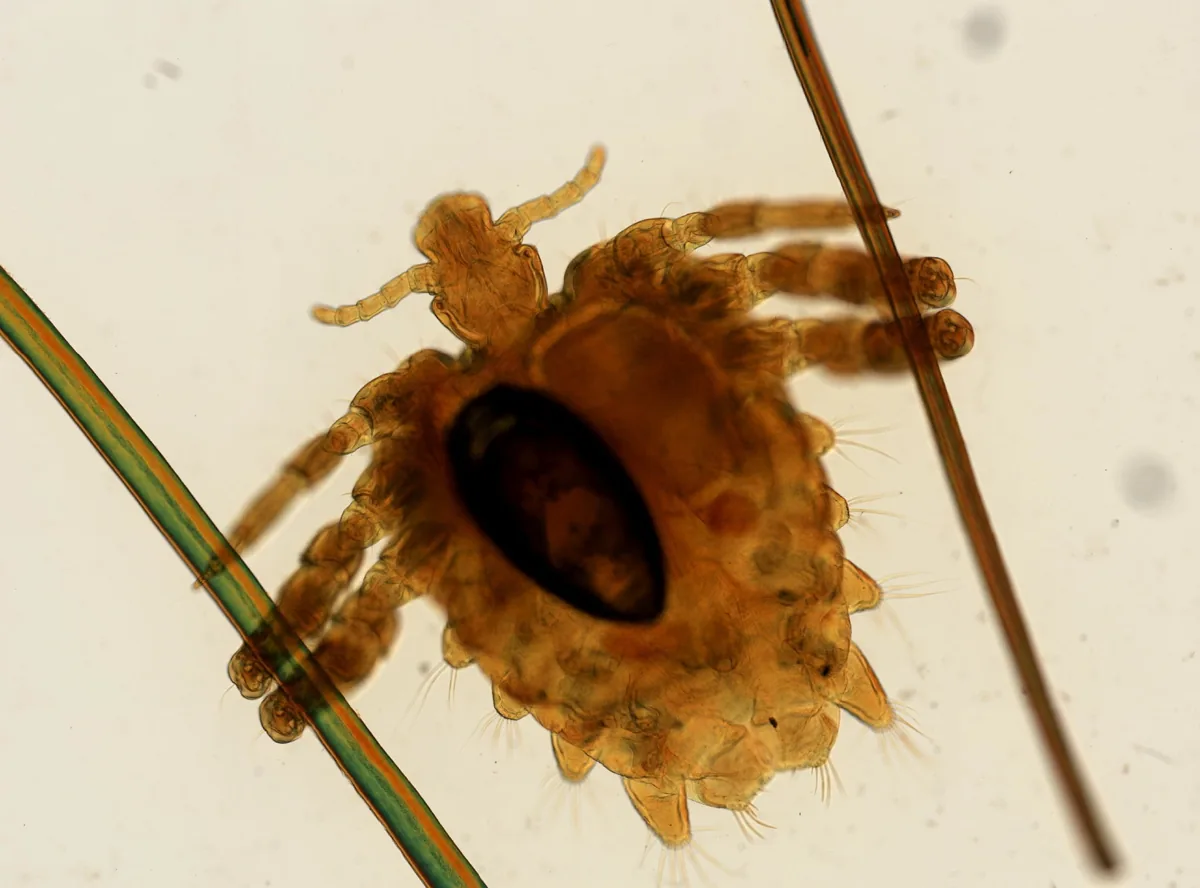
- Grayish and very small: Clemson Extension says about 1/16 inch, and CDC gives adults 1.1 to 1.8 mm. They are broader and flatter than head or body lice, with enlarged, crab-like second and third pairs of legs.[1][3]
- Look for lice crawling on or holding onto pubic hair and for nits (small gray-white oval eggs) cemented to the hair shafts. A magnifying lens helps.[3][5][1]
- They also turn up in other coarse hair: armpits, chest, back, beard and mustache, eyebrows and eyelashes. Lice found on the scalp are generally head lice.[3][5][1]
Look-alikes
| Look-alike | How to tell them apart |
|---|---|
| Head lice | Head lice live on the scalp and stay on the person for life; CDC notes lice found on the head are generally head lice, which look very different from the short, broad pubic louse.[1][3] |
| Body lice | Body lice hide in clothing seams and visit the skin only to feed.[1] |
Where it lives
Found only on humans; one of three kinds of lice that live on people. A 2021 review puts estimates of incidence at 0.3% to 4.6% and adult prevalence around 2%, and says pubic hair grooming has reduced incidence in recent years.[1][3][6]
Biology and life cycle
Egg counts differ by source: Clemson Extension gives 15 to 50 white eggs per female, laid two or three a day at the base of coarse hairs; CDC says about 30 eggs over a 3- to 4-week life.[1][3]
Eggs hatch in about a week (Clemson says six to eight days). CDC says nymphs mature in 6 to 9 days, while Clemson puts the whole cycle from egg to adult at four to six weeks, with adults living another two to four.[1][3]
Once nymphs start feeding they usually stay put, gripping a hair shaft with their crab-like legs.[1]
Off the body they die quickly: within 24 hours according to Clemson, or within 24 to 48 hours without a blood meal according to CDC. Animals do not get or spread pubic lice.[1][3][5]
Damage and signs
Health risk
The main symptom is itching in the genital area, often worse at night; it may not start until 2 to 4 weeks after contact. Bites can turn the skin red or bluish-gray, and heavy scratching can cause sores and bacterial infection. CDC says pubic lice do not transmit disease; a 2021 review notes reports raising the possibility that they carry Bartonella or Acinetobacter bacteria and says this needs more study.[5][3][6]
Control
Prevention
Sex partners from the past month should be checked and treated, and sexual contact avoided until everyone has been treated. CDC and MedlinePlus advise testing for other sexually transmitted infections, as do European and U.S. clinical reviews.[4][3][5][7][8]
Sanitation
Machine wash and dry the infested person's clothing and bedding hot (CDC says water of at least 130°F and a hot dryer), dry clean them, or seal them in a plastic bag for two weeks. CDC says fumigant sprays and fogs are unnecessary and can be toxic; MedlinePlus mentions a store-bought lice spray for items that can't be washed.[3][4][5]
When to call a professional
Over-the-counter lotion with 1% permethrin, or a mousse or shampoo with pyrethrins and piperonyl butoxide, treats pubic lice. CDC's treatment guidelines have these applied to the affected areas and washed off after 10 minutes. Follow the package directions exactly and keep them away from the eyes.[3][4][5]
A second round is not automatic. MedlinePlus says most people need one treatment and a second, if needed, comes 4 days to 1 week later; CDC's guidelines advise a recheck after 1 week if symptoms persist and retreatment if lice or eggs at the base of the hair are found.[5][4]
Resistance to permethrin and pyrethrins is increasingly reported, according to CDC. When treatment fails, a health care provider may use malathion lotion or oral ivermectin. Lice on the eyelashes are treated with an eye ointment or petroleum jelly on the lid margins, not with lice lotion.[4][6]
Why there are fewer cases than there used to be
Pubic hair removal has been linked to fewer pubic lice infestations and to infestations turning up in unusual places on the body.[4][6]
Common questions
- How do you get crab lice?
- Usually through intimate, sexual contact. Clothing, bedding or towels occasionally spread them and a toilet seat very rarely, because they die within a day or two off the body.[3][5][1]
- Do I need to treat twice?
- Not always. Most people need one treatment; recheck after about a week and treat again only if lice or eggs at the base of the hair are still there.[5][4]
- What does it mean if a child has pubic lice?
- CDC and MedlinePlus say pubic lice on a child's head or eyelashes may be a sign of sexual exposure or abuse.[3][5]
Sources
- Clemson Cooperative Extension, Home & Garden Information Center, “Crab Lice (HGIC 2477).” hgic.clemson.edu/factsheet/crab-lice/ (accessed 2026-11-11)
- iNaturalist, “Pthirus pubis taxon page (order and family).” www.inaturalist.org/taxa/395978 (accessed 2026-11-11)
- U.S. Centers for Disease Control and Prevention, “About Pubic "Crab" Lice (June 4, 2024).” www.cdc.gov/lice/about/pubic-lice.html (accessed 2026-11-11)
- U.S. Centers for Disease Control and Prevention, “Sexually Transmitted Infections Treatment Guidelines, 2021: Ectoparasitic Infections (Pediculosis Pubis).” www.cdc.gov/std/treatment-guidelines/ectoparasitic.htm (accessed 2026-11-11)
- MedlinePlus, U.S. National Library of Medicine, “Pubic lice (Medical Encyclopedia).” medlineplus.gov/ency/article/000841.htm (accessed 2026-11-11)
- Clinical and Experimental Dermatology, via PubMed, “Patel PU, Tan A, Levell NJ (2021), A clinical review and history of pubic lice, Clinical and Experimental Dermatology 46(7):1181-1188.” pubmed.ncbi.nlm.nih.gov/33811771/ (accessed 2026-11-11). Cited from the PubMed abstract.
- International Journal of STD & AIDS, via PubMed, “Scott GR, Chosidow O; IUSTI/WHO (2011), European guideline for the management of pediculosis pubis, 2010, International Journal of STD & AIDS 22(6):304-305.” pubmed.ncbi.nlm.nih.gov/21680662/ (accessed 2026-11-11). Cited from the PubMed abstract.
- American Family Physician, via PubMed, “Gunning K, Pippitt K, Kiraly B, Sayler M (2012), Pediculosis and scabies: treatment update, American Family Physician 86(6):535-541.” pubmed.ncbi.nlm.nih.gov/23062045/ (accessed 2026-11-11). Cited from the PubMed abstract.