On this page
How to identify it
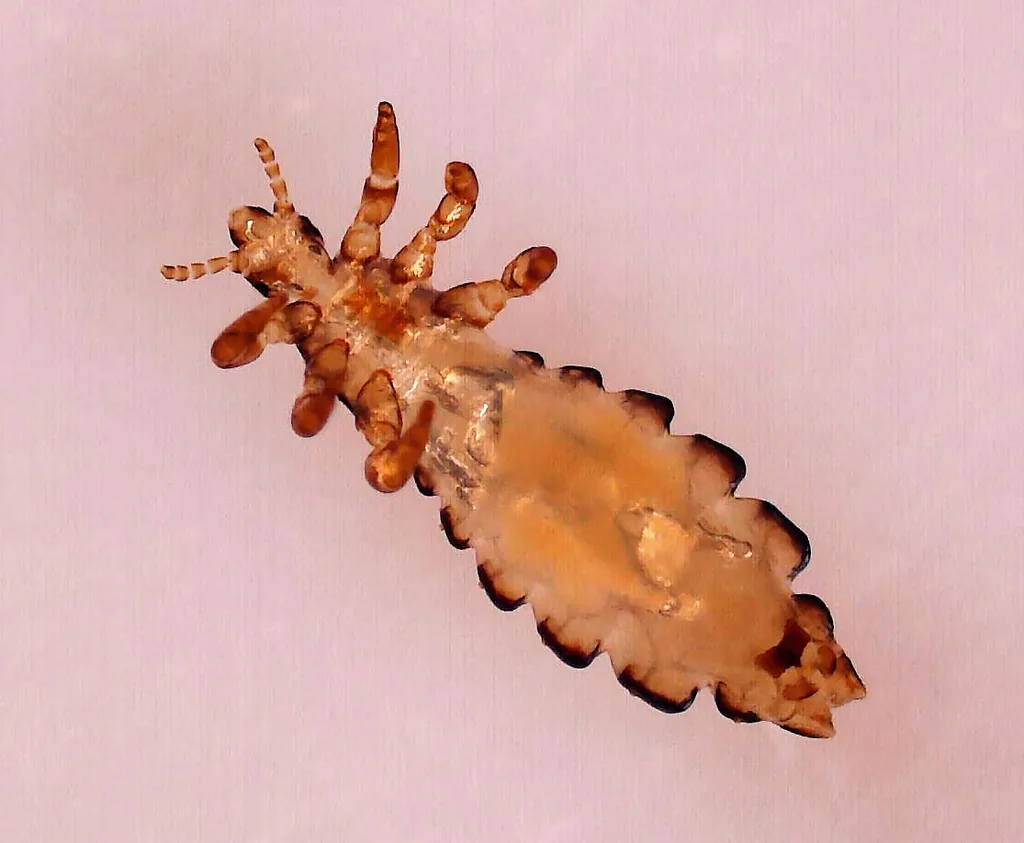
- Adults are about 2.3 to 3.6 millimeters long, roughly the size of a sesame seed, tan to grayish-white, with six legs.[1][4]
- Eggs, called nits, are tiny (about 0.8 by 0.3 mm) and easy to mistake for dandruff. They are laid in clothing, often along the seams, especially around the waistline and under the armpits; Texas DSHS notes they may also be attached to body hair.[1][4]
- Newly hatched nymphs are about the size of a pinhead.[1][4]
- The usual way to confirm body lice is to find eggs and crawling lice in clothing seams; a magnifying lens can help.[1][3][4]
Look-alikes
Where it lives
Body lice occur worldwide but are concentrated where people live in crowded conditions without regular access to bathing and clean clothes.[1][4]
Biology and life cycle
Sources differ on timing. The CDC says nits hatch in 6 to 9 days and nymphs reach adulthood in about a week; Texas DSHS says nits usually take 1-2 weeks to hatch and nymphs become adults about 9-12 days after hatching.[1][4]
A female can lay up to eight nits a day, and adults can live up to 30 days on a person's body.[1][4]
Adults need to feed on blood several times a day; without blood meals they die within 1 to 2 days off the host.[1][4]
They can't hop or fly; they crawl, and usually move to the skin only to feed.[3][4]
Damage and signs
Health risk
Body lice can spread epidemic typhus, trench fever (Bartonella quintana infection) and epidemic relapsing fever. Bites cause intense itching and a rash from an allergic reaction, scratching can lead to infected sores, and long-term infestations thicken and darken the skin around the waist, groin and upper thighs. Texas DSHS notes the itching may take two to three weeks to appear.[1][5][3][4]
Control
Prevention
Avoid sharing clothing, bedding, towels and other personal items with someone who has body lice.[1][3]
Sanitation
Bathe regularly and change into clean, machine-washed clothes at least once a week; better hygiene is the main treatment for body lice.[1][3][4]
Machine-wash infested clothing, bedding and towels in water at least 130 degrees Fahrenheit, then dry them on high heat.[1][4]
Traps and physical control
Dry-clean items that can't be washed, or seal them in a plastic bag for two weeks.[1]
Pesticides
A pediculicide (lice-killing medicine) is sometimes prescribed, but usually isn't needed when hygiene and laundering are kept up; if one is used, follow the label or your health care provider exactly. Insecticide dusting or fumigation is used to control disease outbreaks such as epidemic typhus.[1][3][4]
How body lice spread
They spread through direct contact with a person who has body lice, or through infested clothing, bedding, linens or towels.[1][3][4]
Epidemic typhus, also called louse-borne typhus, spreads to people through contact with infected body lice. Texas DSHS notes outbreaks still occur during war, civil unrest, disasters and in prisons where people live in crowded, unsanitary conditions.[5][4]
Common questions
- What water temperature kills body lice?
- The CDC advises washing infested items in water at least 130 degrees Fahrenheit and drying them on the hot cycle.[1][4]
- Can I get body lice from my dog or cat?
- No. Pets don't spread human lice.[1][3]
- Do I need medicine for body lice?
- Usually not. Regular bathing, clean clothes and hot-water laundering of clothing and bedding are normally enough.[1][4]
- How are body lice different from head lice?
- Body lice live and lay eggs in clothing and can spread diseases such as typhus, trench fever and relapsing fever; head lice live on the head and are not known to spread disease. Having one type doesn't mean you will get another.[1][2][3]
Sources
- U.S. Centers for Disease Control and Prevention, “About Body Lice (updated June 24, 2024).” www.cdc.gov/lice/about/body-lice.html (accessed 2026-11-12)
- U.S. Centers for Disease Control and Prevention, “About Head Lice.” www.cdc.gov/lice/about/head-lice.html (accessed 2026-11-12)
- NIH National Library of Medicine, MedlinePlus, “Body Lice (health topic).” medlineplus.gov/bodylice.html (accessed 2026-11-12)
- Texas Department of State Health Services, “Body Lice Fact Sheet (Public Health Region 1, Epidemiology and Surveillance).” www.dshs.texas.gov/sites/default/files/region1/documents/Epi/Body-Lice-Fact-Sheet.pdf (accessed 2026-11-12)
- U.S. Centers for Disease Control and Prevention, “Typhus Fevers Basics (updated December 11, 2025).” www.cdc.gov/typhus/about/index.html (accessed 2026-11-12)
- iNaturalist, “Pediculus humanus humanus taxon page (order and family).” www.inaturalist.org/taxa/411752 (accessed 2026-10-06)