On this page
How to identify it
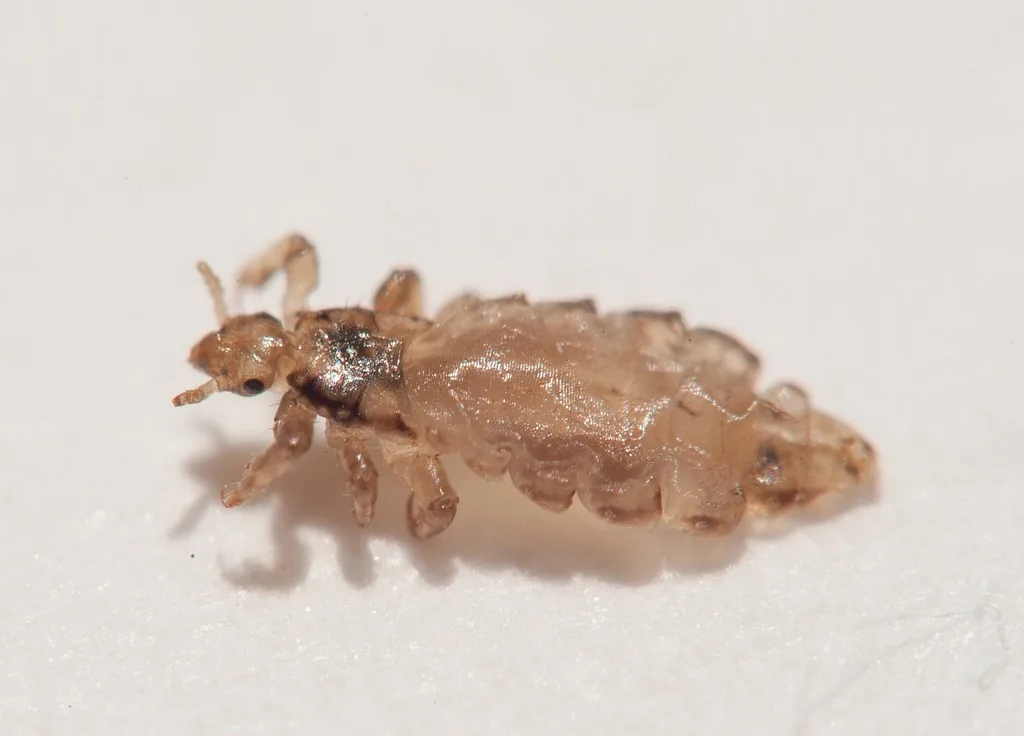
- Adults are about the size of a sesame seed, beige to gray: the CDC gives 2 to 3 mm, and the Minnesota Department of Health about 1/8 inch.[1][4][3]
- Each of the six legs ends in a claw for gripping hair; lice crawl quickly but can't hop, jump or fly.[4][1][3]
- Nits are tiny oval eggs, about 1/32 inch, glued to the hair shaft close to the scalp; nymphs look like small adults.[4][1]
- A nit sticks firmly to the hair, while dandruff, hair spray or gel flakes brush or flick off.[4][3][2]
- Finding a live nymph or adult louse on the scalp or hair is the best way to confirm an infestation; they move fast and avoid light, and a fine-toothed louse comb helps find them.[1]
Look-alikes
| Look-alike | How to tell them apart |
|---|---|
| Dandruff and hair debris | Flakes lift off easily; an empty nit casing stays cemented to the hair shaft, so use a magnifier to check.[4] |
| Old, hatched nits | Nits more than 1/4 inch from the scalp have probably hatched or are dead; finding a live, crawling louse is what confirms an active infestation.[4] |
Where it lives
Head lice live only on people and are found worldwide. In the U.S. most infestations involve preschool and elementary-age children and their household members and caretakers.[1][3][4]
Biology and life cycle
Females glue eggs to hairs near the scalp, mostly at night: about 5 or more a day according to UC IPM, about six a day according to the CDC.[4][1]
Eggs hatch in about a week: the CDC gives 6 to 9 days, UC IPM 7 to 10 days.[1][4]
Nymphs need a blood meal within minutes of hatching and mature in about 7 to 10 days. Adults live about 30 days on a person's head according to the CDC and MedlinePlus; UC IPM gives 3 to 4 weeks.[4][1][2]
Because the scalp stays warm, they breed all year.[4]
Off the head, lice die within about two days and nits usually die within a week; nits that fall off will not hatch or reattach, and lice do not live on pets.[1][3]
Damage and signs
Health risk
Head lice don't transmit any disease. Itching, an allergic reaction to louse bites, can take four to six weeks to start the first time a person has lice, and scratching can cause sores that sometimes become infected with skin bacteria. MedlinePlus advises contacting a health care provider if red, tender skin suggests an infection.[1][2]
Control
Prevention
Do not use fumigant sprays or fogs in the home; they are not needed and can be toxic if inhaled or absorbed through the skin. Avoid head-to-head contact during play and sports, and don't share combs, brushes or towels.[5][1][3]
Sanitation
Step 3: wash bedding, clothes and towels the person used in the two days before treatment in 130 degrees F water and a hot dryer, or seal unwashable items in a plastic bag for two weeks. Soak combs and brushes in water of at least 130 degrees F for 5 to 10 minutes.[5][1][3]
Vacuum the floor and furniture where the person sat or lay; the chance of catching lice from carpet or furniture is very small.[5][3]
Traps and physical control
Step 2: comb wet hair section by section with a nit comb every 2 to 3 days for 2 to 3 weeks after treatment; flea combs for cats and dogs also work.[5][4]
Pesticides
Step 1: check everyone in the household, and treat every infested person and anyone sharing a bed at the same time with an over-the-counter or prescription lice medicine used exactly as the label directs. Don't use a combination shampoo/conditioner, or conditioner, before the lice medicine.[5][6]
Over-the-counter choices: pyrethrins with piperonyl butoxide (brands include A-200, Pronto, R&C, Rid and Triple X), for ages two and up, and 1% permethrin lotion (Nix), for ages two months and up. Both kill lice but not unhatched eggs, so a second treatment is needed about 9 to 10 days later.[7][2]
Prescription choices: 5% benzyl alcohol (Ulesfia), 0.5% ivermectin lotion (Sklice), 0.5% malathion (Ovide) and 0.9% spinosad (Natroba). Spinosad kills eggs too, so retreatment and nit combing usually aren't needed; ivermectin is effective in most patients as one application without nit combing. Malathion is flammable, so keep hair dryers and curling irons away while hair is wet. Lindane is no longer available in the U.S. and the AAP no longer recommends it.[7]
Resistance: the CDC says lice have developed some resistance to permethrin and pyrethrins but the prevalence is unknown, and the Minnesota Department of Health reports resistant populations in Minnesota. If you find no dead lice 8 to 12 hours after treatment, or they seem as active as before, the medicine may not be working; talk to a health care provider before re-treating.[7][5][8]
What not to put on a child's head
Use only one lice product at a time unless a health care provider tells you otherwise, and ask a provider before treating young children.[6][5]
The CDC has no scientific evidence that mayonnaise, olive oil, margarine, butter or similar substances work, and the Minnesota Department of Health cannot recommend such home suffocants without more evidence.[5][3]
Common questions
- Do I need to spray or fog my house for head lice?
- No. The CDC says not to use fumigant sprays or fogs; washing recently used bedding and clothing and vacuuming where the person rested is enough.[5][3]
- Can my dog or cat give us head lice?
- No. Animals do not get or spread head lice.[1][3]
- Should my child stay home from school?
- The CDC says students with head lice don't need to be sent home early; they can go home at the end of the day, be treated and return to class after starting treatment, and Minnesota health officials agree children with lice can go to school. MedlinePlus notes that some schools and daycares still keep children out until treatment is complete, so check local policy.[1][3][2]
- Do I have to pick out every nit?
- Nits more than 1/4 inch from the scalp are probably old and don't mean an active infestation. With spinosad, nit removal is not needed; with most other products, comb out nits and lice every 2 to 3 days for 2 to 3 weeks.[1][5]
Sources
- U.S. Centers for Disease Control and Prevention, “About Head Lice.” www.cdc.gov/lice/about/head-lice.html (accessed 2026-11-12)
- NIH National Library of Medicine, MedlinePlus, “Head lice (Medical Encyclopedia).” medlineplus.gov/ency/article/000840.htm (accessed 2026-11-12)
- Minnesota Department of Health, “Head Lice Fact Sheet.” www.health.state.mn.us/diseases/headlice/headlice.html (accessed 2026-11-12)
- University of California Statewide IPM Program, “Pest Notes: Head Lice, UC ANR Publication 7446.” ipm.ucanr.edu/home-and-landscape/head-lice/ (accessed 2026-11-12)
- U.S. Centers for Disease Control and Prevention, “Treatment of Head Lice.” www.cdc.gov/lice/treatment/index.html (accessed 2026-11-12)
- NIH National Library of Medicine, MedlinePlus, “Head Lice (health topic).” medlineplus.gov/headlice.html (accessed 2026-11-12)
- U.S. Centers for Disease Control and Prevention, “Clinical Care of Head Lice.” www.cdc.gov/lice/hcp/clinical-care/index.html (accessed 2026-11-12)
- Minnesota Department of Health, “Head Lice.” www.health.state.mn.us/diseases/headlice/index.html (accessed 2026-11-12)
- iNaturalist, “Pediculus humanus capitis taxon page (order and family).” www.inaturalist.org/taxa/413842 (accessed 2026-10-06)