The short answer
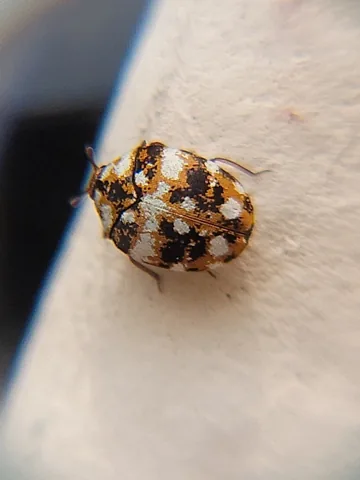
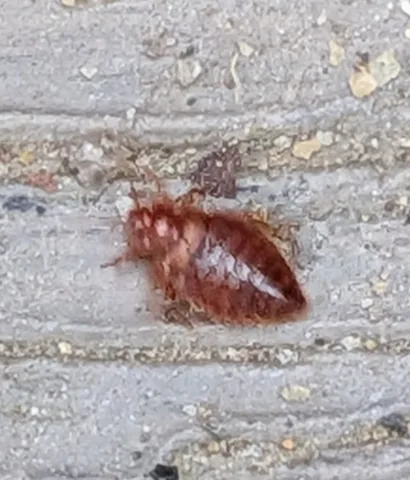
- Look at the shape. An adult bed bug is flat, oval and reddish-brown, about the size of an apple seed. An adult carpet beetle is smaller and nearly round, often with a mottled pattern of white, brown, yellow or orange scales, or plain black.[9][2][1][5]
- Check for wings and where you found it. Carpet beetle adults fly and are usually seen on windowsills, since they are drawn to light. Bed bugs cannot fly and hide in mattress seams, box springs, bed frames and couch cushions.[3][5][10][4]
- If it is fuzzy and worm-like, it is a carpet beetle larva, not a bed bug. Bed bug young (nymphs) look like small, pale adults. Carpet beetle larvae are tan to brown and covered with hairs or bristles.[1][9][2]
- Itchy spots with no bugs in the bed? Doctors in France traced a cluster of itchy lesions, mostly under clothing, to carpet beetle larva hairs; the authors say this rash is underdiagnosed or confused with bed bug or flea bites.[13]
Profiles on this site
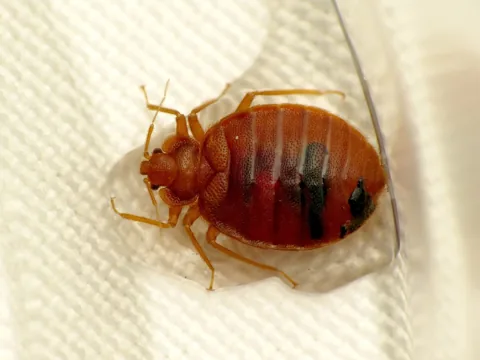 Bed Bug
Cimex lectularius
Bed bugs are wingless, blood-feeding insects that feed on sleeping or resting people, mostly at night; they have resurged worldwide and now turn up even in the finest hotels. CDC says they turn up in five-star hotels and resorts, and how clean a place is does not determine whether bed bugs are present.
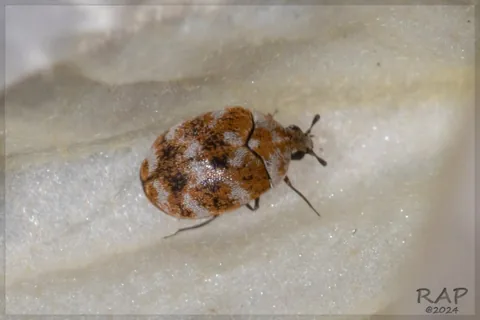 Varied Carpet Beetle
Anthrenus verbasci
Carpet beetles are small beetles whose larvae damage wool, silk, fur, feathers, leather and other animal products; the adults feed on pollen outdoors and often fly in through windows.
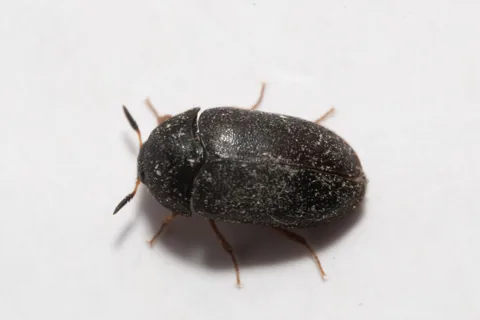 Black Carpet Beetle
Attagenus unicolor
The black carpet beetle is a shiny black carpet beetle whose larvae feed on wool, fur, feathers and other animal products, plus grains and other stored foods. In dry areas such as California, it is more often a pantry pest than a fabric pest. Colorado State Extension calls it one of the most common dermestid beetles.
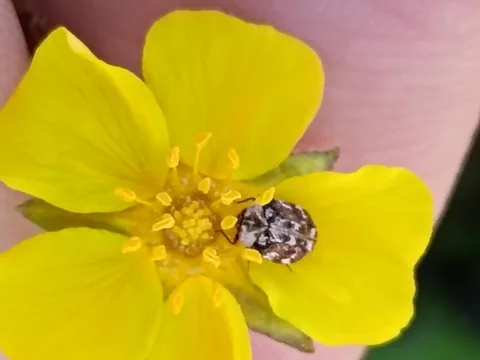 Common Carpet Beetle
Anthrenus scrophulariae
The common carpet beetle is a small, nearly round dermestid beetle whose larvae eat wool, carpets, fur and other animal products. UF/IFAS says it is found worldwide and also attacks preserved museum specimens.
 Furniture Carpet Beetle
Anthrenus flavipes
The furniture carpet beetle is a small, round dermestid beetle whose hairy larvae chew upholstery, carpets, fur and other animal-fiber items. UF/IFAS calls it a cosmopolitan pest that is most destructive in warmer parts of the world; in the United States it is mainly a pest of the southern states, though it also turns up in heated buildings farther north.
 Bat Bugs
Cimex adjunctus (eastern bat bug) and Cimex pilosellus (western bat bug)
Bat bugs are close relatives of bed bugs that feed on the blood of roosting bats. They turn up in homes that have bats in the attic or walls, and they may bite people when the bats leave or are shut out.
Side by side
These are the field marks extension entomologists use. Sizes differ a little from one source to the next, so ranges are given.[2][4][1][3]
- Adult size: bed bug about 3/16 to 1/4 inch (5-7 mm) per EPA, about 3/16 inch per Kentucky and about 1/5 inch per UC IPM. Carpet beetle about 1/16 to 1/8 inch per Kentucky and about 1/10 to 1/8 inch per UC IPM; the black carpet beetle runs larger, 1/8 to 3/16 inch per Ohio State.[9][2][4][1][3][5]
- Shape: bed bug oval and flattened, swelling into a balloon-like, more elongated body after feeding. Carpet beetle adult round or oval, with short antennae.[9][2][3][1]
- Color: bed bug reddish-brown, rusty red or mahogany. Carpet beetles range from black to mottled patterns of white, brown, yellow and orange scales.[2][4][1]
- Wings and flight: carpet beetle adults fly; Ohio State says they fly readily in May and June and come to night-lights. UC IPM calls adult bed bugs wingless, and EPA says their wings are not used for flying.[5][3][4][9]
- Young: bed bug nymphs look like smaller, lighter-colored adults, translucent or whitish-yellow. Carpet beetle larvae look nothing like the adults: about 1/8 to 1/4 inch, tan to brown, slow-moving and densely covered with hairs or bristles.[2][9][1]
- Food: bed bugs feed only on blood. Carpet beetle larvae eat wool, fur, felt, silk, feathers, skins and leather, which contain the animal protein keratin; the adults eat flower pollen and do not damage fabric.[2][1][3]
- Where found: bed bugs gather near the piping, seams and tags of mattresses and box springs, in bed frame and headboard cracks, and in chair and couch seams. Carpet beetle larvae stay in dark, undisturbed places such as rug edges, stored woolens and fabric folds; adults show up on windowsills.[10][2][1][3]
- When: bed bugs feed mostly at night but, EPA says, will seek a host in daylight if hungry. Carpet beetle adults are most noticed in spring, when Kentucky says they often appear on windowsills.[4][10][1][5]
- Shed skins: bed bugs leave light-colored shed skins. Carpet beetle larvae leave brown, shell-like, bristly cast skins.[4][3]
- Droppings: bed bug excrement makes dark spots that may bleed into fabric like a marker, plus rusty smears where bugs were crushed. Carpet beetle fecal pellets are about the size of a grain of salt.[10][2][3]
- Damage or skin effect: bed bugs bite, leaving itchy welts. Carpet beetle larvae leave threadbare spots and irregular holes in wool and similar materials, and their hairs can cause an itchy allergic rash that is not a bite.[2][12][1][13]
Carpet beetle larvae and their shed skins
Most mix-ups start with the larvae or the bristly skins they leave behind, because these turn up in bedrooms, closets and along carpet edges. Clemson says the larvae wander and may be found on items they do not feed on.[7][1]
Species differ. UC IPM says varied carpet beetle larvae grow up to 5/16 inch and range from light brown to almost black. Ohio State describes black carpet beetle larvae as golden to dark brown, about 1/2 inch long and shaped like an elongated carrot with a long brush of bristles at the tail; Colorado State gives about 12 mm (0.5 inch) for them.[3][5][6]
Bites or a rash? The itch confusion
Bed bugs bite people and animals at night while they sleep. CDC says they cause irritation, itching and lost sleep, and are not known to spread disease to people. A 2009 JAMA review found reactions are mostly in the skin and only rarely systemic.[12][16]
Carpet beetles do not bite. The French report in CDC's journal describes allergic skin reactions to larva hairs hooked in the skin, appearing under clothing in several members of one household. The itchy, reddish raised spots lasted about a week, and the authors say they mimic arthropod bites but lack a central blister.[13]
Other reports describe a wider range. A 2021 case report describes carpet beetle dermatitis in a teenager that looked like bullous impetigo and traced it to carpet beetles in a wool rug; a 2024 review ties exposure to these hairs to dermatitis, eye and nose irritation and acute asthma.[15][14]
- In the French cluster, families checked beds and sofas and found no bed bugs or fleas; they found larvae and adult beetles, which a medical entomologist identified. The authors say the home should be checked for this beetle when skin lesions look like bites without a central blister.[13]
How to confirm which one you have
- Catch one: EPA's first tip is to make sure you really have bed bugs, and suggests comparing the insect to EPA's pictures or showing it to your local extension agent.[11]
- Use a hand lens: you can see adult bed bugs and groups of nymphs with the naked eye, but UC IPM says the eggs need a hand-magnifying lens.[4]
- Strip the bed: Kentucky says a thorough bed bug inspection means taking the bed apart and standing the pieces on edge to check upper and lower seams; look for dark spots, crushed-bug smears and pale shed skins.[2][4]
- Set bed-leg monitors: UC IPM says double-cupped interceptors under bed legs caught six times more bed bugs than visual searches alone.[4]
- For carpet beetles, check windowsills for adults and look in stored wool, furs, feathers and rug edges for holes, grazed spots, larvae, bristly skins and salt-grain droppings. Kentucky also points to bird nests, animal carcasses and piles of dead insects in attics.[3][1]
Why the difference matters
Treatment is different. Confirmed bed bug infestations, UC IPM says, are best handled by trained professionals and need follow-up monitoring. EPA warns that misidentifying bed bugs gives them more time to spread. Carpet beetles are a fabric and food-source problem, and UC IPM says management is needed only if larvae are developing in fabrics or other areas of the home.[4][10][3]
- Kentucky notes that ant and cockroach baits are useless against bed bugs because they only feed on blood.[2]
What to do for each
- Bed bugs: launder bedding and clothing at 120°F or more, or run dry items in a dryer on medium-to-high heat for 10 to 20 minutes, and call an experienced company. The bed bug guides below cover preparation, encasements and heat.[2][4]
- Carpet beetles: find the source, then launder, dry-clean or discard infested items; vacuum floors, carpets and heating vents to remove larvae, hair and lint; and dry-clean or launder woolens before long storage.[1][3]
- Carpet beetle prevention: seal gaps at windows, doors and vents, clean dead insects off windowsills, and check cut flowers before bringing them in.[3][6]
- Itchy bites: CDC says an antihistamine may help with itchy bed bug reactions, and that heavy scratching can lead to a secondary skin infection.[12]
Common questions
- Do carpet beetles bite?
- No. The itchy spots people blame on them are allergic reactions to the larvae's hairs, not bites, according to the CDC journal report.[13]
- Can carpet beetles live in a bed?
- Larvae wander and turn up on items they do not eat, and they feed on wool, feathers and similar materials, so wool blankets, feather pillows and similar bedding can be food for them. They do not feed on people or blood.[7][1][3]
- Are the shed skins on my mattress from bed bugs or carpet beetles?
- Bed bug skins are light-colored and shaped like the bug. Carpet beetle larval skins are brown, shell-like and bristly.[4][3]
- Do bed bugs fly?
- No. UC IPM calls adult bed bugs wingless and EPA says their wings are not used for flying. A small beetle flying to a window is much more likely a carpet beetle.[4][9][5]
Photo credits
- Bed Bug: (c) Katja Schulz, some rights reserved (CC BY) — via iNaturalist, CC BY 4.0
- Varied Carpet Beetle: (c) RAP, some rights reserved (CC BY) — via iNaturalist, CC BY 4.0
- Black Carpet Beetle: (c) Поляков Александр, some rights reserved (CC BY) — via iNaturalist, CC BY 4.0
- Common Carpet Beetle: (c) Alexander Petrunin-Suharev, some rights reserved (CC BY) — via iNaturalist, CC BY 4.0
- Furniture Carpet Beetle: (c) Rodolfo Salinas Villarreal, some rights reserved (CC BY) — via iNaturalist, CC BY 4.0
- Bat Bugs: (c) Jason Hill, some rights reserved (CC BY) — via iNaturalist, CC BY 4.0
Sources
- University of Kentucky Entomology, “ENTFACT-601: Carpet Beetles.” entomology.mgcafe.uky.edu/ef601 (accessed 2026-11-14)
- University of Kentucky Entomology, “ENTFACT-636: Bed Bugs.” entomology.mgcafe.uky.edu/ef636 (accessed 2026-11-14)
- University of California Statewide IPM Program, “Pest Notes: Carpet Beetles.” ipm.ucanr.edu/home-and-landscape/carpet-beetles/ (accessed 2026-11-14)
- University of California Statewide IPM Program, “Pest Notes: Bed Bugs.” ipm.ucanr.edu/home-and-landscape/bed-bugs/ (accessed 2026-11-14)
- Ohio State University Extension (Ohioline), “HYG-2103: Carpet Beetles.” ohioline.osu.edu/factsheet/hyg-2103 (accessed 2026-11-14)
- Colorado State University, Department of Agricultural Biology, “Dermestid beetles.” agsci.colostate.edu/agbio/ipm-pests/dermestid-beetles/ (accessed 2026-11-14)
- Clemson Cooperative Extension Home & Garden Information Center, “Fabric Pest Control (HGIC).” hgic.clemson.edu/factsheet/controlling-fabric-pests/ (accessed 2026-11-14)
- Penn State Extension, “Carpet Beetle Dermatitis.” extension.psu.edu/carpet-beetle-dermatitis (accessed 2026-11-14)
- U.S. Environmental Protection Agency, “Bed Bugs Appearance and Life Cycle.” www.epa.gov/bedbugs/bed-bugs-appearance-and-life-cycle (accessed 2026-11-14)
- U.S. Environmental Protection Agency, “How to Find Bed Bugs.” www.epa.gov/bedbugs/how-find-bed-bugs (accessed 2026-11-14)
- U.S. Environmental Protection Agency, “Top Ten Tips to Prevent or Control Bed Bugs.” www.epa.gov/bedbugs/top-ten-tips-prevent-or-control-bed-bugs (accessed 2026-11-14)
- U.S. Centers for Disease Control and Prevention, “About Bed Bugs.” www.cdc.gov/bed-bugs/about/index.html (accessed 2026-11-14)
- U.S. Centers for Disease Control and Prevention (Emerging Infectious Diseases), “Simon L, et al. Anthrenus sp. and an Uncommon Cluster of Dermatitis. Emerging Infectious Diseases 27(7), 2021.” wwwnc.cdc.gov/eid/article/27/7/20-3245_article (accessed 2026-11-14)
- Cutis, via PubMed, “Johnson AG, Rohr BR. What's Eating You? Carpet Beetles (Dermestidae). Cutis 2024;113(3):E6-E9.” pubmed.ncbi.nlm.nih.gov/38648592/ (accessed 2026-11-14)
- Pediatric Dermatology, via PubMed, “Gumina ME, Yan AC. Carpet beetle dermatitis mimicking bullous impetigo. Pediatric Dermatology 2021;38(1):329-331.” pubmed.ncbi.nlm.nih.gov/33247445/ (accessed 2026-11-14)
- JAMA, via PubMed, “Goddard J, deShazo R. Bed bugs (Cimex lectularius) and clinical consequences of their bites. JAMA 2009;301(13):1358-66.” pubmed.ncbi.nlm.nih.gov/19336711/ (accessed 2026-11-14)