On this page
How to identify it
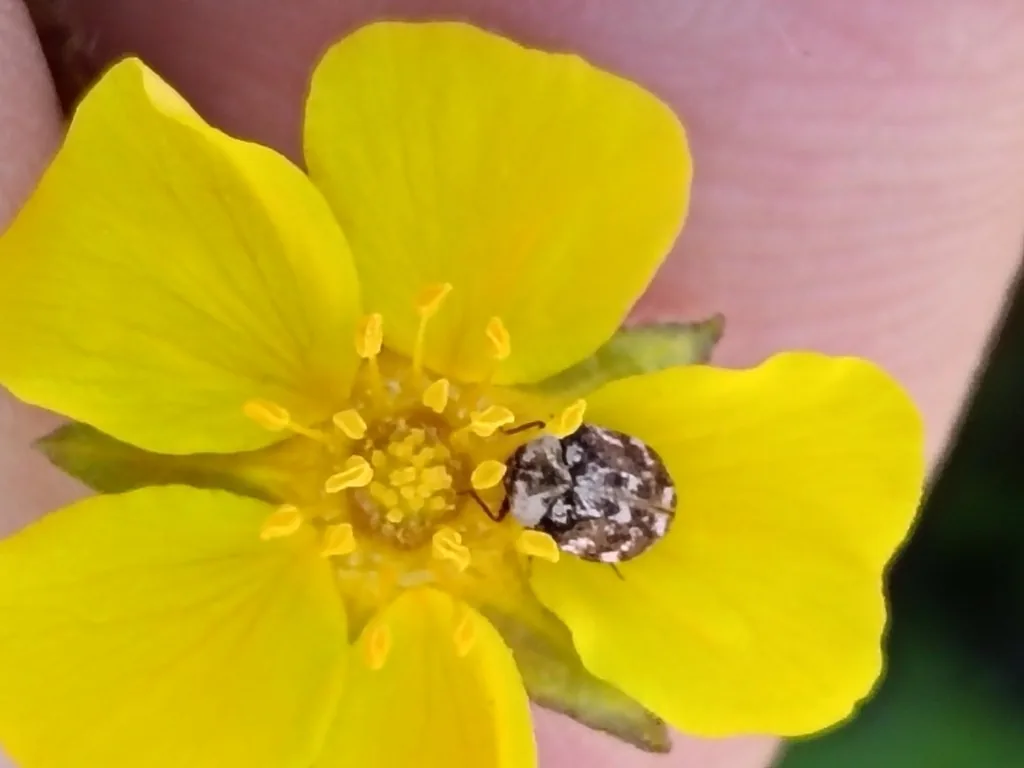
- Adults are about 1/10 to 1/8 inch long, nearly round and gray to black, with tiny whitish scales and a band of orange-red scales down the middle of the back and around the eyes. UF/IFAS gives 2.5 to 3.8 mm for adults: the black head is mostly hidden under the thorax, the thorax is covered with white scales except for a large midline, and the wing covers carry orange to red scales down the middle with variable white patches. Older beetles may lose some or all of their scales, which changes the pattern.[1][4]
- Colorado State gives about 2 to 3 mm for adults of this genus, with color patterns made of yellow, brown and white scales.[2]
- Larvae are elongated ovals about 1/4 inch long, reddish brown and covered with brownish-black hairs, and Ohio State notes they often move quickly. They leave shed skins behind as they grow. UF/IFAS says larvae go through six stages; the last is reddish brown, covered with many dark hairs and 2.5-5.5 mm long.[1][5][4]
- A good hand lens or a microscope is needed to see the scale details that separate the Anthrenus species.[1]
- UF/IFAS describes the eggs as small and white, with projections that help them stick to surfaces.[4]
Look-alikes
| Look-alike | How to tell them apart |
|---|---|
| Varied carpet beetle | Colorado State lists it as the most common Anthrenus in homes, ahead of the furniture and common carpet beetles. Ohio State describes it as usually gray with white, brown and yellow scales and irregular black crossbands, with larvae broader at the rear.[2][1] |
| Furniture carpet beetle | Another Anthrenus beetle of homes, about 1/16 to 1/8 inch, whitish and checkered with black spots outlined in yellowish-orange scales, with yellow-scaled legs and a white underside.[1] |
Where it lives
Extension guides from Ohio, Colorado and South Carolina list it among household carpet beetles; Colorado State ranks it third among Anthrenus species found in Colorado homes, after the varied and furniture carpet beetles. UF/IFAS says it is found worldwide and, in the United States, is most readily found in the north.[1][2][5][4]
Biology and life cycle
Adults feed outdoors on flower pollen and nectar, fly readily and are drawn to light, so they turn up on windows and screens indoors. UF/IFAS says adults prefer white or cream blossoms such as buckwheat, wild asters, daisies, Spiraea and Ceanothus, and that pollen and nectar are thought to encourage mating and egg laying.[1][2][4]
Anthrenus larvae are common in abandoned bee and wasp nests, and carpet beetle larvae also feed on dead insects and animals and in bird and rodent nests. Outdoors, UF/IFAS says the female may lay her eggs in animal nests, beehives or on dead animals; indoors, on textiles, carpets, clothing, preserved specimens or other material of animal or plant origin.[2][5][3][4]
Ohio State says that, depending on species, a female can lay up to 100 eggs, which hatch in 8 to 15 days in warm weather; the larval stage lasts from sixty days to a year or more, depending on food and temperature.[1]
For this species, UF/IFAS says a female lays 30 to 60 eggs that hatch 10 to 20 days later, and larvae need about 66 days at room temperature to develop through six stages.[4]
Larvae pupate inside their last larval skin wherever they were last feeding, such as in carpets, carpet pads or cracks in the floor. UF/IFAS says pupation lasts 7 to 15 days, and new adults rest in the larval skin for about 18 days before becoming active and heading outdoors to feed and mate.[4]
Damage and signs
- Larvae damage carpets, wool, fur, feathers, silk and other items that contain keratin, the animal protein they can digest. Cotton and synthetic fabrics are rarely attacked unless blended with wool or soiled with food stains, body oils or animal waste. UF/IFAS says damaged textiles and carpets end up peppered with irregular holes.[3][1][4]
- Museum objects, insect collections and taxidermy mounts are also at risk. UF/IFAS says museum specimens are eaten away, often with a fine dust left around or beneath them.[3][4]
- Adults don't damage fabrics; the larvae do, often in hidden spots behind baseboards and moldings, in air ducts, in dresser drawers and under heavy furniture.[3][1]
Health risk
Carpet beetles don't bite, and the adults are harmless. Larvae of Anthrenus, the genus this beetle belongs to, carry fine spear-tipped hairs that can lodge in skin and cause itchy red bumps that look like bites but are allergic reactions; reviews also link the airborne hairs to eye and nose symptoms and, rarely, asthma.[6][7]
Control
Sanitation
Vacuum floors, rugs, baseboards, vents and closets regularly, and launder or dry-clean woolens before storing them in tight plastic bags or containers. UF/IFAS calls protecting the food source through good sanitation, such as dusting, vacuuming and regular washing or dry cleaning, the best prevention, with stored materials and specimen collections kept in tightly closed containers.[3][1][5][4]
Remove old bird, rodent and wasp nests and accumulations of dead insects, which can feed larvae.[1][3]
Traps and physical control
To kill larvae in items you can't wash, seal them in plastic and freeze them at 0°F or colder for at least a week (72 hours is enough at -20°F), or heat them for at least 30 minutes at 120°F or higher if the object can take it. UF/IFAS adds that putting goods in hot sunlight makes the larvae abandon them.[3][8][4]
Pesticides
Where cleaning can't reach, such as attics and wall voids, UC IPM suggests an insecticidal dust such as silica aerogel. Kentucky says sprays labeled for fabric insects can supplement cleaning along carpet edges and closet floors, but infested clothing and bedding should not be treated. UF/IFAS mentions insecticidal dusts for cracks, crevices, baseboards and carpet edges, and says fumigation may be the most efficient option in extreme cases where the whole structure is infested.[8][3][4]
Where sources disagree
Generations: Ohio State says most carpet beetles have three to four generations a year, with only the black and varied carpet beetles limited to about one, while Colorado State says Anthrenus beetles in Colorado normally produce one generation a year and spend the winter as larvae or pupae.[1][2]
Eggs: Kentucky gives about 50 to 100 eggs per female for carpet beetles, while Ohio State says up to 100 or more depending on species. UF/IFAS gives 30 to 60 eggs for the common carpet beetle itself.[3][1][4]
Freezing and heat: UF/IFAS says bagged goods can be held in a -20°F freezer for three hours or heated above 105°F for four hours. Kentucky says freezers reaching -20°F kill all life stages within 72 hours, and UC IPM gives at least 30 minutes at 120°F or higher.[4][3][8]
Common questions
- Are the tiny patterned beetles on my windowsill eating my clothes?
- Not the adults. They feed on flower pollen and nectar and don't eat fabric; the larvae do. Kentucky notes that adults showing up on windowsills in spring can be a sign that larvae are developing somewhere in the house.[3][2]
- Can common carpet beetles cause a rash?
- Possibly. Carpet beetles don't bite, but a CDC journal report describes itchy, bite-like bumps caused by allergic reactions to Anthrenus larval hairs, mostly under clothing, that cleared once the larvae were removed and patients were treated.[6]
- How long does a common carpet beetle take to grow up?
- UF/IFAS says eggs hatch in 10 to 20 days, larvae need about 66 days at room temperature, pupation takes 7 to 15 days, and new adults rest about 18 days in the larval skin before becoming active.[4]
- Where is the common carpet beetle found?
- Worldwide. UF/IFAS says that in the United States it is most readily found in the north.[4]
Sources
- Ohio State University Extension (David J. Shetlar), “Carpet Beetles, HYG-2103 (October 2011).” ohioline.osu.edu/factsheet/HYG-2103-10 (accessed 2026-11-14)
- Colorado State University Extension, “Dermestid Beetles (Carpet Beetles) (Fact Sheet 5.593).” extension.colostate.edu/resource/dermestid-beetles-carpet-beetles/ (accessed 2026-11-14)
- University of Kentucky Entomology, “ENTFACT-601: Carpet Beetles.” entomology.mgcafe.uky.edu/ef601 (accessed 2026-11-14)
- University of Florida/IFAS Extension (Featured Creatures), “Common Carpet Beetle, Anthrenus scrophulariae (Linnaeus), EENY482/IN873 (Featured Creatures).” ask.ifas.ufl.edu/publication/IN873 (accessed 2026-11-14)
- Clemson Cooperative Extension, Home and Garden Information Center, “Controlling Fabric Pests (HGIC).” hgic.clemson.edu/factsheet/controlling-fabric-pests/ (accessed 2026-11-14)
- Centers for Disease Control and Prevention (Emerging Infectious Diseases journal), “Simon et al. 2021, Anthrenus sp. and an Uncommon Cluster of Dermatitis, Emerging Infectious Diseases 27(7):1940-1943.” wwwnc.cdc.gov/eid/article/27/7/20-3245_article (accessed 2026-11-14)
- Cutis, via PubMed, “Johnson AG, Rohr BR (2024), What's Eating You? Carpet Beetles (Dermestidae), Cutis 113(3):E6-E9.” pubmed.ncbi.nlm.nih.gov/38648592/ (accessed 2026-11-14). Cited from the PubMed abstract.
- University of California Statewide IPM Program, “Pest Notes: Carpet Beetles, Publication 7436 (web version).” ipm.ucanr.edu/home-and-landscape/carpet-beetles/ (accessed 2026-11-14)
- iNaturalist, “Anthrenus scrophulariae taxon page (order and family).” www.inaturalist.org/taxa/1571453 (accessed 2026-11-14)