On this page
How to identify it
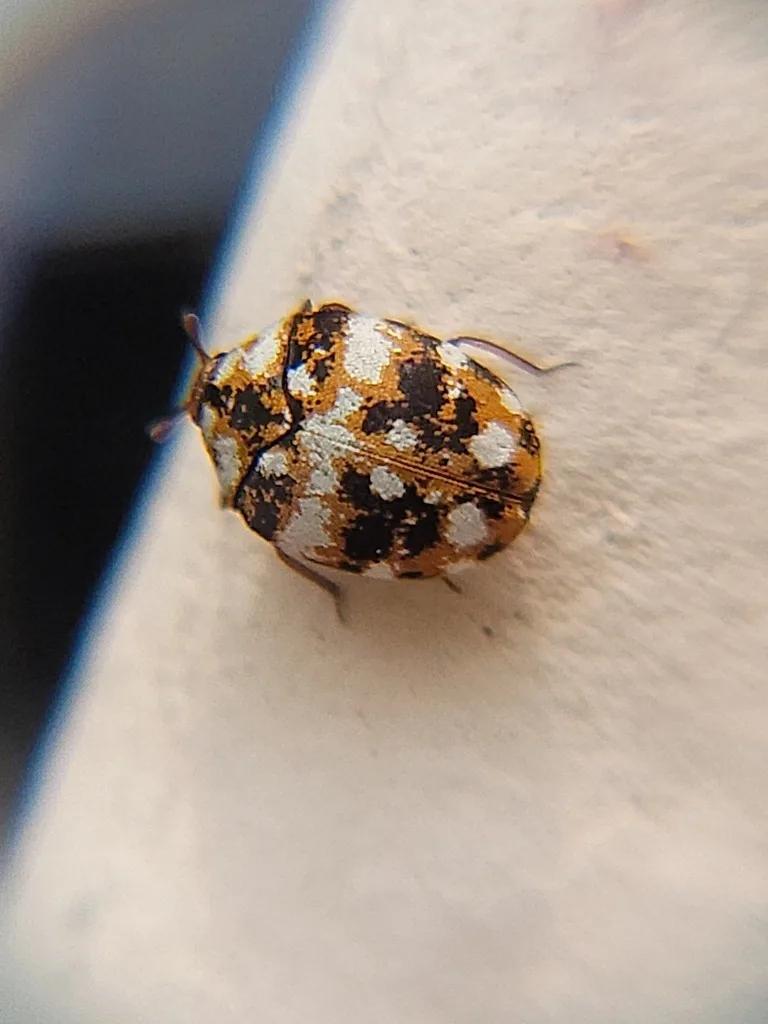
- Adults are nearly round and about 1/16 to 1/8 inch long, whitish and checkered with black spots that are each outlined in yellowish-orange scales; the legs carry yellow scales. UC IPM describes the same mottled look as black spots among white and dark yellow to orange scales.[5][1]
- Worn adults can look solid black because the scales rub off; the underside is white.[1]
- Larvae are white at first and darken to dark red or chestnut brown; grown larvae are about 1/4 inch long, oval and thickly covered with brownish hair, and often crawl quickly.[1][5]
- Seen from above, adults are slightly larger and rounder than varied carpet beetles, and the larvae are broader in front and narrower at the rear.[1]
- UF/IFAS gives adults as round and 2 to 3.5 mm long, black with yellow and white mottled scales on the back and thick yellow scales on the legs. Color patterns vary, so the surest check is the body scales under a hand lens: this species has round or oval scales, where other carpet beetles have long, narrow ones.[4]
- Larvae grow to about 5 mm, oval and covered with brown hair, and their color depends on what they have been eating. A long pencil of hairs at the rear end that keeps vibrating marks this species; the larva of the common carpet beetle is otherwise hard to tell apart.[4]
Look-alikes
| Look-alike | How to tell them apart |
|---|---|
| Varied carpet beetle | Very similar; UC IPM notes the furniture carpet beetle is slightly larger and rounder, with larvae broader at the front end.[1] |
| Black carpet beetle | Adults are shiny black and dark brown, and the larvae are distinctly different, up to 5/16 inch long and light brown to almost black.[1] |
| Common carpet beetle | A close relative (Anthrenus scrophulariae) whose larva is hard to tell from this one; UF/IFAS says the furniture carpet beetle larva has a long, constantly vibrating pencil of hairs at the end of the body.[4] |
Where it lives
Extension guides from California, Colorado, Ohio and South Carolina list it among household carpet beetles; Colorado State ranks it second among Anthrenus species in Colorado homes, after the varied carpet beetle. UF/IFAS describes it as cosmopolitan and most destructive in warmer climates; in the United States it is mainly a southern pest but also lives in heated buildings in northern states.[1][6][5][2][4]
Biology and life cycle
UC IPM's figures add up to roughly three to four months from egg to adult: eggs hatch in 9 to 16 days, larvae feed for 70 to 94 days and pupae take 14 to 17 days. Ohio State notes the cycle runs faster in warm rooms than in unheated parts of a house in winter.[1][5]
Females lay their eggs near larval food, such as lint near the food source, in air ducts, under heavy furniture and under baseboards. UC IPM says a female typically lays about 60 eggs.[5][1]
Larvae feed for 70 to 94 days and may pupate inside their last larval skin; adults live about 4 to 8 weeks and feed on flower pollen outdoors.[1][5]
UF/IFAS says the whole life cycle takes four to 12 months depending on temperature. Females lay 35 to 100 white, oval eggs in cracks and crevices near larval food, and the eggs hatch in one to three weeks.[4]
Larvae pass through six to 12 instars over two to three months, then pupate inside their last larval skin on or near the food; the white pupa stage lasts about two to three weeks. Adults live 30 to 60 days and feed on flower pollen without harming the flowers.[4]
Damage and signs
- Larvae digest keratin, so they eat wool, fur, felt, silk, feathers, hair, skins and leather. Kentucky lists upholstery, down pillows and comforters, rugs and taxidermy mounts among commonly attacked items.[3][5]
- Cotton, linen and rayon are attacked mainly when stained with spilled food, body oils or animal waste.[5][3]
- Infestations can build up unnoticed, so check corners, under furniture and stored wool and silk that has not been moved in a long time.[3][2]
- UF/IFAS singles out the padding and covering of upholstered furniture, along with hair, carpet, fur, horn and silk. The green rubber coating used on furniture horsehair does not protect it, and dried insect specimens in collections are eaten too.[4]
Health risk
Carpet beetles don't bite. Some people react to the fine, spear-tipped hairs on Anthrenus larvae, the genus this beetle belongs to, and get itchy red bumps, mostly under clothing, that look like bites but are allergic reactions; reviews also link the airborne hairs to eye and nose symptoms and, rarely, asthma.[7][8]
Control
Sanitation
Vacuum often along edges, under furniture and wherever lint and pet hair collect, and empty the vacuum contents outdoors. Kentucky adds vacuuming inside floor vents and lifting the edge of wall-to-wall carpet to check beneath it.[1][2][3]
UF/IFAS says careful inspection comes first: check susceptible items for larvae, cast skins and damage, and watch for adults emerging in the warm summer months. Steam cleaning works well because hot soapy water kills all stages, and infested clothes and furs can be professionally dry-cleaned or put in cold storage.[4]
Traps and physical control
Hot laundering or dry cleaning kills all stages in clothes, blankets and furs. For items that can't be cleaned, Clemson suggests about a week in a freezer, and Kentucky says at least a week at 0°F.[1][3][2]
Pesticides
If cleaning isn't enough, vacuum first, then spot-treat carpet edges, closet floors and cracks with a product labeled for carpet beetles, and use a dust such as silica aerogel in attics and wall voids. Don't spray clothing or bedding.[1][3]
For heavy infestations UF/IFAS says to vacuum thoroughly and clean furniture before any treatment so the upholstery isn't stained; an insecticidal dust such as diatomaceous earth or silica aerogel can go into cracks and crevices and along carpet edges near the baseboards.[4]
When to call a professional
Furniture stuffed with hair or feathers cannot be treated by spraying the outside; vault fumigation by a licensed operator kills all stages.[1]
Where sources disagree
Eggs per female: about 60 (UC IPM), about 50 to 100 for carpet beetles in general (Kentucky), or up to 100 or more depending on species (Ohio State).[1][3][5]
Adult size: about 1/16 to 1/8 inch (Ohio State); Colorado State gives 2 to 3 mm for the genus.[5][6]
Freezing: two weeks below 18°F (UC IPM), at least a week at 0°F or 72 hours at -20°F (Kentucky), or about a week in a home freezer (Clemson).[1][3][2]
Life cycle: UF/IFAS says four to 12 months depending on temperature, while UC IPM's stage lengths add up to roughly three to four months.[4][1]
Eggs per female: UF/IFAS gives 35 to 100, alongside the figures above.[4]
Adult size: UF/IFAS gives 2 to 3.5 mm.[4]
Mothballs: UC IPM and Kentucky say paradichlorobenzene or naphthalene works only when the vapor is held in an airtight container, while UF/IFAS says both offer little protection against this beetle and that paradichlorobenzene only slightly inhibits feeding and is not an effective repellent.[1][3][4]
Common questions
- Do mothballs keep furniture carpet beetles away?
- Only in a sealed container. UC IPM and Kentucky say paradichlorobenzene or naphthalene products work only when their vapors are held in an airtight chest, box or bag; closets usually leak too much. Clemson warns that the vapors are unhealthy to breathe for long periods and can damage plastics and furniture finishes.[1][3][2]
- Where do the beetles come from?
- Adults feed on flower pollen outdoors and fly in through open windows and doors, mostly in May and June according to Ohio State. They can also arrive on cut flowers or on furniture coming back from storage or repair, and larvae can spread from old bird, rodent and wasp nests.[5][1]
- Is the damage from a moth or a beetle?
- Both eat fabric. Carpet beetles tend to chew a larger patch in one spot and leave brown, bristly cast skins and no webbing; clothes moths more often leave scattered holes. Look for hairy larvae or cast skins near the damage.[1][2]
- How can I tell a furniture carpet beetle from other carpet beetles?
- Use a hand lens. UF/IFAS says the adult's scales are round or oval, while other carpet beetles have long, narrow scales; the larva carries a long pencil of hairs at the rear that keeps vibrating.[4]
Sources
- University of California Statewide IPM Program, “Carpet Beetles (Pest Notes, home and landscape).” ipm.ucanr.edu/home-and-landscape/carpet-beetles/ (accessed 2026-11-14)
- Clemson Cooperative Extension Home & Garden Information Center, “Fabric Pest Control (HGIC factsheet).” hgic.clemson.edu/factsheet/controlling-fabric-pests/ (accessed 2026-11-14)
- University of Kentucky Entomology, “ENTFACT-601: Carpet Beetles.” entomology.mgcafe.uky.edu/ef601 (accessed 2026-11-14)
- University of Florida/IFAS Extension (Featured Creatures), “Furniture Carpet Beetle, Anthrenus flavipes (LeConte), EENY-019/IN145 (J. E. Gahlhoff).” ask.ifas.ufl.edu/publication/IN145 (accessed 2026-11-14)
- Ohio State University Extension (David J. Shetlar), “Carpet Beetles, HYG-2103 (October 2011).” ohioline.osu.edu/factsheet/HYG-2103-10 (accessed 2026-11-14)
- Colorado State University Extension, “Dermestid Beetles (Carpet Beetles), Fact Sheet 5.549.” extension.colostate.edu/resource/dermestid-beetles-carpet-beetles/ (accessed 2026-11-14)
- Centers for Disease Control and Prevention (Emerging Infectious Diseases journal), “Simon et al. 2021, Anthrenus sp. and an Uncommon Cluster of Dermatitis, Emerging Infectious Diseases 27(7):1940-1943.” wwwnc.cdc.gov/eid/article/27/7/20-3245_article (accessed 2026-11-14)
- Cutis, via PubMed, “Johnson AG, Rohr BR (2024), What's Eating You? Carpet Beetles (Dermestidae), Cutis 113(3):E6-E9.” pubmed.ncbi.nlm.nih.gov/38648592/ (accessed 2026-11-14). Cited from the PubMed abstract.
- iNaturalist, “Anthrenus flavipes taxon page (order and family).” www.inaturalist.org/taxa/1614783 (accessed 2026-11-14)