On this page
How to identify it
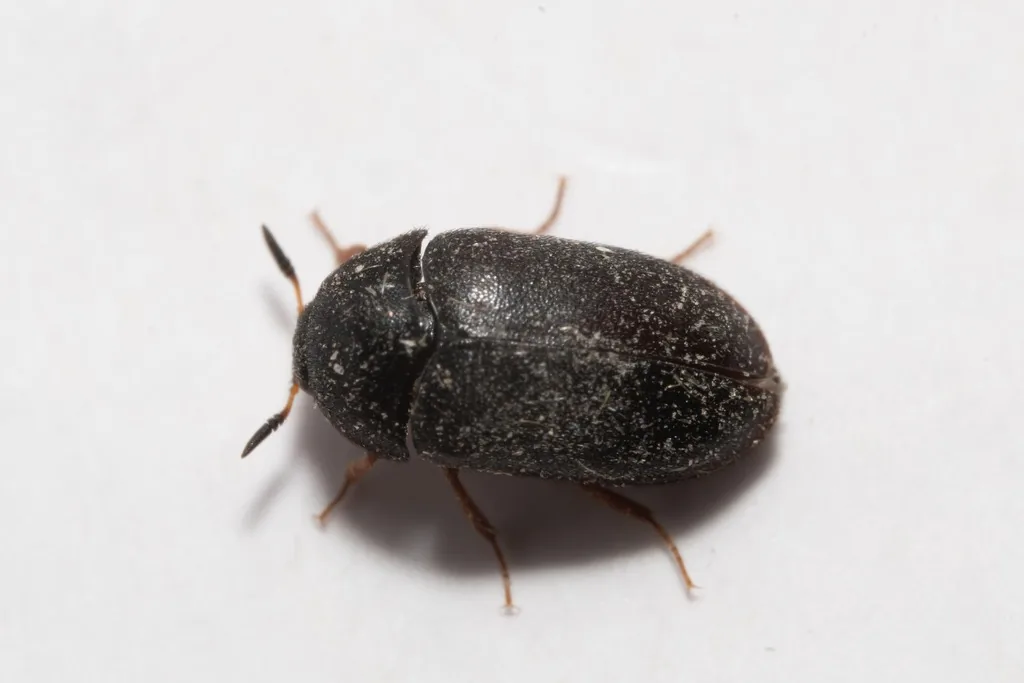
- Adults are oval, shiny black to dark brown beetles with brownish legs, about 1/8 to 3/16 inch long.[1][2]
- Larvae are golden to dark brown, shiny, smooth and hard, covered in short stiff hairs, and grow to about 5/16 to 1/2 inch.[1][2]
- The larva's body tapers toward the rear like a carrot or cigar and ends in a long tuft of bristles.[1][2][3]
- Larvae leave brown, shell-like, bristly cast skins where they feed, and they spin no webbing. Clemson notes that larvae molt many times, so a pile of skins can make an infestation look bigger than it is.[1][3]
Look-alikes
| Look-alike | How to tell them apart |
|---|---|
| Varied carpet beetle | Adults are smaller and nearly round, mottled gray with white, brown and yellow scales; its larvae are about 1/4 inch and wider at the rear.[2] |
| Furniture carpet beetle | Adults are nearly round and whitish, checkered with black spots outlined in yellow-orange scales, with yellow-scaled legs.[2] |
| Webbing clothes moth | Moth damage tends to be scattered holes with webbing, while carpet beetles chew a larger area in one spot and leave cast skins. Clemson adds that clothes moth adults, unlike carpet beetles, are not drawn to lights.[1][3] |
Where it lives
Found in homes, warehouses and museums; extension guides from California, Ohio and South Carolina all list it among the common household carpet beetles.[1][2][3]
Biology and life cycle
A female usually lays about 90 eggs, more than other common carpet beetles, and the eggs hatch in roughly one to two weeks. Colorado State likewise says Attagenus adults can lay up to 90 eggs at a time.[1][6]
Larvae feed for about 166 to 330 days before pupating, and adults live 4 to 8 weeks; there may be only one generation a year. Colorado State says Attagenus species produce one generation a year and spend the winter as a pupa or late-stage larva.[1][2][6]
Larvae avoid light and feed in dark, undisturbed places such as under baseboards and heavy furniture, along carpet edges and in air ducts. Kentucky Extension says carpet beetle larvae often feed inside folds such as hems, collars and cuffs of items stored for a long time, while clothing and rugs in regular use are seldom attacked.[2][1][4]
Adults feed on flower pollen outdoors, are drawn to light, fly in through open windows and doors, and also ride in on cut flowers.[1][2]
Damage and signs
- Larvae eat wool, silk, leather, fur, feathers, pet hair and natural-bristle brushes, but not synthetic fibers. Kentucky Extension explains that these materials contain keratin, an animal protein the larvae can digest; cotton and synthetics are rarely attacked unless blended with wool or heavily soiled.[1][4]
- They also infest grains, flour, cereals, dry pet food and other stored foods, and cotton or rayon stained with spilled food or animal waste.[2][1]
- Piano felts and hammers can be damaged badly enough to affect the instrument's tone.[1]
Health risk
Carpet beetles are mainly a damage pest: adults feed on pollen and nectar, and the larvae damage fabrics, furs and stored foods. They don't bite, but dermatologists report that carpet beetle larvae shed tiny spear-shaped hairs that can drift in the air and cause skin rashes in sensitive people; exposure has also been tied to eye and nose symptoms and asthma.[1][8]
Control
Prevention
Store clean woolens and furs in tightly sealed containers; cedar chests alone are not reliable protection. Kentucky agrees that cedar closets and chests seldom work because they don't hold enough of the oil's vapor.[1][2][4]
Keep them out
Keep window screens, doors and vents tight, and check cut flowers for beetles before bringing them inside.[1]
Sanitation
Vacuum rugs, upholstery, closets, baseboards and vents often and thoroughly, and empty the vacuum promptly because it can hold eggs and larvae. Kentucky also advises vacuuming inside heating vents and beneath the edges of carpets and stored items.[1][2][4]
Remove lint, hair and dead insects, discard badly infested items, and clear out old bird, rodent and wasp nests that can harbor larvae.[1][2]
Traps and physical control
Wash washable items in hot water or dry-clean them; items that tolerate it can be frozen for two weeks below 18 degrees F or heated to 120 degrees F for 30 minutes. Kentucky gives a different freezer schedule: at least one week at 0°F, or 72 hours at -20°F, with items sealed in plastic first and left wrapped for about a day while they warm back up.[1][4]
Pesticides
If needed, spot-treat carpet edges, closet floors and cracks with a product labeled for carpet beetles; don't spray clothing or bedding. Kentucky says sprays with fabric insects on the label can supplement cleaning, aimed at carpet edges, floor and wall joints, under furniture and closet floors.[1][4]
Total-release foggers generally don't reach the cracks where larvae hide.[2]
When to call a professional
Hair- or feather-stuffed furniture and pillows can be fumigated in a vault by a licensed pest control, dry-cleaning or storage firm.[1]
Where sources disagree
Larva size: UC IPM says full-grown larvae reach about 5/16 inch, while Ohio State and Colorado State give about 1/2 inch.[1][2][6]
Freezing: UC IPM says two weeks below 18°F, Kentucky says at least a week at 0°F (or 72 hours at -20°F), and Clemson suggests about a week in a freezer.[1][4][3]
Egg hatch: UC IPM's text gives 9 to 16 days for black carpet beetle eggs, while the life-cycle table on the same page lists 6 to 16 days.[1]
Common questions
- I found a few small black beetles on a windowsill. Should I worry?
- A few adult carpet beetles indoors aren't cause for alarm; take action if you find larvae developing in fabrics or other materials.[1]
- Can black carpet beetles get into my pantry?
- Yes. Besides fabrics, the larvae feed on grains, flour, cereals and pet food, and in dry climates they are mainly a stored-food pest.[1][2]
- Where should I look for the source?
- Use a flashlight under baseboards, in upholstered furniture, air ducts, closets and stored cereals; cast skins are often easier to find than larvae.[2]
- Can carpet beetle larvae cause a rash?
- They can in some people. Carpet beetles don't bite, but the larvae's loose spear-shaped hairs can cause itchy skin reactions, and a CDC journal report describes bite-like bumps, mostly under clothing, that were allergic reactions to larval hairs rather than bites. See a doctor about a persistent rash and look for larvae and cast skins in the home.[8][7]
Sources
- University of California Statewide IPM Program, “Pest Notes: Carpet Beetles, Publication 7436 (web version).” ipm.ucanr.edu/home-and-landscape/carpet-beetles/ (accessed 2026-11-11)
- Ohio State University Extension (David J. Shetlar), “Carpet Beetles, HYG-2103 (October 2011).” ohioline.osu.edu/factsheet/HYG-2103-10 (accessed 2026-11-11)
- Clemson Cooperative Extension, Home and Garden Information Center, “Controlling Fabric Pests (HGIC).” hgic.clemson.edu/factsheet/controlling-fabric-pests/ (accessed 2026-11-11)
- University of Kentucky Entomology, “ENTFACT-601: Carpet Beetles.” entomology.mgcafe.uky.edu/ef601 (accessed 2026-11-11)
- Colorado State University Extension, “Dermestid Beetles (Carpet Beetles), Fact Sheet 5.549.” extension.colostate.edu/resource/dermestid-beetles-carpet-beetles/ (accessed 2026-11-11)
- Colorado State University, Department of Agricultural Biology, “Dermestid beetles.” agsci.colostate.edu/agbio/ipm-pests/dermestid-beetles/ (accessed 2026-11-11)
- Centers for Disease Control and Prevention (Emerging Infectious Diseases journal), “Simon et al. 2021, Anthrenus sp. and an Uncommon Cluster of Dermatitis, Emerging Infectious Diseases 27(7):1940-1943.” wwwnc.cdc.gov/eid/article/27/7/20-3245_article (accessed 2026-11-11)
- Cutis, via PubMed, “Johnson AG, Rohr BR (2024), What's Eating You? Carpet Beetles (Dermestidae), Cutis 113(3):E6-E9.” pubmed.ncbi.nlm.nih.gov/38648592/ (accessed 2026-11-11). Cited from the PubMed abstract.
- iNaturalist, “Attagenus unicolor taxon page (order and family).” www.inaturalist.org/taxa/1571455 (accessed 2026-11-11)