On this page
How to identify it
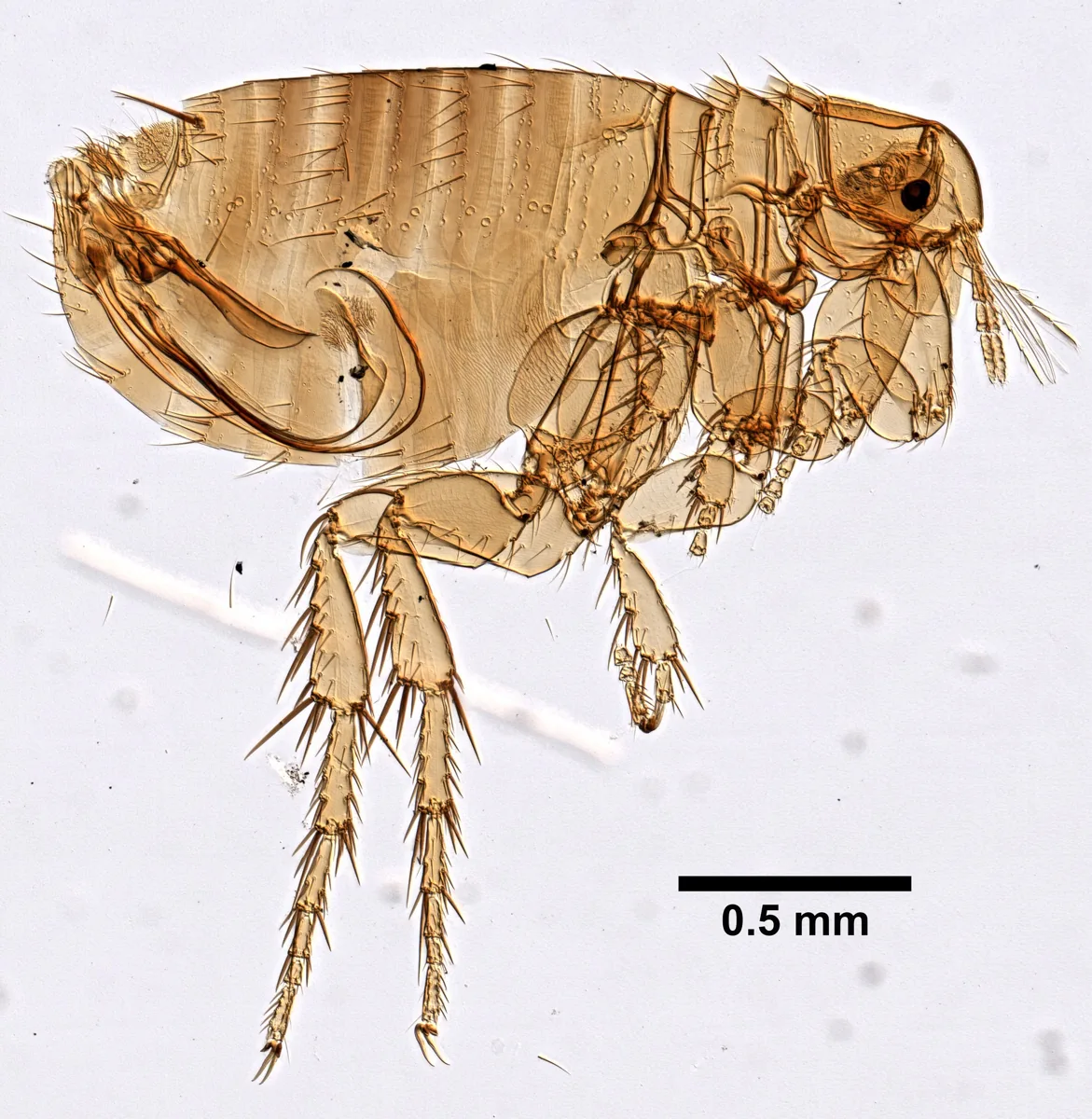
- Like other fleas it has a body flattened side to side and large hind legs; females look more rounded than males. UF/IFAS describes adults as brown and 2 to 4 mm long, with backward-pointing bristles, a compact, helmet-like head and long legs bearing many spines.[1][4]
- Unlike cat and dog fleas, it has no combs: it lacks the two combs of spines, one at the cheek and one behind the head, that look like a mustache and a mane on cat and dog fleas. UF/IFAS likewise says the absence of the genal and pronotal combs separates it from the cat flea and dog flea.[1][4]
- Its closest look-alike is the human flea. Under a microscope the rat flea has several hairs behind the antenna and a rod-shaped ridge (the pleural rod) above the second pair of legs; the human flea has one hair there and no rod.[1]
Look-alikes
| Look-alike | How to tell them apart |
|---|---|
| Cat flea | Cat fleas carry combs below the eye and behind the head; the oriental rat flea has neither. Both species spread flea-borne typhus. UF/IFAS shows the same difference: the cat flea has both the genal and pronotal combs, the oriental rat flea neither.[1][5][4] |
| Ground squirrel flea | In the United States, plague usually reaches people through ground squirrel fleas in the rural West; the oriental rat flea is the main plague flea worldwide.[3] |
Where it lives
The CDC calls it the flea that spreads plague globally; flea-borne typhus, which it carries, occurs in tropical, subtropical and temperate climates on several continents. In the United States most typhus cases are reported from southern California, Hawaii and southern Texas. A 2020 review warns that global warming may widen the area where these fleas can survive. UF/IFAS calls it cosmopolitan, with a distribution that follows its hosts, including rats, gerbils and other small mammals. Temperature and humidity are presumably its only limits: egg laying goes best around 27°C with humidity of at least 70%, and adults may disappear during long, hot, dry spells.[3][5][2][4]
Biology and life cycle
It feeds mainly on rats but also on mice, opossums and other mammals, and bites people when it is hungry, often after its usual host has died. UF/IFAS says it prefers rats and other small mammals such as gerbils but also feeds on domestic cats and dogs and wild mammals; people are accidental hosts.[1][5][6][4]
Fleas pick up plague and typhus bacteria by feeding on an infected animal. A flea infected with the typhus bacterium stays infected for the rest of its life.[1][5]
Plague bacteria can build up in the flea's gut until they block it; the starving flea bites again and again and can bring up bacteria as it feeds. Fleas that are not blocked can also spread plague.[1]
When rats die off, from disease or from poison, their fleas leave in search of new hosts, which is when people and pets get bitten.[6][1][7]
UF/IFAS says eggs are laid singly, more often in the host's nest and surroundings than on the host; a female may produce up to six eggs a day and 300 to 400 in her lifetime.[4]
Larvae live in and around the nest and pass through three instars in about two weeks, though development has taken as long as 200 days in poor conditions. Unlike many fleas, UF/IFAS says, they don't depend on blood-containing flea feces and can feed on detritus and even spilled cereal grains.[4]
Pupae are 2 to 4 mm long, in a silk cocoon coated with sand and dirt, and the pupal stage is thought to last roughly 2 to 9 weeks, depending on temperature and cues such as vibration. Both sexes feed on blood, and UF/IFAS says adults can live up to six weeks without a blood meal and well over 100 days with access to one.[4]
Damage and signs
Health risk
Plague: the CDC says plague is spread to people mainly by bites of infected rodent fleas, and that oriental rat fleas spread it globally while ground squirrel fleas are the usual source in the rural western United States. Flea-borne typhus: the bacterium Rickettsia typhi is in flea droppings, which get rubbed into the bite or other breaks in the skin; symptoms such as fever, chills, headache, body aches and rash begin 3 to 14 days after exposure, and the CDC says fewer than 5 percent of patients remember a flea bite. Both diseases are treated with antibiotics, and the CDC says doxycycline treats flea-borne typhus at all ages. See a health care provider for these symptoms and mention any contact with rats, fleas, stray cats or opossums. The flea has also been found carrying Rickettsia felis and two Bartonella species.[8][3][5][1]
Control
Prevention
Keep fleas off pets with products your veterinarian recommends; pets that roam outside are more likely to bring fleas in. Never use permethrin on cats.[5][9]
Use an EPA-registered repellent when outdoors where fleas may be, such as DEET on skin and clothing or permethrin on clothing only, wear gloves when handling sick or dead animals, and don't feed or pet stray or wild animals.[9][5]
Keep them out
Keep rodents out: seal holes in the home, store food and pet food in tight containers, keep lids on compost and trash, and clear brush, rock piles, junk and clutter outside.[5][9]
Sanitation
UF/IFAS notes that fleas in several life stages live in the nests of hosts as well as on them, which complicates control and can lead to reinfestation of nearby buildings. It describes management as host reduction, generally trapping and poisoning rats and other small pest mammals, plus insecticides applied to burrows and runways.[4]
Pesticides
Treat for fleas before or along with rat control. The CDC's 1983 report on a Texas typhus outbreak found that rat poison set out two to three weeks earlier may have triggered the illnesses, and advised that where murine typhus occurs, rat control programs should be preceded by insecticide applications against the fleas.[6][1]
Insecticides are losing ground: in Madagascar, where this flea spreads plague, most populations tested were resistant to deltamethrin, permethrin and DDT, and a dermatology review notes resistance to commonly used pesticides may limit their effect. UF/IFAS likewise says insecticides are becoming less effective because of resistance, with most tested populations resistant to the most-used pesticides.[10][1][2][4]
How the CDC traced a household typhus outbreak
In late 1982 five people in and around a farmhouse in Comanche County, Texas, fell ill with murine typhus; four were treated with tetracycline and all five recovered. Rodents had been heard in the attic, rat poison had been set out two to three weeks earlier, and five cats in the home died during the outbreak. None of the patients remembered a flea bite.[6]
Where sources disagree
Which flea matters most for typhus: the CDC's 1983 report treated the rat flea as the source and said cat and cat flea infections were not important in maintaining the bacterium in nature; today's CDC page lists the oriental rat flea and the cat flea as the most common sources, and a 2010 dermatology review says the cat flea is now the most important typhus vector in South Texas.[6][5][1]
Where U.S. typhus cases come from: the CDC names southern California, Hawaii and southern Texas, while the 1983 report said about 80 percent of reported cases then came from Texas.[5][3][6]
Order of control: UF/IFAS describes rat removal by trapping and poisoning together with insecticide in burrows and runways, without saying which should come first, while the CDC's 1983 report advises that where murine typhus occurs, rat control should be preceded by insecticide applied against the fleas.[4][6]
Common questions
- Does the oriental rat flea carry plague?
- Yes. It is the main flea behind plague worldwide, though in the United States most human plague comes from ground squirrel fleas in the rural West.[3][1][2]
- Why do rat fleas come back after treatment?
- They come back from the rats. As long as rodents nest in or near the building, new fleas arrive with them, and killing the rats without treating the fleas sends hungry fleas looking for people and pets.[6][1][5]
- Can I get typhus from a rat flea bite?
- Yes, mostly from the flea's droppings rubbed into the bite. See a provider for fever, headache and rash after contact with rats or fleas; doxycycline is the treatment.[5][6]
- Where do rat fleas live besides on rats?
- Mostly in the nest. UF/IFAS says eggs are laid more often in the host's nest and surroundings than on the host, larvae develop there, and fleas left in nests can reinfest nearby buildings if not managed.[4]
Sources
- Cutis (peer-reviewed dermatology journal), “What's Eating You? Oriental Rat Flea (Krug and Elston 2010), Cutis 86(6):282-284.” cdn.mdedge.com/files/s3fs-public/Document/September-2017/086060282.pdf (accessed 2026-11-11)
- Cutis, via PubMed, “What's eating you? oriental rat flea (Wells and Elston 2020).” pubmed.ncbi.nlm.nih.gov/33104121/ (accessed 2026-11-11)
- Centers for Disease Control and Prevention, “About Fleas.” www.cdc.gov/fleas/about/index.html (accessed 2026-11-11)
- University of Florida IFAS Extension (EDIS), “Oriental Rat Flea, Xenopsylla cheopis (Rothschild, 1903), EENY-775/IN1330 (C. L. Cross, J. L. Williams and A. Lucky; Featured Creatures).” ask.ifas.ufl.edu/publication/IN1330 (accessed 2026-11-14)
- Centers for Disease Control and Prevention, “About Flea-borne Typhus.” www.cdc.gov/typhus/about/murine.html (accessed 2026-11-11)
- U.S. Centers for Disease Control and Prevention, “Outbreak of Murine Typhus -- Texas (MMWR 32(9), March 11, 1983).” www.cdc.gov/mmwr/preview/mmwrhtml/00001270.htm (accessed 2026-11-11)
- Centers for Disease Control and Prevention, “How Plague Spreads.” www.cdc.gov/plague/causes/index.html (accessed 2026-11-11)
- Centers for Disease Control and Prevention, “About Plague.” www.cdc.gov/plague/about/index.html (accessed 2026-11-11)
- Centers for Disease Control and Prevention, “Preventing Plague.” www.cdc.gov/plague/prevention/index.html (accessed 2026-11-11)
- PLoS Neglected Tropical Diseases, via PubMed, “Knockdown resistance mutations are common and widely distributed in Xenopsylla cheopis fleas that transmit plague in Madagascar (Hutton et al. 2023).” pubmed.ncbi.nlm.nih.gov/37607174/ (accessed 2026-11-11)
- iNaturalist, “Xenopsylla cheopis taxon page (order and family).” www.inaturalist.org/taxa/271312 (accessed 2026-11-11)