The short answer
- Look at the body. A bed bug is a broad, flat oval, reddish-brown and about the size of an apple seed. A flea is narrow and squeezed from side to side, so it looks as if it walks on its edge.[1][3][8][11]
- Watch how it moves. Bed bugs don't fly or jump; they crawl, and quickly. Fleas have strong jumping legs and can spring onto a passing pet, shoe or pant leg.[1][9][10]
- Check where it is. Bed bugs hide in mattress seams, box springs, bed frames and cracks near where people sleep. Adult fleas live mostly on dogs and cats, with eggs and larvae in pet bedding and carpet.[2][1][9][15]
- Don't rely on the bites. Health sources say bed bug bites can look like flea, mosquito or other bites, and some people don't react at all. Finding the insect, its fecal spots or flea dirt is what confirms it.[4][7][2]
Pests on this page
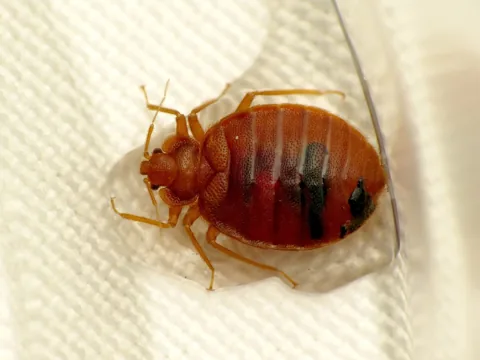 Bed Bug
Cimex lectularius
Bed bugs are wingless, blood-feeding insects that feed on sleeping or resting people, mostly at night; they have resurged worldwide and now turn up even in the finest hotels. CDC says they turn up in five-star hotels and resorts, and how clean a place is does not determine whether bed bugs are present.
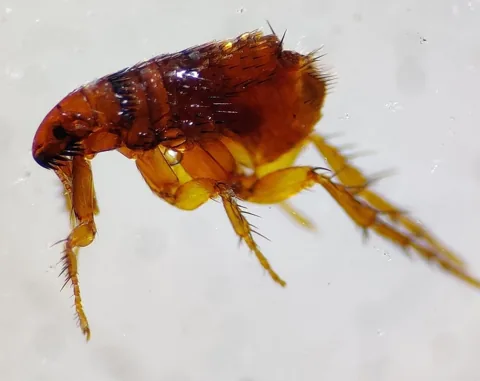 Cat Flea
Ctenocephalides felis
The cat flea is the most common external parasite of domestic cats and dogs, and the flea most often found on both. Adults spend most of their time on the pet, while eggs, larvae and pupae build up wherever the pet rests.
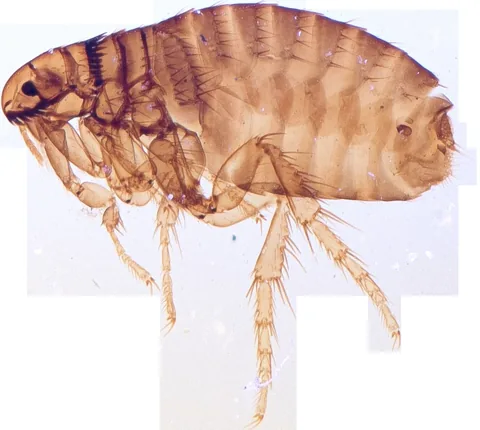 Dog Flea
Ctenocephalides canis
The dog flea looks very much like the cat flea but is the less common of the two on U.S. pets: UC IPM says the cat flea is the most common external parasite on domestic cats and dogs and calls the dog flea rare in California. In some countries, such as South Korea and Uzbekistan, surveys have found it to be the main flea on dogs.
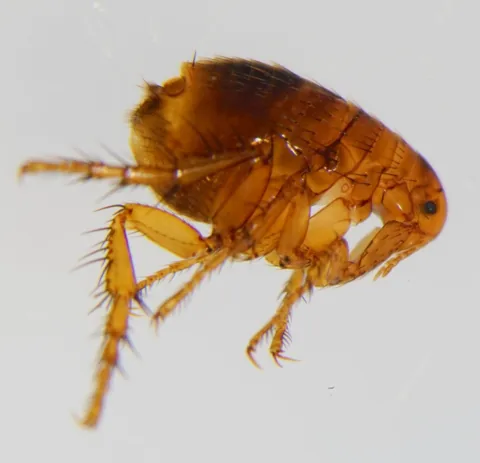 Human Flea
Pulex irritans
The human flea is a bloodsucking flea with a long association with people, one of its main hosts, though it also feeds on a wide range of wild and domestic animals. UF/IFAS notes it has even been found in archaeological sediments in Europe and Greenland.
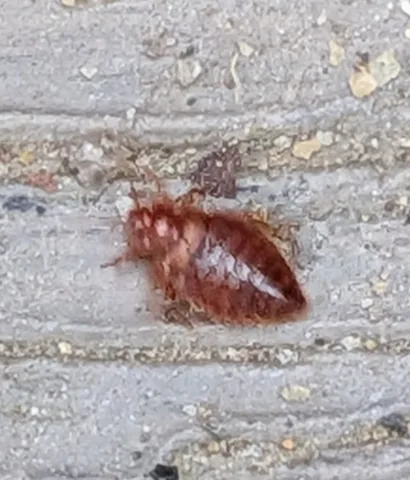 Bat Bugs
Cimex adjunctus (eastern bat bug) and Cimex pilosellus (western bat bug)
Bat bugs are close relatives of bed bugs that feed on the blood of roosting bats. They turn up in homes that have bats in the attic or walls, and they may bite people when the bats leave or are shut out.
Side by side
These comparisons use the common bed bug, Cimex lectularius, and the cat flea. UC IPM calls the cat flea the common flea in California and says it attacks both dogs and cats and will bite people.[1][8]
- Size: an adult bed bug is about 3/16 inch long; EPA gives 5 to 7 mm (3/16 to 1/4 inch). An adult flea is about 1/8 inch or less, and a peer-reviewed review gives fleas as 1.5 to 4 mm.[1][3][8][10][16]
- Shape: bed bugs are flat and oval when unfed, then balloon-like and longer after a meal. Fleas are flattened from side to side, an adaptation for moving between hairs.[1][3][8][11]
- Color: bed bugs are reddish-brown, and young ones are smaller and lighter, straw-colored when they first hatch. Adult fleas are reddish-brown to brown or black.[1][3][8][10]
- Legs and wings: neither has working wings. Bed bugs are true bugs with a beak, four-part antennae and short golden hairs. Fleas have long claws and strong jumping legs, with spines that help keep them from being groomed off.[3][2][10][11]
- Movement: bed bugs crawl rapidly over floors, walls and ceilings but never jump. Fleas jump, up to about 6 inches straight up, which is how they get onto a passing pet or a person's shoes and pant legs.[1][9]
- Where found: bed bugs gather in mattress seams and tufts, box springs, bed frames, headboards and cracks near where people sleep or rest. Adult fleas spend most of their time on the dog or cat; eggs fall into pet bedding, carpet, furniture and soil.[2][1][9][15]
- Host: the common bed bug prefers people but will also bite other warm-blooded animals. Cat fleas feed on dogs, cats and other furred animals; they bite people but don't live and breed on them.[1][10]
- Season: fleas tend to build up in spring and early summer. A review of biting arthropods notes no seasonality for bed bugs.[8][16]
- Telltale sign: bed bugs leave dark fecal spots that bleed into fabric like a marker, tan shed skins and rusty smears on sheets. Fleas leave flea dirt, dark pepper-like specks of dried blood in the pet's fur.[4][1][9][15]
Bites: what health sources say, and what they can't tell you
Bite location gives a hint but not proof. The Washington State Department of Health says flea bites tend to be around the ankles, while bed bugs bite any skin exposed during sleep, such as the face, neck, arms, hands or legs. A peer-reviewed review likewise places flea bites in humans mostly on the legs and ankles.[7][16]
Bed bug bites often show up clustered or in a straight line, often along the edge of clothing or where sheets were pulled up, according to Washington's health department. The same review describes a linear or zigzag pattern sometimes called breakfast, lunch and dinner. Illinois public health says flea bites can also appear as lines or clusters of itchy red marks.[7][16][11]
Reactions vary. Some people have no reaction to bed bug bites; others get small marks, itching or welts, and the welts can take up to 14 days to appear in some people. MedlinePlus lists flea bites among bites that itch more than they hurt.[6][7][17]
Washington's health department says bed bug bites may be mistaken for flea or mosquito bites, and EPA calls bites a poor indicator of bed bugs because they can look like other insect bites, rashes or hives. UC IPM says telling bed bug bites from flea, mosquito or spider bites is difficult to impossible, and the only real confirmation is finding the bugs or their signs.[7][4][2]
Disease risk differs. CDC and MedlinePlus say bed bugs are not known to spread disease, though scratching can lead to infection and allergic reactions are possible. CDC says fleas can sometimes pass the germs that cause flea-borne typhus, plague or cat scratch disease to people or pets.[5][6][12]
Fecal spots or flea dirt? Reading the evidence
Bed bug signs collect where the bugs hide: dark spotting and staining from dried excrement on the mattress, box spring, bed frame and headboard, along with eggs, tan shed skins and rusty smears from crushed bugs.[1][4][7]
Flea dirt is found on the animal. Merck Veterinary Manual says slowly parting a pet's hair often shows flea excrement or fast-moving fleas. The specks are reddish-black and pellet or comma-shaped.[15][14][9]
A damp paper towel tells flea dirt from ordinary dirt. Merck says the excrement dissolves in water or on a damp paper towel and leaves a reddish-brown color, because it is dried blood.[15][14]
Flea larvae are another clue that you're dealing with fleas. They are small, white, worm-like and legless, and they hide deep in carpet fibers, pet bedding and cracks in floors.[14][11][10]
How to confirm which one you have
For bed bugs, use a flashlight and a magnifying glass to check mattress seams, box springs, bed frames and nearby cracks. EPA notes they can hide in any crack that will hold a credit card.[2][4]
For fleas, UC IPM suggests walking around pet resting areas in white socks pulled up to the knee; fleas jump onto the socks and are easy to see.[8]
Monitors help with both. Bed bug monitors use lures such as heat or carbon dioxide to draw bugs into a pitfall or sticky trap, and Illinois public health describes light traps with sticky inserts for monitoring adult fleas.[2][11]
If you catch one and still aren't sure, your county extension office can help identify it.[3][10]
Why the difference matters
The fixes don't overlap much. Bed bugs live in and around beds and furniture, and UC IPM says getting rid of them is best done by a professional and may mean removing or treating all infested material and monitoring until the bugs are gone.[2][1]
Fleas live on pets. Merck says the first step in flea control is getting rid of fleas on the animal, then the infestation in the home, then preventing it from coming back.[14][9]
EPA calls correct identification the first step, to avoid treating for the wrong bug.[3][2]
What to do for each
Once you know which pest you have, the steps are different: bed bug work centers on the bed and sleeping areas, flea work starts with the pet.[2][14]
- Bed bugs: vacuum mattress seams, baseboards and other hiding spots, then follow our bed bug guides for encasements, heat and preparing for a professional visit.[2][1]
- Bed bugs: check luggage and used furniture; the bugs travel easily on luggage, clothing, beds and furniture.[1][5]
- Fleas: talk to your veterinarian about flea control products that are right for your pet.[13][14]
- Fleas: vacuum carpets, rugs, furniture cushions and pet resting areas often, and empty or discard the vacuum bag outside.[13][9][8]
- Fleas: wash pet bedding, and if the home needs treatment, choose a product with an insect growth regulator for carpets and upholstery. UC IPM notes fleas may keep emerging from cocoons for up to 2 weeks after treatment.[8][9]
Common questions
- Can bed bugs jump like fleas?
- No. Bed bugs don't fly or jump. They crawl, quickly, over floors, walls and ceilings. A small bug that jumps off the bed is more likely a flea.[1][9]
- How do fleas get into a house?
- Pets pick them up from kennels, groomers, stray dogs and cats, or wildlife such as opossums and raccoons in the yard. Fleas can also jump onto a person's shoes or pant legs.[9]
- Do bed bugs live on pets like fleas do?
- No. Bed bugs don't stay on their hosts; after feeding they crawl back to a hiding spot. Fleas, by contrast, generally stay on the animal unless grooming or insecticide forces them off.[1][15]
- Bites on my ankles: fleas or bed bugs?
- Ankle bites point toward fleas, but bites alone can't identify the insect. Look for fleas or flea dirt on pets and for bed bugs and their spots in mattress seams.[7][16][2]
- What do the black specks on my sheets mean?
- Dark spots that smear like marker ink on sheets or mattress seams are typical of bed bug excrement. Flea dirt is mostly found in a pet's fur and turns reddish-brown on a damp paper towel.[4][1][15]
Photo credits
- Bed Bug: (c) Katja Schulz, some rights reserved (CC BY) — via iNaturalist, CC BY 4.0
- Cat Flea: (c) Thomas Gyselinck, some rights reserved (CC BY) — via iNaturalist, CC BY 4.0
- Dog Flea: Ctenocephalides canis by Hallvard Elven, Naturhistorisk museum, Universitetet i Oslo — via Wikimedia Commons, CC BY 3.0
- Human Flea: (c) carnifex, some rights reserved (CC BY) — via iNaturalist, CC BY 4.0
- Bat Bugs: (c) Jason Hill, some rights reserved (CC BY) — via iNaturalist, CC BY 4.0
Sources
- University of Kentucky Entomology, “ENTFACT-636: Bed Bugs.” entomology.mgcafe.uky.edu/ef636 (accessed 2026-11-14)
- University of California Statewide IPM Program, “Pest Notes: Bed Bugs.” ipm.ucanr.edu/home-and-landscape/bed-bugs/ (accessed 2026-11-14)
- U.S. Environmental Protection Agency, “Bed Bugs: Appearance and Life Cycle.” www.epa.gov/bedbugs/bed-bugs-appearance-and-life-cycle (accessed 2026-11-14)
- U.S. Environmental Protection Agency, “How to Find Bed Bugs.” www.epa.gov/bedbugs/how-find-bed-bugs (accessed 2026-11-14)
- Centers for Disease Control and Prevention, “About Bed Bugs.” www.cdc.gov/bed-bugs/about/index.html (accessed 2026-11-14)
- MedlinePlus, U.S. National Library of Medicine, “Bed Bugs.” medlineplus.gov/bedbugs.html (accessed 2026-11-14)
- Washington State Department of Health, “Bed Bugs.” doh.wa.gov/community-and-environment/pests/bed-bugs (accessed 2026-11-14)
- University of California Statewide IPM Program, “Pest Notes: Fleas.” ipm.ucanr.edu/home-and-landscape/fleas/ (accessed 2026-11-14)
- University of Kentucky Entomology, “ENTFACT-602: Ridding Your Home of Fleas.” entomology.mgcafe.uky.edu/ef602 (accessed 2026-11-14)
- Texas A&M AgriLife Extension Service, “Fleas (ENT-3001).” citybugs.tamu.edu/factsheets/biting-stinging/others/ent-3001/ (accessed 2026-11-14)
- Illinois Department of Public Health, “Fleas.” idph.illinois.gov/envhealth/pcfleas.htm (accessed 2026-11-14)
- Centers for Disease Control and Prevention, “About Fleas.” www.cdc.gov/fleas/about/index.html (accessed 2026-11-14)
- Centers for Disease Control and Prevention, “Preventing Fleas.” www.cdc.gov/fleas/prevention/index.html (accessed 2026-11-14)
- Merck Veterinary Manual, “Fleas in Dogs and Cats (Professional Version).” www.merckvetmanual.com/integumentary-system/fleas-and-flea-allergy-dermatitis/fleas-in-dogs-and-cats (accessed 2026-11-14)
- Merck Veterinary Manual, “Fleas of Dogs (Pet Owner Version).” www.merckvetmanual.com/dog-owners/skin-disorders-of-dogs/fleas-of-dogs (accessed 2026-11-14)
- Diagnostics, via PubMed Central, “Who Bites Me? A Tentative Discriminative Key to Diagnose Hematophagous Ectoparasites Biting Using Clinical Manifestations. Diagnostics (Basel) 2020 (PMID 32429276).” pmc.ncbi.nlm.nih.gov/articles/PMC7277957/ (accessed 2026-11-14)
- MedlinePlus, U.S. National Library of Medicine, “Insect bites and stings (Medical Encyclopedia).” medlineplus.gov/ency/article/000033.htm (accessed 2026-11-14)