On this page
How to identify it
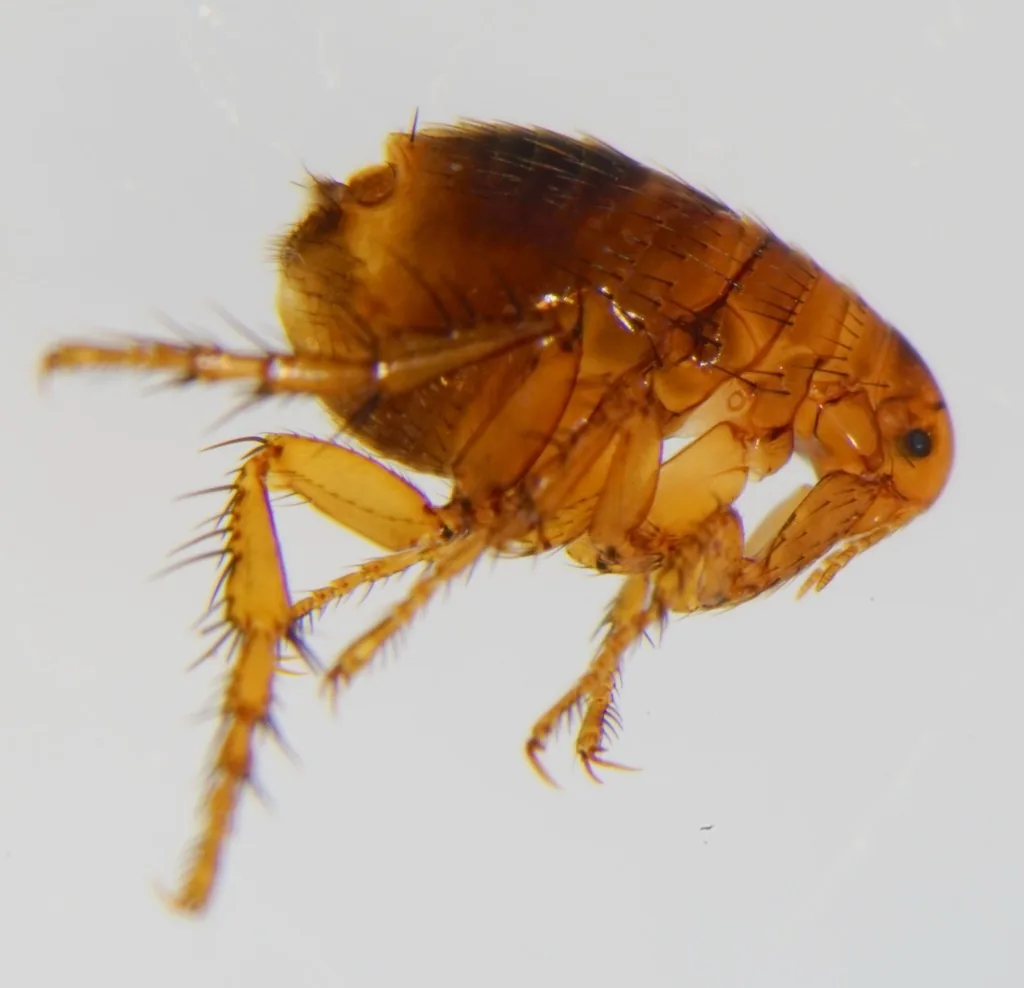
- Like other fleas it has a side-flattened body and large hind legs.[4]
- It is the flea closest in appearance to the oriental rat flea, which has no head combs, but Pulex fleas lack the rod above the second pair of legs and carry only one hair behind the antennae, where the rat flea has several.[4]
- Researchers separate it from other fleas by body features and sometimes by DNA.[2][4]
- Adults are light brown and average 2 to 3 mm; UF/IFAS gives males 2.0 to 2.5 mm and females 2.5 to 3.5 mm.[3]
- UF/IFAS says it has a rounded head with a single bristle under the eye and no combs of thick bristles below the eyes or behind the head.[3]
- Eggs are pearly white and about 0.5 mm across. Larvae are legless, whitish to pale tan grubs with 13 segments, a hardened head and no eyes; pupae sit in a loose silk cocoon that starts out sticky and picks up debris as camouflage.[3]
Look-alikes
| Look-alike | How to tell them apart |
|---|---|
| Oriental rat flea | It has a rod visible above the second pair of legs and several hairs behind the antennae; the human flea lacks the rod and has one hair there. UF/IFAS describes the missing feature as a hardened ridge on the plate over the second pair of legs.[4][3] |
| Cat flea | Cat and dog fleas have prominent combs on the head, like a mustache and mane; the combless oriental rat flea is the flea most like the human flea. UF/IFAS says the human flea has no combs below the eyes or behind the head.[4][3] |
Where it lives
Widespread around the world; in the western United States it lives mainly on foxes and owls. A 2026 study modeled its range from 564 location records worldwide and projects that warming will shift suitable habitat toward higher latitudes. UF/IFAS says most recent North American records are west of the Mississippi River, and that it is not known to be established in Florida, where it is often confused with a close relative, Pulex simulans; the two are reported to occur together elsewhere, including Georgia.[1][5][3]
Biology and life cycle
Hosts include people, dogs, cats and other domestic animals, rodents, bats, birds, large carnivores and wild hoofed animals. In the western United States foxes and owls are among its main hosts. UF/IFAS adds pigs and other carnivores, and dairy goats in Greece.[1][2][3]
It is often found on pets: in one Iranian study, 74 of 1,053 fleas collected from cats, dogs and other animals were human fleas.[2]
Fleas such as the human flea can be abundant in houses, where they bite people.[1]
In a 2025 laboratory study, wild-caught adults fed on blood lived an average of 6 days (males) and 10 days (females), and larvae pupated in cocoons.[6]
UF/IFAS says development from egg to adult averages 63 to 77 days. Larvae feed on blood-rich flea droppings and take 9 to 15 days at 25 °C but up to 200 days in the cold; pupae rest about a week, or up to 300 days in very cold conditions.[3]
Females lay only 2 to 3 eggs a day, up to 448 over 196 days in one report, and with enough food adults can live over a year.[3]
Human fleas live mostly in the nests and burrows of their hosts rather than on them, except when feeding, and shelter in homes and outbuildings where people and animals live close together.[3]
Health risk
Flea bites itch and irritate; a dermatology review describes human flea bites as intensely itchy bumps (papules) treated with topical anti-itch products and corticosteroids. In the United States, CDC names cat, dog, ground squirrel and oriental rat fleas, not the human flea, as the few species that affect people's health.[7][8]
Control
Prevention
Keep dogs and cats free of fleas: CDC says this is the best way to prevent fleas on people. Talk to your veterinarian about flea control products and treat pets year-round.[9]
Keep rodents and other wild animals away from the house: store food and pet food in sealed containers, clear brush, rock piles and junk, seal rodent entry holes and keep tight lids on trash and compost.[9]
To avoid bites, cover legs and feet with long socks and pants and use an EPA-registered repellent; don't feed or handle stray or wild animals, and wear gloves around sick or dead ones.[9]
Sanitation
Vacuum carpets, rugs and chair and sofa cushions well and often, emptying the vacuum bag outside, and wash bedding, especially pet bedding, often in soap and water.[9]
UF/IFAS says every life stage must be controlled or reinfestation is likely, so treatment has to reach nests, burrows and the cracks and crevices of the home. Where small mammal pests are the source, trapping them removes hosts.[3]
Pesticides
UF/IFAS says there is no single management strategy for fleas, many control attempts are only temporary, and insecticide resistance in fleas is widespread.[3]
Plague and other germs
The human flea has been named as a plague vector as far back as the 14th century, and Yersinia pestis, the plague bacterium, was found in human fleas during an outbreak in Madagascar.[8][10]
In a 2021 laboratory study using human fleas collected from foxes and owls in the western United States, many fleas stayed infected with the plague bacterium for up to 20 days but passed it on only rarely and inefficiently, supporting its reputation as a weak plague carrier compared with rodent fleas.[1]
North American human fleas haven't been implicated in plague cycles among wild rodents, because their main hosts there, foxes and owls, don't get sick from plague and the fleas rarely bite susceptible rodents.[1]
Bartonella bacteria, which can cause trench fever, and several Rickettsia species have also been found in human fleas.[8][2][5]
In the United States, plague reaches people mostly through ground squirrel fleas and is most often reported in rural areas of the West; worldwide the oriental rat flea is the main carrier.[7][11]
Where sources disagree
How dangerous it is: reviews call the human flea an important or medically significant vector of plague, Bartonella and Rickettsia, while a 2021 laboratory study found it a poor plague vector and its authors questioned how much it drives plague spread.[8][5][1]
Egg development: UF/IFAS cites 7 to 10 days at 25 °C from one reference and 4 to 6 days from another.[3]
Adult life span: in a 2025 lab study blood-fed adults lived an average of 6 to 10 days, while UF/IFAS says that with enough food they can live over a year.[6][3]
Common questions
- Why do fleas keep coming back?
- Fleas can survive year-round if they have an animal to feed on, and they live in carpets, bedding and furniture that pets use. CDC says to treat pets year-round, vacuum often and wash bedding to keep them from coming back.[9]
- Do human flea bites itch?
- Yes. Bites are intensely itchy bumps, often on the lower legs and feet.[8][9]
- Is the human flea found in Florida?
- UF/IFAS says it is not known to be established there; fleas reported as human fleas in Florida are often its close relative, Pulex simulans.[3]
Sources
- Peer-reviewed literature (PubMed Central), “Poor vector competence of the human flea, Pulex irritans, to transmit Yersinia pestis (Miarinjara A et al., Parasites & vectors, 2021).” pmc.ncbi.nlm.nih.gov/articles/PMC8194109/ (accessed 2026-11-14)
- Journal of Arthropod-Borne Diseases, via PubMed, “Pulex irritans on dogs and cats: morphological and molecular approach (Azarm et al. 2022).” pubmed.ncbi.nlm.nih.gov/37056642/ (accessed 2026-11-14)
- University of Florida/IFAS Extension (Featured Creatures), “Human Flea, Pulex irritans Linnaeus, EENY-798/IN1383.” ask.ifas.ufl.edu/publication/IN1383 (accessed 2026-11-14). Used for identification, range, biology and non-chemical management; its medical section is not used on its own.
- Cutis (peer-reviewed dermatology journal), “What's Eating You? Oriental Rat Flea (Krug and Elston 2010), Cutis 86(6):282-284.” cdn.mdedge.com/files/s3fs-public/Document/September-2017/086060282.pdf (accessed 2026-11-14)
- Scientific Reports, via PubMed, “Climate change impacts on the global potential distribution of the human flea, Pulex irritans (Magdy et al. 2026).” pubmed.ncbi.nlm.nih.gov/41667532/ (accessed 2026-11-14)
- Parasites & Vectors, via PubMed, “Establishing a laboratory colony of the human flea, Pulex irritans (Miarinjara et al. 2025).” pubmed.ncbi.nlm.nih.gov/40867010/ (accessed 2026-11-14)
- Centers for Disease Control and Prevention, “About Fleas.” www.cdc.gov/fleas/about/index.html (accessed 2026-11-14)
- Cutis, via PubMed, “What's eating you? Human flea (Pulex irritans) (O'Donnell and Elston 2020).” pubmed.ncbi.nlm.nih.gov/33465194/ (accessed 2026-11-14)
- Centers for Disease Control and Prevention, “Preventing Fleas.” www.cdc.gov/fleas/prevention/index.html (accessed 2026-11-14)
- Emerging Infectious Diseases, via PubMed, “Yersinia pestis in Pulex irritans fleas during plague outbreak, Madagascar (Ratovonjato et al. 2014).” pubmed.ncbi.nlm.nih.gov/25061697/ (accessed 2026-11-14)
- Centers for Disease Control and Prevention, “How Plague Spreads.” www.cdc.gov/plague/causes/index.html (accessed 2026-11-14)
- iNaturalist, “Pulex irritans taxon page (order and family).” www.inaturalist.org/taxa/308321 (accessed 2026-11-14)