The short answer
- Cat fleas carry the germ. Cats most commonly become infected through flea bites, and the bacteria reach people when flea feces get into a cat scratch, CDC and Merck say.[1][6]
- Most cat scratches do not lead to cat scratch disease, and MedlinePlus says it is most often not serious.[1][5]
- See a healthcare provider if you or your child has a fever, enlarged and tender lymph nodes after a cat scratch, or a pustule at the scratch site, CDC says. MedlinePlus says to contact your provider if you have enlarged lymph nodes and have been exposed to a cat.[1][5]
- People with weakened immune systems are at higher risk for severe disease, CDC says, so they should be quickest to call.[1][5]
- Prevention starts with flea control on your cat, gentle play, and washing any scratch with soap and water.[1][5]
The flea behind cat scratch disease
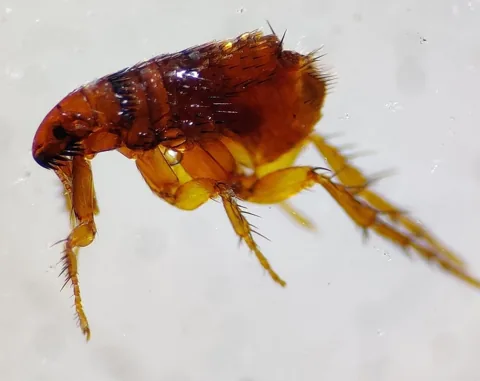 Cat Flea
Ctenocephalides felis
The cat flea is the most common external parasite of domestic cats and dogs, and the flea most often found on both. Adults spend most of their time on the pet, while eggs, larvae and pupae build up wherever the pet rests.
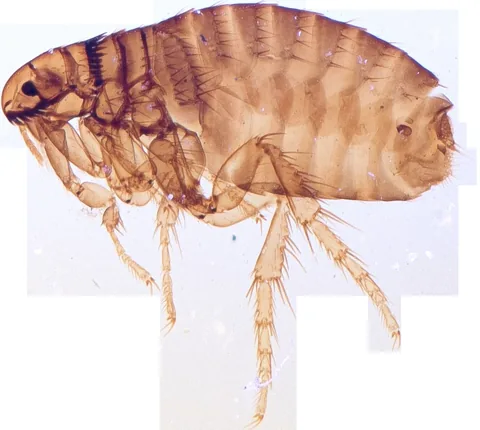 Dog Flea
Ctenocephalides canis
The dog flea looks very much like the cat flea but is the less common of the two on U.S. pets: UC IPM says the cat flea is the most common external parasite on domestic cats and dogs and calls the dog flea rare in California. In some countries, such as South Korea and Uzbekistan, surveys have found it to be the main flea on dogs.
How cat fleas spread it
Cats most commonly become infected with B. henselae through flea bites, CDC says; less commonly through fights with other infected cats or blood transfusions.[1]
Merck says the bacteria live within fleas, and humans are infected when flea fecal pellets (flea dirt) make contact with a scratch or bite wound, which is where the name cat scratch disease comes from. CDC says the same: the bacteria pass from cat to person when the scratch is contaminated with flea feces.[6][1]
Infected cats that bite, or lick a person's open wound, can also spread it, CDC says. MedlinePlus adds cat saliva on broken skin or on the eyes, nose or mouth.[1][5]
CDC says some evidence suggests infected cat fleas may spread the bacteria directly to people by biting, but this has not been proven. MedlinePlus lists flea bites among possible routes. CDC also says there is no evidence that Bartonella spreads to people through tick bites.[1][5][2]
Stray cats are more likely than pet cats to be infected, and kittens are the cats most often linked to cases, CDC says.[1]
Your cat probably looks healthy
Merck says cats infected with B. henselae are generally subclinically affected, though they can develop a self-limiting fever. CDC says most infected cats simply have the bacteria in their blood without getting sick, and some studies have found it in up to 1 in 3 healthy cats, particularly kittens.[6][1]
A healthy-looking cat can still carry it, so you cannot tell by looking. CDC says testing and treating a healthy cat is not recommended; call your vet if your cat seems sick.[1][3]
Dogs can carry it too. Merck says dogs are more likely than cats to develop clinical disease, including fever, swollen lymph nodes and endocarditis; call your vet if your dog shows signs like these.[6]
Who gets it
CDC says cat scratch disease is more common among children under the age of 15, though it can affect people of all ages.[1]
In the United States it is more common in the Southeast but occurs throughout the country, and most cases occur in the fall and winter, CDC says. It can occur wherever cats and fleas are found together.[1]
CDC lists the people at highest risk as those who interact with cats that have fleas.[2]
Symptoms and when to see a doctor
CDC lists a low-grade fever, enlarged and tender lymph nodes, and a papule or pustule at the site of the scratch. MedlinePlus adds fatigue, headache and overall discomfort, and less often loss of appetite, sore throat and weight loss.[1][5]
The bump at the scratch is usually the first sign, MedlinePlus says, and the swollen lymph nodes are near the scratch or bite.[5]
Rarely, infections of the eye, liver, spleen, brain, bones or heart valves can occur, CDC says, some mainly in people with weakened immune systems.[1][5]
When to get care: CDC says see a healthcare provider for a fever, enlarged and tender lymph nodes after a scratch, or a pustule at the scratch site. MedlinePlus says contact your provider if you have enlarged lymph nodes and have been exposed to a cat. Only a provider can diagnose it.[1][5]
For any cat bite or scratch, CDC says to get medical attention if the cat appears sick, you don't know whether it is vaccinated against rabies, the wound is serious, or the wound becomes red, painful, warm or swollen.[4]
MedlinePlus says the disease is hard to diagnose, partly because it is rare; a provider may suspect it from swollen lymph nodes plus a cat scratch or bite, and a blood test can detect the infection. Most cases resolve without antibiotics, CDC says; your provider decides whether treatment is needed.[5][1]
People at higher risk
Most cat scratches do not result in cat scratch disease, but CDC says people with weakened immune systems are at higher risk for severe disease. MedlinePlus says it can be more serious in people with HIV/AIDS and others with a weak immune system.[1][5]
CDC says you can still own a cat if you are living with HIV, being treated for cancer or have another immune-suppressing condition. Keep the cat indoors, avoid scratches, bites and licks, and avoid owning cats less than one year old.[1]
Merck's zoonoses table notes a risk of bacteremia, disseminated disease and bacillary angiomatosis in immunosuppressed people. Ask your provider about your own risk.[7]
Prevention: fleas first
Control fleas on your cat. MedlinePlus says to use flea control measures to lower the risk that your cat will develop the disease, and CDC says to talk to your veterinarian about flea prevention products. Never use products that contain permethrin on cats, CDC says.[5][1]
Keep cats indoors and away from stray cats, CDC says, which also cuts their flea exposure. MedlinePlus says not to handle feral cats.[1][3][5]
Play gently. MedlinePlus says to play gently with cats so they don't scratch and bite, and CDC advises avoiding rough play when animals are young so they scratch and bite less as they get older.[5][4]
Wash. Clean scratch wounds with soap and water and wash your hands promptly after handling cats, CDC says.[1][5]
Don't let a cat lick your skin, eyes, mouth or open wounds, MedlinePlus says.[5]
CDC does not recommend declawing to prevent cat scratch disease.[1]
Common questions
- Can I get cat scratch disease without being scratched?
- Yes, though scratches are the usual route. CDC says infected cats that bite or lick an open wound can spread it, and MedlinePlus lists cat saliva on broken skin or the eyes, nose or mouth.[1][5]
- Should I get my cat tested?
- Not if it is healthy. CDC says testing and treating your cat for B. henselae is not recommended unless your pet is sick. Call your vet if your cat seems ill.[1][3]
- Do I need to give up my cat?
- No. CDC says even people with weakened immune systems can still own a cat; keep it indoors, control its fleas and avoid scratches.[1]
- Is cat scratch disease serious?
- Most often not, MedlinePlus says, and people with a healthy immune system should recover fully. It can be more serious with a weak immune system.[5][1]
- Can ticks give me Bartonella?
- CDC says there is no evidence that Bartonella spreads to people through tick bites.[2]
Photo credits
- Cat Flea: (c) Thomas Gyselinck, some rights reserved (CC BY) — via iNaturalist, CC BY 4.0
- Dog Flea: Ctenocephalides canis by Hallvard Elven, Naturhistorisk museum, Universitetet i Oslo — via Wikimedia Commons, CC BY 3.0
Sources
- Centers for Disease Control and Prevention, “About Cat Scratch Disease.” www.cdc.gov/bartonella/about/about-cat-scratch-disease.html (accessed 2026-11-15)
- Centers for Disease Control and Prevention, “About Bartonella.” www.cdc.gov/bartonella/about/index.html (accessed 2026-11-15)
- Centers for Disease Control and Prevention, “Veterinary Guidance for Bartonellosis.” www.cdc.gov/bartonella/hcp/veterinary-guidance/index.html (accessed 2026-11-15)
- Centers for Disease Control and Prevention, “Cats (Healthy Pets, Healthy People).” www.cdc.gov/healthy-pets/about/cats.html (accessed 2026-11-15)
- MedlinePlus, U.S. National Library of Medicine, “Cat-scratch disease (Medical Encyclopedia).” medlineplus.gov/ency/article/001614.htm (accessed 2026-11-15)
- Merck Veterinary Manual, “Fleas in Dogs and Cats (Professional Version).” www.merckvetmanual.com/integumentary-system/fleas-and-flea-allergy-dermatitis/fleas-in-dogs-and-cats (accessed 2026-11-15)
- Merck Veterinary Manual, “Table: Global Zoonotic Diseases: Bacterial and Rickettsial Diseases.” www.merckvetmanual.com/multimedia/table/global-zoonotic-diseases-bacterial-and-rickettsial-diseases (accessed 2026-11-15)