The short answer
- Watch for intense itching and hair loss over the lower back, tail base and back of the thighs in dogs, and for tiny crusted bumps along the back and neck in cats. Merck says those are the classic patterns.[1][2][3]
- You may not find a single flea. Merck says extremely allergic pets, cats especially, can be virtually flea-free because they groom the fleas off, which makes the allergy easy to doubt.[1][3]
- Call your vet if your pet keeps scratching, chewing or licking, or if the skin looks raw, crusted, smelly or oozing. Merck says self-trauma can lead to hot spots and bacterial or yeast skin infections that need their own treatment.[1]
- Flea control is the treatment. Merck says getting rid of the fleas on the pet removes or greatly reduces the signs, and that prevention needs treatment of the allergic pet, the other pets in the household and the home.[1]
- Itch medicine can make your pet comfortable while fleas are brought under control, but Merck says it is not a substitute for flea control. Let your vet choose any medicine and amount; this page gives no doses.[1][3]
The fleas behind the allergy
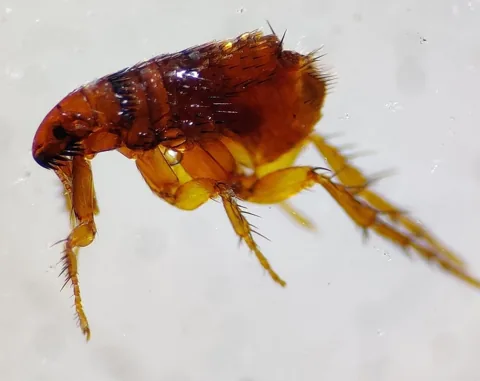 Cat Flea
Ctenocephalides felis
The cat flea is the most common external parasite of domestic cats and dogs, and the flea most often found on both. Adults spend most of their time on the pet, while eggs, larvae and pupae build up wherever the pet rests.
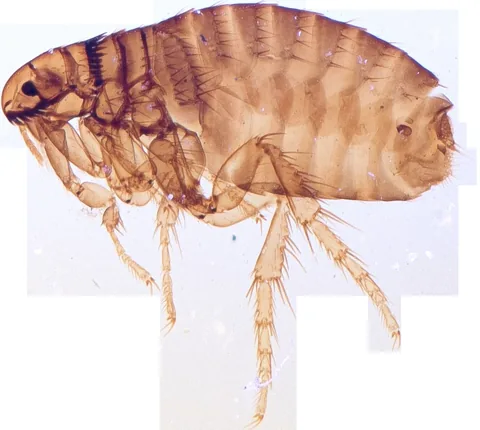 Dog Flea
Ctenocephalides canis
The dog flea looks very much like the cat flea but is the less common of the two on U.S. pets: UC IPM says the cat flea is the most common external parasite on domestic cats and dogs and calls the dog flea rare in California. In some countries, such as South Korea and Uzbekistan, surveys have found it to be the main flea on dogs.
What flea allergy dermatitis is
Fleas inject saliva while they feed. Merck says many dogs and cats are allergic to it, and that the saliva carries histamine-like compounds, enzymes and proteins that act as irritants or allergens.[2][4]
A pet that is not allergic may only scratch now and then from the annoyance of the bites, Merck says, while an allergic dog can itch intensely in some or all areas of the body.[2][3]
FDA says the scratching can cause permanent hair loss or other skin problems, and that in severe infestations blood loss to fleas can lead to anemia and, rarely, death.[6]
Merck says most cases show up in late summer, when flea numbers peak, but warm climates and indoor pets can have the problem year-round. The owner pages say pets under 1 year old don't usually have it; the professional chapter says it can occur at any age, with no sex or breed tendency.[1][2][3]
Where it shows on dogs
In dogs the pattern is fairly specific. Merck lists itching and crusted bumps on the middle to lower back, the tail base and the back and inner thighs. The owner page describes crusted, itchy skin over the hips, base of the tail and thighs.[1][2]
The most visible sign is hair loss, from licking, chewing and scratching or from a skin infection. Dogs may also rub or scoot. Merck says they are restless and spend much of their time working at their skin.[1][2]
Over time the skin can go fully bald, thickened and darker. Merck says long-standing cases can develop small lumps on the back and rump, and severe cases can spread to the face and ears.[1][2]
Flea bites on a dog that is not allergic tend to show in a different place. Merck says signs of a plain flea infestation in dogs usually appear on the belly and groin.[1]
Where it shows on cats: miliary dermatitis
Cats show it differently. Merck's cat owner page says parting the fur reveals small, solid bumps, a pattern called feline miliary dermatitis because the bumps look like millet seeds, typically spread over the back, neck and face. Merck notes the bumps are not the bites themselves but a body-wide allergic reaction to being bitten.[3][1]
Merck says an allergic cat can show any of four reaction patterns: itching of the head and neck with scratches and hair loss, hair loss the cat causes by overgrooming, raised sores of the eosinophilic granuloma complex, and miliary dermatitis.[1]
Lesions turn up most often on the back, tail base, back of the thighs, groin, head and neck. Because the hair loss comes from overgrooming, the coat can look unkempt, Merck says.[1]
Itching in cats ranges from minimal to severe depending on how sensitive the cat is, according to Merck.[3][1]
Why you may not see any fleas
The most allergic pets are often the cleanest. Merck says extremely hypersensitive animals, especially cats, can be virtually free of fleas because of excessive self-grooming, so finding evidence is hard and owners are hard to convince.[1][3]
Look for flea dirt instead. Merck says slowly parting the hair against the way it lies often shows flea excrement or fast-moving fleas, and a fine-tooth flea comb helps.[1][2]
Flea dirt is reddish black and shaped like small pellets or commas. Merck says that if you put it on a damp paper towel and crush it, it dissolves into a reddish-brown smear.[1][2]
Checking the pet's bedding for flea eggs, larvae and droppings is also useful, Merck says. Our I found fleas on my dog page walks through the flea-comb check.[2]
How your vet diagnoses it
There is no single test. Merck says vets weigh the history, the pattern of the skin signs, any fleas or flea dirt found, and whether other skin diseases have been ruled out.[1]
Your vet will ask about flea control. Merck lists as supporting history: flea products not used consistently on the pet or the other pets in the house, contact with untreated animals at groomers or dog parks, and access to porches, decks, crawl spaces or barns where strays or wildlife spend time.[1]
When no fleas can be found, Merck says the pet's response to flea control can itself be used as the test.[1]
Allergy tests are not the answer for this one. Merck's current chapter says skin and blood allergy tests for flea saliva are not accurate enough and are no longer recommended; the owner pages note that skin testing is unreliable in cats.[1][3]
Other problems look similar, and some come along with it. Merck lists environmental and food allergies, mange and other skin parasites, ringworm in cats, and hair follicle infections. Finding fleas does not rule out another cause.[1][2][3]
Why every pet and the home need flea control
Treating only the itchy pet rarely works. Merck says prevention and treatment require treating the affected pet, the other pets in the household and the environment, and that lasting control means keeping fleas from breeding by using flea control on every animal in the house.[1]
Much of the flea problem lives off the pet. Merck says a female cat flea can lay up to 50 eggs a day; the eggs fall into bedding, carpet and soil, where the larvae develop.[3]
Indoor pets are not safe from it. Merck says wildlife and stray cats and dogs bring fleas into yards, pets that go out briefly can pick them up, and people can carry fleas into the house.[3][2]
In severe allergy cases, Merck says the house may need treatment too: wash pet bedding, throw rugs and carriers, and vacuum where pets rest. Our how to get rid of fleas in the house page covers the steps.[2][3]
Stopping flea control after the fleas are gone lets them back. Merck says lifelong flea control is needed to prevent reinfestation.[1]
If you treat more than one pet with a spot-on or spray, FDA says to apply it to one pet at a time and keep them apart until it dries, and not to use a product made for dogs on a cat.[6]
When to see the vet: skin infection and other warning signs
Scratching and chewing break the skin. Merck says this self-trauma can cause hot spots (acute moist dermatitis) and can lead to bacterial skin infection (pyoderma) and Malassezia yeast infection, which add to the itch and need their own treatment.[1]
Merck says the hallmarks of a deep skin infection in dogs are pain, crusting, odor and oozing of blood and pus; cats with deep infection often have hair loss, ulcers, bloody crusts and draining tracts. Those signs need a vet visit.[5]
Your vet may look at skin samples under a microscope to check for bacteria or yeast. Merck says such infections should be treated promptly.[1]
Heavy flea loads can also drain blood. Merck says anemia may develop in heavy infestations or in young puppies, and FDA says severe infestations can, rarely, cause death. A young or small pet covered in fleas needs a vet promptly.[2][6]
Common questions
- Can a single flea cause flea allergy dermatitis?
- Merck and FDA don't give a set number of bites. The allergy is to flea saliva, and Merck says severely allergic pets can be virtually flea-free because they groom the fleas off, so finding few or no fleas doesn't rule it out.[1][6]
- Is flea allergy dermatitis contagious to other pets or people?
- The allergy itself is not. The fleas are: Merck says an infested pet can bring fleas into a home where they then infest other pets and bite people.[2][3]
- Why does my dog only scratch its lower back and tail?
- That pattern, on the lower back, tail base and back of the thighs, is the classic sign of flea allergy in dogs, Merck says. Ask your vet to check for it even if you have seen no fleas.[1][2]
- Will it go away once the fleas are gone?
- Merck says getting rid of the fleas on the pet eliminates or markedly decreases the signs, and that lifelong flea control on every pet in the house is needed to keep fleas from coming back.[1]
- Can my cat have it if it never goes outside?
- Yes. Merck's cat page says it can occur year-round in indoor pets, and that people and other pets can carry fleas inside.[3]
Photo credits
- Cat Flea: (c) Thomas Gyselinck, some rights reserved (CC BY) — via iNaturalist, CC BY 4.0
- Dog Flea: Ctenocephalides canis by Hallvard Elven, Naturhistorisk museum, Universitetet i Oslo — via Wikimedia Commons, CC BY 3.0
Sources
- Merck Veterinary Manual, “Flea Allergy Dermatitis in Dogs and Cats.” www.merckvetmanual.com/integumentary-system/fleas-and-flea-allergy-dermatitis/flea-allergy-dermatitis-in-dogs-and-cats (accessed 2026-11-15)
- Merck Veterinary Manual, “Fleas of Dogs (Pet Owner Version).” www.merckvetmanual.com/dog-owners/skin-disorders-of-dogs/fleas-of-dogs (accessed 2026-11-15)
- Merck Veterinary Manual, “Fleas of Cats (Pet Owner Version).” www.merckvetmanual.com/cat-owners/skin-disorders-of-cats/fleas-of-cats (accessed 2026-11-15)
- Merck Veterinary Manual, “Fleas in Dogs and Cats.” www.merckvetmanual.com/integumentary-system/fleas-and-flea-allergy-dermatitis/fleas-in-dogs-and-cats (accessed 2026-11-15)
- Merck Veterinary Manual, “Pyoderma in Dogs and Cats.” www.merckvetmanual.com/integumentary-system/pyoderma/pyoderma-in-dogs-and-cats (accessed 2026-11-15)
- U.S. Food and Drug Administration, “Safe Use of Flea and Tick Products in Pets.” www.fda.gov/consumers/consumer-updates/safe-use-flea-and-tick-products-pets (accessed 2026-11-15)