The short answer
- Watch for head shaking, constant ear scratching, an ear flap that droops and dark brown wax in the canal. Merck says the itch varies in intensity and can be severe.[1][2][3]
- Have your vet look before you treat. Merck says a dark ear discharge often means yeast or parasites but can also come with bacterial or mixed infections, and the vet confirms mites by finding their eggs, larvae or adults in the discharge.[6][4]
- Call your vet promptly if the ear smells, oozes pus or is very painful, or if your pet tilts its head, loses its balance or develops a swollen ear flap. Merck links pus and a torn eardrum to severe ear mite cases, and head tilt and balance loss to middle and inner ear infection, which is more serious.[1][2][8][7]
- If one pet has ear mites, the others need treatment too. Merck says animals that have contact with an infested cat or dog should also be treated.[1][2][3]
Ear mites and other pet mites
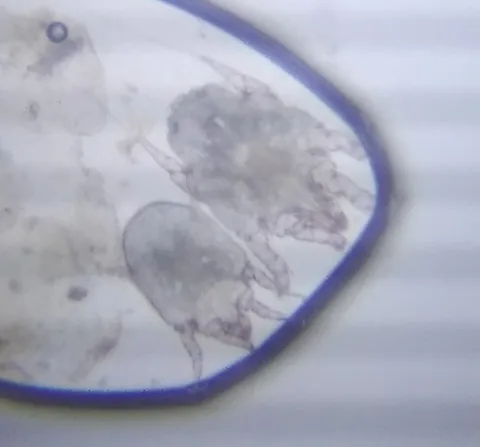 Ear mite
Otodectes cynotis
Ear mites (Otodectes cynotis) are tiny mites that live in the ear canals of cats, dogs and some wild carnivores, filling the ears with dark, coffee-ground debris and setting pets scratching and shaking their heads. They are the most common cause of outer ear inflammation in cats and spread easily between animals, but they rarely bother people. A vet confirms them with an otoscope or microscope; treatment is usually a whole-body parasite product, given to every dog and cat in the home, plus washing bedding and grooming tools.
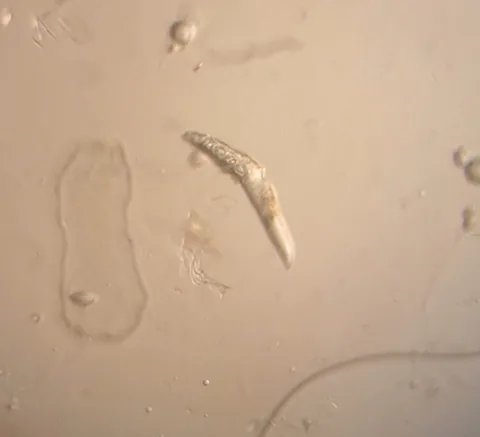 Demodex mites (dog and cat follicle mites)
Demodex canis, D. injai and D. cornei (dogs); D. cati and D. gatoi (cats)
Demodex mites live in the hair follicles of dogs and are considered a normal part of the skin's residents; most dogs that carry them never show signs. In some dogs, mainly puppies and older dogs with other health problems, the mites multiply and cause demodectic mange (demodicosis), which ranges from a few bald patches that heal on their own to a severe skin disease. Cats have their own species, one of which spreads from cat to cat.
No photo yet
Cheyletiella mites
Cheyletiella yasguri (dogs), C. blakei (cats) and C. parasitivorax (rabbits)
Cheyletiella mites live in the fur of dogs, cats and rabbits. They can often be seen moving in the hair coat, which gives the infestation its nickname, walking dandruff. People who handle infested pets can get an itchy rash, but the mites do not stay long on humans and do not complete their life cycle on people; once the pets are treated, the rash in people clears on its own.
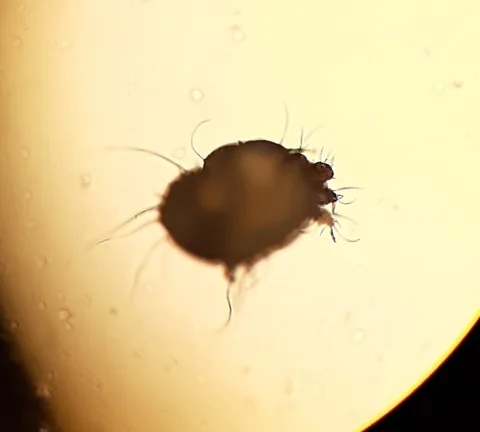 Scabies mite
Sarcoptes scabiei
Scabies is a skin infestation caused by a microscopic mite, Sarcoptes scabiei, that burrows into the upper layer of the skin of people and many other mammals. Its hallmark is intense itching, especially at night, and it spreads mainly through direct, prolonged skin-to-skin contact.
Signs of ear mites
Merck's owner pages describe head shaking and scratching at one or both ears. In dogs whose ears normally stand up, the ear may droop.[1][2]
The debris is usually dark brown wax. Merck's professional chapter on ear inflammation says ear mites should be strongly suspected in a cat whose ear discharge has a dark, coffee-ground look.[3][4]
In severe cases, Merck says, the outer ear can become inflamed and produce pus, and the eardrum can tear.[1][2][3]
Ear mites usually stay deep in the ear canal but are sometimes found on the body, according to Merck. Our ear mites profile describes the skin sores they can cause there and has photos of the mite.[1][2][3]
Why it might not be ear mites
Ear mites are one cause of otitis externa, inflammation of the outer ear canal. Merck lists many others: allergies (food, environmental or contact), other mites, foreign objects, yeast, bacteria, polyps and tumors.[4][6][5]
These problems share the same signs. Merck's owner pages list head shaking, odor, redness, swelling, scratching, discharge and scaly skin for ear canal inflammation in general, whatever the cause.[5][6]
Allergies are a common cause of red, itchy ears in dogs, Merck says, and the face, armpits, inner thighs and feet are often affected too. That pattern points away from mites alone.[7]
Treating only one cause often fails. Merck says that unless every cause is found and treated, ear canal inflammation often comes back. A pet treated at home for mites it doesn't have may still have an untreated yeast or bacterial infection.[6][5]
How your vet checks for ear mites
The vet looks down the ear canal with an otoscope. Merck says this helps find foreign objects, polyps, built-up debris, parasites and eardrum damage, and that a painful or blocked ear may need sedation or anesthesia first.[5][6][4]
A swab of discharge goes under the microscope. Merck says the vet checks it for ear mite eggs, larvae and adults and, on a stained smear, for bacteria and yeast.[6][4][5]
The vet also checks the eardrum before choosing drops. Merck's professional chapter says many ear medications can damage hearing, and that the risk is greater when the eardrum is not intact. That is a good reason not to put anything in an ear the vet has not examined.[4]
Ear mites are mange mites. For the skin mites that cause mange elsewhere on the body, see our mange in dogs guide.[3][2]
Treating every pet in the house
Merck says cats and dogs with ear mites should get a mite-killing medicine in the ears or one that works over the whole body, and that your vet will give a plan that includes the medicine and ear-cleaning instructions. Our ear mites profile lists the product types and why a repeat treatment is sometimes needed.[1][2][3]
Treat the contacts as well. Merck says affected and in-contact animals should all receive treatment, so ask your vet about every cat and dog in the home, even those with clean-looking ears.[3][1][2]
Match each product to the animal. FDA advises checking that a product fits the pet's species, life stage and weight, never using a dog product on a cat, and not treating puppies or kittens unless the label allows it.[9]
If you apply spot-on products to several pets, FDA advises treating one at a time and keeping them apart until the product dries, so they can't lick it off each other.[9]
Call your vet right away if a pet acts sick after a parasite product. FDA lists wobbliness, poor appetite, vomiting, diarrhea, drooling and depression among the warning signs.[9]
What not to do at home
Skip home remedies. Merck says hydrogen peroxide and vinegar can irritate inflamed ear canals and increase secretions that favor bacteria and yeast, and that you should use only the ear products and cleaning methods your vet recommends.[5]
Don't dig in the ear. Merck advises against cotton swabs or anything that pushes debris deeper into the canal.[6]
Follow the full cleaning plan. Merck says discharge and wax can make ear medicines work less well, which is why vets often clean and dry the ears before treatment.[5][6]
Check ears regularly afterward. Merck suggests looking for changes in color, moisture, discharge, scabs or hair loss and booking a prompt exam if you see them, and says healthy cats generally don't need routine ear cleaning unless a vet advises it.[5]
When it is more than an itchy ear
Swollen ear flap: scratching and head shaking can break a small blood vessel and fill the ear flap with blood (an aural hematoma). Merck says this is usually treated surgically by a vet and the underlying ear problem must be treated too.[7]
Head tilt or poor balance: Merck says infection spreading from the outer ear canal can reach the middle ear and then the inner ear, causing a head tilt, balance problems and deafness, and that the damage might not be reversible. See your vet promptly.[8]
Drooping eyelid or facial changes on one side can also come from middle ear disease in cats, according to Merck, because facial nerves run through the middle ear.[8]
Can people catch ear mites?
Ear mites are parasites of cats and dogs, but a 1977 report in the journal Laryngoscope described outer ear inflammation in a person caused by Otodectes cynotis. Our ear mites profile has more on the human reports. If you have an itchy ear or rash after handling an infested pet, see your own doctor.[10][1]
Common questions
- Are ear mites contagious to my other pets?
- Yes. Merck says animals that have contact with an infested cat or dog should also be treated, so ask your vet about every cat and dog in the home.[1][2][3]
- Is dark ear wax always ear mites?
- No. Merck says dark discharge often means yeast or parasites but can also come with bacterial or mixed infections. A vet confirms mites by finding them under the microscope.[6][4]
- Can I use hydrogen peroxide or vinegar to clean my pet's ears?
- Merck advises against it: these can irritate inflamed canals and encourage bacterial or yeast infection. Use only the products and cleaning method your vet recommends.[5]
- Why does my vet need to look in the ear before giving drops?
- Merck says many ear medications can harm hearing, and the risk is greater when the eardrum is torn, which can happen in severe ear mite cases.[4][1][2]
- Can I get ear mites from my cat?
- It has been reported. A 1977 report described ear canal inflammation in a person caused by this mite. See your doctor for any itchy ear or rash.[10]
Photo credits
- Ear mite: (c) Oleksii Vasyliuk, some rights reserved (CC BY) — via iNaturalist, CC BY 4.0
- Demodex mites (dog and cat follicle mites): Caitlin Domon, public domain (CC0), via iNaturalist
- Scabies mite: Tero Linjama, public domain (CC0), via iNaturalist
Sources
- Merck Veterinary Manual, “Mite Infestation (Mange, Acariasis, Scabies) of Cats (Cat Owners).” www.merckvetmanual.com/cat-owners/skin-disorders-of-cats/mite-infestation-mange-acariasis-scabies-of-cats (accessed 2026-11-15)
- Merck Veterinary Manual, “Mite Infestation (Mange, Acariasis, Scabies) in Dogs (Dog Owners).” www.merckvetmanual.com/dog-owners/skin-disorders-of-dogs/mite-infestation-mange-acariasis-scabies-in-dogs (accessed 2026-11-15)
- Merck Veterinary Manual, “Mange in Dogs and Cats.” www.merckvetmanual.com/integumentary-system/mange/mange-in-dogs-and-cats (accessed 2026-11-15)
- Merck Veterinary Manual, “Otitis Externa in Animals.” www.merckvetmanual.com/ear-disorders/otitis-externa/otitis-externa-in-animals (accessed 2026-11-15)
- Merck Veterinary Manual, “Otitis Externa (External Ear Infection) in Cats (Cat Owners).” www.merckvetmanual.com/cat-owners/ear-disorders-of-cats/otitis-externa-external-ear-infection-in-cats (accessed 2026-11-15)
- Merck Veterinary Manual, “Ear Infections and Otitis Externa in Dogs (Dog Owners).” www.merckvetmanual.com/dog-owners/ear-disorders-of-dogs/ear-infections-and-otitis-externa-in-dogs (accessed 2026-11-15)
- Merck Veterinary Manual, “Disorders of the Outer Ear in Dogs (Dog Owners).” www.merckvetmanual.com/dog-owners/ear-disorders-of-dogs/disorders-of-the-outer-ear-in-dogs (accessed 2026-11-15)
- Merck Veterinary Manual, “Otitis Media and Interna in Cats (Cat Owners).” www.merckvetmanual.com/cat-owners/ear-disorders-of-cats/otitis-media-and-interna-in-cats-middle-and-inner-ear-infections (accessed 2026-11-15)
- U.S. Food and Drug Administration (CVM), “Safe Use of Flea and Tick Products in Pets.” www.fda.gov/consumers/consumer-updates/safe-use-flea-and-tick-products-pets (accessed 2026-11-15)
- Laryngoscope, via PubMed, “Otitis externa in man caused by the mite Otodectes cynotis (Laryngoscope, 1977).” pubmed.ncbi.nlm.nih.gov/916787/ (accessed 2026-11-15)