The short answer
- Sarcoptic mange (canine scabies) is the very itchy, very contagious kind. Merck says the itch usually comes on suddenly, sores start on the belly, chest, ears, elbows and legs, and it spreads to other dogs and can infest people who handle the dog.[1][2]
- Demodectic mange is not contagious. Merck says Demodex mites live in small numbers on all dogs; disease shows up when they multiply, in puppies with small hairless patches or as a severe body-wide form tied to an immune problem.[1][2]
- Walking dandruff (Cheyletiella) looks like heavy scaling along the back. Merck says it is very contagious between pets and spreads easily to owners.[1][2]
- Only a vet can tell them apart. Merck says vets use skin scrapings, sometimes a stool sample or blood test, and may treat on suspicion when mites can't be found. Call your vet for any dog with sudden intense itching, crusted sores or patchy hair loss.[1][2]
- Call promptly if the skin is oozing, the dog seems sick, or the hair loss is spreading. Merck says generalized demodectic mange is a serious disease, and that severe long-term sarcoptic mange can leave a dog emaciated and can even kill it.[1][2]
The mites behind mange
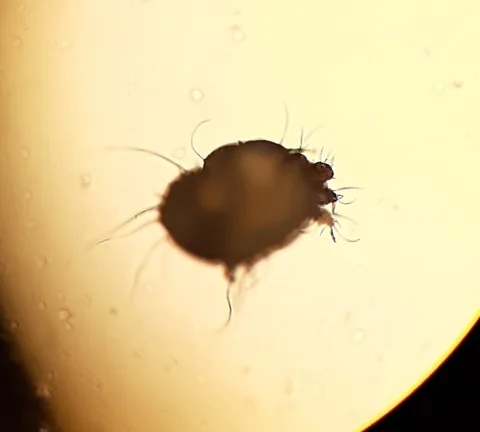 Scabies mite
Sarcoptes scabiei
Scabies is a skin infestation caused by a microscopic mite, Sarcoptes scabiei, that burrows into the upper layer of the skin of people and many other mammals. Its hallmark is intense itching, especially at night, and it spreads mainly through direct, prolonged skin-to-skin contact.
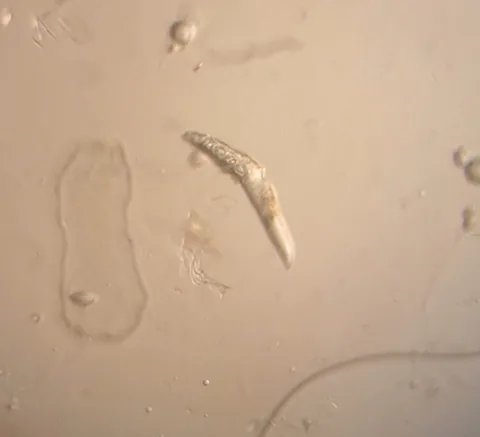 Demodex mites (dog and cat follicle mites)
Demodex canis, D. injai and D. cornei (dogs); D. cati and D. gatoi (cats)
Demodex mites live in the hair follicles of dogs and are considered a normal part of the skin's residents; most dogs that carry them never show signs. In some dogs, mainly puppies and older dogs with other health problems, the mites multiply and cause demodectic mange (demodicosis), which ranges from a few bald patches that heal on their own to a severe skin disease. Cats have their own species, one of which spreads from cat to cat.
No photo yet
Cheyletiella mites
Cheyletiella yasguri (dogs), C. blakei (cats) and C. parasitivorax (rabbits)
Cheyletiella mites live in the fur of dogs, cats and rabbits. They can often be seen moving in the hair coat, which gives the infestation its nickname, walking dandruff. People who handle infested pets can get an itchy rash, but the mites do not stay long on humans and do not complete their life cycle on people; once the pets are treated, the rash in people clears on its own.
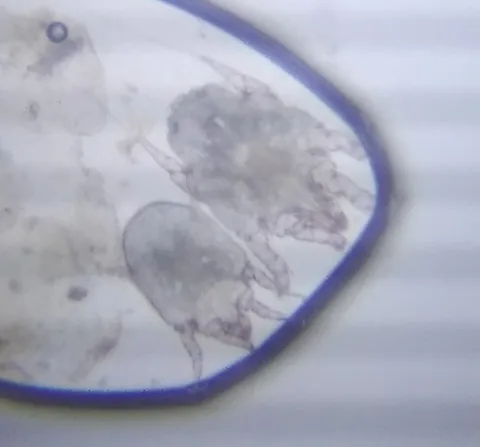 Ear mite
Otodectes cynotis
Ear mites (Otodectes cynotis) are tiny mites that live in the ear canals of cats, dogs and some wild carnivores, filling the ears with dark, coffee-ground debris and setting pets scratching and shaking their heads. They are the most common cause of outer ear inflammation in cats and spread easily between animals, but they rarely bother people. A vet confirms them with an otoscope or microscope; treatment is usually a whole-body parasite product, given to every dog and cat in the home, plus washing bedding and grooming tools.
The three kinds of mange at a glance
Sarcoptic mange: caused by Sarcoptes scabiei var canis. Merck calls it highly contagious between dogs, found worldwide, and zoonotic, meaning people who touch an infested dog may be infested too.[1][2]
Demodectic mange (demodicosis): caused by Demodex canis. Merck says these mites are normal residents of every dog's hair follicles, pass from mother to puppies while nursing, and that the disease is not considered contagious.[1][2]
Walking dandruff (cheyletiellosis): caused by Cheyletiella yasguri in dogs. Merck says the dandruff that seems to walk is actually the mites moving on the skin, and that it is very contagious in kennels, catteries and multi-pet homes.[1][2]
Ear mites are a fourth mite of dogs and cats, mostly in the ear canal, Merck says; our ear mites profile covers them. Mange in sheep, goats and other livestock involves other mites; see the psoroptic mange mite and goat mange mite profiles.[1][3]
Sarcoptic mange: the contagious, intensely itchy one
Merck's owner page says most infested dogs have intense itching that comes on suddenly, probably from sensitivity to the mites' droppings. Small solid bumps appear first; scratching and biting turn them into thick, crusted sores.[1][2]
Sores usually start on the abdomen, chest, ears, elbows and legs and, if not treated, spread over the whole body. Merck says dogs with long-term mange develop oily dandruff, thickened and wrinkled skin and weeping sores, and can become emaciated and even die.[1][2]
It spreads mainly by direct contact between animals. Merck says indirect spread through infested bedding, combs, brushes, towels and blankets is less common but can occur.[1][2]
Not every infested dog shows signs, Merck says, and the professional chapter notes symptom-free carriers may exist. Merck also describes well-groomed dogs that itch but whose regular baths remove the crusts, which makes the mites hard to find.[1][2]
Secondary yeast or bacterial infections can develop in the damaged skin, according to Merck. Our scabies mite profile covers the mite itself.[1][2]
Demodectic mange: not contagious, usually puppies or a weak immune system
Every dog carries a few Demodex mites with no signs. Merck says that for reasons not fully understood some dogs end up with large numbers, causing inflammation and hair loss, and that heredity and a suppressed immune response appear to play a role.[1][2]
Localized demodectic mange is the mild form. Merck's owner page says it is usually seen in dogs under 1 year old, with 1 to 5 small, isolated patches that are usually hairless, red and scaly, little or no itch, and that most cases resolve without treatment.[1][2]
Generalized demodectic mange is the serious form. Merck says the juvenile-onset kind results from an inherited immune defect, while adult-onset disease is often linked to an underlying illness that suppresses the immune system, so your vet will also look for that illness.[1][2]
Merck's professional chapter says generalized disease is usually made worse by bacterial skin infection, and dogs can become lethargic, feverish and have swollen lymph nodes when deep infection sets in. A dog like that needs a vet visit soon.[2]
Because demodectic mange is not contagious, other pets and people in the house are not at risk from the mites, per Merck. Our Demodex mites profile has the mite biology.[2]
Walking dandruff (Cheyletiella)
Merck says scaling of the skin along the back is the common sign. Itching is often intense, though some pets don't itch at all, and pets with no signs can still carry the mites and pass them to other pets and to people.[1][2]
Dog, cat and rabbit Cheyletiella species can cross between hosts, Merck says. The professional chapter notes infestations are rare where regular flea control is used, and that the mites and eggs can be hard to find on pets that are bathed often.[1][2]
Vets look for the mites with clear tape preparations, superficial skin scrapings and flea combing, according to Merck. Our Cheyletiella mites profile covers the mite and the bumps it leaves on owners.[2]
How vets diagnose mange
Merck's owner page says the vet will examine the dog, collect skin scrapings and possibly a stool sample, and some clinics also use a blood test.[1]
Sarcoptic mites are often missed. Merck's professional chapter says skin scrapings are often negative, so vets take several scrapings from the ears, elbows and hocks; when the signs strongly suggest sarcoptic mange but no mites turn up, a treatment trial is warranted.[2][1]
Merck says cases of sarcoptic mange are frequently treated as another allergic skin disease before the real cause is found, so tell your vet if other pets or people in the house are itching too. That history is part of the diagnosis.[2]
Demodex is usually easier to find. Merck says deep skin scrapings or hair plucks typically show mites, eggs and larvae in high numbers in generalized disease.[2][1]
Treatment depends on the mite and on the dog, and Merck notes several mange treatments are used off-label. Let your vet choose any medicine and amount; this page gives no drug names or doses. Our pet-safe pest control guide covers household products around pets.[2][1]
Other pets, bedding and the home
Treat the contacts, not just the itchy dog. For sarcoptic mange and walking dandruff, Merck says treatment should include all dogs and other animals that have been in contact with one another.[1][2]
Merck's mange overview says successful treatment includes the affected animals, contact animals and environmental control, and that isolating affected animals is often recommended to limit spread.[3]
For walking dandruff, Merck says treating the pet's environment is needed to kill mites in bedding, carpets and other areas, and kennels and other multi-pet settings need treatment to halt an outbreak.[1][2]
For sarcoptic mange, Merck lists bedding, combs, brushes, towels and blankets as possible routes of spread, so wash the dog's bedding and grooming gear and keep an infested dog off shared furniture until your vet clears it.[1][2]
Demodectic mange does not need house cleaning for the mites' sake. Merck says the mites spend their whole life cycle on the dog and the disease is not considered contagious.[2]
Can people catch mange from a dog?
Not human scabies. CDC says animals do not spread human scabies; pets carry a different kind of scabies mite that causes mange. MedlinePlus likewise says pets and animals usually do not spread human scabies.[4][5]
Dog scabies mites can still make you itch. CDC says the mites that infest animals cannot survive or reproduce on people, but they can get under the skin and cause temporary itching and irritation, which is why all animals with mange should be treated.[4][6]
Walking dandruff mites bite people too. Illinois Department of Public Health says Cheyletiella mites cause itching in people who handle infested pets but do not stay long on humans; Merck says it is very easy for them to spread from pets to owners.[6][1]
If you or your family have an itchy rash after contact with a mangy dog, see your doctor and mention the dog. Merck suggests owners of pets with walking dandruff check with their physicians. Our chiggers vs scabies and mites that bite people pages help sort out other itchy rashes.[1][4]
Common questions
- Is mange contagious to other dogs?
- Sarcoptic mange and walking dandruff are, Merck says, highly or very contagious between animals. Demodectic mange is not considered contagious, because the mites are normal residents of every dog's skin.[1][2]
- Can I get mange from my dog?
- You can get temporary itching from sarcoptic mites, CDC says, but they cannot reproduce on people. Walking dandruff mites also bite people, according to Illinois DPH and Merck. Demodex mites of dogs are not a risk to people, per Merck.[4][6][1]
- Why does my puppy have bald patches around its face?
- Localized demodectic mange is one common cause in dogs under a year old, Merck says, and most cases clear on their own, but other skin diseases look similar. Have your vet do a skin scraping to know which it is.[1]
- My vet found no mites. Can it still be mange?
- Yes, for sarcoptic mange. Merck says skin scrapings are often negative and that a treatment trial is warranted when the signs strongly suggest it.[2][1]
- Do I need to clean my house if my dog has mange?
- For sarcoptic mange and walking dandruff, Merck says to treat contact animals and the environment, including bedding and carpets for walking dandruff. Demodectic mange stays on the dog and is not contagious.[1][2][3]
Photo credits
- Scabies mite: Tero Linjama, public domain (CC0), via iNaturalist
- Demodex mites (dog and cat follicle mites): Caitlin Domon, public domain (CC0), via iNaturalist
- Ear mite: (c) Oleksii Vasyliuk, some rights reserved (CC BY) — via iNaturalist, CC BY 4.0
Sources
- Merck Veterinary Manual, “Mite Infestation (Mange, Acariasis, Scabies) in Dogs (Dog Owners).” www.merckvetmanual.com/dog-owners/skin-disorders-of-dogs/mite-infestation-mange-acariasis-scabies-in-dogs (accessed 2026-11-15)
- Merck Veterinary Manual, “Mange in Dogs and Cats.” www.merckvetmanual.com/integumentary-system/mange/mange-in-dogs-and-cats (accessed 2026-11-15)
- Merck Veterinary Manual, “Overview of Mange in Animals.” www.merckvetmanual.com/integumentary-system/mange/overview-of-mange-in-animals (accessed 2026-11-15)
- Centers for Disease Control and Prevention, “Preventing Scabies.” www.cdc.gov/scabies/prevention/index.html (accessed 2026-11-15)
- MedlinePlus, U.S. National Library of Medicine, “Scabies (Medical Encyclopedia).” medlineplus.gov/ency/article/000830.htm (accessed 2026-11-15)
- Illinois Department of Public Health, “Mites Affecting Humans.” dph.illinois.gov/topics-services/environmental-health-protection/structural-pest-control/mites-affecting-humans.html (accessed 2026-11-15)