The short answer
- What causes it: a tick bite. CDC says a biting tick can transfer alpha-gal from its saliva into a person's blood, and the immune system can then treat alpha-gal as a threat. In the US the lone star tick is most often associated with AGS; a few cases have followed bites from blacklegged and western blacklegged ticks.[1][8]
- Where: most reported US cases come from southern, eastern and central states, the areas where most lone star ticks are found. A CDC study of lab tests from 2017 to 2022 found suspected cases mainly in the South, Midwest and mid-Atlantic, with some outside the lone star tick's range.[1][8][5]
- The warning sign is a delayed reaction: hives, stomach pain, vomiting, diarrhea, swelling or trouble breathing that usually starts 2 to 6 hours after eating red meat or dairy. Virginia's health department notes people may wake up with symptoms in the night after an evening meal.[2][8]
- Get emergency care right away for a severe allergic reaction or anaphylaxis; reactions can include trouble breathing, swelling of the lips, throat or tongue, and dizziness or fainting. CDC says people who use an epinephrine auto-injector or nasal spray should still seek emergency care.[2][3][8]
- Prevention is preventing tick bites. CDC says this is the best way to protect yourself and your family from AGS, and for people who already have it, new tick bites may reactivate allergic reactions.[1][3]
Ticks linked to alpha-gal syndrome
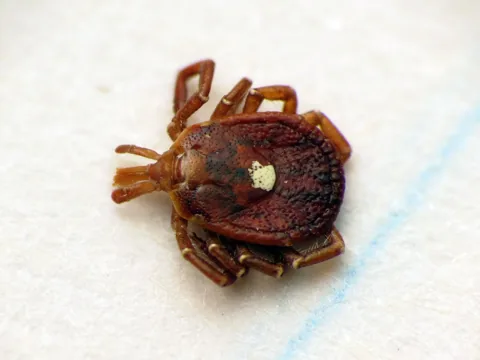 Lone Star Tick
Amblyomma americanum
The lone star tick is a very aggressive tick that readily bites people and pets across the Northeast, South and Midwest; its bite is linked to alpha-gal syndrome, a red meat allergy.
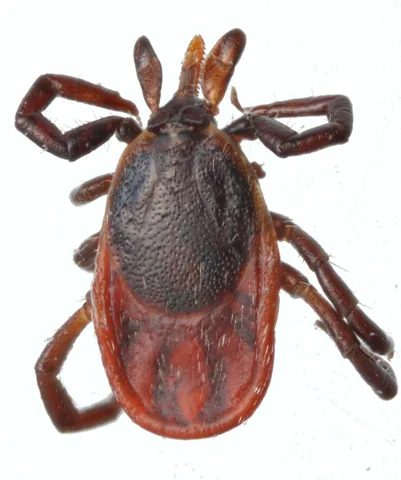 Blacklegged Tick
Ixodes scapularis
The blacklegged tick, often called the deer tick, is widely distributed across the eastern United States and spreads the bacteria that cause Lyme disease along with several other infections.
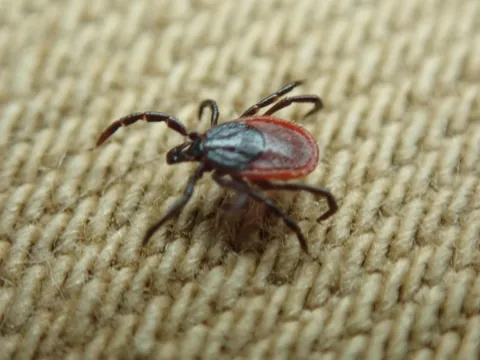 Western Blacklegged Tick
Ixodes pacificus
The western blacklegged tick is the Pacific Coast relative of the eastern deer tick and, in California, the only tick whose nymphs and adult females pass Lyme disease bacteria to people. It attaches to people more often than any other tick species in the state.
What alpha-gal syndrome is
Alpha-gal (galactose-alpha-1,3-galactose) is made naturally in the bodies of most mammals, such as cows and pigs, but not in people. It is also found in the saliva of some ticks. CDC says the allergy is why AGS is also called red meat allergy or tick bite meat allergy.[1][8]
The reaction comes later, not at the bite. Virginia's health department explains that the tick injects alpha-gal into the skin with its saliva, and that can later cause an immune response when the person eats or is otherwise exposed to meat or other products that contain alpha-gal.[8][1]
Not everyone bitten gets it. CDC says not every person bitten by a lone star, blacklegged or western blacklegged tick develops AGS, and why some people do and others don't is not known. Most reported cases are in adults, but people of all ages can develop it.[1][8]
The lone star tick link
In the United States AGS is primarily associated with the bite of the lone star tick (Amblyomma americanum), and less often with the blacklegged tick or western blacklegged tick. In other countries, other tick species have been linked to AGS. Virginia's health department adds that other kinds of ticks have not been ruled out.[1][8][10]
CDC's tick pages say the lone star tick is widely distributed in the Northeast, South and Midwest, and that growing evidence suggests alpha-gal syndrome may be triggered by its bite. Virginia's health department says lone star ticks are the most common tick species to bite people in Virginia.[7][8]
For telling a lone star tick from a deer tick, the diseases it also carries and its range, see the lone star tick profile and the lone star ticks vs deer ticks guide linked below; this page sticks to the allergy.[7]
Where alpha-gal syndrome is reported
CDC says more than 110,000 suspected AGS cases were identified in the US between 2010 and 2022, and as many as 450,000 people may be affected. AGS is not nationally notifiable to CDC, so the actual number of cases is not known.[1]
A 2023 CDC report (MMWR) looked at alpha-gal antibody tests from the lab that ran nearly all US testing before 2022. During 2017 to 2022, 90,018 people tested positive, and the number of people with positive results rose from 13,371 in 2017 to 18,885 in 2021. Suspected cases came mostly from counties in the southern, midwestern and mid-Atlantic regions.[5]
The same report named a nearly continuous region with the most suspected cases relative to population, including parts of Oklahoma, Kansas, Arkansas, Missouri, Mississippi, Tennessee, Kentucky, Illinois, Indiana, North Carolina, Virginia, Maryland and Delaware. The counties with the most suspected cases were Suffolk County, New York, and Bedford County, Virginia.[5]
Some states now track it. West Virginia, for example, asks healthcare providers to report AGS cases to the state health department within one week.[9]
Symptoms: a delayed reaction
Two delays set AGS apart. First, CDC says it can take weeks to months after a tick bite before a person has AGS symptoms. Second, each reaction usually starts 2 to 6 hours after eating red meat or dairy. Virginia's health department points out that this delay is unlike typical food allergies, and that symptoms can begin suddenly after years of eating meat without problems.[2][8]
Reactions vary from person to person and from mild to severe, and some are life-threatening. CDC says people with AGS might not react to every product that contains alpha-gal, and the same person can react differently each time, even to the same product.[2][1]
- Skin: hives or an itchy rash. CDC says hives or a rash are a common symptom of an AGS reaction.[2][8]
- Stomach: nausea or vomiting, severe stomach pain, heartburn or indigestion, and diarrhea.[2][8]
- Breathing: cough, shortness of breath or difficulty breathing.[2][8]
- Swelling of the lips, throat, tongue or eyelids (Virginia's health department lists swelling of the face and other areas of the body too).[2][8]
- A drop in blood pressure, dizziness or faintness; Virginia's health department also lists headaches.[2][8]
- A combination of these, called anaphylaxis: a potentially life-threatening allergic reaction involving multiple organ systems.[2][8]
When to get emergency care
Get emergency care right away for a severe allergic reaction or anaphylaxis. CDC and Virginia's health department both say anyone having a severe allergic reaction should seek immediate emergency care.[2][8]
If a healthcare provider has prescribed an epinephrine auto-injector or epinephrine nasal spray, CDC says people who use it should still seek emergency care. Ask your provider how to use it, how to prepare for a reaction and how to recognize anaphylaxis.[2][3]
For milder, repeated reactions hours after meals, CDC's advice is to talk to your healthcare provider if you think you may have AGS.[2][1]
How it is diagnosed
CDC says a healthcare provider diagnoses AGS with a physical exam, a detailed patient history and a blood test for antibodies the body makes in response to alpha-gal. The provider may also suggest allergy skin testing for allergens such as pork and beef.[1][10]
A positive blood test alone is not the diagnosis. Virginia's health department says people can test positive for alpha-gal antibodies without having symptoms after eating red meat (called sensitization), and they would not be diagnosed with AGS. An allergist may sometimes ask for a food challenge, eating red meat in a healthcare setting, to confirm symptoms.[8]
A review by University of Virginia allergists says that in most cases the diagnosis rests on a history of delayed reactions to mammalian meat plus the alpha-gal antibody blood test.[10]
Red meat and other mammal products
There is no cure, and AGS should be managed with an allergist or other healthcare provider. CDC says most providers recommend that patients stop eating meat from mammals, and some patients also need to avoid dairy, gelatin or certain medications. Work out with your provider which products you need to avoid.[1][3][8]
CDC says a person with AGS is more likely to react to mammal meat, such as beef, pork or lamb, than to other alpha-gal products like dairy, and many patients with AGS can tolerate milk products. Virginia's health department notes that in some people the allergy is limited to beef or other high-fat meats.[4][8]
- Meat: beef, pork, lamb, venison, rabbit and other mammal meat, plus organ meats such as liver, kidneys, intestines or sweetbreads.[4][1]
- Milk and milk products may contain alpha-gal. CDC notes cow's milk is the only alpha-gal ingredient that is a major food allergen, so food labels must name it.[4][3]
- Other animal products: gelatin made from beef or pork; foods made or cooked with mammal fat such as lard, tallow or suet; meat broth, bouillon, stock and gravy.[4][3]
- Non-food products: some medications and vaccines contain additives, stabilizers or coatings that may contain alpha-gal, such as gelatin, glycerin, magnesium stearate or bovine extract. CDC says not all patients react to them; talk to your provider before a new medication or vaccine.[4][3]
- Foods CDC lists as not containing alpha-gal: poultry such as chicken, turkey, duck or quail; fish and seafood; eggs; fruits and vegetables.[4]
Why avoiding more tick bites matters
CDC says new tick bites may reactivate allergic reactions to alpha-gal. Some people with AGS who avoid more tick bites may be able to tolerate alpha-gal products again, but that is an individual medical decision to make with a healthcare provider.[3]
Virginia's health department also says the allergy diminishes over time in some people, particularly without further lone star tick bites, and the University of Virginia review found that blood levels of alpha-gal antibody often drop in patients who avoid repeat tick bites, though how fast varies.[8][10]
CDC singles out hunters as being at heightened risk, because they spend more time outdoors, walk through thick grass and dense woods, and are often low to the ground. Virginia's health department says the same of anyone who spends a lot of time in thick grass and wooded tick habitat.[1][8]
Preventing tick bites
These are CDC's tick-bite steps, which CDC repeats on its AGS management page. If a tick is already attached, follow the removal steps in our tick bite guide rather than waiting.[3][6]
- Use an EPA-registered insect repellent with DEET, picaridin, IR3535, oil of lemon eucalyptus (OLE), para-menthane-diol (PMD) or 2-undecanone, and look for the EPA Reg. No. on the label. If you also use sunscreen, put sunscreen on first and repellent second.[3][6]
- Wear clothing and gear treated with 0.5% permethrin, or buy pre-treated clothing; CDC says permethrin on boots, clothing and camping gear stays protective through several washings.[3][6]
- Shower and check your whole body for ticks after coming indoors. CDC says showering within two hours of coming indoors has been shown to lower Lyme disease risk and may help with other tickborne diseases.[3][6]
- Check clothing too. Ticks ride indoors on clothes; CDC says tumble drying dry clothes on high heat for 10 minutes kills them, and if clothes need washing first, use hot water.[6]
- Protect pets and cut down ticks around the house: CDC's AGS page points to pet tick protection and reducing tick exposure around your home as more ways to lower risk. Our yard tick control guide covers that in detail.[1][6]
Common questions
- Can a lone star tick bite make you allergic to red meat?
- Yes. CDC says alpha-gal syndrome can develop after a tick bite, and in the US the lone star tick is the tick most often associated with it. Not everyone bitten develops AGS.[1][8]
- How long after a tick bite does alpha-gal syndrome start?
- CDC says it can take weeks to months after the bite before symptoms appear. After that, reactions usually begin 2 to 6 hours after eating red meat or dairy.[2][8]
- Can I still eat chicken and fish with alpha-gal syndrome?
- CDC lists poultry, fish and seafood, eggs, fruits and vegetables as foods that don't contain alpha-gal. Check processed foods for mammal ingredients such as gelatin, lard or meat broth, and follow your provider's advice.[4]
- Does alpha-gal syndrome go away?
- Sometimes. Virginia's health department says the allergy diminishes over time in some people, especially without more lone star tick bites, and CDC says some people who avoid new bites may tolerate alpha-gal products again. Only reintroduce foods under a healthcare provider's guidance.[8][3]
- Should I get tested for alpha-gal after every tick bite?
- CDC's advice is to talk to your healthcare provider if you think you may have AGS, meaning you are having reactions. Virginia's health department notes a positive antibody test without symptoms is sensitization, not AGS.[2][8]
Photo credits
- Lone Star Tick: (c) Katja Schulz, some rights reserved (CC BY) — via iNaturalist, CC BY 4.0
- Blacklegged Tick: (c) Christian Back, some rights reserved (CC BY) — via iNaturalist, CC BY 4.0
- Western Blacklegged Tick: Randal, public domain (CC0), via iNaturalist
Sources
- Centers for Disease Control and Prevention, “About Alpha-gal Syndrome.” www.cdc.gov/alpha-gal-syndrome/about/index.html (accessed 2026-11-14)
- Centers for Disease Control and Prevention, “Symptoms of Alpha-gal Syndrome.” www.cdc.gov/alpha-gal-syndrome/signs-symptoms/index.html (accessed 2026-11-14)
- Centers for Disease Control and Prevention, “Managing Alpha-gal Syndrome.” www.cdc.gov/alpha-gal-syndrome/managing/index.html (accessed 2026-11-14)
- Centers for Disease Control and Prevention, “Fast Facts: Products That May Contain Alpha-gal.” www.cdc.gov/alpha-gal-syndrome/data-research/products-containing-alpha-gal/index.html (accessed 2026-11-14)
- Centers for Disease Control and Prevention, “Geographic Distribution of Suspected Alpha-gal Syndrome Cases, United States, January 2017-December 2022 (MMWR 2023;72(30)).” www.cdc.gov/mmwr/volumes/72/wr/mm7230a2.htm (accessed 2026-11-14)
- Centers for Disease Control and Prevention, “Preventing Tick Bites.” www.cdc.gov/ticks/prevention/index.html (accessed 2026-11-14)
- Centers for Disease Control and Prevention, “Where Ticks Live.” www.cdc.gov/ticks/about/where-ticks-live.html (accessed 2026-11-14)
- Virginia Department of Health, “Alpha-gal Syndrome (fact sheet).” www.vdh.virginia.gov/epidemiology/epidemiology/epidemiology-fact-sheets/alpha-gal-syndrome/ (accessed 2026-11-14)
- West Virginia Office of Epidemiology and Prevention Services, “Alpha-gal Syndrome.” oeps.wv.gov/alpha-gal-syndrome (accessed 2026-11-14)
- Journal of Allergy and Clinical Immunology: In Practice, “Platts-Mills TAE et al. Diagnosis and Management of Patients with the alpha-Gal Syndrome. J Allergy Clin Immunol Pract 2020;8(1):15-23 (PMID 31568928).” pubmed.ncbi.nlm.nih.gov/31568928/ (accessed 2026-11-14)