The short answer
- Body: a harvestman's body looks like one oval piece, with no visible waist. A cellar spider has two clearly separate body regions, a small rounded head section and an abdomen behind it.[4][5][6][2]
- Eyes: harvestmen have just two eyes, on a raised bump on top of the body. Cellar spiders have eight eyes in three groups, two in the middle with a cluster of three on each side.[2][6][5][7]
- Webs: a long-legged animal hanging upside down in a loose, messy web is a cellar spider. Harvestmen make no silk and build no webs, so they are found walking on walls, trees, mulch and the ground.[5][7][1][4]
- Neither one is a danger to people. Harvestmen have no venom glands or fangs; cellar spiders have venom, but their mouthparts are too small to puncture human skin.[6][1][9][8]
Profiles on this site
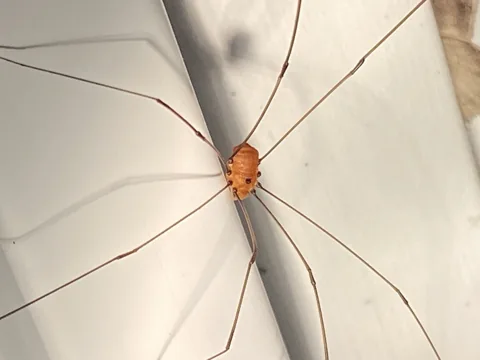 Harvestmen (Daddy Longlegs)
Opiliones (e.g., eastern harvestman, Leiobunum vittatum)
Harvestmen, widely called daddy longlegs, are arachnids related to spiders but are not true spiders. They make no silk, have no venom glands, and are beneficial predators and scavengers in yards and gardens.
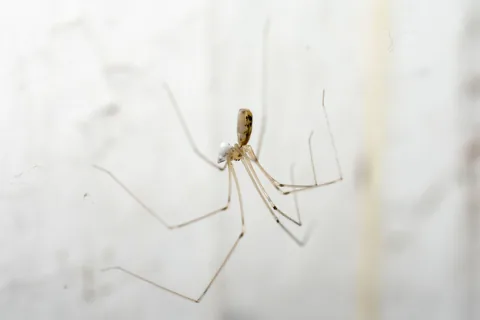 Longbodied Cellar Spider
Pholcus phalangioides
The longbodied cellar spider is the most common cellar spider in the United States: a small, pale spider with extremely long legs that lives in buildings all year. Penn State says it isn't known to be harmful in any way; its main offense is messy webbing.
Side by side: harvestman and cellar spider
What they are: harvestmen belong to the order Opiliones, which Clemson says holds more than 6,500 species; they are related to spiders, ticks, mites and scorpions but are not spiders. Cellar spiders are true spiders in the family Pholcidae, order Araneae. Penn State says the longbodied cellar spider, Pholcus phalangioides, is the most common member of the family in the United States.[1][6][5][7]
Body size, legs not counted: Clemson and Minnesota put most adult harvestmen at 1/16 to 1/2 inch, and Ohio State at 2 to 10 mm. Missouri says cellar spider bodies are usually no more than about ¼ inch, and Penn State gives 7 to 8 mm for female longbodied cellar spiders and 6 mm for males. The ranges overlap, so size alone won't settle it, though Missouri says cellar spiders are generally much smaller and more delicate.[1][3][2][5][7][4]
Body shape: Ohio State says the two body sections of a harvestman do not narrow where they join, so it looks like a single oval. A cellar spider's head and abdomen are clearly separate. Missouri describes most cellar spider abdomens as oval or rounded, sometimes called peanut shaped; in the longbodied cellar spider Penn State says the abdomen is about three times as long as it is wide.[2][4][5][7]
Color: Ohio State says harvestmen are cryptically colored and blend in with their surroundings. Cellar spiders are gray, tan or whitish (Missouri); Penn State describes the longbodied cellar spider as pale tan or yellow with a gray mark in the middle of the front body section, and Bohart notes darker markings at the leg joints of most individuals.[2][5][7][8]
Legs: both have eight very long, thin legs. Minnesota says a harvestman's legs are several times the length of its body, and Clemson and Ohio State say the second pair is the longest and works as a feeler. Cellar spider legs have flexible tips (Missouri, Bohart), and Penn State gives the front legs of an adult female longbodied cellar spider as about 50 mm long. Some cellar spiders have dark leg joints that give them a knobby-kneed look.[3][1][2][5][8][7]
Eyes: two on a raised turret (Ohio State calls it an ocularium) in harvestmen. In cellar spiders Missouri describes eight eyes in three groups, and Penn State describes the longbodied cellar spider's as two groups of three larger, light-colored eyes plus a pair of small dark eyes in front.[2][4][5][7]
Silk: harvestmen have no spinnerets and no silk glands, so they never build webs. Cellar spider females build loose, nonsticky, untidy cobwebs in corners and crevices; Penn State calls the web an irregular mesh of threads and Connecticut calls it a three-dimensional cobweb.[1][4][5][7][9]
Mouthparts and venom: harvestmen have no fangs or venom glands. Clemson and the Missouri Poison Center say their mouthparts work like those of crabs or scorpions, holding prey while they eat, and Missouri Conservation says they eat small chunks of solid food rather than sucking up liquids. Cellar spiders do have venom; Missouri says it is comparatively mild, and Bohart says their jaws are too small and weak to puncture human skin.[6][1][4][5][8]
- Food: harvestmen are omnivores and scavengers. Clemson and Ohio State list aphids and other small insects, dead insects, feces and other organic matter, and Ohio State adds psyllids, beetle larvae, slugs, mites, caterpillars and some pollen. Cellar spiders catch small insects in their webs, especially mosquitoes, midges and other small flies (Bohart), and Missouri says they also take prey larger than themselves, including wolf spiders and crane flies.[1][2][8][5]
How each one acts
Cellar spiders hang belly-up in their webs. When threatened they vibrate or bounce so fast that they blur and become hard to see; Bohart says some instead look like they are doing pushups.[5][7][8]
Some harvestmen bounce too. Ohio State says certain species bob their bodies rapidly when a predator threatens, so shaking alone doesn't prove you're looking at a spider. Check whether the animal is in a web.[2]
Harvestmen defend themselves with smell. They release a compound from scent glands when disturbed, which the Missouri Poison Center and Missouri Conservation describe as an unpleasant or weird odor.[2][6][4][1]
Harvestmen drop legs. If a predator grabs a leg, the harvestman detaches it, and Ohio State says the loose leg twitches for up to an hour while the harvestman escapes. Lost legs do not grow back.[2][1]
Eggs: a female cellar spider carries her loosely bound cluster of eggs in her jaws (Missouri, Penn State, Bohart); Penn State says a cluster holds twenty-five to sixty eggs. Harvestmen lay their eggs in soil, under stones or bark, in mulch or in cracks in wood, and Ohio State says some females guard them until they hatch.[5][7][8][1][2]
- Groups: harvestmen sometimes gather by the hundreds (Ohio State), clustering on trees and homes around eaves and windows in fall (Clemson) and especially in dry weather, which Missouri Conservation says may reduce water loss. Bohart says cellar spiders also tend to live near each other, though they are not social.[2][1][4][8]
Where and when you'll see them
Cellar spiders live indoors year-round. Penn State says both sexes are found in heated buildings throughout the year, in cellars, warehouses, garages and other dark, quiet spots; Missouri adds basements and ceiling corners anywhere in the home. Connecticut says they favor undisturbed dark corners of rooms, basements and cellars.[7][5][9]
Harvestmen are mostly outdoor animals. Ohio State finds them on the soil surface, under rocks and mulch, on tree trunks, on garden plants and on buildings. Clemson says they turn up in damp crawl spaces, unfinished basements and garages but are rarely found in finished living spaces.[2][1]
Season: harvestmen are seen from May to November (Clemson) or spring to fall (Minnesota), in the largest numbers in fall around harvest time, which gave them their name. Most are active at night, though Missouri Conservation says many are also active by day.[1][3][2][4]
How to confirm what you saw
Start with the web. If the animal is hanging in a tangle of silk in a corner, it is a spider; Missouri Conservation says harvestmen cannot spin webs at all. A harvestman will be walking or resting on a surface with no silk around it.[5][4][1]
Take a photo from the side and zoom in on the body. Look for a narrow waist between two body parts, which marks a spider, against a single oval body with no waist, which marks a harvestman. Missouri says the harvestman's head and abdomen are usually hard to tell apart.[4][5][6][2]
Then check the eyes with a hand lens or a close photo: a harvestman's two eyes sit together on a raised bump centered on the front body section, while a cellar spider's eyes sit in small groups on the head. Missouri notes that telling one cellar spider species from another takes close examination of the palps, face and eye groups.[2][5][7]
Why the difference matters
Neither needs a pesticide, but the reasons differ. Clemson says harvestmen are beneficial predators and scavengers, cluster only briefly in fall and do not damage buildings, so control is rarely needed. Connecticut calls cellar spiders excellent at controlling pests indoors and a natural alternative to pesticides in basements, cellars and bathrooms.[1][9]
The nuisance is different. With cellar spiders it is the webbing: UC IPM says they mainly cause problems by producing messy webs, and Penn State says they can build large populations in protected spots. With harvestmen it is the fall clusters on siding, eaves and windows.[10][7][1]
The venom legend is told about both, and it is wrong both ways. The story says daddy longlegs carry the deadliest venom but can't bite. Clemson, Ohio State and the Missouri Poison Center say harvestmen have no venom at all. For cellar spiders, Bohart says venom studies show it is no more potent than any other spider's, and Connecticut calls the highly venomous story an urban legend.[1][2][6][8][9]
- Missouri Conservation suggests the cellar spider myth may have grown from its ability to kill dangerous spiders, including widows. It does that by throwing long swaths of silk over the prey from a safe distance, not by having stronger venom.[5]
Bites and handling
Harvestmen: the Missouri Poison Center rates them as no danger, with no symptoms expected. First aid is typically not needed, though it suggests washing your hands after handling one.[6]
Cellar spiders: Penn State says they are not known to bite people. Bohart and Connecticut say their mouthparts are too small to puncture human skin, while UC IPM puts it more cautiously: their fangs are too short to pierce skin in most cases. Connecticut says bites are extremely rare.[7][8][9][10]
- Questions after contact with a daddy longlegs can go to the poison center at 1-800-222-1222, which the Missouri Poison Center says is open all day, every day, for poisoning emergencies and questions.[6]
What to do about each
Harvestmen on the house: sweep or vacuum them off walls and structures. Clemson says insecticide sprays are almost never needed and the fall clusters pass on their own.[1]
Harvestmen in the garden: leave them. Ohio State says they help with biological control, and that rocks, mulch, logs, flowering plants and avoiding broad-spectrum insecticides help keep them around.[2]
Cellar spider webs: Connecticut suggests tapping the switched-off vacuum nozzle on the web so the spider leaves, then vacuuming the web. To move one outdoors, Connecticut says to capture it and release it outside, starting with a clear drinking glass placed over it so it can't run off.[9]
Fewer cellar spiders over time: run a dehumidifier, fix leaks, caulk exterior cracks, seal windows and screen vents. Connecticut says this keeps out both the spiders and the insects they eat.[9]
- Many people keep a few cellar spiders on purpose. Missouri says they eat so many other spiders and insects that people tolerate them in cellars.[5]
Common questions
- Which one is the real daddy longlegs?
- Both get the name. Bohart says the true daddy-long-legs are harvestmen, but Missouri Conservation lists daddy longlegs spider and vibrating spider among the common names for cellar spiders too.[8][5][6]
- Is a daddy longlegs the most venomous spider in the world?
- No. Harvestmen have no venom glands or fangs, and cellar spider venom is mild and, per Bohart, no more potent than any other spider's. Neither can bite through human skin.[1][6][8][5]
- Do harvestmen spin webs?
- No. They have no silk glands. If a long-legged animal is sitting in a web, it is a cellar spider.[1][4][5]
- Why do daddy longlegs in my basement shake when I get close?
- Cellar spiders vibrate rapidly in their webs when threatened, which makes them hard to see. Some harvestmen bob their bodies the same way, so look for the web to tell which one you have.[7][5][2]
- Can harvestmen live in my basement?
- They can show up in damp crawl spaces, unfinished basements and garages, but Clemson says they are rarely found in finished living spaces, and Ohio State says they dry out easily.[1][2]
Photo credits
- Harvestmen (Daddy Longlegs): (c) Mark Eanes, some rights reserved (CC BY) — via iNaturalist, CC BY 4.0
- Longbodied Cellar Spider: (c) Kyle Elshoff, some rights reserved (CC BY) — via iNaturalist, CC BY 4.0
Sources
- Clemson Cooperative Extension, Home & Garden Information Center, “Daddy Longlegs (HGIC 2418).” hgic.clemson.edu/factsheet/daddy-longlegs/ (accessed 2026-11-14)
- Ohio State University Extension, “Ohio's Natural Enemies: Harvestmen (also known as daddy longlegs), ENT-68.” ohioline.osu.edu/factsheet/ent-68 (accessed 2026-11-14)
- University of Minnesota Extension, “Harvestmen (daddy longlegs), What insect is this?.” apps.extension.umn.edu/garden/diagnose/insect/general-curiosity-insects/relatives/medium/harvestmen.html (accessed 2026-11-14)
- Missouri Department of Conservation, “Daddy Longlegs (Harvestmen) (Field Guide).” mdc.mo.gov/discover-nature/field-guide/daddy-longlegs-harvestmen (accessed 2026-11-14)
- Missouri Department of Conservation, “Cellar Spiders (Field Guide).” mdc.mo.gov/discover-nature/field-guide/cellar-spiders (accessed 2026-11-14)
- Missouri Poison Center, “Daddy Longlegs (Is This a Poison?).” missouripoisoncenter.org/is-this-a-poison/daddy-longlegs/ (accessed 2026-11-14)
- Penn State Extension, “Longbodied Cellar Spider (updated January 19, 2026).” extension.psu.edu/longbodied-cellar-spider (accessed 2026-11-14)
- Bohart Museum of Entomology, University of California, Davis, “Cellar Spiders (Information No. 36).” bohart.ucdavis.edu/sites/g/files/dgvnsk4616/files/media/documents/note_36_cellar_spider.pdf (accessed 2026-11-14)
- The Connecticut Agricultural Experiment Station, “Spiders in the House.” portal.ct.gov/-/media/caes/documents/publications/fact_sheets/entomology/spiders_in_the_house.pdf (accessed 2026-11-14)
- University of California Statewide IPM Program, “Spiders (Pest Notes, Home and Landscape).” ipm.ucanr.edu/home-and-landscape/spiders/ (accessed 2026-11-14)