The short answer
- Count the eyes. Recluses have six eyes in three pairs set in a semicircle; most other spiders have eight. You'll need a good hand lens to see them.[1][3][5][6]
- Look at the legs and abdomen. A recluse's are one even color with fine hairs, no spines, and no stripes, rings, bands or mottling. A spider with banded legs, spiny legs or a patterned abdomen is not a recluse.[1][3][4]
- Don't go by the violin mark alone. It is fairly consistent in adult brown recluses but faint in young ones and very faint to missing in some southwestern recluses, while harmless spiders often have dark marks people read as a violin.[1][3][4]
- Check where you live. The brown recluse lives from southeastern Nebraska to southwestern Ohio and south through Texas to north Georgia. Outside its range a stray spider can arrive in boxes or furniture, but infestations seldom take hold.[1][3][5]
Spiders on this page
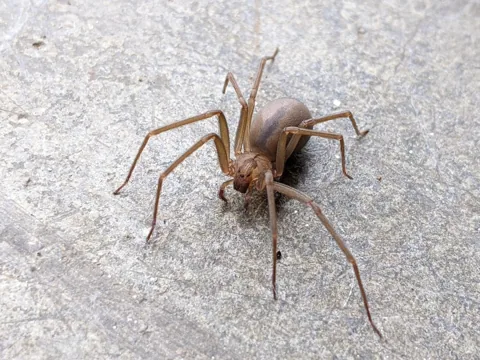 Brown Recluse
Loxosceles reclusa
The brown recluse is a secretive spider of the south-central and Midwestern United States whose bite can occasionally cause serious wounds; it is widely over-reported outside its range. The Illinois Department of Public Health says it occurs in roughly the southeastern quarter of the country and that bites are uncommon even where the spider is common.
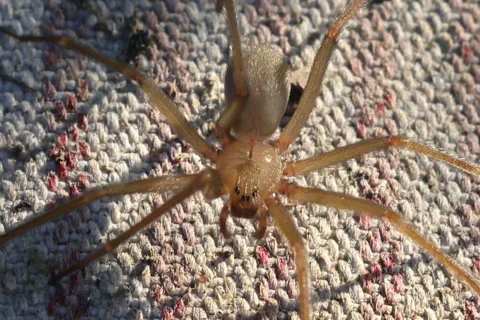 Desert Recluse
Loxosceles deserta
The desert recluse is the most common recluse spider in California and the one most likely behind a true recluse find there. It is native to the desert Southwest, lives mainly outdoors in native vegetation and is seldom found indoors.
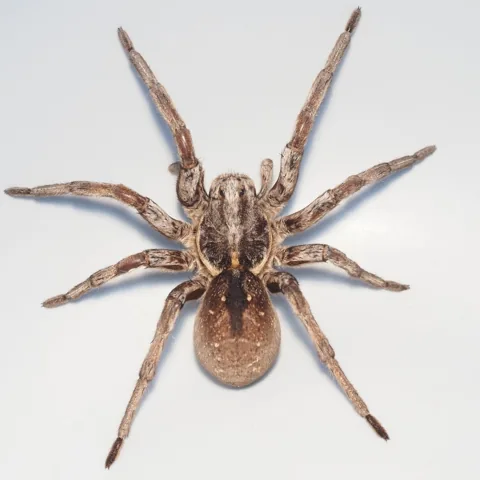 Carolina Wolf Spider
Hogna carolinensis
Wolf spiders are large hunting spiders that don't use webs; they wander into homes by accident, especially males searching for mates, and they don't persist indoors.
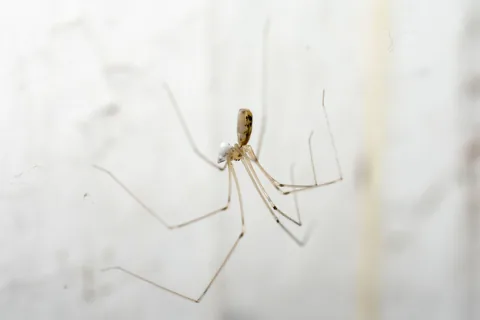 Longbodied Cellar Spider
Pholcus phalangioides
The longbodied cellar spider is the most common cellar spider in the United States: a small, pale spider with extremely long legs that lives in buildings all year. Penn State says it isn't known to be harmful in any way; its main offense is messy webbing.
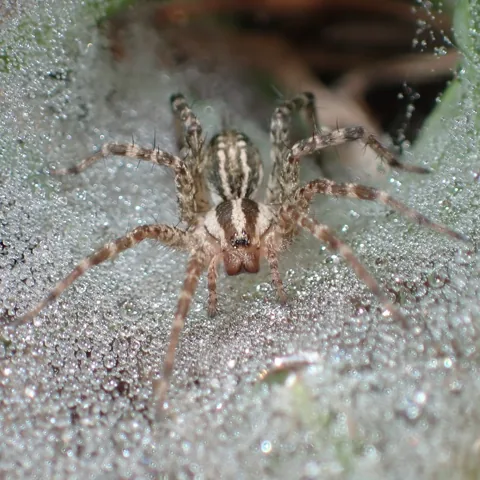 Grass Spiders (Funnel Weavers)
Agelenopsis species
Grass spiders are common funnel weavers whose flat, sheet-like webs with a funnel off to one side show up in lawns, ground covers and shrubs. They are fast and shy, often wander indoors in fall, and are considered beneficial.
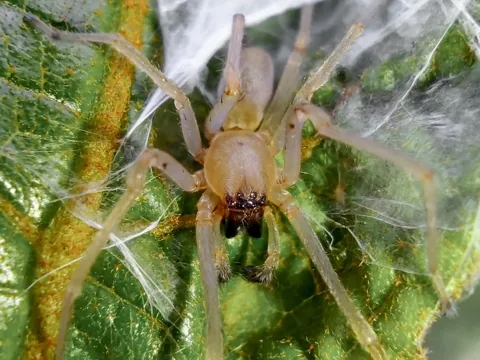 Yellow Sac Spider
Cheiracanthium species (shown: C. inclusum)
Yellow sac spiders are small, pale hunting spiders that rest by day in silk sacs in the corners of walls and ceilings, under siding or among leaves, and come out at night to hunt instead of building a web.
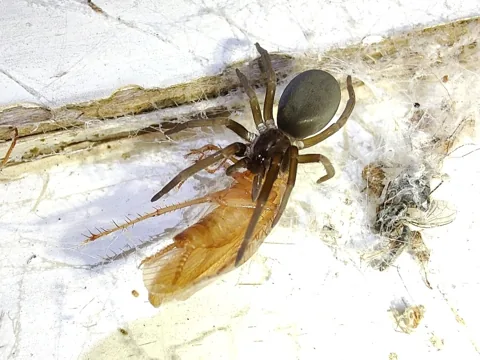 Southern House Spider
Kukulcania hibernalis
The southern house spider, also called a crevice weaver, is a spider of buildings in the southern United States. It worries people mainly because its males are mistaken for brown recluses, but verified bites have been minor. It is also called the southern crevice spider, and UF/IFAS says it is common throughout Florida and much of the southern United States in populated areas.
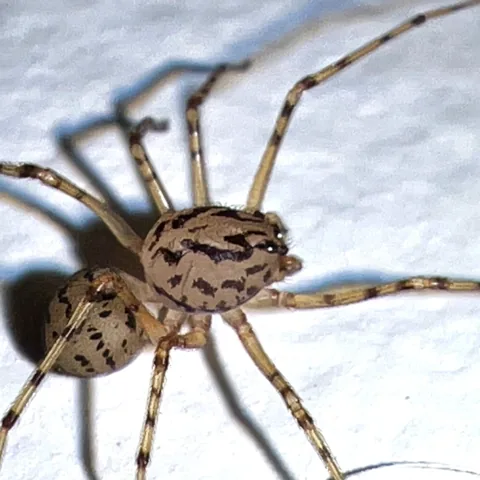 Spitting Spider
Scytodes thoracica
The spitting spider is a slow-moving, spotted spider found in and around buildings. It builds no web; instead it spits a zigzag of silk, glue and venom that pins insects in place.
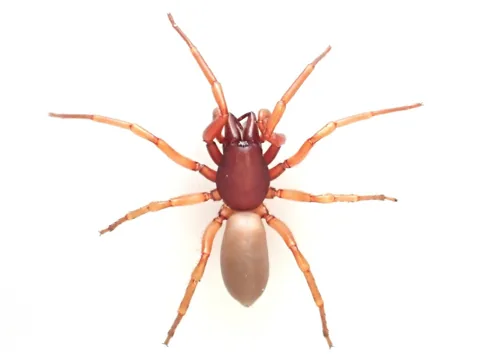 Woodlouse Spider
Dysdera crocata
The woodlouse spider, or woodlouse hunter, is a Mediterranean spider now found around homes across much of North America. It hunts sowbugs and pill bugs in damp places and looks fierce because of its large fangs, but Utah State calls it beneficial.
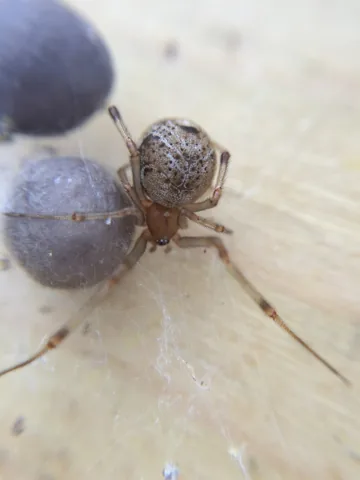 Common House Spider
Parasteatoda tepidariorum
The common house spider is a cobweb weaver found through most of the world. It builds its tangled webs in the corners of walls and windows, along floor joists and in basements, barns and crawl spaces.
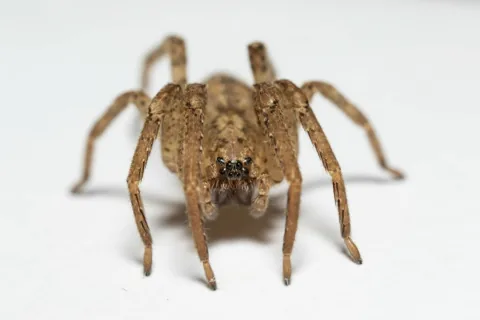 Zoropsis Spider
Zoropsis spinimana
The Zoropsis spider is a large brown hunting spider from the Mediterranean that now lives around San Francisco Bay. It startles people who find it indoors, but UC IPM calls it harmless and says control is unnecessary.
The marks of a real recluse
An adult brown recluse with its legs spread out is about the size of a U.S. quarter; Kansas State puts it at a quarter to a half-dollar. It is tan to dark brown, with long, thin legs.[3][5][4]
UC IPM calls the eyes the most definitive feature: six eyes of equal size in three pairs, one pair at the front and one on each side. Most spiders have eight eyes, usually in two rows of four, so checking the eyes rules out almost every suspect at once.[1][5][6]
The abdomen is covered in fine hairs and is never patterned, though its shade runs from light beige to dark brown depending partly on what the spider has recently eaten. The legs are also one color and hairy, where many other spiders have stout spines or striped, ringed or spotted legs.[1][3]
Recluses hide by day in silk retreats and hunt at night. They also spin an irregular web with a white, cobwebby look that works as a trip line for prey walking nearby.[1][5]
Why the violin mark is a poor test
The dark violin shape sits on the top of the front body section, with the neck of the violin pointing back toward the abdomen. Kentucky says it is consistent in adult brown recluses but hard to see and less obvious in young spiders.[3][4][6]
UC IPM says the mark can vary in intensity and is very faint to absent in several southwestern recluses, including the desert recluse. It also says physicians, pest control operators and even some entomologists have seen violins on harmless spiders and wrongly called them recluses.[1]
Cellar spiders, pirate spiders and sheet web spiders all have dark marks on the head region that convince people they have a recluse. The marbled cellar spider fools people even though its dark marks are on the underside, and Zoropsis spinimana in Northern California has a dark mark on top of the abdomen rather than the front body section.[1]
Side by side: recluse and the spiders mistaken for it
Kentucky's spider chart says wolf, grass, cellar, American house, yellow sac and fishing spiders are all often mistaken for brown recluses, and UC IPM adds ground spiders, orb weavers, male crevice spiders and male widows and false widows. UC IPM notes that all the brown spiders on its list have eight eyes.[4][1]
- Brown recluse: quarter-size with legs out; tan to dark brown; six eyes in three pairs; legs and abdomen plain, with no spines, stripes or bands; violin mark on the front body section in adults; hides in boxes, paper, firewood and wall voids; hunts at night.[4][3][1][5]
- Wolf spider: from about a quarter inch to 1 inch long in body, up to silver-dollar size with legs out; gray or brown, usually with contrasting spots or stripes; eight eyes, with a row of four small eyes under four larger ones; runs on the ground and builds no web.[12][4]
- Wolf spider legs: in some common species the legs are banded with lighter brown at the joints, a quick sign it isn't a recluse, though other species have plain legs, so check the eyes and abdomen stripe too.[11][3]
- Cellar spider: half-dollar size with legs out but with a small, thin body and far longer, thinner legs than a recluse; pale tan, yellow or gray with a gray mark in the middle of the front body section; eight eyes; hangs in a loose, messy web and vibrates rapidly when disturbed.[4][13]
- Grass spider: quarter-size with legs out; brown with prominent gray or tan stripes running lengthwise, dark bands on the front body section and often ringed legs; two finger-like spinnerets that stick out past the end of the abdomen; lives in a sheet web with a funnel in lawns and ground covers and sometimes wanders indoors.[4][14][15]
- Yellow sac spider: nickel-size with legs out; low and flat; light yellow to cream, with a yellow abdomen and dark brown jaws, palps and leg tips; a slightly darker stripe down the abdomen; eight eyes and no violin; hunts without a web.[4][16][1]
- Southern house spider (male): khaki to amber, with long, slender legs and palps; usually larger than a recluse with much longer legs; eight eyes bunched on a raised bump rather than six in three pairs; its brown stripe narrows quickly behind the eyes, while the recluse violin is wider and runs to the back edge of the front body section. Females are charcoal gray and live in tangled webs radiating from a crevice.[17][19][18]
The few other six-eyed spiders
Six eyes alone doesn't settle it. Spitting spiders, close relatives of recluses, have six eyes in a similar pattern but carry many black spots or lines and a strongly domed front body section. The woodlouse spider has six eyes in two groups of three and no markings at all.[1]
Where brown recluses actually live
UC IPM describes the brown recluse range as the south-central Midwest from southeastern Nebraska to southwestern Ohio and south through Texas to north Georgia. Kansas State describes it as Colorado to Ohio and Nebraska and Iowa to the Gulf States, and MedlinePlus says it is most common in Missouri, Kansas, Arkansas, Louisiana, eastern Texas and Oklahoma.[1][5][7]
Eleven recluse species are native to the United States. Several others live in the Southwest and southern California, such as the desert recluse in the Sonoran and Mojave deserts, and the Chilean recluse is established in a small part of Los Angeles County.[1][3]
Outside the range, recluses are rare. In a nationwide study where people mailed in spiders they believed were brown recluses, 1,773 arachnids came from 49 states, and from 25 of 29 states completely or almost completely outside the recluse range no recluses were submitted at all.[8]
California sent in nearly 600 of those spiders. Only one was a brown recluse, from a house whose family had moved from Missouri, and fewer than 20 verified brown recluse specimens have been collected in the state over several decades.[1]
Wounds blamed on recluses
Doctors outside the recluse range often diagnose a recluse bite from a dead-tissue wound alone. Over 41 months, researchers learned of 216 such diagnoses in California, Oregon, Washington and Colorado, yet could find historical evidence of only 35 brown or Mediterranean recluses from those four states.[10]
In most published reports from areas without recluses, no spider was identified with the wound. Many conditions have been misdiagnosed as brown recluse bites, some of them fatal or debilitating, so in those regions a presumed recluse bite is improbable.[9][8]
If you think you've been bitten, wash the area with soap and water and put a cloth with cold water or ice on it, then get medical care or call Poison Help at 1-800-222-1222. Bring the spider in a secure container if you can do so safely; it helps with treatment.[6][7]
Our bug bite guide and the brown recluse control guide cover bite symptoms and what doctors do in more detail.[6][7]
How to confirm what you caught
- Look at the eyes with a good hand lens before anything else. Any eight-eyed spider can be dropped from the list.[2][1][3]
- Keep the spider whole. A crushed specimen can be hard to identify, so catch it on a sticky trap or in a secure container rather than swatting it.[1][7]
- To mail a spider to an expert, freeze it, soak it in rubbing alcohol for a few days, pour off the alcohol and rinse it with water before shipping. Don't mail it in alcohol, which breaks postal rules.[1]
- Put flat sticky traps along baseboards and floor edges, out of reach of pets and children. They show whether recluses are present and roughly how many.[1][3]
- Have the identification confirmed by an entomologist or a knowledgeable pest control firm, or take the spider to your county Cooperative Extension office. Telling recluse species apart takes a high-magnification microscope and an arachnologist.[3][1][2]
Why the difference matters
Inside the range, recluses can be abundant. In one Kansas house a family collected 2,055 brown recluses in 6 months. Kentucky recommends dozens of glue traps to find where they are concentrated and says treatment is best done by professionals.[1][3]
UC IPM says that even inside the range of these spiders you need to verify that you have recluses before you start control. For a wolf or grass spider that wandered in, UC IPM's advice for house spiders applies: vacuum up the spider and its web and seal the gaps it came through.[1][2]
What to do next
- Confirmed recluses: follow our brown recluse control guide for sticky traps, clutter, bedding and careful insecticide placement.[1][3][5]
- Wolf, grass, sac or southern house spiders: vacuum up the spider and its web, seal cracks in the foundation and gaps around windows and doors, and keep screens tight.[2]
- Not sure what you have: compare it against our types of spiders in homes guide, then get it checked by your extension office.[4][3]
Common questions
- Does a violin mark mean it's a brown recluse?
- No. Many harmless spiders have dark marks that look like a violin, and some recluses barely show one. Check for six eyes in three pairs and plain, unbanded legs instead.[1][3]
- Can I have brown recluses if I live outside their range?
- A single spider occasionally arrives in boxes or furniture, but infestations seldom become established outside the native range.[3][1][8]
- Is a big brown spider running across the floor a recluse?
- It is often a wolf spider. Wolf spiders run on the ground, don't build webs and are often mistaken for brown recluses, but they have eight eyes and usually spots or stripes.[4][12]
- What spider looks most like a brown recluse?
- In the Southeast the male southern house spider is often taken for a recluse because of its color and shape. It is larger, with much longer legs and palps, and has eight eyes clustered on a raised bump.[17][19][18]
- My doctor said it was a brown recluse bite. Could it be something else?
- Possibly, especially outside the recluse range. Many conditions have been misdiagnosed as brown recluse bites, and most reports from areas without recluses had no spider identified. Follow your doctor's care and bring any spider you find.[9][10][7]
Photo credits
- Brown Recluse: iamfindingplants, public domain (CC0), via iNaturalist
- Desert Recluse: (c) nmoorhatch, some rights reserved (CC BY) — via iNaturalist, CC BY 4.0
- Carolina Wolf Spider: (c) Russell Pfau, some rights reserved (CC BY) — via iNaturalist, CC BY 4.0
- Longbodied Cellar Spider: (c) Kyle Elshoff, some rights reserved (CC BY) — via iNaturalist, CC BY 4.0
- Grass Spiders (Funnel Weavers): (c) dhasdf, some rights reserved (CC BY) — via iNaturalist, CC BY 4.0
- Yellow Sac Spider: (c) Jhonatan Matheus, some rights reserved (CC BY) — via iNaturalist, CC BY 4.0
- Southern House Spider: Bruno R. Giozza, public domain (CC0), via iNaturalist
- Spitting Spider: (c) Healthy Yards, some rights reserved (CC BY) — via iNaturalist, CC BY 4.0
- Woodlouse Spider: (c) Joss Carr, some rights reserved (CC BY) — via iNaturalist, CC BY 4.0
- Common House Spider: (c) Erin Lalime, some rights reserved (CC BY) — via iNaturalist, CC BY 4.0
- Zoropsis Spider: (c) Alexis Lours, some rights reserved (CC BY) — via iNaturalist, CC BY 4.0
Sources
- University of California Statewide IPM Program, “Pest Notes: Brown Recluse and Other Recluse Spiders.” ipm.ucanr.edu/home-and-landscape/brown-recluse-and-other-recluse-spiders/ (accessed 2026-11-14)
- University of California Statewide IPM Program, “Pest Notes: Spiders.” ipm.ucanr.edu/home-and-landscape/spiders/ (accessed 2026-11-14)
- University of Kentucky Entomology, “ENTFACT-631: Brown Recluse Spider.” entomology.mgcafe.uky.edu/ef631 (accessed 2026-11-14)
- University of Kentucky Entomology, “Spider Identification Chart.” entomology.mgcafe.uky.edu/spider-chart (accessed 2026-11-14)
- Kansas State University Research and Extension, “Brown Recluse Spiders, MF3133 (2014).” bookstore.ksre.ksu.edu/pubs/MF3133.pdf (accessed 2026-11-14)
- CDC National Institute for Occupational Safety and Health (NIOSH), “Venomous Spiders at Work.” www.cdc.gov/niosh/outdoor-workers/about/venomous-spiders.html (accessed 2026-11-14)
- MedlinePlus, U.S. National Library of Medicine, “Brown recluse spider (Medical Encyclopedia).” medlineplus.gov/ency/article/002859.htm (accessed 2026-11-14)
- Journal of Medical Entomology, via PubMed, “Vetter RS. 2005. Arachnids submitted as suspected brown recluse spiders: Loxosceles spiders are virtually restricted to their known distributions but are perceived to exist throughout the United States. J Med Entomol 42(4):512-21.” pubmed.ncbi.nlm.nih.gov/16119538/ (accessed 2026-11-14). Cited from the PubMed abstract.
- Clinical Infectious Diseases, via PubMed, “Vetter RS, Bush SP. 2002. Reports of presumptive brown recluse spider bites reinforce improbable diagnosis in regions of North America where the spider is not endemic. Clin Infect Dis 35(4):442-5.” pubmed.ncbi.nlm.nih.gov/12145729/ (accessed 2026-11-14). Cited from the PubMed abstract.
- Toxicon, via PubMed, “Vetter RS, Cushing PE, Crawford RL, Royce LA. 2003. Diagnoses of brown recluse spider bites (loxoscelism) greatly outnumber actual verifications of the spider in four western American states. Toxicon 42(4):413-8.” pubmed.ncbi.nlm.nih.gov/14505942/ (accessed 2026-11-14). Cited from the PubMed abstract.
- Penn State Extension, “Wolf Spiders.” extension.psu.edu/wolf-spiders (accessed 2026-11-14)
- Missouri Department of Conservation, “Wolf Spiders (Field Guide).” mdc.mo.gov/discover-nature/field-guide/wolf-spiders (accessed 2026-11-14)
- Penn State Extension, “Longbodied Cellar Spider.” extension.psu.edu/longbodied-cellar-spider (accessed 2026-11-14)
- Penn State Extension, “Grass Spiders.” extension.psu.edu/grass-spiders (accessed 2026-11-14)
- Missouri Department of Conservation, “Grass Spiders (Field Guide).” mdc.mo.gov/discover-nature/field-guide/grass-spiders (accessed 2026-11-14)
- Penn State Extension, “Agrarian Sac Spider and Longlegged Sac Spider.” extension.psu.edu/agrarian-sac-spider-and-longlegged-sac-spider (accessed 2026-11-14)
- University of Florida IFAS Extension, “Featured Creatures EENY-144/IN301: Southern House Spider, Kukulcania hibernalis.” ask.ifas.ufl.edu/publication/IN301 (accessed 2026-11-14)
- Texas A&M Urban and Structural Entomology Program, “Southern House Spider.” urbanentomology.tamu.edu/spiders/southern-house-spider/ (accessed 2026-11-14)
- Clemson Cooperative Extension Home & Garden Information Center, “What is it? Wednesday: Male Southern House Spider.” hgic.clemson.edu/what-is-it-wednesday-8/ (accessed 2026-11-14)