On this page
How to identify it
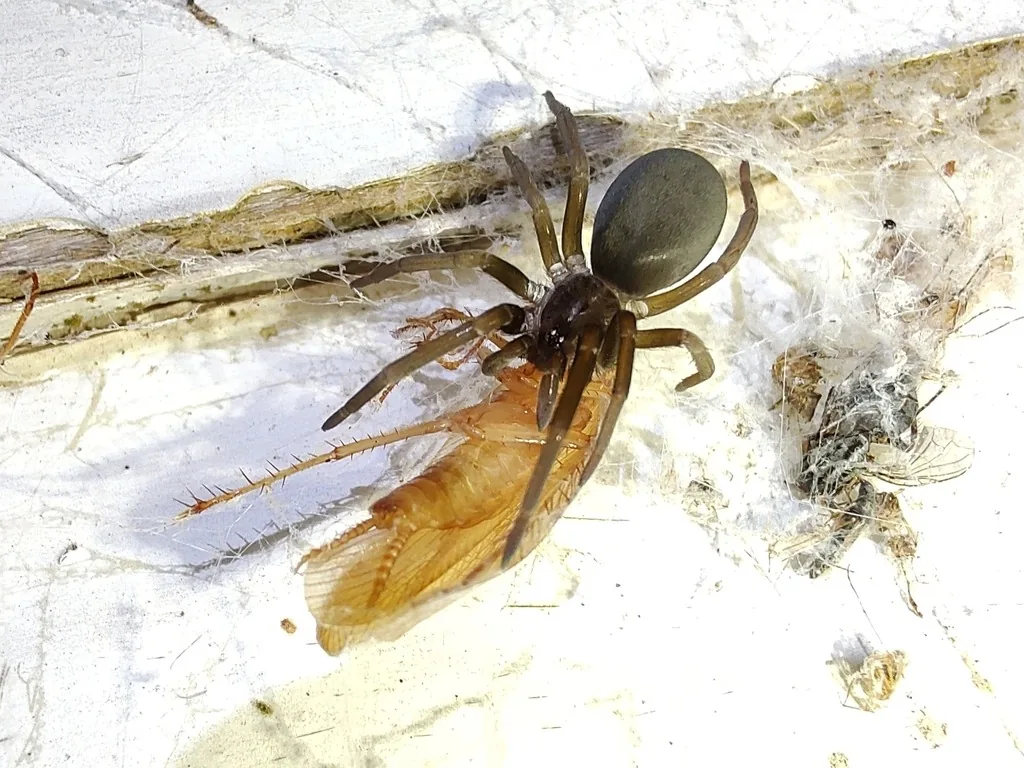
- Females are larger and darker brown than males. UF/IFAS describes females as charcoal gray and 13 to 19 mm (1/2 to 3/4 inch) long, often with dusky patches on the front body section and an elongate oval abdomen that can swell after feeding or when carrying eggs.[1][11]
- Males have much longer legs and palps (the feelers by the mouth) than a brown recluse, and Clemson says the male is generally larger than a brown recluse. UF/IFAS gives males as 9 to 10 mm long and khaki to amber, with long slender legs and palps and a brown stripe behind the eyes that narrows quickly.[4][1][11]
- It has eight eyes in a cluster; a brown recluse has six. UF/IFAS says the eight eyes sit together on a raised bump, while a brown recluse has six eyes in three pairs.[1][4][6][11]
- The web radiates outward from a central hole or cavity where the spider hides. UF/IFAS describes a flat, tangled web spread over the surface around the crevice that serves as the nest; it looks unkempt, collecting debris and the remains of insect prey.[1][11]
- It is a cribellate spider: its capture threads are made of very fine nanofibres combed out with a comb-like structure on the hind legs. A 2019 study found it lays these threads in a zigzag pattern that holds prey better than straight threads. UF/IFAS says the web has no sticky droplets: the woolly silk snags on the claws, bristles, spines and textured skin of insects, much like Velcro.[9][10][11]
Look-alikes
| Look-alike | How to tell them apart |
|---|---|
| Brown recluse | A brown recluse has six eyes and a dark violin-shaped mark on its head. A male southern house spider has eight clustered eyes, is generally larger, and has much longer legs and palps. UF/IFAS adds that the brown recluse's violin mark is much wider than the male southern house spider's stripe and runs to the rear edge of the head region.[6][4][1][11] |
Where it lives
Clemson says it is readily found throughout the southern United States. It also lives around buildings in South America, where records run from northern Venezuela to southern Brazil. UF/IFAS says it is common throughout Florida and much of the southern United States in human populated areas, and that in Florida all life stages seem to be present year round.[4][8][11]
Biology and life cycle
Texas A&M says it is commonly found in old barns and undisturbed buildings, with the web built into a hole or cavity.[1]
It is a synanthropic species, meaning it lives alongside people.[8]
UF/IFAS says it favors spaces in the masonry of buildings, especially dark recesses of windowsills, shutters and overhangs, and builds its webs on houses, barns, bridges and other structures, occasionally under tree bark.[11]
Females and young stay in their webs, hiding in the crevice by day and coming out to sit on the web at night. Small young can build webs in the crease between a wall and ceiling; larger ones need a deeper retreat, such as a hole or a gap between boards.[11]
Adult males build no webs and wander in search of females.[11]
A female lays about 200 eggs, loosely wrapped in a silk ball about 15 mm across that she keeps in her nest. UF/IFAS, citing Kaston (1972), says females may live up to eight years.[11]
It was first described in the genus Filistata and later moved to Kukulcania. Its family, Filistatidae, is related to other spiders found in houses, such as cellar spiders, spitting spiders and recluses.[11]
Damage and signs
- The webs can look unsightly on buildings. Like most spiders, it feeds on insects, which UC IPM and Colorado State say makes spiders mostly beneficial. UF/IFAS calls it a beneficial spider that captures many pest insects, including house flies, horse flies, mud daubers, cockroaches and May beetles.[1][2][5][11]
- Old webs collect dust; UC IPM notes that a dusty web is usually abandoned, because spiders keep the webs they use clean.[2]
Health risk
A 2022 report of five verified bites in southern North America, three of them in children, found only minor effects. The author warns that these spiders are often misidentified as brown recluses, which can lead to unneeded, aggressive treatment such as cutting away tissue. For any spider bite, CDC NIOSH advises washing it with soap and water, applying a cold, damp cloth or ice and seeking medical care.[7][6]
Control
Prevention
Clear trash, leaf litter and heavy vegetation from next to the foundation, move woodpiles and debris away from the house, and keep lights off the structure and away from doors and windows, since light draws the insects spiders eat. UF/IFAS adds inspecting firewood for spiders or egg sacs before bringing it indoors.[2][5][11]
Keep them out
Seal cracks in the foundation and gaps around windows and doors, and keep screens in good repair; good screening also keeps out the insects spiders feed on. UF/IFAS adds plugging holes where water pipes and electrical lines enter and keeping screens securely on chimneys.[2][5][11]
Traps and physical control
Vacuum or sweep webs and spiders from windows, corners, storage areas and the outside of buildings; vacuuming kills most spiders. UF/IFAS says routine vacuuming along baseboards, under furniture and in other undisturbed areas removes webs, nests and egg sacs and can eliminate spiders over time.[2][5][11]
Pesticides
UC IPM says insecticides give no long-term control and generally shouldn't be used against spiders outdoors. Colorado State says indoor treatment of corners works only alongside these cleanup steps.[2][5]
Where the sources disagree
Female color: Texas A&M describes females as darker brown than males; UF/IFAS describes them as charcoal gray.[1][11]
Insecticides: UC IPM says insecticides give no long-term control and generally shouldn't be used against spiders outdoors; UF/IFAS says that in rare cases where spiders are numerous and keep entering the house, an insecticide applied only where spiders are present may be used.[2][11]
Common questions
- Is the southern house spider a brown recluse?
- No. The tan males are often mistaken for brown recluses, but they have eight clustered eyes instead of six and much longer legs and palps.[4][1][7]
- Is the southern house spider dangerous?
- Verified bites have been minor. The bigger risk is being treated as a brown recluse bite when it isn't.[7]
- Where do southern house spiders hide?
- In crevices of buildings. UF/IFAS says they favor dark recesses of windowsills, shutters and overhangs, hiding in the crevice by day and sitting on the web around it at night.[11]
- How long do southern house spiders live?
- A long time for a spider: UF/IFAS, citing a 1972 reference, says females may live up to eight years.[11]
Sources
- Texas A&M AgriLife Extension, Urban and Structural Entomology, “Southern House Spider.” urbanentomology.tamu.edu/spiders/southern-house-spider/ (accessed 2026-11-11)
- University of California Statewide IPM Program, “Spiders (Pest Notes, Home and Landscape).” ipm.ucanr.edu/home-and-landscape/spiders/ (accessed 2026-11-11)
- iNaturalist, “Kukulcania hibernalis taxon page (order and family).” www.inaturalist.org/taxa/122357 (accessed 2026-11-11)
- Clemson Cooperative Extension Home & Garden Information Center, “What is it? Wednesday: male southern house spider, Kukulcania hibernalis (V. Bertagnolli, Nov. 4, 2020).” hgic.clemson.edu/what-is-it-wednesday-8/ (accessed 2026-11-11)
- Colorado State University Agricultural Biology, “Spiders in the Home.” agsci.colostate.edu/agbio/ipm-pests/spiders-in-the-home (accessed 2026-11-11)
- CDC / NIOSH, “Venomous Spiders at Work.” www.cdc.gov/niosh/outdoor-workers/about/venomous-spiders.html (accessed 2026-11-11)
- Toxicon: X, via PubMed, “Vetter RS (2022), Verified envenomations by crevice weaver spiders (genus Kukulcania): bites are of minor expression but the spiders are commonly misidentified, Toxicon: X 14:100091.” pubmed.ncbi.nlm.nih.gov/35106475/ (accessed 2026-11-11). Cited from the PubMed abstract.
- Zootaxa, via PubMed, “Brescovit AD, Magalhaes ILF (2013), The spider genus Kukulcania in South America (Araneae: Filistatidae): a redescription of K. brevipes and new records of K. hibernalis, Zootaxa 3734(3).” pubmed.ncbi.nlm.nih.gov/25277914/ (accessed 2026-11-11). Cited from the PubMed abstract.
- Scientific Reports, via PubMed, “Joel AC, et al. (2019), Small behavioral adaptations enable more effective prey capture by producing 3D-structured spider threads, Scientific Reports 9.” pubmed.ncbi.nlm.nih.gov/31754208/ (accessed 2026-11-11). Cited from the PubMed abstract.
- Journal of Experimental Biology, via PubMed, “Joel AC, et al. (2017), Nanofibre production in spiders without electric charge, Journal of Experimental Biology 220.” pubmed.ncbi.nlm.nih.gov/28396357/ (accessed 2026-11-11). Cited from the PubMed abstract.
- University of Florida IFAS Extension, EDIS, “Southern House Spider, Kukulcania hibernalis (Hentz), EENY144/IN301 (Featured Creatures).” ask.ifas.ufl.edu/publication/IN301 (accessed 2026-11-14)