The short answer
- Eyes: a brown recluse has 6 equal-sized eyes arranged in 3 pairs. A yellow sac spider has 8 eyes, all about equal in size, in 2 horizontal rows. You need a good hand lens to see this.[2][3][7][1][4]
- Color: a yellow sac spider is light yellow to cream, with a yellow abdomen, a slightly darker stripe down the abdomen and dark brown jaws, palps and leg tips. A brown recluse is tan to dark brown with a uniformly colored abdomen and legs, never striped, banded or mottled.[5][1][4][3][2]
- The violin: adult brown recluses have a dark violin-shaped mark on the back with the neck pointing toward the abdomen; the yellow sac spider has no violin. UC IPM warns the violin varies and is not a reliable test on its own, so check the eyes.[4][3][2]
- Size: Kentucky compares a yellow sac spider with legs outstretched to a U.S. nickel and a brown recluse to a U.S. quarter.[4][3]
Profiles on this site
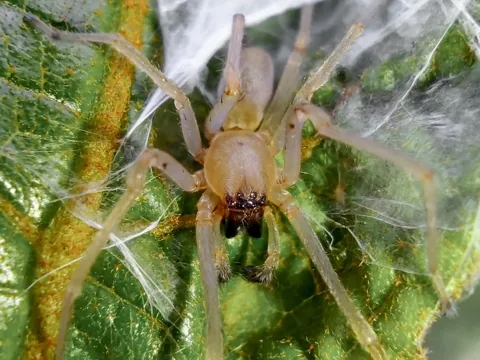 Yellow Sac Spider
Cheiracanthium species (shown: C. inclusum)
Yellow sac spiders are small, pale hunting spiders that rest by day in silk sacs in the corners of walls and ceilings, under siding or among leaves, and come out at night to hunt instead of building a web.
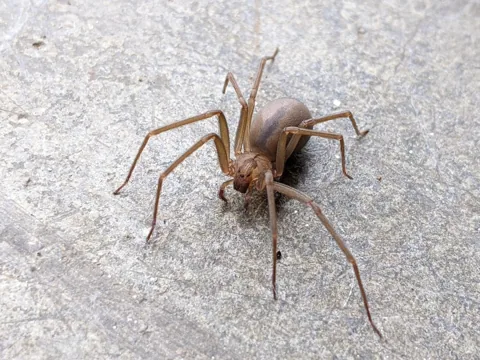 Brown Recluse
Loxosceles reclusa
The brown recluse is a secretive spider of the south-central and Midwestern United States whose bite can occasionally cause serious wounds; it is widely over-reported outside its range. The Illinois Department of Public Health says it occurs in roughly the southeastern quarter of the country and that bites are uncommon even where the spider is common.
Side by side
Both are tan-to-pale hunting spiders found indoors, but they differ in eyes, color, legs and range. Use these marks together rather than any one alone.[4][2]
- Size: yellow sac spider about the size of a nickel with legs out; Penn State gives females 5 to 10 millimeters and males 4 to 8 millimeters in body length. Brown recluse about the size of a quarter with legs out.[4][5][3]
- Color: yellow sac spider light yellow to cream (the longlegged sac spider has a slightly greenish tinge to its abdomen), with dark brown jaws, palps and leg tips. Brown recluse tan to dark brown; UC IPM says the abdomen can range from light beige to dark brown depending partly on what it has eaten, but it never has a color pattern.[5][1][3][2]
- Markings: yellow sac spider has a slightly darker stripe running down the abdomen and no violin. Brown recluse has a dark violin-shaped mark on the cephalothorax (the front body part), consistent in adults but harder to see in young spiders.[5][1][4][3]
- Eyes: yellow sac spider 8 eyes in 2 rows. Brown recluse 6 equal-sized eyes in 3 pairs (one pair in front and one on each side), a pattern most other spiders don't have.[1][4][2][3][7]
- Legs: brown recluse legs are long and thin, uniformly colored, covered with fine hairs and without conspicuous spines. Yellow sac spider legs are tan, darkening at the tips.[3][2][4][5]
- Webs and hiding places: yellow sac spiders build no capture web; they spin a small silken sac in ceiling and wall corners and behind shelves and pictures, hide in it by day and hunt at night, often running on walls and ceilings. Brown recluses hide in undisturbed places such as boxes, clutter, closets, shoes and wall voids.[4][1][5][3][7]
- Where in the U.S.: Penn State says the agrarian sac spider is native to much of the country except the northernmost states, and the longlegged sac spider, introduced from Europe, is now found throughout the United States north of Virginia, Utah and California. The brown recluse lives in the south-central Midwest, from southeastern Nebraska to southwestern Ohio and south through Texas to north Georgia (UC IPM); NIOSH says the midwestern and southern United States.[5][2][7]
- Bite: a yellow sac spider bite is usually painful at first but normally does not cause serious problems. A brown recluse bite may be felt as a sharp sting or not at all, and in serious cases the venom destroys skin tissue and needs medical care.[5][1][8][7]
How to confirm what you caught
Check the eyes. Kentucky says the six-eye pattern takes a good quality hand lens to see, and UC IPM calls the eye pattern the best way to rule out almost all non-recluse spiders, while relying on the violin can lead to mistakes.[3][2]
Keep the spider intact. UC IPM says a crushed spider may be hard to identify; it suggests freezing the spider, soaking it in rubbing alcohol for a few days, then pouring off the alcohol and rinsing it before shipping it for identification.[2]
Get an expert opinion. Kentucky says many harmless brown spiders are mistaken for the brown recluse, so have a specimen confirmed by an entomologist or a knowledgeable pest control firm.[3]
Use glue traps to survey. Kentucky and the Illinois Department of Public Health recommend flat sticky traps placed along baseboards, in corners and behind furniture; the more traps the better, and Illinois says 50 or more in an average home is not excessive. Keep traps out of reach of pets and small children.[3][6][1]
- Think about where you live. In a study of 1,773 arachnids people sent in as suspected brown recluses, no recluse spiders were submitted from 25 of 29 states completely or almost completely outside the recluse range.[11]
Why the difference matters
Bites: in 20 verified yellow sac spider bites from the United States and Australia, none caused necrosis, and a review of 39 verified Cheiracanthium bites worldwide found only one case of mild necrosis, in a European species. The authors say the idea that these spiders cause skin wounds came mostly from animal venom tests and unconfirmed reports.[9]
Misdiagnosis: a 2002 review says brown recluse bites are reported across North America even where the spider is not known to live, usually with no spider identified, and that many medical conditions, some fatal or debilitating, have been misdiagnosed as brown recluse bites. If a doctor calls a wound a spider bite, mention whether a spider was actually seen.[10]
What to do about each
Yellow sac spiders: UC IPM says it is just as easy and much less toxic to crush the spider or vacuum it up, and that spraying gives only temporary control unless paired with housekeeping. Seal cracks and gaps around windows and doors, keep screens tight, and vacuum regularly. Sticky traps also catch them.[1]
Brown recluses: start with glue traps to find where spiders are most numerous, cut clutter and store items in sealed plastic, move firewood and debris away from the foundation and seal exterior cracks. Wear long sleeves and gloves when sorting boxes, and keep clothes and shoes off the floor or shake them out before wearing. Kentucky says insecticides are often needed for an established infestation.[3][6][2][7]
Bites, first aid and pets
Brown recluse bite: MedlinePlus says pain usually develops within the first several hours and may become severe, with possible fever, chills, nausea, itching, a reddish or purplish ring and a large sore. In serious cases black tissue (eschar) forms and sloughs off after about 2 to 5 weeks, leaving an ulcer that can take many months to heal.[8]
First aid (NIOSH and MedlinePlus): wash the bite with soap and water and apply a cloth with cold water or ice; MedlinePlus says 10 minutes on and 10 minutes off. NIOSH says to elevate the area if possible, not to try to remove venom, and to get professional medical attention. MedlinePlus says to seek emergency care right away for a brown recluse bite.[7][8]
Call 911 for a serious reaction, or Poison Help at 1-800-222-1222 from anywhere in the United States for advice from poison experts (MedlinePlus). NIOSH says to identify the spider if it is safe to do so, to aid treatment.[8][7]
Yellow sac spider bite: Penn State describes it as very painful and burning at first, with redness, swelling and intense itching, sometimes followed by fever, malaise, muscle cramps and nausea; studies of verified bites have not confirmed necrotic wounds.[5][9]
- Pets: the Merck Veterinary Manual says recluse bites in animals are painless, so the spider is rarely seen; a blister can form within 2–8 hours and progress to a bull's-eye lesion that may turn dark and necrotic. Treatment is supportive wound care from a veterinarian, and there is no antivenom in the US.[12]
Common questions
- Is the yellow spider on my ceiling a brown recluse?
- Almost certainly not. A pale yellow spider with a darker stripe on the abdomen, 8 eyes and dark leg tips is a yellow sac spider. Brown recluses are tan to brown with a uniform abdomen and 6 eyes.[4][1][5][2]
- Are yellow sac spider bites dangerous?
- They hurt but are rarely serious. Kentucky says the bite is not medically significant except to allergic individuals, and verified bites studied in the US and Australia did not cause necrosis.[4][5][9]
- Can a brown recluse live where I am?
- Check the range: the brown recluse lives in the south-central US, and Kentucky says recluse spiders are rare outside their native range and widely over-reported. A spider moved in boxes or furniture seldom starts an infestation.[2][3][11]
- How do I check the eyes?
- Use a good hand lens on a trapped or preserved spider. Recluses have 6 eyes in 3 pairs; nearly every other house spider, including the yellow sac spider, has 8.[3][2][1]
- What if my dog or cat was bitten?
- Call your veterinarian. The Merck Veterinary Manual says recluse bites in animals cause local skin damage that needs wound care, and that serious whole-body signs are rare in companion animals.[12]
Photo credits
- Yellow Sac Spider: (c) Jhonatan Matheus, some rights reserved (CC BY) — via iNaturalist, CC BY 4.0
- Brown Recluse: iamfindingplants, public domain (CC0), via iNaturalist
Sources
- University of California Statewide IPM Program, “Spiders (Pest Notes).” ipm.ucanr.edu/home-and-landscape/spiders/ (accessed 2026-11-14)
- University of California Statewide IPM Program, “Brown Recluse and Other Recluse Spiders (Pest Notes).” ipm.ucanr.edu/home-and-landscape/brown-recluse-and-other-recluse-spiders/ (accessed 2026-11-14)
- University of Kentucky Entomology, “Brown Recluse Spider (ENTFACT-631).” entomology.mgcafe.uky.edu/ef631 (accessed 2026-11-14)
- University of Kentucky Entomology, “Urban Spider Chart.” entomology.mgcafe.uky.edu/spider-chart (accessed 2026-11-14)
- Penn State Extension, “Agrarian Sac Spider and Longlegged Sac Spider.” extension.psu.edu/agrarian-sac-spider-and-longlegged-sac-spider (accessed 2026-11-14)
- Illinois Department of Public Health, “Brown Recluse and Black Widow Spiders.” dph.illinois.gov/topics-services/environmental-health-protection/structural-pest-control/brown-recluse-black-widow-spiders.html (accessed 2026-11-14)
- CDC National Institute for Occupational Safety and Health (NIOSH), “Venomous Spiders at Work.” www.cdc.gov/niosh/outdoor-workers/about/venomous-spiders.html (accessed 2026-11-14)
- MedlinePlus, U.S. National Library of Medicine, “Brown recluse spider (Medical Encyclopedia).” medlineplus.gov/ency/article/002859.htm (accessed 2026-11-14)
- PubMed (peer-reviewed), “Vetter RS et al. Verified bites by yellow sac spiders (genus Cheiracanthium) in the United States and Australia: where is the necrosis? Am J Trop Med Hyg 2006;74(6):1043-8.” pubmed.ncbi.nlm.nih.gov/16760517/ (accessed 2026-11-14)
- PubMed (peer-reviewed), “Vetter RS, Bush SP. Reports of presumptive brown recluse spider bites reinforce improbable diagnosis in regions of North America where the spider is not endemic. Clin Infect Dis 2002;35(4):442-5.” pubmed.ncbi.nlm.nih.gov/12145729/ (accessed 2026-11-14)
- PubMed (peer-reviewed), “Vetter RS. Arachnids submitted as suspected brown recluse spiders (Araneae: Sicariidae). J Med Entomol 2005;42(4):512-21.” pubmed.ncbi.nlm.nih.gov/16119538/ (accessed 2026-11-14)
- Merck Veterinary Manual, “Spider and Scorpion Bites and Stings to Animals.” www.merckvetmanual.com/toxicology/venomous-arthropods/spiders-and-scorpions (accessed 2026-11-14)