The short answer
- Eyes: a wolf spider has a row of four small eyes low on the face, a middle pair of much larger eyes, and a widely spaced pair on top of the head. A grass spider's eyes are about the same size and sit in two rows.[5][1][8]
- Rear end: grass spiders have two long, finger-like spinnerets sticking out from the tip of the abdomen, easy to see from above. Missouri gives the long spinnerets as a quick way to tell a grass spider from a wolf spider.[2][4][6][1]
- Web: grass spiders live on a flat sheet web with a funnel retreat at one side, common on lawns and shrubs. Wolf spiders build no web to catch prey; they run it down on the ground.[2][4][1][6]
- Babies: a female wolf spider carries her egg sac attached to her spinnerets, then carries the spiderlings on her back. A female grass spider instead deposits a white, lens-shaped egg sac.[1][7][8][4]
Profiles on this site
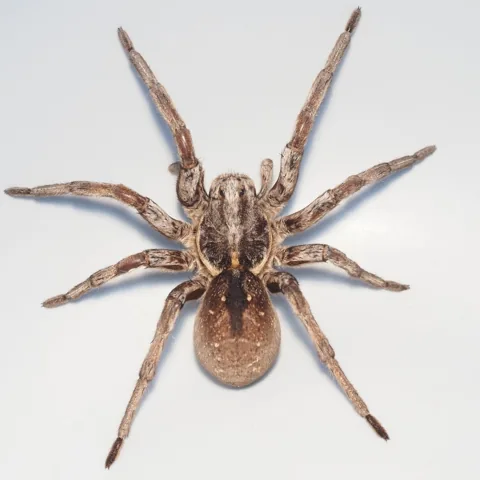 Carolina Wolf Spider
Hogna carolinensis
Wolf spiders are large hunting spiders that don't use webs; they wander into homes by accident, especially males searching for mates, and they don't persist indoors.
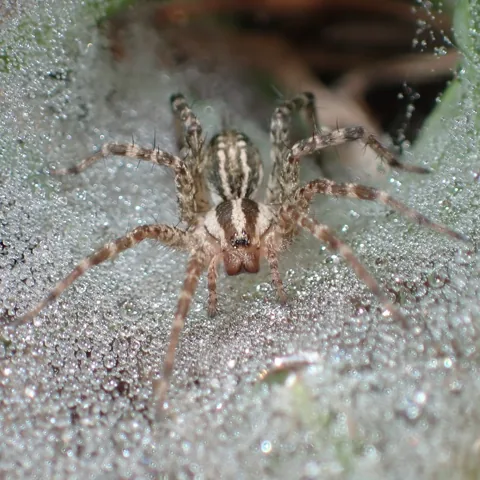 Grass Spiders (Funnel Weavers)
Agelenopsis species
Grass spiders are common funnel weavers whose flat, sheet-like webs with a funnel off to one side show up in lawns, ground covers and shrubs. They are fast and shy, often wander indoors in fall, and are considered beneficial.
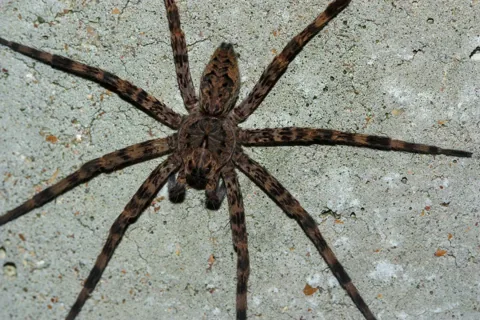 Fishing Spiders
Dolomedes species (e.g., D. tenebrosus, the dark fishing spider)
Fishing spiders, genus Dolomedes, are large brown hunting spiders that can run across water and even dive. The dark fishing spider, the species most often found around homes, lives mainly in wooded areas and is harmless despite its size.
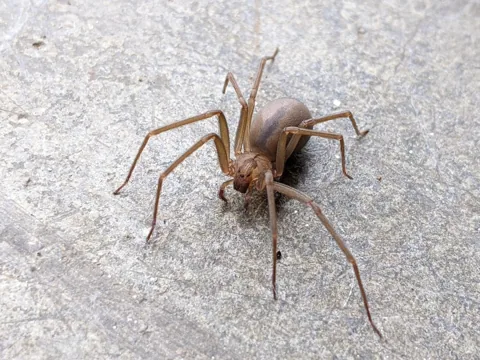 Brown Recluse
Loxosceles reclusa
The brown recluse is a secretive spider of the south-central and Midwestern United States whose bite can occasionally cause serious wounds; it is widely over-reported outside its range. The Illinois Department of Public Health says it occurs in roughly the southeastern quarter of the country and that bites are uncommon even where the spider is common.
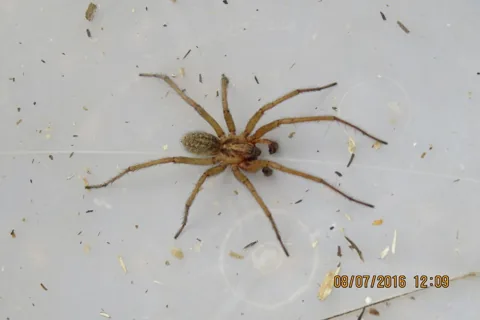 Hobo Spider
Eratigena agrestis
The hobo spider is a European funnel weaver that was labeled potentially toxic in the 1980s. Later research questioned that, and UC IPM says it is no longer considered of probable medical importance.
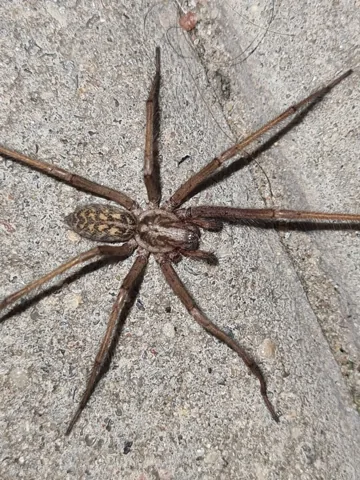 Giant House Spider
Eratigena atrica (formerly Tegenaria gigantea and T. duellica)
The giant house spider is one of the largest spiders in the Pacific Northwest, with a leg span that can reach 4 inches. It is common in and around homes west of the Cascades and is often mistaken for the hobo spider, but its bite is not known to threaten people.
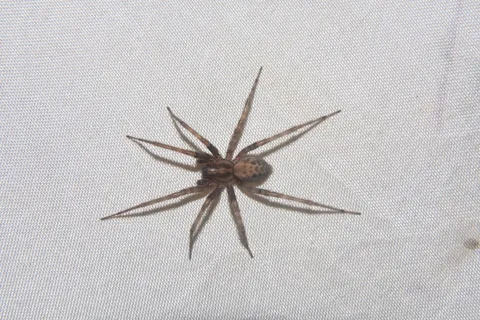 Barn Funnel Weaver
Tegenaria domestica
The barn funnel weaver, also called the house funnel weaver, is a fast, shy, light brown spider that builds a flat sheet web with a funnel retreat in basements, barns, sheds and door crevices, where it can survive indoors for years. No bites have been documented, and Penn State expects any bite would be mild. To get rid of it, vacuum spiders and webs, clear clutter, and seal cracks and gaps; sprays alone give only temporary control.
Side by side
Family: wolf spiders belong to the Lycosidae, with about 200 species in North America (UC IPM) or about 240 in the United States (Penn State). Grass spiders are funnel weavers (Agelenidae) in the genus Agelenopsis, 14 species in North America north of Mexico.[5][3][2]
Eyes: wolf spiders have three rows: 4 small eyes in front in a straight row, one middle pair of larger eyes, and one rear pair of widely spaced eyes on top of the head. Missouri says the two big center eyes face forward. Funnel weavers have 6 or 8 eyes, all about the same size, in 2 rows; Colorado State says they usually have four pairs of eyes that are the same size.[5][1][8]
Spinnerets: grass spiders have greatly elongated hind spinnerets that Kentucky describes as two finger-like projections at the end of the abdomen, very large and distinctive compared with other spiders. Missouri points to them as the quick way to separate grass spiders from wolf spiders.[4][6][7][1]
Size (body only, not legs): Missouri gives wolf spiders a quarter inch to 1 inch depending on species; Colorado State says up to 1/2-2 inches when fully grown; the big Hogna carolinensis females that wander into Pennsylvania homes are 22 to 35 millimeters. Grass spider females are about half to three-quarters of an inch (Missouri) or 10 to 20 millimeters (Penn State), with males slightly smaller; Colorado State puts funnel weavers at 8.5-17 mm.[1][8][3][2][4]
Color and pattern: wolf spiders are usually gray, brown, black or tan with darker stripes or spots, and look hairy; some, like the tiger wolf spider, have banded legs. Grass spiders are brown with a pair of dark bands running lengthwise down the front body section and a lighter band between, an abdomen with a lighter middle band or zigzag stripe, and legs often ringed darker at the ends of the segments.[1][6][8][3][2][4]
Web: grass spiders spin a sheetlike, mostly horizontal web with a funnel leading to a retreat; Missouri says the sheet may reach 3 feet wide, and webs stand out on dewy mornings. The sheet is not sticky; a tangle of threads above it knocks flying insects onto it. Wolf spiders make no web to catch prey, only a small, thick web where they rest, or a burrow or silk-lined retreat.[2][4][5][8]
How they hunt: a grass spider waits at the mouth of its funnel and dashes out when something lands on the sheet. Wolf spiders hunt on the ground, often at night, and run smoothly over the ground rather than jumping.[2][5][1]
Egg sac and young: the female wolf spider attaches her egg sac to her spinnerets and later carries the spiderlings on her back; Colorado State says they ride there for the first few weeks. The female grass spider deposits a lens-shaped, white egg sac in late summer to fall, and the eggs hatch in spring.[1][7][8][3][4]
Where found: wolf spiders live on the ground in leaf litter, grass, low plants, under rocks, boards and firewood, and in burrows. Grass spiders build webs in grass, weeds, ground covers such as ivy and pachysandra, shrubs, fencerows and brush piles, and in window wells of outbuildings.[1][3][7][2][4]
Season and why they come indoors
Grass spiders: Penn State says homeowners often see these fast spiders indoors in autumn as they seek shelter from falling temperatures, but the adults do not overwinter; Colorado State calls funnel weavers the most common spiders in homes, usually in early fall. Kentucky's EF622, by contrast, says funnel web spiders seldom come indoors, and its spider chart says they occasionally wander in.[4][8][7][6]
Wolf spiders: Kentucky says they often wander into homes but do not persist indoors; they are accidental invaders. Colorado State says they usually do not enter homes unless their habitat is disturbed, and UC IPM says large hunting spiders found indoors are often mature males searching for females.[6][7][8][5]
- Penn State says wolf spiders mate in autumn and the males die before winter, while mated females overwinter in protected places, including buildings, and produce egg sacs the following May or June.[3]
Other spiders mistaken for these two
Brown recluse: both wolf and grass spiders are often mistaken for recluses because they are brown and similar in size. A recluse has six eyes, not eight, and uniformly colored legs and abdomen with no stripes or bands.[6][10]
Fishing spiders: they carry the egg sac in their jaws, not on the spinnerets, don't carry their young on their backs and lack the two large forward-facing eyes. They prefer damp places near water but may turn up in basements.[1][7]
Hobo spider: a funnel weaver like the grass spider, found from the Pacific Northwest to northern Utah, Wyoming and Colorado; UC IPM describes a fast-running brown spider with a herringbone or chevron pattern on the abdomen that builds webs in basements, window wells and wood piles. Our hobo spider vs giant house spider guide separates it from its lookalikes.[5]
Bites
Neither spider is aggressive. NIOSH says spiders are usually not aggressive and most bites happen because a spider is trapped or touched.[10]
Wolf spiders: in an Australian study of 45 definite wolf spider bites, pain occurred in all bites and was usually brief, with a median duration of 10 min; there were no cases of necrotic ulcers, and the authors concluded effects are no more severe than most other spiders. A Brazilian study of 515 wolf spider bites found pain, generally mild, was the main symptom and no local necrosis.[11][12]
Grass spiders: grass spiders were long considered harmless. A 1998 report from southern California described the first two cases of clinically significant bites by the grass spider Agelenopsis aperta, one in a child with several envenomation symptoms; the author says the spider may be generally innocuous but of occasional medical importance.[13]
First aid (NIOSH): wash the bite with soap and water and apply a cloth dampened with cold water or filled with ice to reduce swelling. If possible, safely identify the spider to aid medical treatment, and for bites from venomous spiders NIOSH also advises professional medical attention.[10]
How to confirm which one you have
Look at the rear end from above. If two long spinnerets stick out past the abdomen, it is a grass spider.[2][6][4]
Look at the face with a hand lens or a zoomed photo. Two large forward-facing eyes in the middle row mean wolf spider; small, even-sized eyes in two rows mean a funnel weaver.[5][1][8]
Check what's on or near it. A female carrying a round egg sac on her rear end or a mass of babies on her back is a wolf spider. A spider sitting at the mouth of a funnel in a sheet web is a grass spider.[1][7][2]
Sticky traps along baseboards and under furniture catch and show which spiders are moving through a room; keep them out of reach of kids and pets.[9]
- For help identifying a spider, contact your local county extension office.[9]
Why the ID matters
Neither one needs a spray. Both are beneficial predators of insects, and UC IPM says pesticides are not generally needed for spiders; focus on removing webs and hiding places.[5][2]
NPIC says to identify the spider before choosing a treatment, and that residual pesticides indoors may help control insects spiders eat but may not provide long-term spider control.[9]
What to do about each
A single wolf or grass spider indoors: vacuum up the spider and its web, and any egg sacs.[5][9]
Keep them out: seal cracks in the foundation and gaps around windows and doors, keep screens tight, and cut clutter indoors and around the foundation.[5][9]
Fewer insects, fewer hunters: use yellow or sodium vapor bulbs outdoors so lights draw fewer insects for spiders to eat.[9]
Grass spider webs on shrubs or the lawn: remove spiders and webs from plants and yard items with a hard spray of water, or leave them; each funnel web holds a single spider that catches insects.[9][2]
Common questions
- Is the big brown spider running across my floor a wolf spider or a grass spider?
- If it has no web, looks hairy and has two large eyes facing forward, it is most likely a wolf spider. A grass spider has two long spinnerets at the tip of the abdomen and lives in a sheet web with a funnel; it may wander in during fall.[6][1][5][4]
- Which spider carries its babies on its back?
- The wolf spider. The female carries her egg sac on her spinnerets and then the spiderlings on her back. A female grass spider deposits a white, lens-shaped egg sac instead.[1][8][4]
- Do wolf spiders make webs?
- Not to catch prey. They hunt on the ground and may line a burrow or retreat with silk or make a small, thick resting web.[5][8][1]
- Are wolf spider or grass spider bites dangerous?
- Medical studies of hundreds of wolf spider bites found mostly brief or mild pain and no skin necrosis. For grass spiders, the first report of clinically significant bites, in 1998, described two cases. Wash the bite and seek care if symptoms are severe.[11][12][13][10]
- Why do I see more of these spiders in the fall?
- Grass spiders seek shelter from falling temperatures in autumn, and wolf spider males wander looking for mates in fall before they die.[4][8][3][5]
Photo credits
- Carolina Wolf Spider: (c) Russell Pfau, some rights reserved (CC BY) — via iNaturalist, CC BY 4.0
- Grass Spiders (Funnel Weavers): (c) dhasdf, some rights reserved (CC BY) — via iNaturalist, CC BY 4.0
- Fishing Spiders: (c) Andrew Meeds, some rights reserved (CC BY) — via iNaturalist, CC BY 4.0
- Brown Recluse: iamfindingplants, public domain (CC0), via iNaturalist
- Hobo Spider: Steve Wells, public domain (CC0), via iNaturalist
- Giant House Spider: (c) Marcin Jasiński, some rights reserved (CC BY) — via iNaturalist, CC BY 4.0
- Barn Funnel Weaver: (c) Sebastian Serna Muñoz, some rights reserved (CC BY) — via iNaturalist, CC BY 4.0
Sources
- Missouri Department of Conservation, “Wolf Spiders (Field Guide).” mdc.mo.gov/discover-nature/field-guide/wolf-spiders (accessed 2026-11-14)
- Missouri Department of Conservation, “Grass Spiders (Field Guide).” mdc.mo.gov/discover-nature/field-guide/grass-spiders (accessed 2026-11-14)
- Penn State Extension, “Wolf Spiders.” extension.psu.edu/wolf-spiders (accessed 2026-11-14)
- Penn State Extension, “Grass Spiders.” extension.psu.edu/grass-spiders (accessed 2026-11-14)
- University of California Statewide IPM Program, “Pest Notes: Spiders.” ipm.ucanr.edu/home-and-landscape/spiders/ (accessed 2026-11-14)
- University of Kentucky Entomology, “Urban Spider Chart.” entomology.mgcafe.uky.edu/spider-chart (accessed 2026-11-14)
- University of Kentucky Entomology, “Common Spiders Found Around Homes and Buildings (EF622).” entomology.mgcafe.uky.edu/ef622 (accessed 2026-11-14)
- Colorado State University, Department of Agricultural Biology, “Spiders in the home.” agsci.colostate.edu/agbio/ipm-pests/spiders-in-the-home (accessed 2026-11-14)
- National Pesticide Information Center, “Spiders.” npic.orst.edu/pest/spiders.html (accessed 2026-11-14)
- CDC National Institute for Occupational Safety and Health (NIOSH), “Venomous Spiders at Work.” www.cdc.gov/niosh/outdoor-workers/about/venomous-spiders.html (accessed 2026-11-14)
- Journal of Toxicology: Clinical Toxicology, via PubMed, “Isbister GK, Framenau VW. Australian wolf spider bites (Lycosidae): clinical effects and influence of species on bite circumstances. J Toxicol Clin Toxicol 2004;42(2):153-61.” pubmed.ncbi.nlm.nih.gov/15214620/ (accessed 2026-11-14)
- Toxicon, via PubMed, “Ribeiro LA et al. Wolf spider bites in Sao Paulo, Brazil: a clinical and epidemiological study of 515 cases. Toxicon 1990;28(6):715-7.” pubmed.ncbi.nlm.nih.gov/2402765/ (accessed 2026-11-14)
- Annals of Emergency Medicine, via PubMed, “Vetter RS. Envenomation by a spider, Agelenopsis aperta (family: Agelenidae) previously considered harmless. Ann Emerg Med 1998;32(6):739-41.” pubmed.ncbi.nlm.nih.gov/9832673/ (accessed 2026-11-14)