The short answer
- Eyes: a hobo spider has eight small eyes in two rows of four. A wolf spider has a bottom row of four small eyes, two large eyes above them facing forward and two more on top of the head, and its eyes shine back green in a flashlight beam at night.[1][2][4][6]
- Web: a hobo spider lives in a silk web with a tube-shaped retreat and waits there for prey. Wolf spiders don't build webs to catch food; they run it down.[2][3][6][8]
- Where you live: in North America the hobo spider is limited to the Pacific Northwest and nearby parts of the Rockies (British Columbia east to Montana, Wyoming and Colorado, south through Oregon and northern Utah). Wolf spiders are widespread: Missouri finds them statewide, Kentucky counts them among its most common spiders, and North America has about 200 (UC IPM) to nearly 250 (Missouri) species.[1][13][4][6][8]
- Bite: neither one is listed by the CDC as a venomous spider of concern, and verified bites by both have caused only short-lived pain and redness.[11][2][17][5][18]
Spider profiles on this site
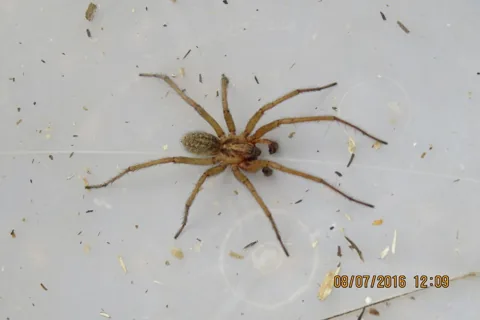 Hobo Spider
Eratigena agrestis
The hobo spider is a European funnel weaver that was labeled potentially toxic in the 1980s. Later research questioned that, and UC IPM says it is no longer considered of probable medical importance.
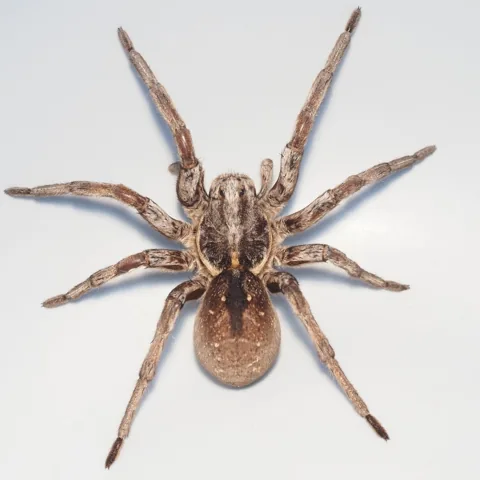 Carolina Wolf Spider
Hogna carolinensis
Wolf spiders are large hunting spiders that don't use webs; they wander into homes by accident, especially males searching for mates, and they don't persist indoors.
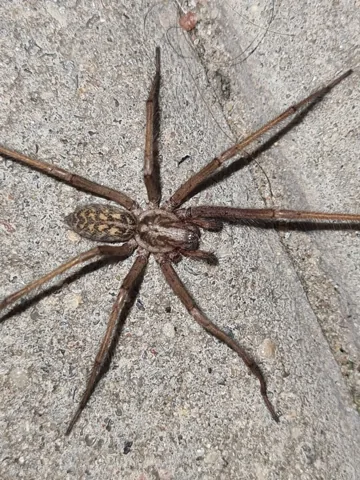 Giant House Spider
Eratigena atrica (formerly Tegenaria gigantea and T. duellica)
The giant house spider is one of the largest spiders in the Pacific Northwest, with a leg span that can reach 4 inches. It is common in and around homes west of the Cascades and is often mistaken for the hobo spider, but its bite is not known to threaten people.
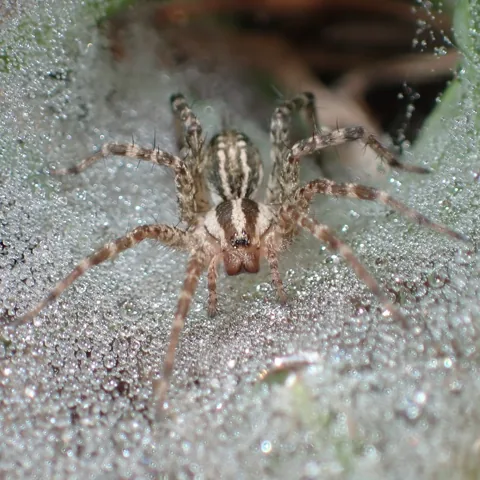 Grass Spiders (Funnel Weavers)
Agelenopsis species
Grass spiders are common funnel weavers whose flat, sheet-like webs with a funnel off to one side show up in lawns, ground covers and shrubs. They are fast and shy, often wander indoors in fall, and are considered beneficial.
 Barn Funnel Weaver
Tegenaria domestica
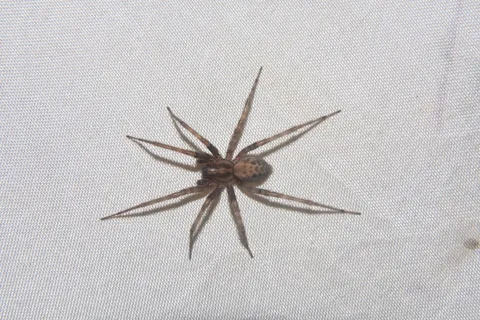
The barn funnel weaver, also called the house funnel weaver, is a fast, shy, light brown spider that builds a flat sheet web with a funnel retreat in basements, barns, sheds and door crevices, where it can survive indoors for years. No bites have been documented, and Penn State expects any bite would be mild. To get rid of it, vacuum spiders and webs, clear clutter, and seal cracks and gaps; sprays alone give only temporary control.
Side by side
Color is the least reliable clue for both spiders, and Utah State University says it causes many hobo spider misidentifications. Start with the eyes, the web and where you live, then use the other marks below.[2]
- Family: hobo spider, a funnel-web spider (Agelenidae), the family that also holds grass spiders and the closely related giant house spider. Wolf spider, Lycosidae, a family of hunting spiders with about 240 species in the United States (Penn State) or nearly 250 north of Mexico (Missouri Department of Conservation).[1][2][7][17][5][6]
- Eyes: hobo spider, eight eyes in two rows; Utah State adds that the outer eyes of the top row sit slightly lower than the middle two. Wolf spider, four small eyes in a straight row in front, a middle pair of larger eyes, and a widely spaced rear pair on top of the head.[1][2][4][6]
- Size: hobo spider females 9.5 to 16.5 mm (3/8 to 5/8 inch) and males 7 to 13.5 mm in body length (Utah State); UC IPM gives 1/2 to 5/8 inch, and Washington State 1 to 1 3/4 inches including legs. Wolf spiders run from 1/4 inch to 1 inch without legs depending on species; the Carolina wolf spider female reaches 22 to 35 mm.[2][1][3][6][5]
- Markings: hobo spider, brown cephalothorax with darker brown marks, brown legs with no dark bands, and a pattern of yellow chevrons on a gray abdomen that is hard to see without a hand lens. Wolf spiders are gray, brown, black or tan, usually with dark stripes or spots; some, such as the tiger wolf spider, have banded legs.[2][1][6][8][5]
- Rear end: Kentucky describes funnel-web spiders, the hobo spider's family, as having a pair of long silk-spinning tubes at the tip of the abdomen. A female wolf spider is the one you may see carrying a pea-sized egg sac attached to her spinnerets, and later carrying her spiderlings on her back.[7][6][5]
- Web: hobo spider, a web with a funnel or tube retreat in a sheltered spot; UC IPM says its webs are almost always hidden under objects and not noticeably funnel-like. Wolf spider, no prey-catching web; UC IPM says they make a small, thick web to rest in, and some species dig retreats in soil.[2][3][1][4][5]
- Range: hobo spider, a European species detected in the Pacific Northwest in 1936 (Utah State), now from southern British Columbia, Washington, Oregon and Idaho to northern Utah, western Montana, western Wyoming and two isolated spots in Colorado. Wolf spiders, statewide in Missouri and among the most common spiders in Kentucky; Penn State counts about 240 species in the United States.[2][13][1][6][8][5]
- Hunting: a hobo spider waits at the mouth of its funnel and runs out to grab insects that land on the web. A wolf spider chases down ground insects with its eyesight, or sits still until one comes close.[2][4][6]
The eye check, with and without a hand lens
UC IPM points out that most spiders have eight eyes in two rows of four, so two straight rows only tells you the spider is not one of the many funnel weavers with a 2-4-2 eye layout. It does not prove a hobo spider. It does rule out a wolf spider, which has two large forward-facing eyes above a row of four small ones.[1][4][6]
Webs, hiding places and how each one hunts
Hobo spiders build their webs outdoors in sheltered spots such as wood and rock piles, retaining walls, tall grass and foundation cracks, and indoors in basements and window wells. The spider waits at the small hole at the bottom of the funnel until prey makes contact, then comes out to bite it.[2][4]
Sources describe the web differently. Washington State and Utah State call it funnel-shaped. UC IPM says hobo spider webs are almost always hidden under objects and not noticeably funnel-like, unlike the open, trampoline-like funnel webs of most relatives such as grass spiders (Agelenopsis).[3][2][1]
- Wolf spiders live on the ground in leaf litter, grass, low plants, stream edges and under boards, stones and firewood. Penn State says the large Hogna and Tigrosa species hide in holes or tunnels in soil or under siding and come out at night to hunt; UC IPM and Kentucky say wolf spiders as a group hunt by day or night.[6][5][4][7]
Why they show up indoors in fall
Utah State says August through October brings an influx of hobo spiders and other spiders into homes. Hobo spiders' feet are built for walking on webs, not for climbing smooth painted walls, so indoors they stay at ground level in basements; wandering ones may end up in clothing, shoes or bedding left on the floor.[2]
- Wolf spiders that show up indoors are often mature males searching for females, and UC IPM says new homes in developments can be invaded by wolf spiders that lost their outdoor habitat. For the large Hogna and Tigrosa species, Penn State says mating happens in autumn, males die before winter, and females overwinter in protected places, including buildings.[4][5]
What the research says about bites
The hobo spider's reputation comes from the 1980s and 1990s. UC IPM says it was designated in the 1980s as potentially toxic in the United States, and a 1996 CDC report in MMWR described three cases blamed on hobo spider bites in Idaho, Oregon and Washington and urged Northwest physicians to consider the species as a cause of toxic spider bites.[1][12]
Later work did not back that up. A 2001 study found no venom components unique to U.S. hobo spiders compared with European ones; in Europe the species is considered medically harmless. A 2004 article in Canadian Family Physician concluded that hobo spiders have not been reliably linked to skin necrosis, and a 2011 Washington State study found no MRSA transfer by the spiders and venom that did not harm vertebrate red blood cells.[14][15][16]
In a 2014 series of 33 verified spider bites in Oregon, none caused necrosis. The one hobo spider bite caused pain, redness and calf-muscle twitching that cleared in 12 hours. UC IPM now says the hobo spider is no longer considered of probable medical importance, and Utah State notes the CDC does not list it among spiders toxic to people; CDC NIOSH's venomous spider page covers the black widow and brown recluse.[17][1][2][11]
Wolf spiders have been blamed for skin wounds too, but two large clinical studies found none: 515 bites treated at a Sao Paulo, Brazil, hospital and 45 confirmed bites in Australia, where the spider was caught and identified, produced no necrotic ulcers. Pain was the main effect, with redness and some swelling. Penn State says symptoms of wolf spider bites generally subside within 24 hours, and Kentucky calls them harmless except to allergic people.[19][18][5][8]
- Washington State Department of Health says spiders rarely bite and that wounds blamed on spider bites are often other conditions such as MRSA infection. Its first aid for a bite is to wash with soap and water, apply ice, and elevate the area; get medical care right away for any severe allergic reaction.[10]
How to confirm which one you have
A close photo of the face and the top of the abdomen helps, but the eye rows and the hobo spider's chevrons are hard to see without magnification. Catch the spider in a jar or on a sticky trap and look with a hand lens.[1][2]
A sure ID of a hobo spider takes a microscope. Utah State looks for feather-like plumose hairs on the legs that all funnel-web spiders share, and in males the pedipalps: the hobo spider's have two prongs, while the domestic house spider and giant house spider have one. UC IPM says a reliable species ID by eye is unlikely and that virtually any hobo spider ID by a non-specialist in California should be suspect.[2][1]
- Utah State University Extension notes that many funnel-web spiders look alike and asks people to verify identifications with its specialists.[9]
What to do about each
Neither spider needs a pesticide in most homes. UC IPM says pesticides are not generally needed for spiders and recommends sealing foundation cracks and gaps around doors and windows, keeping screens in good repair, cutting clutter indoors and around the foundation, and vacuuming spiders and webs.[4][2]
For hobo spiders, Utah State suggests weather stripping on outside doors, sticky traps folded against baseboards during the August to October peak, removing bed skirts and moving the bed about 8 inches from walls. Washington State says sticky traps work well for wandering spiders such as hobo spiders. Wolf spiders eat many insect pests outdoors, and the Missouri Department of Conservation says their bites are harmless; for a stray one indoors, UC IPM's advice to vacuum up the spider works.[2][3][6][4]
Common questions
- Is a big brown spider running across my basement floor a hobo spider or a wolf spider?
- Check the eyes and where you live. Two large forward-facing eyes and green eyeshine under a flashlight mean a wolf spider. Two rows of small eyes and a home in the Pacific Northwest or northern Rockies make a hobo spider or one of its close relatives possible.[6][4][1][2]
- Are there hobo spiders outside the Pacific Northwest?
- Documented North American records run from southern British Columbia, Washington, Oregon and Idaho to northern Utah, western Montana, western Wyoming and two isolated populations in Colorado. UC IPM says the hobo spider has not been documented in California.[13][1][4]
- Do hobo spider bites cause flesh-eating wounds?
- The evidence says no. Venom studies, a review of the medical literature and a series of verified bites in Oregon found no necrosis from hobo spiders, and the CDC does not list them among venomous spiders.[14][15][17][2][11]
- Do wolf spiders build webs?
- Not to catch prey. They hunt on the ground by sight and may rest in a small silk retreat or a burrow. A spider sitting in a sheet web with a funnel is a funnel weaver, not a wolf spider.[6][4][7][8]
- Why is it called the aggressive house spider?
- Utah State University says the old name came from a misreading of the species name agrestis, which means of the field. Hobo spiders are not aggressive and seldom bite.[2]
Photo credits
- Hobo Spider: Steve Wells, public domain (CC0), via iNaturalist
- Carolina Wolf Spider: (c) Russell Pfau, some rights reserved (CC BY) — via iNaturalist, CC BY 4.0
- Giant House Spider: (c) Marcin Jasiński, some rights reserved (CC BY) — via iNaturalist, CC BY 4.0
- Grass Spiders (Funnel Weavers): (c) dhasdf, some rights reserved (CC BY) — via iNaturalist, CC BY 4.0
- Barn Funnel Weaver: (c) Sebastian Serna Muñoz, some rights reserved (CC BY) — via iNaturalist, CC BY 4.0
Sources
- University of California Statewide IPM Program, “Hobo Spider (Pest Notes).” ipm.ucanr.edu/home-and-landscape/hobo-spider/ (accessed 2026-11-14)
- Utah State University Extension, “Hobo Spider.” extension.usu.edu/planthealth/research/hobo-spiders (accessed 2026-11-14)
- Washington State University, “Hobo spider (Pestsense fact sheet).” pestsense.cahnrs.wsu.edu/fact-sheet/hobo-spider/ (accessed 2026-11-14)
- University of California Statewide IPM Program, “Spiders (Pest Notes).” ipm.ucanr.edu/home-and-landscape/spiders/ (accessed 2026-11-14)
- Penn State Extension, “Wolf Spiders.” extension.psu.edu/wolf-spiders (accessed 2026-11-14)
- Missouri Department of Conservation, “Wolf Spiders field guide.” mdc.mo.gov/discover-nature/field-guide/wolf-spiders (accessed 2026-11-14)
- University of Kentucky Entomology Extension, “Common Spiders Found Around Homes and Buildings (ENTFACT-622).” entomology.mgcafe.uky.edu/ef622 (accessed 2026-11-14)
- University of Kentucky Entomology Extension, “Urban Spider Chart.” entomology.mgcafe.uky.edu/spider-chart (accessed 2026-11-14)
- Utah State University Extension, “Hobo & Grass Spiders.” extension.usu.edu/planthealth/ipm/notes_nuisance/hobo-grass-spiders (accessed 2026-11-14)
- Washington State Department of Health, “Spiders.” doh.wa.gov/community-and-environment/pests/spiders (accessed 2026-11-14)
- CDC National Institute for Occupational Safety and Health, “Venomous Spiders at Work.” www.cdc.gov/niosh/outdoor-workers/about/venomous-spiders.html (accessed 2026-11-14)
- CDC, MMWR (PubMed 8618542), “Necrotic arachnidism, Pacific Northwest, 1988-1996. MMWR Morb Mortal Wkly Rep 1996;45(21):433-6.” pubmed.ncbi.nlm.nih.gov/8618542/ (accessed 2026-11-14)
- Journal of Medical Entomology (PubMed 12693843), “Vetter RS et al. Distribution of the medically-implicated hobo spider and a benign congener, Tegenaria duellica, in the United States and Canada. J Med Entomol 2003;40(2):159-64.” pubmed.ncbi.nlm.nih.gov/12693843/ (accessed 2026-11-14)
- Toxicon (PubMed 11223084), “Binford GJ. An analysis of geographic and intersexual chemical variation in venoms of the spider Tegenaria agrestis. Toxicon 2001;39(7):955-68.” pubmed.ncbi.nlm.nih.gov/11223084/ (accessed 2026-11-14)
- Canadian Family Physician (PubMed 15455808), “Bennett RG, Vetter RS. An approach to spider bites: erroneous attribution of dermonecrotic lesions to brown recluse or hobo spider bites in Canada. Can Fam Physician 2004;50:1098-101.” pubmed.ncbi.nlm.nih.gov/15455808/ (accessed 2026-11-14)
- Journal of Medical Entomology (PubMed 21485377), “Gaver-Wainwright MM et al. Misdiagnosis of spider bites: bacterial associates, mechanical pathogen transfer, and hemolytic potential of venom from the hobo spider. J Med Entomol 2011;48(2):382-8.” pubmed.ncbi.nlm.nih.gov/21485377/ (accessed 2026-11-14)
- Toxicon (PubMed 24726469), “McKeown N, Vetter RS, Hendrickson RG. Verified spider bites in Oregon (USA) with the intent to assess hobo spider venom toxicity. Toxicon 2014;84:51-5.” pubmed.ncbi.nlm.nih.gov/24726469/ (accessed 2026-11-14)
- Journal of Toxicology: Clinical Toxicology (PubMed 15214620), “Isbister GK, Framenau VW. Australian wolf spider bites (Lycosidae): clinical effects and influence of species on bite circumstances. J Toxicol Clin Toxicol 2004;42(2):153-61.” pubmed.ncbi.nlm.nih.gov/15214620/ (accessed 2026-11-14)
- Toxicon (PubMed 2402765), “Ribeiro LA et al. Wolf spider bites in Sao Paulo, Brazil: a clinical and epidemiological study of 515 cases. Toxicon 1990;28(6):715-7.” pubmed.ncbi.nlm.nih.gov/2402765/ (accessed 2026-11-14)