The short answer
- Eyes: a wolf spider has two noticeably larger eyes facing forward, above a row of four small eyes. Fishing and nursery web spiders have all eight eyes about the same size, with no big forward-facing pair.[4][5][1]
- Egg sac: a female wolf spider drags her egg sac attached to the spinnerets at the rear of her body. A fishing or nursery web spider carries hers in her jaws, then hangs it in a 'nursery' of leaves tied with silk and guards it.[4][5][1][10]
- Babies: wolf spider spiderlings ride on the mother's back after hatching. Fishing spiders don't carry their young; the female guards them in the nursery web instead.[5][1][2]
- Posture and place: wolf spiders run on the ground. Fishing spiders often sit still on tree trunks, walls, wood or stone, often head down or upside down with legs held almost straight out, and many live at the water's edge and can run on the surface.[7][6][8][1][2]
Profiles on this site
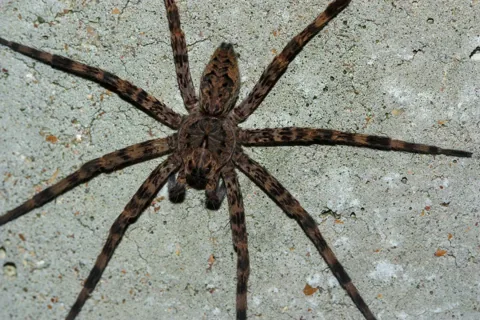 Fishing Spiders
Dolomedes species (e.g., D. tenebrosus, the dark fishing spider)
Fishing spiders, genus Dolomedes, are large brown hunting spiders that can run across water and even dive. The dark fishing spider, the species most often found around homes, lives mainly in wooded areas and is harmless despite its size.
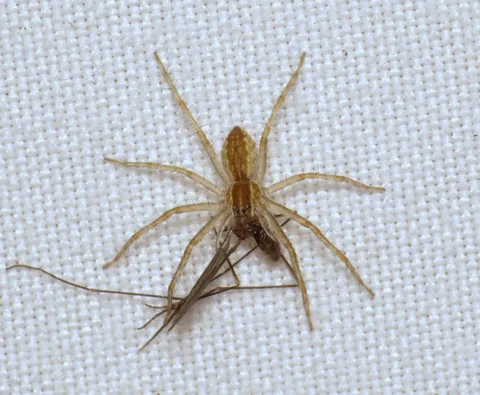 Nursery Web Spider
Pisaurina mira
The nursery web spider (Pisaurina mira) is a long-legged, slender hunting spider of tall grass, shrubs and woodland edges. It doesn't spin a web to catch prey. Its name comes from the leaf tent the female builds and guards around her egg sac. The Missouri Department of Conservation calls nursery web spiders harmless to people and useful predators of garden insects.
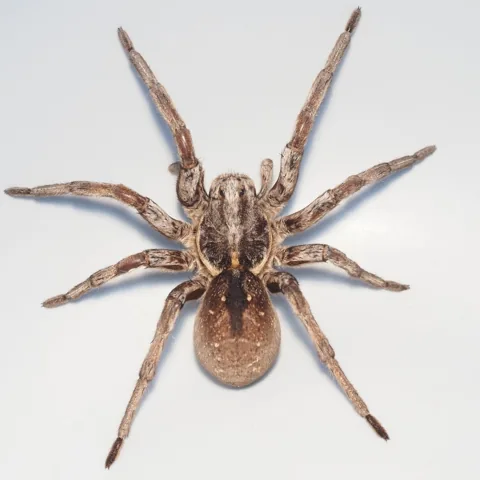 Carolina Wolf Spider
Hogna carolinensis
Wolf spiders are large hunting spiders that don't use webs; they wander into homes by accident, especially males searching for mates, and they don't persist indoors.
Side by side
Fishing spiders are the genus Dolomedes; the slender, long-legged nursery web spiders (Pisaurina) are close relatives that share the egg-carrying habit and eye pattern. Wolf spiders are the family Lycosidae, with more than 40 species in Missouri alone, from small to quite large.[1][4][5]
Size and color alone won't separate them. Use the eyes and, in early summer, the way a female carries her egg sac.[2][4][5]
- Size: Penn State gives dark fishing spider females 15 to 26 millimeters in body length and males 7 to 13 millimeters; Missouri gives females ½ to 1 inch and males ¼ to ½ inch, and Minnesota 1 1/4 inches long, up to 3 1/2 inches including the legs. Wolf spiders run from ¼ inch to 1 inch in body length (Missouri), and Penn State gives the big Carolina wolf spider (Hogna carolinensis) 22 to 35 millimeters for females. Kentucky puts a fishing spider a little larger than a silver dollar with legs outstretched, and wolf spiders from pencil-eraser size to about a silver dollar.[2][6][9][5][3][7]
- Color and pattern: fishing spiders are brownish gray to dark brown with black and lighter markings, usually dark W-shaped or chevron marks across the top of the abdomen, and banded legs. Wolf spiders are gray, brown, black or tan, usually with darker stripes or spots; the Carolina wolf spider has a darker stripe down the abdomen and solid-colored legs, while the tiger wolf spider has banded legs.[2][6][9][7][5][3]
- Eyes: NC State says that through a hand lens a fishing spider's front four eyes form a curved row, the outer two higher than the inner two, on top of the head. A wolf spider's front row of four small eyes is straight and faces forward, with two noticeably larger eyes above it; Missouri adds that fishing spiders lack the two large forward-facing eyes.[1][5][4]
- Egg sac: wolf spider females carry a pea-sized egg sac attached to their spinnerets. Fishing and nursery web spider females carry theirs in the jaws (UW-Green Bay notes it is also held by the spinnerets), then suspend it in folded leaves tied with silk.[5][4][1][10]
- Young: wolf spiderlings climb onto the mother's abdomen and stay there for up to two weeks or more. Fishing spider young stay in the nursery web under the female's guard and leave in about a week; Penn State says they may number 1,000 or more.[5][1][2]
- Posture: fishing spiders often rest on tree trunks with the head facing down, or upside down or vertically on wood or stone, legs held almost straight out. Nursery web spiders rest on plant foliage with the front two pairs of legs held together. Wolf spiders run smoothly over the ground, though Missouri says they can climb short distances up tree trunks.[8][6][7][4][5]
- Water: fishing spiders can run on the water surface, dive and stay under for a short while, and catch tadpoles and small fish. NC State says wolf spiders tend to be completely terrestrial, and UW-Green Bay says wolf spiders do not fish, though a 2014 review of fish catches by spiders lists the wolf spider family (Lycosidae) among the families seen taking fish.[1][5][10][11]
- Where found: fishing spiders live around ponds, swamps, slow streams and lakeshores, but the dark fishing spider often lives in woods far from water and comes onto decks, patios and house walls. Wolf spiders live on the ground in leaf litter, low plants, stream edges and gravel bars, in burrows or under boards, stones, firewood and siding.[9][10][2][8][5][3]
- Season: dark fishing spider adults are found from early May through September, with egg sacs in June and young from July through September. Wolf spiders mate in autumn; the females overwinter in protected places, including buildings, make egg sacs in May or June and carry their young through summer.[2][9][3]
- Webs: neither builds a web to catch prey. Both hunt by running down or ambushing insects, mostly at night, and fishing spider silk goes into the nursery web around the egg sac.[5][8][4][1]
How to confirm what you found
Look at the eyes with a hand lens, or a sharp close-up photo of the face. Two big eyes staring forward mean wolf spider; eight small, similar eyes mean fishing or nursery web spider.[1][5][4]
If the spider is a female carrying an egg sac, note where: a ball trailing from the rear is a wolf spider; a sac held under the head in the jaws is a fishing or nursery web spider. A female covered in babies is a wolf spider.[5][4][1]
At night, shine a flashlight held beside your eyes across the lawn. Missouri says wolf spider eyes shine back like a cat's.[5]
Check where it was sitting. A big brown spider resting head down on a tree trunk, deck post or brick wall is more likely a dark fishing spider; one running across the floor or patio is more likely a wolf spider. Kentucky notes both are often mistaken for brown recluses, which are smaller and lack the fishing spider's dark patterning.[8][7]
- Still unsure? Catch the spider in a jar and take it or a clear photo to your county Cooperative Extension office.[1]
Why the difference matters
Where they come from: a fishing spider indoors has usually wandered in from nearby woods or water, and Kentucky says they sometimes enter homes near streams and wooded areas. Wolf spider females overwinter in protected spots including buildings, and they shelter under boards, firewood and siding near the house.[7][2][3]
Not a pest either way: NC State says these spiders don't feed on plants and are not household pests.[1]
What to do about each
One spider indoors (either kind): NC State says it can be corralled into a jar or other container and released outside, or swatted or killed with a household aerosol if you prefer.[1]
Fishing spiders: Penn State says they are shy and run from people at the slightest movement. They overwinter as immatures under stones and loose bark, in tree cavities and in human-made structures.[2]
- Wolf spiders: Penn State says they hide by day in holes and tunnels in the soil, under boards, stones and firewood and under siding, and come out at night. Those are the spots to check around the house; see our house spiders guide for sealing and cleanup steps.[3]
Bites, first aid and pets
Spiders in general are usually not aggressive, and most bites happen when a spider is trapped or touched (NIOSH). MedlinePlus says most spider bites are harmless and look like a bee sting: redness, pain and swelling.[12][13]
Wolf spider bites: in 45 confirmed wolf spider bites in Australia, pain occurred in every case and was severe in 24%, with a median duration of 10 minutes; redness occurred in 67% and swelling in 20%, and there were no necrotic ulcers. A study of 515 wolf spider bites in Brazil found pain, generally mild, in 83% and no local necrosis.[14][15]
The Australian study also found that 7 of the 45 bites (16%) happened while the person was swimming in or cleaning a pool, and Missouri notes that some wolf spiders (Pardosa) prefer moist places near water, so a big brown spider by the water is not always a fishing spider.[14][5]
First aid: wash the area with soap and water, apply an ice pack or wet compress, and take an over-the-counter pain reliever if needed; MedlinePlus says to seek treatment for small children and adults with severe symptoms.[13][12]
- Pets: the Merck Veterinary Manual says the U.S. spiders capable of causing clinical envenomation in animals are the widow and recluse spiders; fishing and wolf spiders are not in either group.[16]
Common questions
- Is a fishing spider just a wolf spider that lives by water?
- No. Fishing spiders (Dolomedes) belong to the nursery web spider family, not the wolf spider family. They carry egg sacs in their jaws and lack the two big forward-facing eyes of wolf spiders.[1][4][5]
- Why is there a fishing spider in my house when I don't live near water?
- The dark fishing spider often lives in wooded areas far from water, rests on tree trunks and building walls, and sometimes wanders indoors.[2][8][6]
- Do fishing spiders really catch fish?
- Yes, now and then. A 2014 review collected more than 80 records of semi-aquatic spiders catching fish, usually 2 to 6 cm long, mostly by Dolomedes and related pisaurids; insects are still most of their diet.[11][1]
- Which one carries babies on its back?
- Only the wolf spider. Fishing spider young stay in the nursery web while the mother stands guard.[5][1]
Photo credits
- Fishing Spiders: (c) Andrew Meeds, some rights reserved (CC BY) — via iNaturalist, CC BY 4.0
- Nursery Web Spider: (c) Nick Block, some rights reserved (CC BY) — via iNaturalist, CC BY 4.0
- Carolina Wolf Spider: (c) Russell Pfau, some rights reserved (CC BY) — via iNaturalist, CC BY 4.0
Sources
- NC State Extension, “Fishing Spiders and Wolf Spiders.” content.ces.ncsu.edu/fishing-spiders-and-wolf-spiders (accessed 2026-11-14)
- Penn State Extension, “Fishing Spider.” extension.psu.edu/fishing-spider (accessed 2026-11-14)
- Penn State Extension, “Wolf Spiders.” extension.psu.edu/wolf-spiders (accessed 2026-11-14)
- Missouri Department of Conservation, “Nursery Web Spiders (Field Guide).” mdc.mo.gov/discover-nature/field-guide/nursery-web-spiders (accessed 2026-11-14)
- Missouri Department of Conservation, “Wolf Spiders (Field Guide).” mdc.mo.gov/discover-nature/field-guide/wolf-spiders (accessed 2026-11-14)
- Missouri Department of Conservation, “Dark Fishing Spider (Field Guide).” mdc.mo.gov/discover-nature/field-guide/dark-fishing-spider (accessed 2026-11-14)
- University of Kentucky Entomology, “Urban Spider Chart.” entomology.mgcafe.uky.edu/spider-chart (accessed 2026-11-14)
- Mississippi State University Extension, “Dark Fishing Spider (Bug's Eye View, Vol. 8, No. 25).” extension.msstate.edu/newsletters/bugs-eye-view/2022/dark-fishing-spider-vol-8-no-25 (accessed 2026-11-14)
- University of Minnesota Extension, “Fishing spider (What insect is this?).” apps.extension.umn.edu/garden/diagnose/insect/general-curiosity-insects/relatives/large/fishingspider.html (accessed 2026-11-14)
- Cofrin Center for Biodiversity, University of Wisconsin-Green Bay, “Fishing spiders, Dolomedes (Econotes, 2005).” www.uwgb.edu/biodiversity-old/econotes/2005/dolomedes.htm (accessed 2026-11-14)
- PubMed (peer-reviewed), “Nyffeler M, Pusey BJ. Fish predation by semi-aquatic spiders: a global pattern. PLoS One 2014;9(6):e99459.” pubmed.ncbi.nlm.nih.gov/24940885/ (accessed 2026-11-14)
- CDC National Institute for Occupational Safety and Health (NIOSH), “Venomous Spiders at Work.” www.cdc.gov/niosh/outdoor-workers/about/venomous-spiders.html (accessed 2026-11-14)
- MedlinePlus, U.S. National Library of Medicine, “Spider Bites (Health Topic).” medlineplus.gov/spiderbites.html (accessed 2026-11-14)
- PubMed (peer-reviewed), “Isbister GK, Framenau VW. Australian wolf spider bites (Lycosidae): clinical effects and influence of species on bite circumstances. J Toxicol Clin Toxicol 2004;42(2):153-61.” pubmed.ncbi.nlm.nih.gov/15214620/ (accessed 2026-11-14)
- PubMed (peer-reviewed), “Ribeiro LA et al. Wolf spider bites in Sao Paulo, Brazil: a clinical and epidemiological study of 515 cases. Toxicon 1990;28(6):715-7.” pubmed.ncbi.nlm.nih.gov/2402765/ (accessed 2026-11-14)
- Merck Veterinary Manual, “Spider and Scorpion Bites and Stings to Animals.” www.merckvetmanual.com/toxicology/venomous-arthropods/spiders-and-scorpions (accessed 2026-11-14)